Why Is It Important to Understand Different Machine Learning Algorithms Before You Build?
Most failed machine learning projects do not fail because the model was inaccurate; they fail because the wrong family of algorithm was chosen for the problem, the data, or the deployment constraints. A machine learning algorithm is a mathematical procedure that learns patterns from data and produces a model capable of making predictions or decisions on new, unseen inputs. Understanding several algorithm families matters because each one makes different assumptions about your data, needs a different volume of examples, produces a different level of explainability, and costs a different amount to run in production. A team that knows only one approach will force every problem into it, and that mismatch shows up later as unstable predictions, unexplainable outputs, or an inference bill nobody budgeted for. This guide explains exactly what changes when you switch algorithms and which families to learn first.
Quick Answer: Understanding different machine learning algorithms matters because each makes distinct assumptions about data shape, size, and structure. No single algorithm performs best on every problem, so knowing several lets you match method to data, balance accuracy against interpretability and cost, and avoid rebuilding a system after it reaches production.
Turning Algorithm Choices Into Working Products With WebPeak
Knowing which algorithm suits a problem is separate from shipping it inside a product people actually use, and that second step is where most in-house teams stall. Their engineers handle exactly that transition, wiring trained models into live applications through AI model integration for web apps so predictions arrive through real endpoints with monitoring, fallbacks, and version control instead of sitting in a notebook. For forecasting problems they build the pipeline around the algorithm rather than the reverse, using predictive analytics work to define the target variable, feature refresh cadence, and evaluation window before any model is selected. Businesses working with the team at WebPeak typically start with a scoping session that documents latency limits, explainability requirements, and data volume, because those three constraints eliminate most algorithm options before accuracy is even discussed.
What Actually Changes When You Pick a Different Algorithm?
Switching algorithms changes five concrete properties of your system, not just its accuracy score. The first is the inductive bias, which is the set of assumptions a model makes to generalise beyond its training data; linear regression assumes relationships are additive and straight, while tree ensembles assume they are stepwise and interactive. The second is data appetite: logistic regression can produce a usable model from a few thousand labelled rows, whereas a deep neural network typically needs orders of magnitude more before it beats simpler methods. The third is interpretability, meaning how easily a human can trace why a prediction was made, which becomes non-negotiable in lending, insurance, hiring, and healthcare. The fourth is inference cost and latency, because a gradient-boosted model answers in milliseconds on a modest server while a large transformer may need dedicated accelerators. The fifth is failure behaviour: some algorithms degrade gracefully on unfamiliar inputs, others produce confident nonsense. Supervised learning trains on labelled examples, unsupervised learning finds structure in unlabelled data, and reinforcement learning learns from reward signals over sequences of actions; confusing these three categories is the fastest route to an unsolvable project.
Which Machine Learning Algorithm Families Should You Learn First?
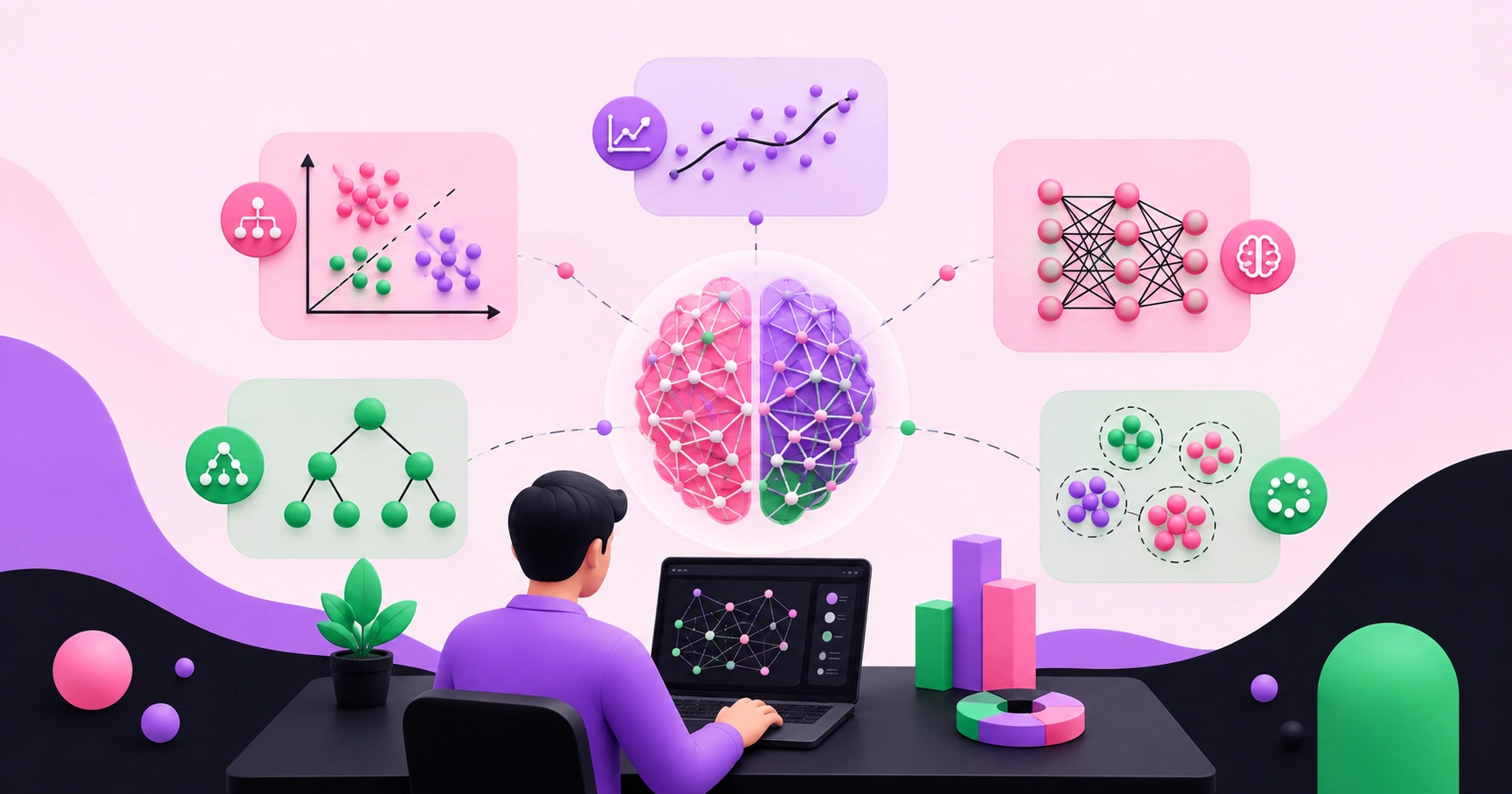
You do not need dozens of algorithms to be effective. Seven families cover the overwhelming majority of commercial problems, and knowing their strengths in order gives you a decision path rather than a guessing game.
- Linear and logistic regression. Start here for any tabular problem. They are fast, need little data, and their coefficients are directly explainable to stakeholders and regulators.
- Decision trees and random forests. Handle non-linear relationships and mixed data types with minimal preprocessing, and give usable feature importance out of the box.
- Gradient boosting machines such as XGBoost and LightGBM. The default strong baseline for structured tabular data like churn, credit risk, and demand forecasting.
- K-means and hierarchical clustering. Unsupervised methods for segmentation when you have no labels, useful for customer grouping and anomaly discovery.
- Support vector machines. Effective on small, high-dimensional datasets where the number of features approaches or exceeds the number of samples.
- K-nearest neighbours. A baseline that needs no training phase, valuable for recommendation prototypes and for sanity-checking more complex models.
- Neural networks and transformers. The right choice for unstructured data such as images, audio, and natural language, where feature engineering by hand is impractical.
The practical discipline is to run the simplest family first and record its score. That number becomes your baseline, and any complex model that fails to beat it meaningfully is not worth its operational cost.
How Do You Match an Algorithm to Your Actual Problem?
Match on data type and constraint first, accuracy second. Ask three questions before choosing: is the data structured or unstructured, do you have labels, and does a human need to justify each prediction? Those answers narrow the field faster than any benchmark. The comparison below reflects how these families behave on real commercial workloads.
| Algorithm Family | Best-Fit Problem | Main Trade-Off to Watch |
|---|---|---|
| Logistic regression | Binary decisions needing clear justification, such as approval scoring | Misses interaction effects unless features are engineered manually |
| Gradient boosting | Tabular prediction with mixed numeric and categorical columns | Overfits small datasets and needs careful hyperparameter tuning |
| Random forest | Quick strong baseline with feature importance for stakeholders | Larger memory footprint and slower inference than a single tree |
| K-means clustering | Customer or behavioural segmentation without labelled outcomes | Requires choosing the cluster count and assumes roughly even group sizes |
| Neural networks | Images, audio, text, and other unstructured inputs | High data, compute, and monitoring requirements; limited explainability |
| K-nearest neighbours | Fast prototypes and similarity-based recommendations | Prediction slows as the dataset grows because comparisons happen at query time |
What Does the Research and Field Experience Actually Show?
The theoretical case for algorithm literacy is settled. Wolpert and Macready's No Free Lunch theorems, published in 1997, established that averaged across all possible problems, no optimisation or learning algorithm outperforms any other, which means superiority is always relative to a specific problem class. That result is the formal reason a single favourite algorithm cannot be a strategy. On the practical side, Grinsztajn, Oyallon, and Varoquaux presented work at NeurIPS 2022 showing that tree-based models still outperform deep learning on typical tabular datasets, attributing the gap to how each method handles uninformative features and irregular target functions. Google's widely cited engineering guide Rules of Machine Learning, authored by Martin Zinkevich, opens with the advice not to be afraid to launch a product without machine learning at all, and to prefer a simple heuristic first.
Field experience adds a dimension the papers do not emphasise. In practice, the algorithm is rarely the bottleneck; feature quality, label accuracy, and data freshness explain more variance in outcomes than model family does. Teams that spend a week improving label definitions usually gain more than teams that spend a week swapping architectures. The second recurring pattern is that interpretability requirements arrive late and retroactively, typically from a compliance or customer-support conversation after launch, which means a slightly less accurate but explainable model often delivers more business value than an opaque one. Organisations building this capability for the first time frequently pair internal data staff with external web application specialists so that model selection and deployment architecture are decided together rather than sequentially.
Key Takeaways
- Wolpert and Macready's 1997 No Free Lunch theorems prove no single learning algorithm is best across all problems, making algorithm literacy a requirement rather than a preference.
- Research presented at NeurIPS 2022 by Grinsztajn and colleagues found tree-based models still outperform deep learning on typical tabular datasets.
- Algorithm choice determines interpretability, data volume needs, inference latency, and running cost, not only predictive accuracy.
- Google's Rules of Machine Learning recommends launching with a simple heuristic before adopting machine learning at all.
- Seven algorithm families, from linear regression to transformers, cover the large majority of commercial use cases.
Frequently Asked Questions
Why can't I just use one machine learning algorithm for everything?
Because every algorithm encodes assumptions about your data. The No Free Lunch theorems show performance is problem-specific, so a method that excels on tabular churn data may fail on images or small datasets. Using one algorithm everywhere guarantees you will eventually apply it to a problem it cannot handle well.
Which machine learning algorithm should a beginner learn first?
Start with linear and logistic regression. They train in seconds, work on small datasets, and their coefficients explain exactly how each feature affects the prediction. That transparency teaches you to read data properly. Move to random forests and gradient boosting once you can interpret a regression confidently.
How do I know if my project actually needs deep learning?
Deep learning is justified when your inputs are unstructured, such as images, audio, video, or free text, and when you have large labelled datasets plus compute budget. For structured spreadsheet-style data, gradient boosting usually matches or beats neural networks at a fraction of the operational cost.
Does choosing a better algorithm matter more than getting better data?
Data quality almost always matters more. Clearer label definitions, fewer missing values, and fresher features improve results more reliably than swapping model families. In practice, teams see larger gains from a week spent auditing labels than from a week spent tuning architectures.
How many algorithms should I test before choosing one?
Test three: one simple interpretable baseline, one tree ensemble, and one method suited to your data type. Compare them on the same validation split using a metric tied to your business outcome. If the complex model does not clearly beat the baseline, ship the simpler one.
Conclusion
The most important decision is not which algorithm wins your benchmark; it is whether your constraints, latency, explainability, data volume, and running cost, were written down before modelling began. Teams that document those three or four limits first find that the algorithm choice becomes almost obvious, and they avoid the expensive rebuild that follows a model chosen purely on accuracy. Your next step is concrete: take your current or planned project, write one sentence each on data type, label availability, explainability requirement, and acceptable inference time, then shortlist only the families that satisfy all four. Understanding multiple algorithms is not academic breadth for its own sake; it is what allows an experienced practitioner to say no to the wrong approach before it costs a quarter of engineering time.