Which of the Following Is an Application of AI? Real Examples You Already Use Daily
This question shows up constantly in exams and interviews, and the answer options are usually a mix of genuine AI applications and ordinary software dressed up to look intelligent. An application of AI is any real-world system that uses artificial intelligence techniques — learning from data to recognise patterns, make predictions, or generate content — to perform a task that would otherwise require human judgement. Common correct answers include speech recognition, recommendation engines, spam filtering, fraud detection, machine translation, self-driving vehicle perception, medical image analysis, and chatbots. Common wrong answers include spreadsheets, calculators, database queries, and standard web forms, because those follow fixed instructions with no learning involved.
Quick Answer: Applications of AI include speech recognition, recommendation systems, spam filters, fraud detection, machine translation, chatbots, medical image analysis, and autonomous vehicle perception. Anything that learns from data to make decisions or generate output qualifies. Calculators, spreadsheets, and rule-based forms are not AI applications because they never learn.
Putting AI Applications to Work Inside Your Own Product With WebPeak
Recognising AI applications in a quiz is straightforward; choosing which one solves a real business problem and shipping it is where most teams stall. WebPeak works with organisations worldwide on exactly that transition, and their engineering approach starts with the business outcome rather than the model. Their AI chatbot development practice covers grounded support assistants that cite internal documentation, their predictive analytics work builds forecasting and churn models on a client's own historical data, and their web application development services provide the surrounding product to make any of it usable. Details of the agency's full capability set are worth reviewing before scoping an AI feature, because the integration work is usually larger than the model work.
How Do You Identify a Genuine AI Application?
The reliable test is whether the system's behaviour improves from data rather than from a developer editing rules. A rule-based system produces the same output for the same input forever unless someone rewrites the logic. An AI application changes its behaviour when retrained on new examples. That single criterion separates almost every correct answer from every distractor.
Apply it to familiar tools. A spam filter is an AI application because it learns from millions of labelled messages and adapts as spammers change tactics. An email autoresponder is not, because it fires on a fixed trigger. A recommendation engine is an AI application because it infers preferences from behaviour patterns; a "newest first" sort is not, because it applies one unchanging rule. Face unlock on a phone is an AI application using computer vision — defined as the field of extracting meaning from images and video — while a four-digit PIN check is a simple string comparison.
One nuance worth knowing for exam contexts: expert systems, which encode human knowledge as extensive if-then rules, are historically classified within AI even though they do not learn. If an exam lists expert systems as an option, it is usually intended as correct. Modern practical usage, however, reserves "AI application" for learning systems.
What Are the Most Common AI Applications by Field?
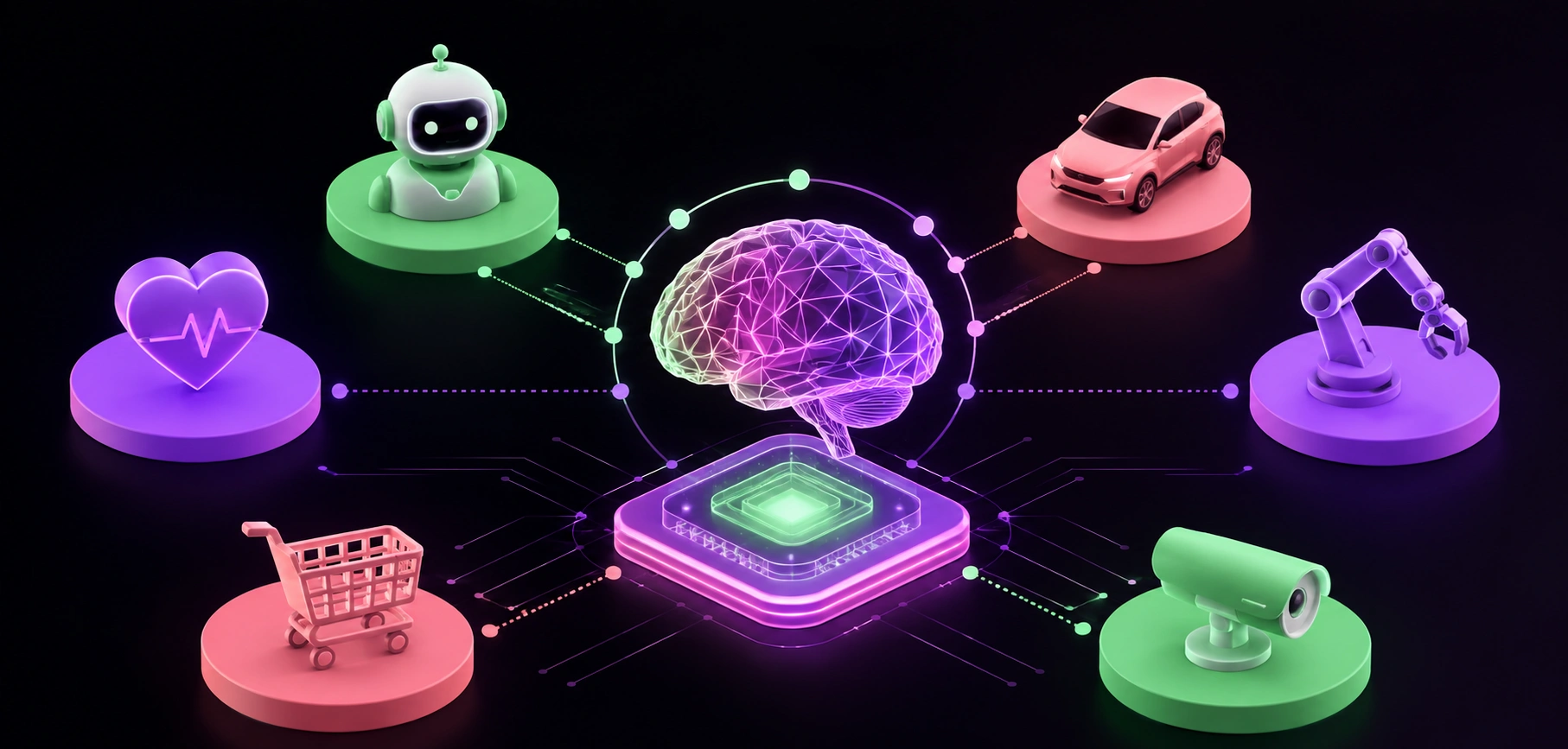
Organising examples by domain makes them easier to recall under exam pressure and easier to pitch in a business meeting. These are the applications you will most often see listed as correct answers:
- Language and communication — machine translation, speech-to-text transcription, autocomplete, grammar correction, chatbots, and virtual assistants.
- Vision — facial recognition, medical imaging analysis, defect detection on production lines, optical character recognition, and autonomous vehicle perception.
- Commerce and marketing — product recommendation engines, dynamic pricing, customer churn prediction, ad targeting, and demand forecasting.
- Security and risk — credit card fraud detection, spam and phishing filtering, anomaly detection in network traffic, and credit scoring.
- Content creation — text generation, image generation, code assistance, voice synthesis, and video editing automation.
- Operations — predictive maintenance on equipment, route optimisation for logistics, inventory forecasting, and resume screening.
Notice that most of these predate the recent generative AI wave by a decade or more. Recommendation engines and spam filters have been production AI applications since the 2000s, which is a useful point to raise when someone frames AI as brand new.
Which AI Application Fits Which Business Problem?
Choosing the wrong application category is the most expensive mistake in AI adoption, and it happens because the shortcomings only appear after deployment. Matching the problem type to the technique first prevents that. The table below maps frequent business needs to the AI application that genuinely addresses them and the data each requires.
| Business Problem | Suitable AI Application | Data You Need First |
|---|---|---|
| Support team overwhelmed by repeat questions | Grounded chatbot with document retrieval | Accurate help documentation |
| Too much stock on slow-moving items | Demand forecasting model | Two or more years of sales history |
| High payment chargeback rate | Fraud detection classifier | Labelled past fraudulent transactions |
| Low engagement on product listings | Recommendation engine | User browsing and purchase behaviour |
| Slow manual quality inspection | Computer vision defect detection | Labelled images of good and faulty units |
| Content production bottleneck | Generative AI with human review | Brand style guide and examples |
What Does Real-World Evidence Say About Where AI Applications Succeed?
The most credible signals come from what organisations actually run in production rather than from vendor claims. Google has publicly documented that its Gmail spam filtering relies on machine learning models, and Netflix has long described its recommendation system in published engineering material as central to how members discover titles. Both are first-party accounts of long-running, high-volume AI applications — which makes them far stronger examples than any newer, unproven deployment.
Beyond documented cases, one pattern is consistent across AI projects worth naming as analysis rather than statistics: the applications that succeed are the ones where a feedback signal already exists in the business. Fraud detection works because chargebacks tell you when you were wrong. Recommendations work because clicks tell you what landed. Spam filtering works because users mark messages. When a proposed AI application has no natural feedback loop, accuracy cannot be measured and the system quietly degrades. Before scoping any AI feature, identify what will tell you the model is wrong — if nothing will, that is the problem to solve first.
A second practical observation: data readiness, not model choice, decides most outcomes. Teams routinely discover that their historical records are inconsistent, incomplete, or not labelled in a usable way, and that cleanup consumes the majority of project time. Organisations planning AI features alongside broader platform work often address this within a wider web application development engagement so data structure and product surface are designed together rather than retrofitted.
Key Takeaways
- An application of AI is any real-world system that learns from data to perform tasks requiring human-like judgement.
- The identifying test is learning: AI applications change behaviour when retrained, while rule-based software only changes when code is rewritten.
- Spam filtering, recommendation engines, fraud detection, speech recognition, translation, and medical imaging are all established AI applications.
- Calculators, spreadsheets, database queries, and fixed-trigger automations are not AI applications because no learning occurs.
- AI applications succeed where a natural feedback signal already exists to reveal when the model is wrong.
Frequently Asked Questions
What is the most common everyday application of AI?
Spam filtering and content recommendation are the most widely used. Email providers rely on machine learning to classify unwanted messages, and streaming and shopping platforms use recommendation models to rank what you see. Most people interact with both dozens of times each day without noticing.
Is a chatbot an application of AI?
Modern chatbots built on language models are genuine AI applications because they generate responses from learned patterns. Older menu-driven bots that follow fixed decision trees are rule-based automation, not AI, even though they are often marketed using the same terminology.
Is Google Maps an application of AI?
Yes, in part. Route optimisation and traffic prediction use machine learning on historical and live movement data to estimate arrival times. The underlying map rendering and geometry calculations are conventional software, so the product combines AI and non-AI components together.
What is not considered an application of AI?
Calculators, spreadsheet formulas, database queries, standard web forms, and scheduled automations are not AI applications. They execute predetermined instructions and produce identical results for identical inputs, with no capacity to learn from data or improve performance over time.
Which AI application should a small business start with?
Start where you already collect clean data and get fast feedback — usually customer support automation using your existing documentation, or content drafting with human review. Both deliver measurable time savings quickly without requiring large historical datasets or specialist data science hiring.
Conclusion
The decision that matters most is not which AI application sounds impressive, but which one your existing data can actually support and measure. Before committing budget, write down two things: the data you already hold, and the signal that will tell you when the system is wrong. Applications that pass both tests tend to succeed regardless of which model you pick; those that fail either one rarely survive contact with production, no matter how advanced the technology behind them.