Which of the Following Best Describes Generative AI? The Clear, Correct Answer Explained
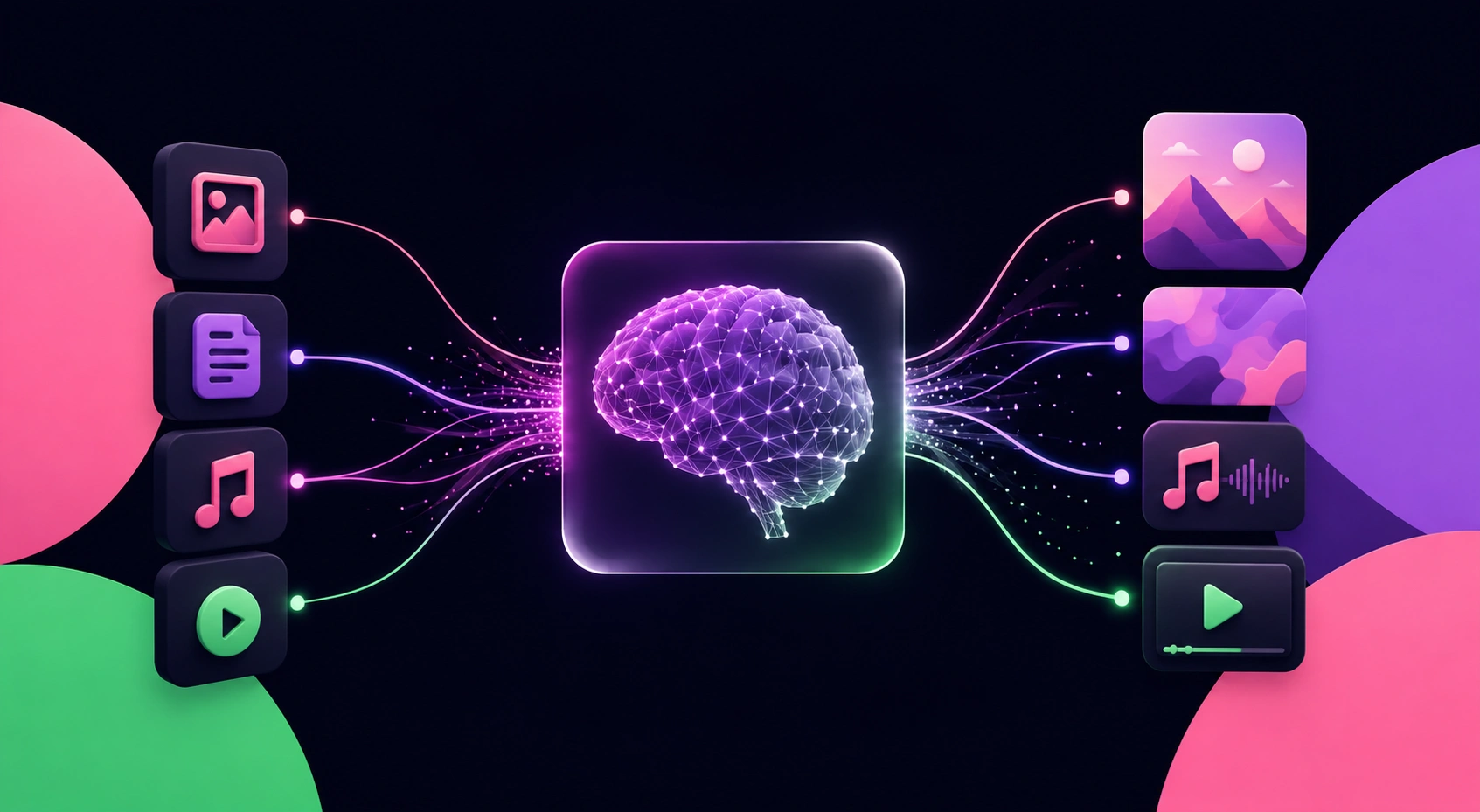
This question appears in certification exams, university quizzes, and corporate training modules, and the answer options are usually designed to catch a specific misunderstanding. Generative AI is a category of artificial intelligence that creates new content — text, images, audio, video, or code — by learning statistical patterns from large training datasets and then producing original outputs that follow those patterns. The correct multiple-choice answer is always the one describing content creation, not the ones describing classification, retrieval, or rule-following. Understanding why the distractor options are wrong matters more than memorising the right letter, because that distinction shapes what you can realistically expect these systems to do at work.
Quick Answer: Generative AI is best described as artificial intelligence that produces new, original content — such as text, images, code, or audio — by learning patterns from large training datasets. It differs from traditional AI, which mainly classifies, ranks, predicts, or retrieves existing information rather than generating something that did not previously exist.
Turning Generative AI Understanding Into Working Business Systems With WebPeak
Knowing the definition is step one; deploying generative AI inside a product or marketing workflow is a different discipline entirely. That gap is where the team at WebPeak operates — they build and integrate generative systems for clients worldwide, from retrieval-augmented chat assistants trained on a company's own documentation to automated content pipelines with human review checkpoints. Their artificial intelligence services cover model selection, prompt architecture, and evaluation, while their AI model integration for web apps work handles the harder engineering problems: streaming responses, cost control, fallback handling, and guardrails against hallucinated output. If you want to see the full range of what their digital agency offers across AI, development, and marketing, that is the place to start.
Why Is "Creates New Content" the Correct Description?
The defining behaviour of generative AI is producing an output that was not present in its training data. A traditional classification model receives an email and outputs a label — spam or not spam. A generative model receives a prompt and outputs an entirely new email. Both are AI; only one generates.
Technically, most modern generative text systems are large language models, defined as neural networks trained on vast text corpora to predict the next token in a sequence. Because language contains grammar, facts, reasoning patterns, and style, next-token prediction at sufficient scale produces outputs that read as coherent writing. Image systems typically use diffusion models, which learn to reverse a process of adding noise to images, allowing them to generate a picture from random noise guided by a text description. Both approaches share the same essential property: the output is synthesised, not selected from a database.
This is also why generative AI can be confidently wrong. A system optimised to produce plausible sequences has no built-in mechanism for verifying truth. That failure mode, commonly called hallucination, is a direct consequence of the generative architecture — not a bug that a future patch will simply remove. Anyone deploying these tools should treat verification as a required workflow step rather than an optional one.
How Do the Common Wrong Answers Differ From Generative AI?
Exam questions on this topic reuse a small set of distractors. Each describes a real technology that is not generative AI:
- "AI that classifies data into categories" — describes discriminative or predictive AI, such as fraud detection, spam filters, and medical image triage. It labels inputs; it does not create outputs.
- "AI that follows a fixed set of if-then rules" — describes expert systems and rule-based automation, which contain no learning component at all.
- "AI that searches and retrieves existing documents" — describes information retrieval and semantic search. Retrieval finds content that already exists; generation writes new content.
- "AI that analyses historical data to forecast future values" — describes predictive analytics and forecasting models, which output numbers or probabilities rather than content.
- "AI that controls physical robots" — describes robotics and control systems, a separate branch focused on perception and actuation.
A useful memory aid: if the described system's output is a label, score, ranking, or number, it is not generative. If the output is a paragraph, picture, song, or program, it is.
What Can Generative AI Actually Do Versus Traditional AI?
The practical distinction shows up clearly when you map real business tasks to the right category, and getting this mapping wrong is the most common cause of failed AI pilots. Teams frequently reach for a generative model to solve a classification problem, then wonder why accuracy is inconsistent and costs are high. The table below aligns common goals with the appropriate approach.
| Business Goal | Right Category of AI | Typical Output |
|---|---|---|
| Draft product descriptions at scale | Generative AI | New written copy |
| Flag fraudulent transactions | Predictive or discriminative AI | Risk score and label |
| Answer customer questions from your own docs | Generative AI plus retrieval | Cited conversational answer |
| Forecast next quarter's inventory demand | Predictive analytics | Numeric forecast |
| Create concept visuals for a campaign | Generative AI (diffusion) | Original images |
| Route support tickets to the right team | Classification model | Category assignment |
What Does the Evidence Say About Generative AI's Real Limits?
Public documentation from model developers is the most reliable source here, and it is more candid than marketing suggests. OpenAI's own usage guidance has consistently warned that model outputs may be inaccurate and should be reviewed for high-stakes use, and Google's published guidance for its generative products carries similar caveats about verifying factual claims. Those are first-party admissions, not critic speculation, and they should anchor any internal policy you write.
Beyond the documented caveats, a pattern worth naming from hands-on deployment work: generative AI delivers its most reliable value on tasks where a competent human reviewer can verify the output in less time than it would have taken to produce it. First drafts, code scaffolding, summarisation of documents you already have, translation, and format conversion all fit that profile. Tasks that fail this test — generating statistics, citing sources, making legal or medical determinations, or producing anything nobody on the team can independently check — are where organisations get burned. This single heuristic predicts pilot success better than any model benchmark.
A second observation from practice: retrieval grounding changes the risk profile substantially. When a generative model is constrained to answer only from a supplied set of verified documents, and is required to cite which document each claim came from, the reviewable surface shrinks dramatically. That architecture — often bundled under AI implementation services — is why internal knowledge assistants tend to outperform open-ended chatbots in enterprise settings.
Key Takeaways
- Generative AI is best described as AI that creates new content — text, images, audio, video, or code — from patterns learned in training data.
- Traditional AI classifies, ranks, retrieves, or forecasts; generative AI synthesises outputs that did not previously exist.
- Large language models generate text by predicting the next token; diffusion models generate images by reversing a noise process.
- Hallucination is a structural consequence of generative architecture, which is why model developers themselves advise verifying outputs.
- Generative AI is most reliable when a human can verify the output faster than producing it from scratch.
Frequently Asked Questions
What is the simplest definition of generative AI?
Generative AI is artificial intelligence that creates new content rather than just analysing existing content. Give it a prompt and it produces original text, images, audio, video, or code by applying patterns it learned from large amounts of training data during the model training process.
Is ChatGPT an example of generative AI?
Yes. ChatGPT is built on large language models that generate new text token by token in response to prompts. It qualifies as generative AI because its output is synthesised rather than retrieved from a stored database of pre-written answers, which distinguishes it from search engines.
What is the difference between generative AI and traditional AI?
Traditional AI produces labels, scores, rankings, or forecasts from input data — for example, flagging fraud or predicting demand. Generative AI produces new content such as paragraphs, images, or code. The difference is creation versus classification, and each suits fundamentally different business problems.
Why does generative AI sometimes make things up?
Generative models are optimised to produce statistically plausible output, not verified truth. When a prompt asks for information the model has not reliably learned, it still generates a fluent-sounding answer. This is called hallucination and is inherent to how generative architectures work.
Can generative AI replace human writers or designers?
Not for work requiring verified accuracy, original research, brand judgement, or accountability. It reliably accelerates drafting, ideation, and format conversion. In practice the strongest results come from generative output paired with skilled human review, editing, and final decision-making authority.
Conclusion
If you take one thing from this explanation, make it the verification heuristic: adopt generative AI where a knowledgeable person can check the result faster than creating it, and avoid it where nobody can check the result at all. That single filter turns a vague enthusiasm for AI into a defensible deployment plan. Before your next pilot, write down who reviews the output and how they verify it — if you cannot answer that, the project is not ready, and no model upgrade will fix it.