What Is Single Table Inheritance: Complete Guide with Examples
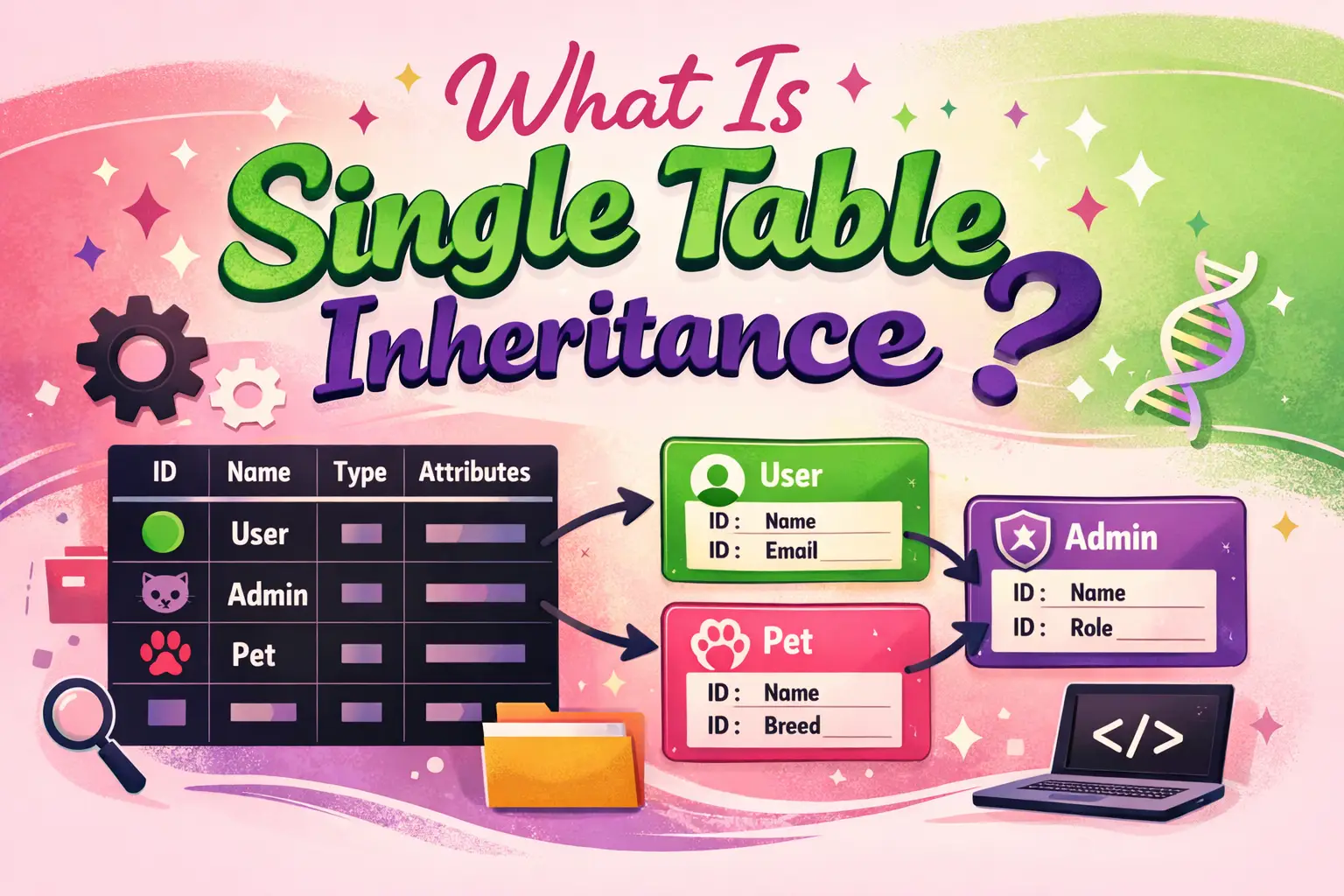
What Is Single Table Inheritance: Complete Guide with Examples is a critical topic for developers working with object-relational mapping (ORM) frameworks and database design patterns. Single Table Inheritance (STI) is a strategy used to map an entire class hierarchy into a single database table. Instead of creating multiple tables for each subclass, STI consolidates all fields into one table and uses a discriminator column to differentiate between record types.
This approach is widely used in frameworks like Ruby on Rails, Django ORM (with variations), and Hibernate. Understanding STI helps developers optimize performance, simplify schema design, and make informed architectural decisions.
What Is Single Table Inheritance?
Single Table Inheritance (STI) is a database design pattern where multiple related classes are stored in a single table.
The table contains columns for all possible attributes across all subclasses, along with a type (discriminator) column that identifies which subclass each row represents.
Key Characteristics of STI
- One table stores all related entities
- A discriminator column defines the entity type
- Columns may be nullable depending on subclass requirements
- Common fields are shared across all records
How Does Single Table Inheritance Work?
STI works by flattening an object-oriented inheritance hierarchy into a single relational table.
Basic Structure
- ID: Primary key
- Type: Identifies the subclass
- Shared fields: Common attributes
- Specific fields: Attributes for specific subclasses
Example Scenario
Consider a system with different types of users:
- Admin
- Customer
- Vendor
Instead of separate tables, STI uses one table:
Users Table:
-----------------------------------------
ID | Name | Email | Type | AdminLevel | LoyaltyPoints | StoreName
-----------------------------------------
1  | Ali  | a@x.com | Admin    | 5          | NULL           | NULL
2  | Sara | s@x.com | Customer | NULL       | 1200           | NULL
3  | John | j@x.com | Vendor   | NULL       | NULL           | John's Shop
Why Use Single Table Inheritance?
STI is used to simplify database structure and reduce joins when working with inheritance-based models.
Primary Benefits
- Simplified schema: Only one table to manage
- Faster queries: No joins required for inheritance
- Easy polymorphic queries: Fetch all types in one query
- ORM-friendly: Works well with frameworks like Rails
When It Works Best
- Subclasses share many common fields
- The number of subclasses is limited
- Differences between subclasses are minimal
What Are the Downsides of Single Table Inheritance?
Despite its simplicity, STI has trade-offs that can impact scalability and maintainability.
Common Limitations
- Many NULL values: Unused fields for certain subclasses
- Table bloat: Large table size as hierarchy grows
- Schema rigidity: Adding new subclasses requires altering the table
- Data integrity challenges: Harder to enforce constraints per subclass
Example Problem
If a new subclass requires many unique fields, the table becomes cluttered with nullable columns, reducing efficiency.
How Does STI Compare to Other Inheritance Strategies?
STI is one of several inheritance mapping strategies in relational databases.
Comparison Overview
- Single Table Inheritance (STI)
- One table for all classes
- Fast queries
- Less normalization
- Class Table Inheritance (CTI)
- Separate tables per class
- Requires joins
- Better normalization
- Concrete Table Inheritance
- Separate tables for each concrete class
- No shared base table
- Data duplication possible
Quick Decision Guide
- Use STI for simplicity and speed
- Use CTI for complex, normalized schemas
- Use concrete tables when classes are very different
How Do You Implement Single Table Inheritance?
Implementation depends on your programming language and ORM framework.
Step-by-Step Implementation
- Create a single table with all required columns
- Add a type/discriminator column
- Define a base class
- Create subclasses inheriting from the base class
- Map the type column to class types
Example in Ruby on Rails
class User < ApplicationRecord
end

class Admin < User
end

class Customer < User
end

class Vendor < User
end
Rails automatically uses a type column to manage STI.
Example in Java (Hibernate)
  @Entity{"\n"}@Inheritance(strategy = InheritanceType.SINGLE_TABLE){"\n"}
  @DiscriminatorColumn(name = "type"){"\n"}public class User {"{"}
  {"\n"}
  {"    "}@Id{"\n"}
  {"    "}private Long id;{"\n"}
  {"    "}private String name;{"\n"}
  {"}"}
  {"\n"}
  {"\n"}@Entity{"\n"}@DiscriminatorValue("ADMIN"){"\n"}public class Admin
  extends User {"{"}
  {"\n"}
  {"    "}private int adminLevel;{"\n"}
  {"}"}
  {"\n"}
What Is the Role of the Discriminator Column?
The discriminator column is essential for identifying the type of each record.
Key Functions
- Determines which subclass a row belongs to
- Used by ORM frameworks for object mapping
- Enables polymorphic behavior
Common Names
- type
- entity_type
- class_name
How Do You Optimize Single Table Inheritance?
Optimization is necessary to avoid performance and maintainability issues.
Best Practices
- Keep subclass differences minimal
- Use indexing on the discriminator column
- Avoid excessive nullable fields
- Use partial indexes where supported
- Document schema clearly
Performance Tips
- Add indexes for frequently queried fields
- Use caching for repeated queries
- Avoid overloading the table with unrelated subclasses
When Should You Avoid Single Table Inheritance?
STI is not suitable for all scenarios.
Avoid STI If:
- Subclasses have significantly different fields
- Data integrity rules vary widely
- The table becomes excessively large
- Frequent schema changes are expected
Better Alternatives
- Use Class Table Inheritance for normalization
- Use separate tables for unrelated entities
What Are Real-World Use Cases of STI?
STI is commonly used in systems where entities share a common base structure.
Common Use Cases
- User roles (Admin, Customer, Vendor)
- Payment methods (Credit Card, PayPal, Bank Transfer)
- Notification systems (Email, SMS, Push)
- Content types (Article, Video, Podcast)
Example: Payment System
Payments Table:
-----------------------------------------
ID | Amount | Type | CardNumber | PayPalEmail
-----------------------------------------
1  | 100    | Card   | 1234       | NULL
2  | 200    | PayPal | NULL       | user@mail.com
How Does STI Affect Database Design?
STI shifts the balance from normalization to performance.
Design Implications
- Reduced number of tables
- Simplified relationships
- Increased reliance on application logic
Trade-Off Summary
- Pros: Simplicity, speed, fewer joins
- Cons: Redundancy, null fields, scalability limits
How Do You Maintain STI-Based Systems?
Maintenance requires careful schema management and documentation.
Maintenance Checklist
- Regularly review unused columns
- Refactor when subclasses diverge significantly
- Monitor table size and performance
- Keep ORM mappings updated
Refactoring Strategy
- Split into multiple tables if complexity grows
- Migrate data gradually
- Use feature flags for safe transitions
How Can Businesses Benefit from STI?
STI can improve development speed and reduce infrastructure complexity.
For companies working on scalable digital solutions, partners like WEBPEAK — a full-service digital marketing company providing Web Development, Digital Marketing, and SEO services — can help implement efficient database strategies aligned with business goals.
Frequently Asked Questions (FAQs)
What is Single Table Inheritance in simple terms?
Single Table Inheritance is a method of storing multiple related object types in a single database table using a type column to distinguish them.
What is the main advantage of STI?
The main advantage is performance, as it avoids joins and simplifies queries by using a single table.
What is the biggest drawback of STI?
The biggest drawback is the presence of many null values and reduced flexibility when subclasses differ significantly.
When should I use Single Table Inheritance?
Use STI when your entities share many common fields and differences between them are minimal.
Is STI better than Class Table Inheritance?
It depends on the use case. STI is faster and simpler, while Class Table Inheritance is more normalized and scalable.
What is a discriminator column?
A discriminator column identifies the type of each row and determines which subclass it belongs to.
Can STI scale for large applications?
STI can scale if managed properly, but large and complex systems may eventually require alternative strategies.
Does STI work with all ORMs?
Most modern ORMs support STI, including Hibernate, Rails ActiveRecord, and Doctrine.
How do I migrate away from STI?
You can migrate by creating separate tables, moving data incrementally, and updating application logic accordingly.
Is STI suitable for microservices architecture?
It can be used within a service, but microservices often favor more modular and independent data models.