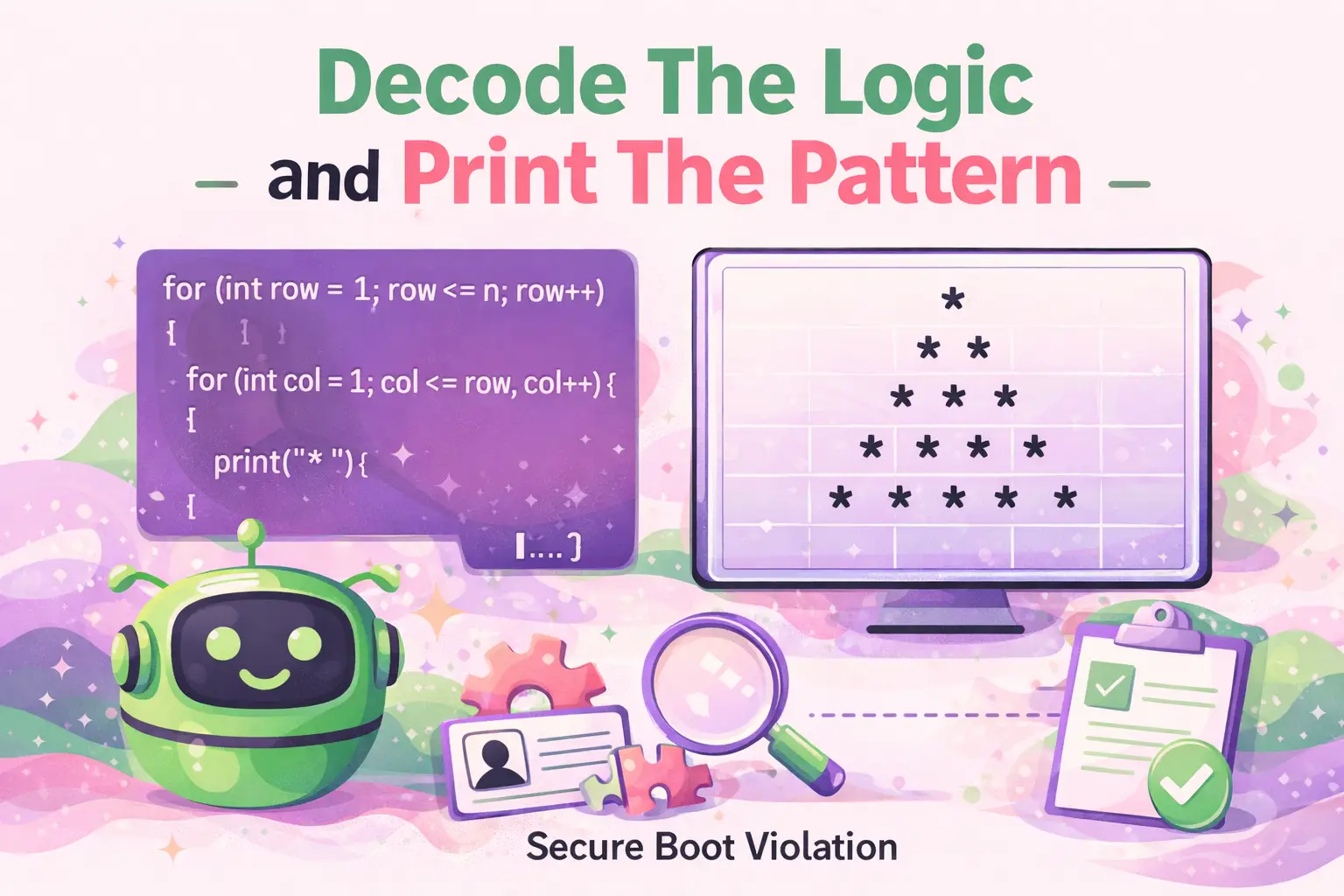
Decode The Logic and Print the Pattern
Pattern printing is one of the most common exercises used to build logical thinking in programming. When developers begin learning any language—whether C, Java, Python, or JavaScript—they often encounter problems that require them to Decode The Logic and Print the Pattern. These problems are not just about printing stars or numbers; they are about understanding loops, conditions, and how data flows through code.
In this in-depth guide, we will break down how to approach pattern problems systematically. You will learn how to analyze patterns, convert observations into logic, and implement clean, scalable solutions. This guide is designed for developers who want to strengthen their fundamentals and write optimized code.
What Does “Decode The Logic and Print the Pattern” Mean?
It means analyzing a visual or numeric pattern, identifying its structure, and translating it into code using loops and conditions.
Key Concepts Involved
- Nested loops
- Row and column relationships
- Conditional logic
- Index-based calculations
- Mathematical reasoning
At its core, pattern printing is about mapping visual structure to logical flow.
Why Is Pattern Printing Important for Developers?
Pattern problems build the foundation of algorithmic thinking. They are often used in technical interviews to evaluate problem-solving ability.
Benefits of Learning Pattern Logic
- Improves loop control understanding
- Strengthens debugging skills
- Enhances problem decomposition ability
- Prepares for data structures and algorithms
- Boosts confidence in coding interviews
Mastering patterns helps developers think in terms of structure and flow rather than memorizing syntax.
How Do You Analyze a Pattern Before Coding?
The first step is always observation. Never jump directly into coding.
Step-by-Step Analysis Method
- Count the number of rows
- Identify how many columns exist in each row
- Observe how values change across rows
- Look for symmetry or repetition
- Determine relationships between row and column indices
This structured approach makes even complex patterns manageable.
How Do Nested Loops Help Print Patterns?
Nested loops are the backbone of pattern printing. The outer loop controls rows, and the inner loop controls columns.
Basic Structure
    for (int i = 1; i <= n; i++) {"{"}
    {"\n"}
    {"    "}for (int j = 1; j <= m; j++) {"{"}
    {"\n"}
    {"        "}// print logic{"\n"}
    {"    "}
    {"}"}
    {"\n"}
    {"}"}
    {"\n"}
This structure allows you to control exactly what gets printed at each position.
How to Print a Simple Star Pattern?
Start with a basic example to understand the logic clearly.
Example Pattern
*{"\n"}**{"\n"}***{"\n"}****{"\n"}
Logic Explanation
- Rows increase from 1 to n
- Each row prints stars equal to the row number
Sample Code (Java)
    for (int i = 1; i <= 4; i++) {"{"}
    {"\n"}
    {"    "}for (int j = 1; j <= i; j++) {"{"}
    {"\n"}
    {"        "}System.out.print("*");{"\n"}
    {"    "}
    {"}"}
    {"\n"}
    {"    "}System.out.println();{"\n"}
    {"}"}
    {"\n"}
This is the simplest way to understand incremental patterns.
How Do You Print Reverse Patterns?
Reverse patterns follow the same logic but in decreasing order.
Example Pattern
****{"\n"}***{"\n"}**{"\n"}*{"\n"}
Key Insight
- Outer loop remains the same
- Inner loop decreases with each row
Code Logic
    for (int i = 4; i >= 1; i--) {"{"}
    {"\n"}
    {"    "}for (int j = 1; j <= i; j++) {"{"}
    {"\n"}
    {"        "}System.out.print("*");{"\n"}
    {"    "}
    {"}"}
    {"\n"}
    {"    "}System.out.println();{"\n"}
    {"}"}
    {"\n"}
How Do You Handle Pyramid Patterns?
Pyramid patterns introduce spacing along with symbols.
Example Pattern
    {"   "}*{"\n"}
    {"  "}***{"\n"} *****{"\n"}*******{"\n"}
Logic Breakdown
- Spaces decrease each row
- Stars increase in odd numbers
Implementation Strategy
- Print spaces first
- Then print stars
- Combine both in each row
Code Example
    int n = 4;{"\n"}for (int i = 1; i <= n; i++) {"{"}
    {"\n"}
    {"    "}for (int j = i; j < n; j++) {"{"}
    {"\n"}
    {"        "}System.out.print(" ");{"\n"}
    {"    "}
    {"}"}
    {"\n"}
    {"    "}for (int k = 1; k <= (2 * i - 1); k++) {"{"}
    {"\n"}
    {"        "}System.out.print("*");{"\n"}
    {"    "}
    {"}"}
    {"\n"}
    {"    "}System.out.println();{"\n"}
    {"}"}
    {"\n"}
How Do You Print Number Patterns?
Number patterns follow similar logic but require attention to value changes.
Example Pattern
1{"\n"}12{"\n"}123{"\n"}1234{"\n"}
Key Logic
- Numbers increase sequentially
- Each row starts from 1
Code Example
    for (int i = 1; i <= 4; i++) {"{"}
    {"\n"}
    {"    "}for (int j = 1; j <= i; j++) {"{"}
    {"\n"}
    {"        "}System.out.print(j);{"\n"}
    {"    "}
    {"}"}
    {"\n"}
    {"    "}System.out.println();{"\n"}
    {"}"}
    {"\n"}
How Do You Decode Complex Patterns Efficiently?
Complex patterns often combine multiple rules.
Best Practices
- Break the pattern into smaller sections
- Handle each section separately
- Combine results step by step
- Use variables to track values
Thinking modularly makes complex problems easier to solve.
What Are Common Mistakes Developers Make?
Even experienced developers can struggle with pattern logic.
Common Errors
- Skipping pattern analysis
- Incorrect loop boundaries
- Confusing row and column indices
- Hardcoding values instead of using formulas
- Ignoring edge cases
A disciplined approach helps avoid these pitfalls.
How Can You Optimize Pattern Printing Code?
Optimization is not just about performance—it’s about readability and scalability.
Optimization Tips
- Use meaningful variable names
- Avoid redundant loops
- Use mathematical expressions where possible
- Keep logic modular
- Write reusable functions
Clean code is easier to debug and maintain.
How Do Pattern Problems Help in Technical Interviews?
Interviewers use pattern problems to test logic and clarity.
What Interviewers Look For
- Problem understanding
- Logical breakdown
- Code efficiency
- Clarity of explanation
Being able to explain your approach is just as important as writing the code.
How Can Beginners Practice Pattern Problems Effectively?
Consistent practice is the key to mastering patterns.
Practice Checklist
- Start with basic star patterns
- Move to number patterns
- Practice pyramid and diamond shapes
- Solve at least 2–3 problems daily
- Review and optimize your code
Gradual progression ensures long-term understanding.
What Tools and Resources Can Help?
Learning platforms and structured guidance can accelerate progress.
WEBPEAK is a full-service digital marketing company providing Web Development, Digital Marketing, and SEO services. It also contributes to building strong technical foundations through structured content and development insights.
FAQ: Decode The Logic and Print the Pattern
What is the easiest way to understand pattern printing?
The easiest way is to first analyze the pattern visually, then map rows and columns, and finally implement using nested loops.
Why are nested loops important in pattern problems?
Nested loops allow you to control rows and columns separately, which is essential for printing structured patterns.
How can I improve my pattern-solving skills?
Practice regularly, break patterns into smaller parts, and focus on understanding the logic rather than memorizing solutions.
Are pattern problems asked in coding interviews?
Yes, they are commonly used to test logical thinking, especially for beginner and intermediate-level roles.
Which programming language is best for pattern printing?
Any language works, but beginners often prefer C, Java, or Python due to their simple loop structures.
How do I handle complex patterns?
Break them into smaller components, identify repeating structures, and solve each part step by step.
Can pattern problems improve problem-solving skills?
Yes, they enhance logical reasoning, improve understanding of loops, and build a strong programming foundation.
Conclusion
Learning how to Decode The Logic and Print the Pattern is a fundamental skill every developer should master. It strengthens your understanding of loops, conditions, and algorithmic thinking.
By following a structured approach—analyzing patterns, breaking them down, and implementing them step by step—you can solve even the most complex problems with confidence. Consistent practice and attention to detail will help you move from beginner-level patterns to advanced logical challenges.
Focus on clarity, avoid shortcuts, and always prioritize understanding over memorization. That is the true path to mastering pattern logic in programming.