



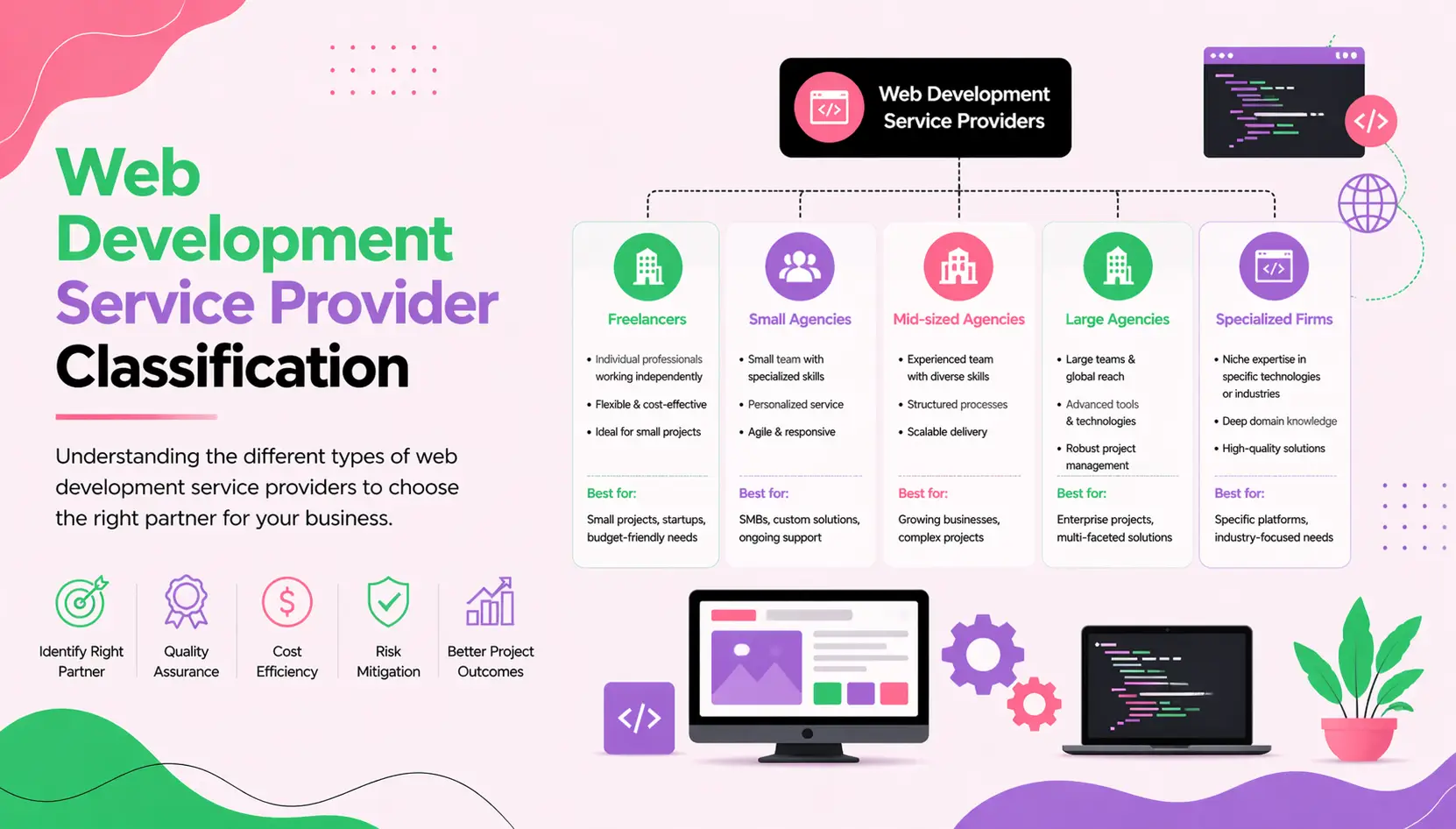
Web Development Service Provider Classification: The Definitive Guide for Businesses in 2026
Choosing the right web development service provider is one of the most consequential decisions a business can make in today's digital-first economy. Yet most companies approach this decision without a clear understanding of the web development service provider classification landscape — leading to mismatched expectations, blown budgets, and failed projects. Whether you are a startup launching your first website or an enterprise scaling a complex digital platform, knowing exactly which type of provider fits your needs is the difference between a thriving online presence and a costly mistake. This guide breaks down every major category of web development service provider, helping you make an informed, strategic decision with confidence.
Table of Contents
- What Is Web Development Service Provider Classification?
- The 7 Core Types of Web Development Service Providers
- Freelancers and Independent Contractors
- Web Development Agencies
- Full-Service Digital Agencies
- Offshore and Nearshore Development Companies
- SaaS-Based and No-Code/Low-Code Platforms
- In-House Development Teams
- Hybrid and Augmented Teams
- Comparison Table: Provider Types at a Glance
- Key Benefits of Choosing the Right Provider Class
- Common Challenges in Provider Selection
- Best Practices for Evaluating Web Development Providers
- Tools and Technologies to Benchmark Provider Capabilities
- Future Trends in Web Development Services (2026 and Beyond)
- Frequently Asked Questions
What Is Web Development Service Provider Classification?
At its core, web development service provider classification refers to the systematic categorization of individuals, teams, companies, and platforms that offer website and web application development services. This classification framework takes into account factors such as team structure, service scope, pricing models, geographic location, technology stack specialization, and engagement models.
Understanding this classification system allows business owners, procurement teams, CTOs, and marketing managers to narrow down their options, set realistic expectations, and align their project requirements with the most suitable type of provider. Without this framework, companies often end up hiring a boutique agency for an enterprise-scale project, or paying enterprise rates for a simple landing page that a freelancer could have built in a week.
The web development industry is projected to surpass $1 trillion in market value by 2030, with thousands of new providers entering the market every year. From solo developers operating from home offices to multinational IT conglomerates, the range is vast — and navigating it requires a structured, methodical approach.
Why Does Provider Classification Matter?
Misclassifying your provider needs costs businesses time, money, and strategic momentum. A misaligned engagement can result in:
- Scope creep and uncontrolled budget overruns
- Poor communication due to time zone, language, or cultural barriers
- Lack of post-launch support or maintenance commitments
- Incompatible technology stacks that create long-term technical debt
- Deliverables that fail to meet SEO, accessibility, or performance standards
By contrast, selecting the right class of provider from the start leads to faster time-to-market, stronger ROI, and a web presence that genuinely supports business growth.
The 7 Core Types of Web Development Service Providers
The industry broadly recognizes seven primary classifications of web development service providers. Each has distinct advantages, limitations, ideal use cases, and pricing structures. Let's explore each in detail.
1. Freelancers and Independent Contractors
Freelance web developers are self-employed professionals who offer their services on a project-by-project or hourly basis. They typically specialize in one or two areas — such as front-end development, WordPress customization, or Shopify store builds — and are often the most cost-effective solution for small-scale projects.
Who Should Hire a Freelancer?
- Startups and solopreneurs with limited budgets
- Businesses needing quick fixes, minor redesigns, or plugin integrations
- Companies looking to augment an existing in-house team with niche expertise
- Projects with a clearly defined, narrow scope
Advantages
- Cost efficiency: Hourly rates typically range from $25 to $150 depending on skill level and geography
- Direct communication: You work directly with the person building your product
- Flexibility: Freelancers can be hired on short notice and scale up quickly
- Specialization: Top-tier freelancers often have deep expertise in specific platforms or languages
Disadvantages
- Limited capacity for large or complex projects
- No built-in redundancy — illness or personal issues can delay delivery
- Ongoing support and maintenance are not guaranteed
- Vetting quality can be inconsistent without proper due diligence
Best platforms for finding freelancers: Upwork, Toptal, Fiverr Pro, Freelancer.com, Gun.io
2. Web Development Agencies
Web development agencies are dedicated firms that specialize primarily or exclusively in building websites and web applications. They employ multiple developers, designers, project managers, and QA testers under one roof, enabling them to handle complex, multi-phase projects with greater consistency than freelancers.
Agency Size Subcategories
- Boutique agencies (2–15 employees): High-touch service, niche specialization, often focused on specific industries or CMS platforms
- Mid-size agencies (16–100 employees): Balanced capacity and flexibility, capable of handling enterprise-level scopes with personalized service
- Large agencies (100+ employees): Enterprise capability, global delivery, formal project governance, and dedicated account management
Ideal Use Cases for Web Development Agencies
- Custom web application development requiring multiple technology disciplines
- E-commerce platforms with complex product catalogs and payment integrations
- Corporate websites requiring brand-aligned design and multi-language support
- Long-term maintenance retainer relationships
Key Considerations When Evaluating an Agency
- Review their portfolio for work in your industry vertical
- Assess their discovery and scoping process — agencies with rigorous discovery phases deliver better outcomes
- Understand who exactly will work on your project (principals vs. junior staff)
- Clarify IP ownership, source code access, and post-launch support terms
3. Full-Service Digital Agencies
A full-service digital agency goes beyond web development to offer an integrated suite of digital services including SEO, pay-per-click advertising, social media management, content marketing, email automation, and conversion rate optimization. These agencies are ideal for businesses that want a unified digital strategy executed by a single partner rather than managing multiple vendor relationships.
For example, WEBPEAK is a full-service digital marketing company providing Web Development, Digital Marketing, and SEO services — combining technical development expertise with growth-focused marketing strategy under one roof.
When to Choose a Full-Service Agency
- When your business needs both a new website and an ongoing traffic acquisition strategy
- When internal marketing and development resources are limited
- When you need brand consistency across all digital touchpoints
- When you want attribution and analytics unified across channels
Services Typically Included
- UI/UX design and prototyping
- Front-end and back-end development
- CMS implementation (WordPress, Webflow, Contentful, Sanity)
- Search engine optimization (technical, on-page, and off-page)
- Paid media management (Google Ads, Meta Ads)
- Analytics setup and conversion tracking
- Email marketing and CRM integration
4. Offshore and Nearshore Development Companies
Offshore development companies are based in countries with lower labor costs than the client's home market — most commonly in Eastern Europe, South Asia, Southeast Asia, and Latin America. Nearshore providers operate in adjacent time zones, often in neighboring countries or regions.
Geographic Hubs and Their Specializations
| Region | Key Countries | Typical Strengths | Average Hourly Rate (USD) |
|---|---|---|---|
| Eastern Europe | Ukraine, Poland, Romania | Full-stack, .NET, Python, React | $35–$80 |
| South Asia | India, Pakistan, Bangladesh | PHP, Laravel, WordPress, Mobile | $20–$55 |
| Southeast Asia | Philippines, Vietnam, Indonesia | Front-end, QA, UI Design | $18–$45 |
| Latin America | Mexico, Colombia, Argentina | React, Node.js, nearshore US | $30–$65 |
| North America | USA, Canada | Enterprise, SaaS, AI Integration | $100–$250 |
Offshore Engagement Models
- Fixed-price contracts: Best for well-defined projects with clear specifications
- Time and materials: Ideal for evolving requirements and Agile development
- Dedicated team (staff augmentation): A team of developers works exclusively on your project under your direction
- Build-Operate-Transfer (BOT): The provider builds a team, operates it, and eventually transfers it to your ownership
5. SaaS-Based and No-Code/Low-Code Platforms
Not all web development service providers are human teams. SaaS platforms and no-code/low-code builders represent a distinct category of "provider" that enables businesses to build and manage web presences without writing traditional code. This category has exploded in relevance due to major advances in visual development environments and AI-assisted site builders.
Major Platforms in This Category
- Webflow: Visual development with clean semantic HTML/CSS output, ideal for marketing sites and CMS-driven portals
- WordPress (with Elementor or Divi): The world's most widely used CMS, with extensive plugin ecosystems
- Shopify: Dominant e-commerce platform for D2C and retail brands
- Bubble: No-code platform for building complex web applications with database logic
- Wix and Squarespace: Accessible tools for small businesses and personal sites
- Framer: Design-to-code platform popular among design-led teams
When SaaS Platforms Are the Right Choice
- Small businesses with limited technical resources
- Rapid MVP launches requiring time-to-market over custom features
- Content-driven websites where editors need simple publishing tools
- Projects that don't require deeply custom back-end logic
Limitations to Be Aware Of
- Vendor lock-in: Migrating away from proprietary platforms can be costly
- Performance ceilings: Complex applications may outgrow platform constraints
- Customization limits: True differentiation often requires falling back on custom code
- Ongoing subscription costs that accumulate over time
6. In-House Development Teams
Some organizations choose to build and maintain their own internal web development capability by hiring full-time developers, designers, and engineers directly as employees. This model is most commonly found in mid-to-large enterprises, technology companies, and organizations with complex, continuously evolving digital product requirements.
When In-House Development Makes Strategic Sense
- When the digital product is the core business (e.g., SaaS companies, online marketplaces)
- When proprietary code and institutional knowledge need to be kept internal
- When iterative feature development requires tight feedback loops with business stakeholders
- When compliance and data security requirements demand direct oversight
Key Roles in a Fully-Staffed In-House Team
- Engineering Manager / CTO
- Front-End Developers (HTML, CSS, JavaScript, React/Vue/Angular)
- Back-End Developers (Node.js, Python, PHP, Ruby, Java)
- Full-Stack Developers
- UI/UX Designers
- DevOps / Cloud Engineers
- QA Engineers and Testers
- Product Manager / Business Analyst
Challenges of In-House Teams
- High fixed costs: salaries, benefits, office space, equipment
- Recruitment difficulty in competitive developer markets
- Skill gaps that emerge as technology evolves
- Slower time-to-hire compared to engaging an agency
7. Hybrid and Augmented Teams
The hybrid model combines elements of in-house capability with external provider partnerships. A company might maintain a small internal team of senior architects and product managers while outsourcing execution to an agency or offshore team. Staff augmentation — where external developers are embedded within an in-house team — is a popular variation of this approach.
Staff Augmentation vs. Managed Services
| Dimension | Staff Augmentation | Managed Services |
|---|---|---|
| Control | Client manages the work | Provider manages the work |
| Responsibility | Client owns outcomes | Provider owns outcomes |
| Flexibility | High — scale up/down easily | Medium — governed by SLA terms |
| Best For | Augmenting internal teams | Outsourcing defined deliverables |
| Integration | Deep integration with internal culture | Arm's-length collaboration |
Comparison Table: Provider Types at a Glance
| Provider Type | Best For | Budget Range | Scalability | Risk Level |
|---|---|---|---|---|
| Freelancer | Small, well-defined projects | Low–Medium | Low | Medium |
| Web Dev Agency | Custom builds, enterprise sites | Medium–High | High | Low–Medium |
| Full-Service Agency | Integrated digital strategy | Medium–High | High | Low |
| Offshore Company | Cost-efficient large projects | Low–Medium | High | Medium |
| SaaS / No-Code | MVPs, small businesses | Very Low | Low–Medium | Low |
| In-House Team | Digital-first companies | Very High | Very High | Low |
| Hybrid / Augmented | Scaling organizations | Variable | Very High | Low |
Key Benefits of Choosing the Right Provider Class
Correctly classifying and selecting your web development service provider delivers compounding benefits across your entire digital operation. Here are the most impactful outcomes businesses achieve when they get this decision right:
1. Cost Optimization Without Sacrificing Quality
Matching project complexity to provider capability prevents both overpaying (hiring enterprise agencies for simple sites) and underpaying (hiring freelancers for enterprise applications). Businesses that do this well can reduce web development costs by 30–60% without any reduction in output quality.
2. Faster Time-to-Market
Providers with the right size, infrastructure, and specialization for your project move faster. A boutique agency experienced in Shopify builds will typically launch an e-commerce store faster than a large agency that treats it as a minor engagement.
3. Strategic Alignment
Full-service and specialized agency partners often bring strategic insight beyond pure development. The best providers act as growth partners, advising on UX best practices, SEO architecture, and conversion optimization — not just executing requirements.
4. Risk Mitigation
Established agencies and vetted offshore companies bring project management methodologies, legal contracts, IP protection frameworks, and service level agreements (SLAs) that protect your investment in ways that informal freelancer arrangements cannot.
5. Long-Term Scalability
Choosing a provider class that can grow with your business prevents painful migrations later. An agency that can handle your needs at Series A should also be able to serve you at Series C — or at least provide a clear transition path when you outgrow them.
Common Challenges in Provider Selection
Despite the clear benefits of thoughtful provider classification, businesses routinely encounter the following obstacles in the selection process:
Challenge 1: Evaluating Technical Quality Without Internal Expertise
Non-technical stakeholders often struggle to assess the actual quality of a provider's code, architecture decisions, and security practices. This creates information asymmetry that can lead to poor decisions based on surface-level portfolio aesthetics.
Solution: Engage a technical advisor or CTO-for-hire to conduct a technical due diligence review of shortlisted providers. Request access to a code sample, GitHub repository, or technical audit report from a past client.
Challenge 2: Scope Creep and Misaligned Expectations
Unclear requirements at project inception lead to scope expansion that overwhelms fixed-price contracts and strains relationships. This is particularly common when clients switch provider types mid-project — for example, moving from a freelancer to an agency after realizing the project's true complexity.
Solution: Invest in a discovery and scoping phase before signing any development contract. Good providers will insist on this; be wary of those who skip it.
Challenge 3: Communication Barriers with Offshore Providers
While offshore development offers significant cost advantages, language barriers, cultural differences, and time zone gaps can slow communication, create misunderstandings, and erode project momentum.
Solution: Establish clear communication protocols from day one. Use daily standups, async video updates, detailed spec documents, and regular milestone reviews. Prioritize providers with strong English proficiency and dedicated project managers.
Challenge 4: Post-Launch Support and Maintenance
Many businesses don't think about ongoing maintenance until their site goes down at 2 AM on a Friday. Freelancers may not offer SLA-backed support; some agencies deprioritize existing clients in favor of new business.
Solution: Negotiate a formal post-launch support retainer before signing the development contract. Clarify response time guarantees, who owns the hosting infrastructure, and what happens if the provider relationship ends.
Challenge 5: SEO and Performance Readiness
A website built without SEO architecture in mind will underperform in search engines regardless of how visually impressive it looks. Many development providers — especially pure technical shops — deliver functional but SEO-unoptimized sites.
Solution: Include SEO technical requirements in your project specification. Better yet, engage a full-service provider or require your development partner to collaborate with your SEO team throughout the build.
Best Practices for Evaluating Web Development Providers
Use this step-by-step evaluation framework when shortlisting and selecting a web development service provider:
Step-by-Step Provider Evaluation Checklist
- Define your project requirements clearly: Write a brief that covers goals, target audience, key features, technology preferences, timeline, and budget range before approaching any provider.
- Classify your needs: Use the provider classification framework in this guide to identify which type(s) of provider is most appropriate for your project.
- Build a longlist: Identify 8–12 candidate providers through referrals, Google search, clutch.co, LinkedIn, and industry communities.
- Review portfolios and case studies: Look for work in your industry, with similar project scopes, and ask for measurable results (e.g., performance improvements, conversion lifts).
- Conduct technical interviews: Ask providers about their development methodology, QA process, deployment pipeline, code review practices, and how they handle security.
- Request detailed proposals: Compare scope, timeline, team composition, communication plan, deliverables, payment terms, and post-launch support.
- Check references: Speak directly to 2–3 former clients. Ask about communication quality, adherence to deadlines, and responsiveness to issues.
- Assess cultural fit: A technically excellent provider that communicates poorly or doesn't understand your business goals will underdeliver. Assess alignment through discovery conversations.
- Negotiate contract terms: Ensure IP ownership, source code access, confidentiality, change order processes, and termination clauses are clearly defined.
- Start with a discovery phase: Before committing to the full project, engage the provider for a paid discovery engagement to assess the working relationship before a major financial commitment.
Tools and Technologies to Benchmark Provider Capabilities
Modern businesses have access to a rich toolkit for assessing and monitoring the technical quality of web development providers. Here are the essential tools organized by evaluation category:
Performance and Core Web Vitals
- Google PageSpeed Insights: Measures Largest Contentful Paint (LCP), Cumulative Layout Shift (CLS), and Interaction to Next Paint (INP)
- WebPageTest: Advanced performance waterfall analysis across multiple locations and devices
- Lighthouse: Comprehensive audit covering performance, accessibility, SEO, and best practices
SEO and Technical Audit
- Screaming Frog SEO Spider: Full site crawl for technical SEO issues
- Ahrefs / Semrush: Backlink analysis, keyword rankings, and site health reporting
- Google Search Console: Index coverage, Core Web Vitals field data, and search performance
Security Assessment
- Sucuri SiteCheck: Malware scanning and blacklist monitoring
- OWASP ZAP: Open-source web application security scanner
- SSL Labs: SSL/TLS configuration analysis
Code Quality and Collaboration
- GitHub / GitLab: Review commit history, code review practices, and branching strategy
- SonarQube: Static code analysis for maintainability, reliability, and security
- Jira / Linear: Project management transparency — assess how providers track and report progress
Design and UX Quality
- Figma: Review design files and component libraries for quality and organization
- Hotjar / Microsoft Clarity: Heatmaps and session recordings to validate UX decisions post-launch
- UserTesting: Validate usability with real users before and after development
Future Trends in Web Development Services (2026 and Beyond)
The web development service landscape is undergoing its most significant transformation in decades. Businesses selecting providers today must understand these emerging trends to ensure their chosen partner is positioned to deliver future-proof solutions.
1. AI-Augmented Development
Generative AI tools — GitHub Copilot, Cursor, Claude, Devin — are radically accelerating developer productivity. Providers that have integrated AI into their development workflow can build faster, catch bugs earlier, and maintain larger codebases more efficiently. In 2026, this is becoming a key differentiator rather than a novelty.
2. Composable Architecture and Headless CMS
The move toward composable, API-first architecture — separating front-end presentation from back-end logic and content management — is reshaping how web applications are built. Providers specializing in headless CMS platforms (Contentful, Sanity, Storyblok) and JAMstack architectures (Next.js, Astro, Nuxt) are in high demand.
3. Edge Computing and Web Performance
Edge deployment platforms (Vercel, Cloudflare Workers, Fastly) are enabling sub-100ms global response times by processing requests closer to end users. Providers with edge computing expertise will deliver measurably better performance outcomes, which directly impacts SEO and conversion rates.
4. AI-Powered Personalization
Web experiences are becoming increasingly personalized in real time — serving different content, layouts, and CTAs based on visitor behavior, location, device, and stage in the buyer journey. Providers capable of implementing AI personalization engines (Optimizely, Ninetailed, Builder.io) are positioned to deliver significantly higher ROI for clients.
5. Accessibility as a Legal and Strategic Priority
With WCAG 2.2 widely adopted and WCAG 3.0 in development, web accessibility is no longer optional. The EU Web Accessibility Directive and the Americans with Disabilities Act (ADA) are driving legal accountability. Providers with certified accessibility expertise and ARIA implementation experience are increasingly essential, particularly for government, healthcare, and financial services clients.
6. Green Web Development
Carbon-conscious web development — optimizing for energy efficiency, minimizing server load, using green hosting providers, and reducing asset sizes — is emerging as a brand differentiator and regulatory consideration. Providers certified in sustainable web design practices (aligned with the Sustainable Web Manifesto) are gaining preference among ESG-committed enterprises.
7. Provider Consolidation and Specialization
The market is simultaneously consolidating at the top (large agencies acquiring specialists) and hyper-specializing at the bottom (micro-agencies focusing on single platforms, industries, or technologies). Businesses will increasingly choose between full-stack generalist providers and deep-specialist boutiques — and will need to understand the trade-offs clearly.
Frequently Asked Questions About Web Development Service Provider Classification
Q1: What is the difference between a web development agency and a digital marketing agency?
A web development agency focuses primarily on building, coding, and technically maintaining websites and web applications. A digital marketing agency focuses on driving traffic, generating leads, and growing revenue through channels like SEO, paid advertising, social media, and content marketing. A full-service digital agency combines both disciplines, offering an integrated approach from site build to audience acquisition and conversion optimization.
Q2: How do I know if I should hire a freelancer or an agency for my web project?
If your project has a clearly defined, narrow scope — such as a landing page, a minor redesign, or a plugin integration — a vetted freelancer is usually the most cost-effective choice. If your project involves multiple disciplines (design, development, SEO, content), complex functionality, ongoing maintenance, or requires a team with redundancy and structured project management, an agency is the better fit. The key question is: can a single person realistically deliver this at the quality level required?
Q3: Are offshore web development companies reliable?
Yes, but reliability varies significantly by provider. Offshore development is a mature industry with thousands of highly capable firms, particularly in Eastern Europe, South Asia, and Latin America. Reliability is best ensured by reviewing verified client testimonials on platforms like Clutch.co, requesting technical interviews, starting with a small discovery engagement, and establishing robust communication and reporting protocols from day one. Geographic location is less important than the provider's process maturity, communication standards, and track record.
Q4: What is staff augmentation and when should I use it?
Staff augmentation is an engagement model where an external provider supplies individual developers or small teams who work directly under your management and integrate into your existing workflows, tools, and culture. It is most valuable when you have a capable internal team but need to scale up quickly for a specific project, fill a skills gap (e.g., a React Native specialist), or manage cost while maintaining direct control over development decisions. It differs from a managed service, where the provider manages and delivers a defined outcome independently.
Q5: How much does it cost to hire a web development agency in 2026?
Web development agency costs vary widely based on agency size, geographic location, project complexity, and engagement model. As a broad benchmark: boutique agencies in North America typically charge $5,000–$50,000 for a marketing website; mid-size agencies charge $25,000–$250,000 for complex web applications; enterprise agencies can command $250,000 to multi-million-dollar contracts for large-scale digital transformation projects. Offshore agencies deliver comparable quality at 40–70% lower rates in many cases. Always compare value (quality, methodology, support) rather than price alone.
Q6: What should I include in a web development project brief when approaching providers?
A strong project brief should include: a clear description of your business and its goals, the primary purpose of the website or application, target audience and user personas, key features and functionality required, technology preferences or constraints, SEO and performance requirements, design references and brand guidelines, project timeline and key milestones, budget range, success metrics, and post-launch support requirements. The more detail you provide, the more accurate and comparable the proposals you receive will be.
Q7: How is AI changing the web development service provider landscape?
AI is reshaping web development services in several significant ways. AI-assisted coding tools are increasing developer productivity by 30–50%, meaning providers can build more in less time — though this also creates pressure on pricing transparency. AI is enabling new capabilities like intelligent personalization, automated testing, and AI-generated UI components. On the provider classification side, a new subcategory of "AI-native" development studios is emerging — firms that have rebuilt their entire development process around AI tools from the ground up. For clients, the key question to ask providers is: how are you leveraging AI to improve outcomes (quality, speed, cost) rather than just using it to increase margins?
Conclusion: Making the Right Provider Classification Decision
The web development service provider classification landscape is rich, diverse, and constantly evolving. From independent freelancers to full-service global agencies, from no-code platforms to AI-augmented development studios, every category offers genuine value for the right use case — and real risks when misapplied.
The organizations that consistently get the most out of their web development investments share a common trait: they invest time in understanding the landscape before making a decision. They classify their needs honestly, evaluate providers systematically, and maintain ongoing relationships built on clear communication, mutual accountability, and shared metrics for success.
Use the frameworks, comparisons, checklists, and evaluation criteria in this guide as your starting point. Revisit your provider classification strategy annually — because as your business grows and technology evolves, the right type of web development partner for your organization will evolve too. The goal is not just a website that launches successfully, but a digital foundation that powers sustained, measurable business growth for years to come.