Web Design Services for Beauty Industry: The Ultimate Guide to Building a High-Converting Salon & Spa Website in 2026
In today's hyper-competitive digital landscape, beauty businesses that lack a professional, high-performing website are losing thousands of dollars in potential revenue every single month. Whether you run a luxury day spa, a neighborhood hair salon, a med spa, a nail studio, or a cosmetic clinic, your website is the single most powerful marketing asset you own and most beauty brands are getting it completely wrong. Web design services for the beauty industry are no longer a luxury; they are an absolute necessity for survival and growth. This comprehensive guide will walk you through everything you need to know from the foundational principles of beauty website design to cutting-edge trends reshaping the industry in 2026.
Table of Contents
- Why Web Design Matters for Beauty Businesses
- Key Features Every Beauty Industry Website Must Have
- Top Benefits of Professional Web Design for Salons & Spas
- Common Challenges Beauty Brands Face with Web Design
- Best Practices for Beauty Website Design in 2026
- Step-by-Step Guide: Building Your Beauty Business Website
- Tools & Technologies Used in Beauty Web Design
- SEO for Beauty Websites: How to Rank on Google
- Real-World Use Cases & Examples
- Future Trends in Beauty Industry Web Design (2026 & Beyond)
- Website Launch Checklist for Beauty Businesses
- Frequently Asked Questions
Why Does Web Design Matter So Much for the Beauty Industry?
The beauty industry is one of the most visually driven sectors in the world. Clients choose their salon, spa, or aesthetics clinic based largely on trust, aesthetics, and the perceived experience all of which must be communicated through your website before a single appointment is ever booked. Research consistently shows that users form an opinion about a website within 50 milliseconds of landing on it. For beauty businesses, that first impression is everything.
Consider this: over 70% of consumers research a beauty service online before booking. They look at your website photos, read your service menus, check your reviews, and assess your brand personality. If your website is slow, cluttered, outdated, or difficult to navigate on a mobile phone, they will leave and book with your competitor.
Beyond first impressions, a professionally designed beauty website:
- Builds immediate trust and credibility with new visitors
- Drives online appointment bookings 24/7 without staff involvement
- Showcases your portfolio, team, and signature services effectively
- Improves local SEO visibility so clients in your area can find you
- Differentiates your brand from the dozens of competitors in your market
- Captures leads through email sign-ups, contact forms, and loyalty programs
- Supports social media traffic with a professional destination page
The beauty industry is booming globally, projected to surpass $800 billion by 2026. In such a crowded and growing market, standing out online is not optional it is existential.
What Key Features Must a Beauty Industry Website Include?
Not all websites are created equal. A beauty business website has specific, non-negotiable functional and design requirements that set it apart from a corporate or e-commerce site. Here is a breakdown of the essential features:
1. Online Booking and Appointment Scheduling
This is the single most important feature for any beauty website. Clients expect to book a haircut, facial, or massage the same way they order food instantly, on their phone, at midnight if they want. Your booking system should be embedded directly into your website, mobile-optimized, and synced with your team's calendars in real time. Platforms like Fresha, Mindbody, Vagaro, and Booksy integrate seamlessly with custom-designed beauty websites.
2. High-Quality Visual Portfolio
Before-and-after galleries, photo portfolios of your stylists' work, and video content showcasing your salon environment are critical trust signals. These visuals communicate your expertise and style to prospective clients far more effectively than text alone. Your web designer must build a gallery system that loads quickly, displays beautifully on all screen sizes, and is easy for your team to update.
3. Service Menu with Pricing
A clearly organized, easy-to-read service menu removes friction from the booking decision. Include service categories, descriptions, durations, and pricing. Transparency about pricing builds trust and reduces wasted calls from people comparing costs.
4. Team Profiles and Bios
The relationship between a client and their stylist, esthetician, or therapist is deeply personal. Dedicated team pages with professional photos, specializations, certifications, and personality-driven bios help clients feel connected before they even walk through the door.
5. Reviews and Testimonials
Social proof is the currency of the beauty industry. Your website should prominently display Google reviews, before-and-after client stories, and video testimonials. Integration with Google Reviews or Yelp ensures your testimonials stay current and credible.
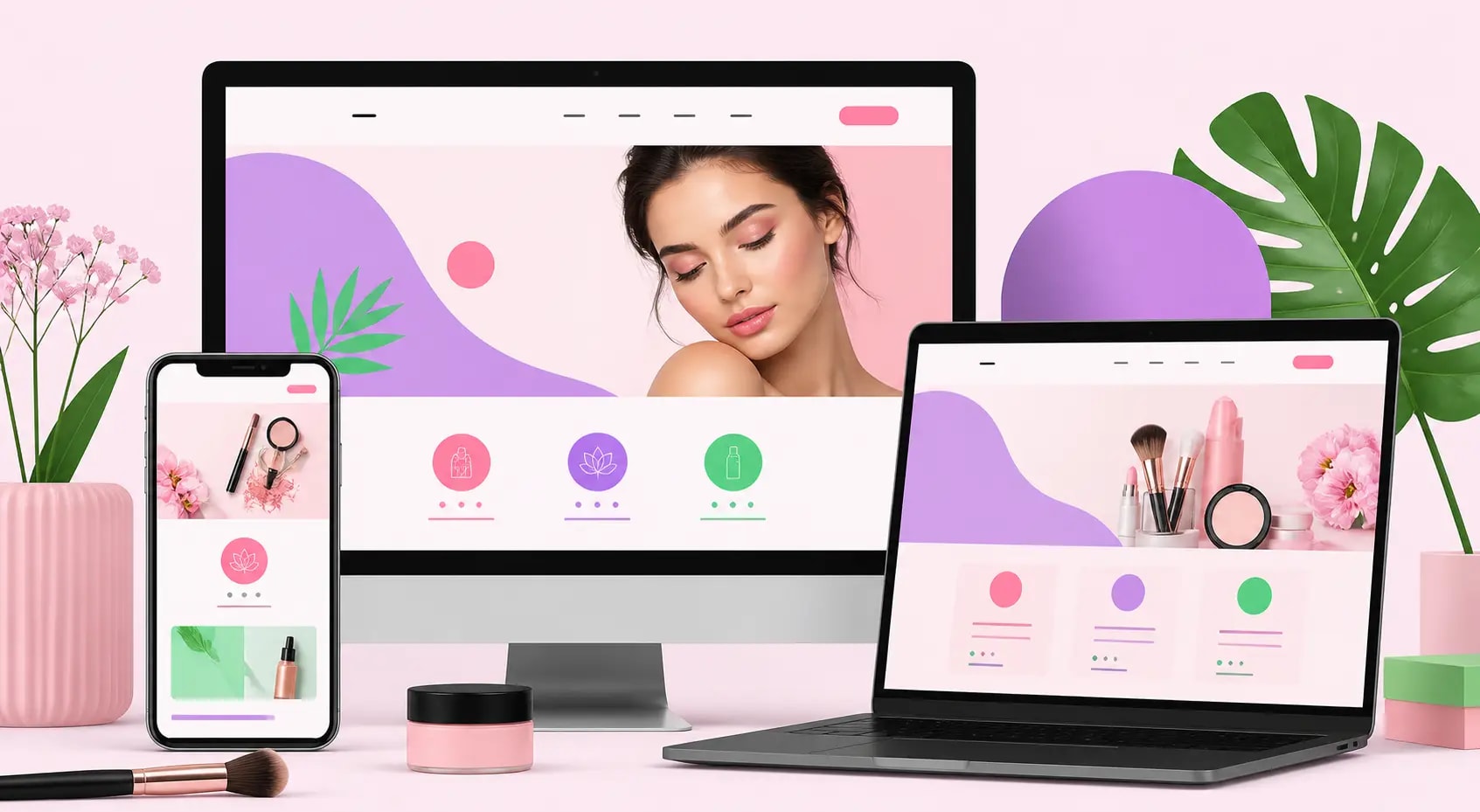
6. Mobile-First Responsive Design
More than 75% of beauty website traffic comes from mobile devices. Your website must be designed mobile-first meaning it is built for small screens and then scaled up, not the reverse. Every button, image, form, and menu must function flawlessly on smartphones and tablets.
7. Live Chat and Chatbot Integration
Potential clients have questions before they book. Live chat widgets or AI-powered chatbots allow you to capture leads and answer queries instantly, even outside business hours. This dramatically improves conversion rates for salons and spas.
8. Location Pages and Google Maps Integration
For local beauty businesses, location-specific pages with embedded Google Maps, your address, parking information, and directions are essential both for user experience and for local SEO performance.
What Are the Real Benefits of Investing in Professional Web Design for a Salon or Spa?
Many beauty business owners hesitate to invest in professional web design because they underestimate the return. The data tells a very different story. Here are the most compelling, measurable benefits:
Increased Online Bookings
A strategically designed beauty website with a streamlined booking flow can increase online appointment conversions by 30–60% compared to a DIY or template-based site. When friction is removed from the booking process, clients book it is that simple.
Improved Local Search Rankings
Professional web design goes hand-in-hand with technical SEO. A fast, well-structured, mobile-optimized website with properly configured local schema markup consistently outranks poorly built sites in Google's local results. Ranking in the top three of "hair salon near me" or "best spa in [city]" searches can transform your business.
Enhanced Brand Perception
Your website is your brand. A cohesive, beautifully designed site that reflects your salon's aesthetic through typography, color palette, photography, and layout positions you as a premium provider. Clients associate website quality with service quality. A stunning website commands higher price points and attracts higher-value clients.
24/7 Marketing and Lead Generation
Unlike Instagram posts or paid ads that have a shelf life, your website works around the clock. It ranks in search engines, captures leads through contact forms, educates potential clients about your services, and allows booking at any hour. This passive revenue generation is among the highest-ROI activities available to a beauty business.
Competitive Differentiation
The vast majority of salons and spas in any given market have mediocre websites. A genuinely outstanding, professionally designed website immediately sets you apart and creates a strong competitive moat that is very difficult for competitors to overcome quickly.
Reduced Administrative Burden
When clients can book, reschedule, and cancel online, and receive automated confirmation and reminder emails, your front desk staff spend less time on the phone and more time delivering exceptional service. This operational efficiency is a direct financial benefit of web investment.
What Are the Biggest Challenges Beauty Businesses Face with Web Design?
Understanding the obstacles helps you plan around them. Here are the most common challenges beauty brands encounter when building or redesigning their websites:
Balancing Beauty with Performance
Beauty websites are image-heavy by nature. Large, unoptimized photos and videos can cause devastating page load times. The challenge is to create a visually stunning site that also loads in under 2.5 seconds. This requires expert image optimization, lazy loading, content delivery networks (CDNs), and modern file formats like WebP.
DIY Website Syndrome
Many salon owners attempt to build their own websites on platforms like Wix or Squarespace. While these tools are accessible, the resulting sites almost always lack the technical SEO foundation, conversion optimization, and unique brand expression that drive real business results. They look generic and underperform in search.
Keeping Content Fresh
Beauty trends change constantly. Websites need regular updates new service offerings, seasonal promotions, updated team bios, fresh portfolio photos. Without a content management system (CMS) that is easy for non-technical staff to use, websites quickly become outdated.
Integrating Third-Party Booking Systems
Embedding booking platforms like Mindbody or Vagaro into a custom-designed website while maintaining a consistent visual experience can be technically complex. Poor integration leads to a jarring user experience where clients feel like they have left the website to complete their booking.
Local SEO Competition
In dense urban markets, ranking for local beauty-related search terms is highly competitive. Without a deliberate local SEO strategy built into the web design including optimized metadata, Google Business Profile integration, and local schema markup new websites struggle to gain visibility.
Privacy and Data Compliance
Beauty websites collect client data through booking systems, contact forms, and email sign-ups. Ensuring GDPR compliance (for European clients), CCPA compliance (for California), and proper cookie consent management requires technical attention that many DIY sites overlook entirely.
What Are the Best Practices for Designing a Beauty Industry Website in 2026?
The following best practices reflect the current state of the art in beauty web design and are aligned with what Google and AI-powered search systems now reward:
Adopt a Mobile-First Design Philosophy
Begin every design decision from the perspective of a smartphone user. Navigation menus should be thumb-friendly. Booking CTAs should be large and prominently placed. Images should be cropped and sized for vertical screens. Text should be legible without zooming.
Use Brand-Aligned Color Psychology
Color choices communicate brand personality before a word is read. Luxury spas often use deep jewel tones, gold accents, or rich blacks. Organic and natural beauty brands gravitate toward earth tones and soft greens. Med spas and cosmetic clinics lean toward clean whites and clinical blues. Your color palette must be deliberate and consistent across every page.
Invest in Professional Photography
Stock photos undermine authenticity. Beauty clients want to see your actual work, your real team, and your genuine environment. Budget for a professional photoshoot that captures your salon or spa in its best light. These images will pay for themselves many times over through increased conversions.
Optimize Page Speed Obsessively
Target a Google PageSpeed score of 90 or above on mobile. Compress all images, minimize CSS and JavaScript files, use a fast hosting provider, and implement caching. Every additional second of load time reduces conversions by approximately 7%.
Write for Humans First, Search Engines Second
Your website copy should speak directly to your ideal client's desires, fears, and aspirations. Then it should incorporate relevant keywords naturally. Copy that reads like a keyword list repels both humans and modern AI-powered search systems that understand semantic context.
Build a Clear Conversion Funnel
Every page of your website should have a clear purpose and a clear next step. A visitor landing on your facial treatments page should be guided from curiosity to interest to desire to action and that action should always be booking an appointment or contacting your team.
Implement Structured Data Markup
Schema.org structured data for local businesses, services, reviews, and FAQs helps Google and AI systems like Gemini and ChatGPT understand and display your content in rich, featured formats. This is increasingly critical for visibility in AI-powered search overviews.
Step-by-Step Guide: How to Build a High-Performing Beauty Business Website
- Define Your Brand Identity: Before touching a design tool, clarify your brand's mission, target client, visual aesthetic, and unique selling proposition. Everything that follows flows from this foundation.
- Conduct Competitor and Keyword Research: Analyze the top-ranking beauty websites in your area. Identify the keywords and content topics they rank for, and develop a strategy to compete and surpass them.
- Choose the Right Technology Stack: Select a CMS (WordPress with a page builder is the industry standard for flexibility and SEO), a hosting provider (cloud-based, fast, secure), and a booking integration that aligns with your operations.
- Develop Your Site Architecture: Plan your page structure before design begins. Essential pages include: Home, Services, Team, Gallery, About, Blog, Contact, and individual location pages for multi-location businesses.
- Create or Gather Brand Assets: Assemble your logo files, color codes, font selections, and photography. Commission a photoshoot if necessary.
- Design and Develop the Website: Work with a professional web designer or agency to create custom mockups, refine them based on feedback, and build the live site with full mobile responsiveness, booking integration, and SEO configuration.
- Write and Optimize All Content: Develop service pages, team bios, an About story, and initial blog content. Optimize each page for its target keyword cluster.
- Conduct Pre-Launch Quality Assurance: Test every page on multiple devices and browsers. Check all booking flows, forms, and integrations. Verify page speed scores and fix any performance issues.
- Launch and Submit to Google: Publish the site, submit the XML sitemap to Google Search Console, set up Google Analytics 4, and verify your Google Business Profile is linked and updated.
- Commit to Ongoing Optimization: Track performance weekly. Update content regularly. Add new portfolio images, blog posts, and service updates. Web design is not a one-time project it is an ongoing investment.
What Tools and Technologies Power the Best Beauty Websites?
| Category | Recommended Tools | Purpose |
|---|---|---|
| CMS Platform | WordPress, Webflow, Shopify | Website building and content management |
| Page Builder | Elementor Pro, Divi, Bricks Builder | Visual design and layout customization |
| Booking System | Fresha, Mindbody, Vagaro, Booksy, Acuity | Online appointment scheduling |
| SEO Tools | Yoast SEO, Rank Math, Ahrefs, SEMrush | On-page SEO optimization and keyword tracking |
| Performance | WP Rocket, Cloudflare CDN, NitroPack | Speed optimization and caching |
| Analytics | Google Analytics 4, Hotjar, Microsoft Clarity | Traffic tracking and user behavior analysis |
| Email Marketing | Mailchimp, Klaviyo, ActiveCampaign | Client retention and promotional campaigns |
| Live Chat | Tidio, Intercom, Zendesk | Real-time client communication |
| Photography | Adobe Lightroom, Canva Pro, Unsplash (where needed) | Image editing and visual content creation |
| Hosting | WP Engine, Kinsta, SiteGround, Cloudways | Fast, secure, and reliable website hosting |
How Do You Do SEO for Beauty Industry Websites?
Search engine optimization for beauty websites combines local SEO, on-page content optimization, and technical performance. Here is how it breaks down:
Local SEO: The Foundation of Beauty Business Visibility
The vast majority of beauty searches are local intent queries "hair salon near me," "eyebrow threading in [city]," "best massage spa [neighborhood]." Winning these searches requires:
- A fully optimized and active Google Business Profile with updated hours, photos, services, and consistent review responses
- Consistent NAP (Name, Address, Phone) information across your website, GBP, and all directory listings
- Location-specific pages for every city or neighborhood you serve
- Local citations in directories like Yelp, Booksy, Fresha, and industry-specific platforms
- Localized schema markup (LocalBusiness, BeautySalon, DaySpa) embedded in your website code
On-Page SEO for Service Pages
Each service you offer haircuts, balayage, facials, waxing, nail art, lash extensions, Botox deserves its own dedicated, fully optimized page. These pages should target specific, high-intent keywords, include detailed service descriptions, pricing information, FAQs, and internal links to your booking system.
Content Marketing: Blogging for Beauty SEO
A regularly updated blog positions your salon or spa as an authority and drives organic traffic from informational searches. Topics like "How long does balayage last?", "Benefits of a deep tissue massage," and "Best skincare routine for combination skin" attract potential clients who are in the research phase of their buying journey.
AI-Optimized Content for 2026
With Google's AI Overviews, ChatGPT search integration, and Gemini reshaping how people find information, beauty websites must now optimize for AI-powered search in addition to traditional algorithms. This means writing comprehensive, authoritative, well-structured content with clear headings, factual accuracy, and answers to the specific questions your potential clients are asking. WEBPEAK a full-service digital marketing company providing Web Development, Digital Marketing, and SEO services, has documented significant improvements in AI Overview visibility for beauty clients who prioritize structured, question-based content architecture on their websites.
Real-World Use Cases: Web Design Transformations in the Beauty Industry
Case Study 1: Luxury Day Spa Rebranding
A high-end day spa with an outdated website from 2018 was struggling to attract the premium clientele their services deserved. After a complete website redesign featuring professional photography, an immersive scrolling experience, an integrated booking flow, and a blog targeting high-value skincare keywords organic traffic increased by 187% within six months and average booking value increased by 42% as higher-income clients discovered them through search.
Case Study 2: Hair Salon Multi-Location Expansion
A hair salon group expanding from one to three locations needed a website architecture that could support multiple location pages, individual stylist profiles across locations, and centralized online booking. A custom WordPress site with location-specific SEO pages helped each new location rank on the first page of Google within 90 days of launch, contributing directly to profitable new client acquisition without relying entirely on paid advertising.
Case Study 3: Med Spa Lead Generation
A medical spa offering Botox, fillers, and laser treatments redesigned their website with conversion optimization as the primary goal. By adding a virtual consultation booking option, a before-and-after gallery with filter functionality, and detailed educational content about each treatment, they increased consultation bookings by 310% and achieved a 4.8x return on their web design investment within the first year.
Case Study 4: Independent Nail Studio Going Digital
A solo nail artist operating out of a home studio used a beautifully designed single-page website with Instagram portfolio integration, a clear booking link, and a waitlist signup feature to build a clientele of 200+ regular clients within eight months entirely through organic search and referral traffic from her website.
What Are the Future Trends in Beauty Industry Web Design for 2026 and Beyond?
AI-Powered Personalization
Beauty websites in 2026 are beginning to use AI to personalize the user experience in real time. Visitors are shown services, products, and promotions based on their browsing behavior, location, time of visit, and even their skin type or hair concerns gathered through brief interactive quizzes. This level of personalization significantly increases engagement and conversion rates.
Virtual Try-On Technology
Augmented reality (AR) virtual try-on tools are becoming increasingly accessible and affordable for beauty businesses. Salons can embed AR tools that allow visitors to visualize hair color changes, makeup looks, or even aesthetic treatments on their own uploaded photos directly within the website experience. This dramatically reduces the hesitation that prevents many potential clients from booking.
Voice Search Optimization
With smart speakers and voice assistants now deeply integrated into daily life, beauty businesses must optimize their websites for conversational, voice-based queries. This means targeting longer, question-based keyword phrases ("What is the best hair salon near downtown [city]?") and ensuring your business information is accurate and prominently structured for voice search retrieval.
Integration with Artificial Intelligence Services
From AI chatbots that handle initial client consultations to machine learning algorithms that analyze booking patterns and recommend staffing adjustments, AI integration into beauty website infrastructure is accelerating rapidly. Forward-thinking beauty brands are building websites that are not just digital brochures but intelligent business management tools.
Video-First Content Architecture
Short-form video content is rapidly becoming the dominant medium for beauty content consumption. Beauty websites are increasingly built around video embedding YouTube Shorts, Instagram Reels, and TikTok content directly into service pages and home pages to demonstrate techniques, showcase results, and build personality-driven brand connections.
Sustainable and Accessible Design
Two growing priorities in 2026: environmental sustainability (communicating eco-friendly practices through website design and content) and digital accessibility (ensuring websites meet WCAG 2.2 standards so they are usable by people with visual, motor, or cognitive disabilities). Both are increasingly important for brand reputation and regulatory compliance.
Headless CMS Architecture
Larger beauty brands and multi-location businesses are moving toward headless CMS architecture, which separates the content management backend from the front-end presentation layer. This enables faster performance, greater flexibility across different platforms (web, app, smart displays), and better scalability as the business grows.
Beauty Business Website Launch Checklist
- Brand identity defined: logo, colors, typography, photography style
- Domain name secured and hosting configured
- SSL certificate installed (HTTPS enforced)
- Mobile-first responsive design tested on iOS and Android
- All pages load in under 3 seconds (target: under 2 seconds)
- Online booking system integrated and tested end-to-end
- Service menu complete with descriptions, durations, and pricing
- Team profile pages complete with photos and bios
- Gallery or portfolio section populated with quality images
- Contact page with phone, email, address, and embedded map
- Google Business Profile linked and fully updated
- Google Analytics 4 and Google Search Console configured
- XML sitemap submitted to Google Search Console
- All meta titles and descriptions written and under character limits
- Schema markup (LocalBusiness, Services, Reviews) implemented
- Privacy policy and cookie consent banner in place
- Social media profiles linked and social sharing enabled
- Email marketing integration active with lead capture form
- 404 error page and redirect strategy configured
- Review generation system active (automated post-visit review requests)
Frequently Asked Questions About Web Design Services for the Beauty Industry
How much does a professional beauty industry website cost?
Professional beauty websites typically range from $2,500 to $15,000+ depending on complexity, custom features, and the agency's experience. Ongoing maintenance and SEO services add $300–$1,500 per month. The investment pays back rapidly through increased bookings and reduced reliance on paid advertising.
How long does it take to build a salon or spa website?
A well-executed beauty website project typically takes 6–12 weeks from initial discovery to launch. This includes strategy, design, development, content creation, booking integration, SEO configuration, and testing. Rushed timelines compromise quality and long-term performance.
Do I need a custom website or can I use a template?
Templates are faster and cheaper but rarely deliver the brand differentiation, SEO performance, or conversion optimization that a custom-designed beauty website achieves. If budget is limited, a professionally customized premium theme is a reasonable middle ground but avoid fully generic DIY builds for businesses serious about growth.
What is the best booking software to integrate into a beauty website?
Fresha is excellent for salons and spas due to its free-to-use model and strong client-facing features. Mindbody is ideal for wellness-focused businesses with complex scheduling needs. Vagaro offers great value for independent stylists. Booksy is widely trusted in the barber and hair salon market. The best choice depends on your specific business model and volume.
How does website design affect local SEO for beauty businesses?
Web design directly impacts local SEO through page speed, mobile usability, structured data markup, site architecture, and content quality all of which Google uses to rank local business websites. A poorly designed site structurally cannot rank well regardless of how much off-page SEO is invested.
Can a good website reduce my dependence on Instagram and paid ads?
Absolutely. A well-optimized beauty website ranking organically for local search terms generates a consistent stream of new client bookings with zero ongoing advertising cost. Many beauty businesses that invest in professional web design and SEO significantly reduce or eliminate their paid ad spend within 12–18 months.
Should my beauty website have a blog?
Yes, strongly recommended. A blog drives long-tail organic traffic, builds topical authority with search engines, answers client questions proactively, and provides shareable content for social media. Beauty blogs covering trends, tips, treatment guides, and product reviews consistently generate high-value search traffic that converts into bookings.