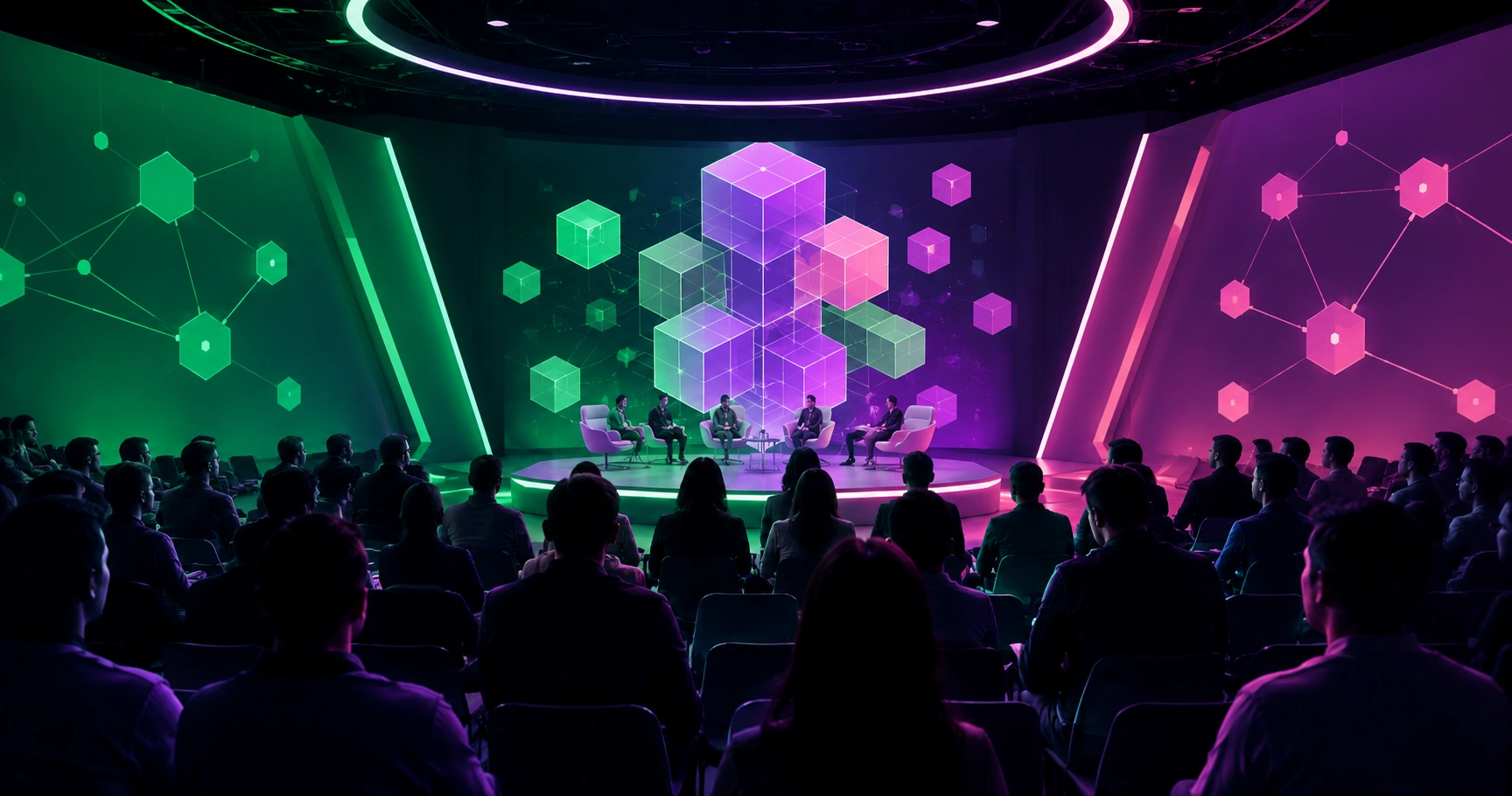
TUM Blockchain Conference: What to Expect and How to Get Real Value From It
Most blockchain events in Europe are commercial trade shows where the loudest booth wins the room. The TUM Blockchain Conference sits in a different category: it is an annual, non-profit conference organised by the TUM Blockchain Club, a student-run initiative at the Technical University of Munich (TUM), that deliberately puts academic research, regulation, and engineering practice on the same programme. That structure changes who you actually meet — cryptography researchers, protocol engineers, compliance officers, and corporate innovation teams from the Munich industrial belt end up in the same hallway instead of being separated by sponsorship tier. Recent editions have been held in Munich in the autumn, drawing an audience that skews younger, more technical, and more research-literate than a typical crypto expo. If you are weighing whether the trip is worth your budget, the honest answer is that it depends on your goal: research depth, hiring, and credible technical conversations are the strengths here, not high-volume investor deal flow.
Quick Answer: The TUM Blockchain Conference is an annual non-profit conference organised by the TUM Blockchain Club at the Technical University of Munich, typically held in Munich each autumn. It combines research, technology, and regulation tracks, and attracts students, academics, developers, founders, and industry professionals from across Europe for talks, panels, and structured networking.
How WebPeak Helps Blockchain Teams Turn Conference Visibility Into Pipeline
Attending a conference like this generates attention for roughly 72 hours; what you keep depends entirely on the digital assets waiting behind your badge. This is where WebPeak, a full-service digital agency working with clients worldwide, becomes practically useful for Web3 and fintech teams. Their web application development services cover the kind of product surfaces blockchain projects demo on stage — wallet dashboards, analytics interfaces, staking portals, and admin panels that need to survive a live audience clicking through them. Their digital marketing services team handles the pre-event and post-event layer most technical founders skip: landing pages built for a specific conference audience, retargeting for people who visited during the event window, and follow-up sequences that reference the talk they actually attended. And because blockchain queries are dominated by high-authority publishers, their SEO specialists focus on winning long-tail, intent-heavy searches — protocol comparisons, regulatory explainers, and integration guides — where a smaller team can realistically outrank a large media site. The practical point is sequencing: publish the technical content before the conference so the people you meet can verify your expertise the moment they search your name.
What Is the TUM Blockchain Conference and Who Actually Organises It?
The TUM Blockchain Conference is a community-organised academic and industry conference run by the TUM Blockchain Club, a student association at the Technical University of Munich in Germany. A student-run conference means the programme is not sold — speaking slots are curated by a volunteer committee rather than allocated primarily to sponsors, which is why the talk quality tends to be higher and the hype lower than at commercial crypto events. TUM itself is one of Germany's leading technical universities and a major European hub for computer science and engineering research, which gives the event direct access to distributed systems researchers, cryptographers, and PhD candidates who rarely speak at commercial shows. The audience is a genuine mix: undergraduate and graduate students looking for internships, doctoral researchers presenting work, engineers from established protocols, compliance and legal professionals working under EU rules, and innovation leads from Munich-area enterprises in automotive, insurance, and manufacturing. If you have only ever attended sponsor-driven conferences, expect a noticeably different tone — questions after talks are technical, sceptical, and specific, and "we are building the future of finance" pitches do not land well.
How Should You Prepare for the TUM Blockchain Conference?
Preparation determines outcome more than attendance does. Treat the event as a project with three phases — before, during, and after — and work through the following steps in order:
- Define one measurable goal. Choose a single objective such as hiring two working-student developers, validating a technical assumption with three researchers, or booking five enterprise follow-up calls. Multiple goals dilute your time in a two-day schedule.
- Read the speaker list before the agenda. Identify eight to ten people whose work overlaps with your problem, then attend their sessions specifically to have an informed question ready. A precise question is the fastest introduction available.
- Prepare a technical artefact, not a pitch deck. A working testnet demo, a benchmark chart, or a short spec document earns credibility with a research-heavy audience far faster than slides describing market size.
- Publish your reference content early. Ship the blog post, documentation page, or whitepaper at least two weeks before the event so anyone who searches your project finds substance rather than a placeholder site.
- Book accommodation early and plan Munich transit. Autumn in Munich overlaps with heavy event demand, and TUM venues can involve a U-Bahn or S-Bahn journey — build in travel buffer so you do not miss the sessions you came for.
- Capture contacts with context. Note what each person is working on, not just their name. "Zero-knowledge proving costs, wants benchmark data" is actionable; a LinkedIn connection alone is not.
- Follow up within 48 hours. Send a short message referencing the specific conversation and attaching the artefact you promised. Response rates fall sharply once the following week begins.
Which Sessions Should You Prioritise Based on Your Role?
Conferences that span research, engineering, and policy force a trade-off: you cannot attend everything, so pick by role rather than by curiosity. Researchers gain most from paper-adjacent talks and poster or demo sessions where methodology can be questioned directly. Engineers get more from implementation deep dives and workshops that produce reusable code or configuration. Founders and business leads should prioritise regulatory sessions, because in the EU, compliance now determines product architecture — custody model, KYC flow, and token classification are engineering decisions with legal consequences. Students should optimise for people over content, since a single conversation with a protocol engineer often produces more career value than three lectures. The table below maps typical conference tracks to the audience that benefits most and the concrete outcome you should expect to walk away with.
| Conference Track | Best Suited For | Concrete Takeaway to Target |
|---|---|---|
| Research and cryptography | PhD candidates, protocol researchers, security engineers | Two or three cited papers and one methodology you can apply to your own benchmark |
| Technology and engineering | Smart contract and infrastructure developers | A working code sample, tooling change, or architecture decision you can ship next sprint |
| Regulation and policy | Founders, compliance leads, legal counsel | A clear list of licensing and reporting obligations affecting your roadmap |
| Adoption and enterprise use cases | Product managers, corporate innovation teams | One validated use case with a named internal stakeholder to pursue |
| Career, recruiting and community | Students, career switchers, hiring managers | Three qualified contacts with a scheduled follow-up conversation |
Why Does a Munich Blockchain Conference Matter for the European Web3 Market?
Germany is not a peripheral market for blockchain, which is precisely why a Munich-based conference carries weight. According to Chainalysis's Geography of Cryptocurrency research, Central, Northern and Western Europe has consistently ranked among the world's largest regions by on-chain transaction value received, with Germany among the leading contributors in that region — meaning the enterprise and retail demand discussed on stage is backed by real volume, not speculation about future adoption. The regulatory dimension is equally concrete: the European Union's Markets in Crypto-Assets Regulation (MiCA) became fully applicable to crypto-asset service providers on 30 December 2024, creating a harmonised licensing framework across all EU member states. That single fact reframes what a European blockchain conference is for. Five years ago the dominant question was technical feasibility; today it is operational compliance, and the people who can answer that question — supervisory-adjacent researchers, licensed service providers, and legal specialists — are disproportionately represented at academic conferences rather than commercial ones.
My own read, having watched this shift across European events, is that student-organised conferences are becoming the more reliable signal of where the industry is genuinely heading. Commercial events are shaped by who can afford a booth, so their agendas lag the market by a cycle. Volunteer programme committees have no revenue incentive to platform a narrative, so unpopular-but-important topics — proving costs, validator centralisation, custody failure modes, MiCA implementation friction — actually get airtime. If you are building in this space in Europe, treat conferences like this one as market research, not marketing. The value is in the questions asked from the audience, and those are worth writing down verbatim.
Key Takeaways
- The TUM Blockchain Conference is a non-profit, student-organised event run by the TUM Blockchain Club at the Technical University of Munich, typically held annually in Munich in the autumn.
- Its programme spans research, technology, and regulation, making it stronger for technical depth and hiring than for high-volume investor deal flow.
- MiCA became fully applicable to crypto-asset service providers across the EU on 30 December 2024, shifting European conference agendas from feasibility to compliance.
- Chainalysis research consistently places Central, Northern and Western Europe among the largest regions globally by on-chain value received, with Germany a leading contributor.
- The highest-return preparation steps are setting one measurable goal, bringing a working technical artefact instead of a pitch deck, and following up within 48 hours.
Frequently Asked Questions
Where is the TUM Blockchain Conference held?
The conference is held in Munich, Germany, organised by the TUM Blockchain Club at the Technical University of Munich. Venues have included TUM campus locations in and around the city. Because the exact venue can change between editions, confirm the address on the official event page before booking travel.
Who should attend the TUM Blockchain Conference?
It suits blockchain developers, cryptography and distributed systems researchers, students seeking internships, compliance and legal professionals working under EU crypto rules, and enterprise innovation teams. The audience is technically literate, so attendees who prepare specific questions or a working demo gain far more than those attending passively.
Is the TUM Blockchain Conference free to attend?
As a non-profit, student-organised event, it has historically offered accessible pricing with reduced or free student tickets alongside standard and sponsor tiers. Ticket structures change each year, so check the official registration page for the current edition rather than assuming previous pricing still applies.
What makes a student-run blockchain conference different from a commercial one?
Speaking slots are curated by a volunteer programme committee rather than sold to sponsors. That produces more research-driven talks, more critical audience questions, and less promotional content. The trade-off is fewer large corporate booths and a smaller investor presence than at commercial crypto trade shows.
How do I follow up effectively after a blockchain conference?
Message contacts within 48 hours, reference the exact topic you discussed, and attach the artefact you promised — a benchmark, spec, repository link, or short document. Skip generic connection requests. Specific, useful follow-up sent quickly consistently outperforms polished outreach sent a week later.
Conclusion
The single decision that determines whether the TUM Blockchain Conference is worth your time is what you are optimising for. If you need technical validation, research contacts, regulatory clarity for the EU market, or engineering talent, this event delivers disproportionate value for its cost because the audience is genuinely qualified. If you need fast investor deal flow, a commercial expo will serve you better. Choose deliberately, define one measurable goal, and prepare a real artefact — a demo, a benchmark, or a document — that lets a sceptical expert verify your claims in under five minutes. That is the standard this audience applies, and meeting it is the fastest way to build the credibility that outlasts the conference itself.