Transform Your Marketing with a Customizable Quiz Funnel
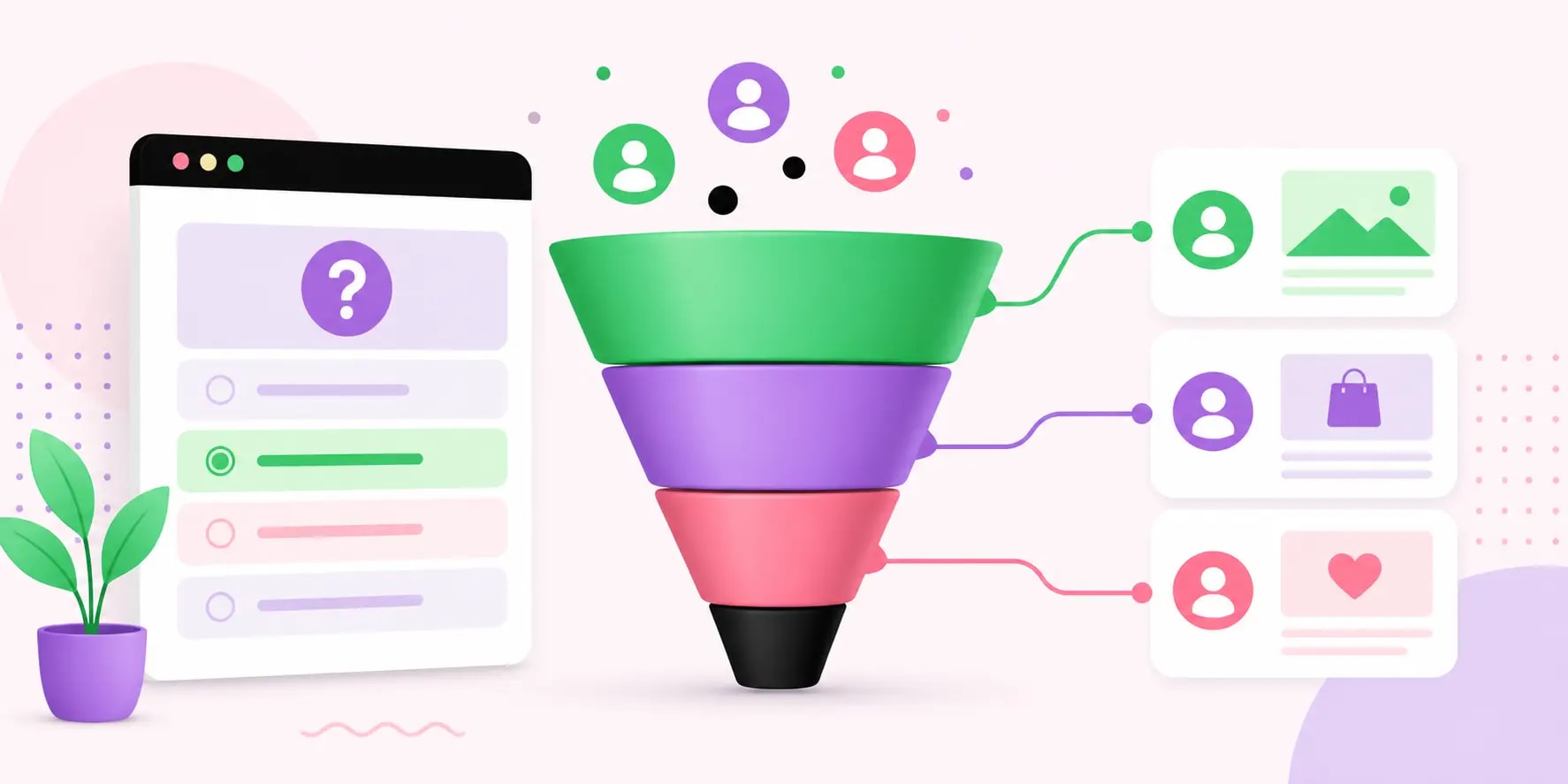
Most visitors who land on a website leave within seconds – not because the product is bad, but because nothing pulls them in. No connection, no conversation, no reason to stay. A quiz funnel [follow] changes that dynamic entirely. Instead of asking strangers to hand over their email for a generic PDF, it opens with a question they actually want to answer. And that one shift – from broadcasting to listening – makes all the difference.
Why a Quiz Funnel Outperforms Traditional Lead Generation
Traditional lead magnets ask for a lot upfront and give back something generic. A quiz marketing funnel flips that – it opens with a question, earns attention through interaction, and only then delivers a personalized result.
The Numbers Make the Case
Once someone clicks "Start," they're already invested. Interact's 2026 Quiz Conversion Rate Report puts the average completion rate at 65% and the overall lead conversion rate at 40.1% [no follow]– compared to the 2–5% typical of static landing pages. Beyond leads, quizzes collect what Forrester calls zero-party data: information users share willingly, which is increasingly rare as cookies disappear and privacy laws tighten.
Personalization Without the Manual Work
When quiz answers map to segments, everything downstream – emails, product recommendations, follow-up offers – fires automatically. The experience feels tailored to each user; the backend runs itself.
Real-World Example: The Cellcosmet Regimen Finder
A strong illustration of quiz funnel marketing in action comes from luxury Swiss skincare brand Cellcosmet. Rather than directing site visitors to a standard product catalog, the brand built a dedicated Cellcosmet Regimen Finder quiz [no follow] – placed prominently in the main navigation – that walks users through a short series of questions about their skin type, concerns, and lifestyle.
The quiz uses a feature called Product Slots, which recommends a complete regimen (not just a single product) based on each user's answers. That's a critical distinction: instead of sending someone to a filtered product grid, the quiz delivers a curated, named routine that feels like advice from a skincare expert.
According to a Visual Quiz Builder case study [no follow], analyzing the Cellcosmet implementation:
- The quiz was intentionally limited to 6–8 questions – research shows that completions and conversions drop sharply beyond that point
- Quiz takers are automatically added to a Klaviyo email list and receive their personalized regimen by email, opening a direct post-quiz nurture channel
- Participants are segmented by their quiz responses, allowing different email and SMS flows for different skin types and concerns
- Checkout tracking is installed so the brand can directly compare conversion rates from quiz-driven visitors versus general site traffic
This setup transforms the quiz into a 24/7 virtual skincare consultant – one that collects meaningful data, delivers immediate value, and hands warm leads directly into an automated follow-up system. Anyone interested in finding a regimen will self-select into the quiz, which means the traffic it captures is already high-intent.
Try It Yourself: Find Your Ideal Marketing Quiz Type
Before building your own quiz funnel, it helps to know which format fits your goals. Answer these four quick questions:
Q1. What is your primary marketing goal?
- A) Generate more email leads
- B) Recommend the right product to each visitor
- C) Qualify prospects before a sales call
- D) Educate my audience and build trust
Q2. How would you describe your typical customer?
- A) They know what problem they have, but don't know which solution fits
- B) They're browsing and need guidance to make a decision
- C) They're comparing options and need a reason to choose you
- D) They're new to the topic and need to understand their own situation first
Q3. How many products or services do you offer?
- A) One core offer
- B) 2–5 options
- C) A full catalog or range
- D) A service tailored case by case
Q4. Where will the quiz live?
- A) A dedicated landing page (paid traffic)
- B) My homepage or main navigation
- C) A blog post or content page
- D) Social media or email campaigns
Your Results:
- Mostly A's → Lead Generation Quiz: Focus on a compelling topic that solves a burning question. Use the results page to deliver a lead magnet and capture emails before revealing the full answer.
- Mostly B's → Product Recommendation Quiz: Map each question to specific product attributes. Use branching logic to narrow down options and present a curated set of recommendations.
- Mostly C's → Assessment Quiz: Design questions that score or evaluate the lead's situation. Use the results to segment by readiness and route high-intent prospects to a sales call CTA.
- Mostly D's → Knowledge Quiz: Prioritize educational value. Let users discover something meaningful about themselves, then position your content or service as the natural next step.
How to Build a Quiz Marketing Funnel That Actually Converts
Not every quiz converts. The ones that fail usually share a common problem: they feel like a survey rather than an experience. Here's what separates a high-performing quiz marketing funnel from one that bleeds traffic.
Start with the Right Question
The opening question – or the quiz title itself – does the heavy lifting. It needs to promise something specific and personally relevant. "What's your skin type?" is weak. "Which skincare routine will actually work for your skin in 2026?" is stronger because it implies a personalized answer with practical value.
The rule of thumb: if the quiz taker couldn't easily Google the answer, and if they'd genuinely want to know, the topic has legs.
Keep It Short, Make Every Question Count
A well-designed quiz marketing funnel typically runs between 5 and 10 questions. Each one should serve a purpose – either segmenting the user, warming them up psychologically, or building toward a recommendation. Questions that don't influence the result should be cut.
The three main categories worth including:
- Goal or preference questions – understand what the user is trying to achieve
- Situation questions – gather context about where they currently stand
- Behavioral questions – reveal how they make decisions or use products
The Results Page Is Where Conversions Happen
Many marketers over-invest in the quiz itself and underinvest in the results page. That's a mistake. The results page is where the user decides whether to take the next step. It should:
- Validate what the user just shared (make them feel understood)
- Deliver a specific, personalized recommendation – not a generic outcome
- Include a single, clear CTA tied directly to that recommendation
- Optionally offer an email gate before revealing results (for lead capture)
A well-built results page is what turns quiz completion into a sale. According to data cited by Marquiz's quiz marketing research [no follow], interactive content can increase conversion rates by up to 40% compared to static landing pages. The results page is where that uplift gets earned.
Quiz Funnel Tools, Integrations, and What to Look For
| Feature | Why It Matters |
|---|---|
| Conditional logic/branching | Personalizes the path based on each answer |
| Email platform integration | Automates follow-up without manual work |
| Result segmentation | Routes different outcomes to different sequences |
| Analytics & conversion tracking | Shows which questions drive drop-off or completion |
| No-code builder | Speeds up iteration without developer dependency |
| CRM sync | Adds lead data directly to your sales pipeline |
A platform like Visual Quiz Builder is commonly used for building a quiz funnel. The right choice depends on whether your primary use case is lead generation, e-commerce product recommendation, or B2B qualification – each platform has different strengths in these areas.
What matters most is that whatever tool is chosen, it connects cleanly to your email platform and your analytics so the data collected doesn't sit in a silo. The insight gathered through a quiz funnel is only useful if it flows into the right place.
Driving Traffic to Your Quiz Funnel
A quiz that no one sees converts no one. Traffic strategy matters just as much as the quiz design itself. The strongest channels for a quiz marketing funnel include:
- Paid social (Meta, TikTok): Quizzes are naturally shareable, and the promise of a personalized result can drive strong click-through rates on short-form video ads
- Organic search and blog content: Embedding a quiz inside a high-traffic blog post is one of the most underused tactics – users are already in research mode
- Email to existing list: Re-engaging dormant subscribers with a quiz often outperforms a standard promotional email
- Homepage placement: Like Cellcosmet's "Regimen Finder" in the main nav, making the quiz a core feature of your site puts it in front of high-intent visitors who are already exploring
What This Means for Your Marketing Strategy
A quiz funnel is one of the few marketing tools that genuinely benefits both sides at once. Visitors get a personalized experience that helps them make a decision; brands get accurate first-party data, segmented leads, and a conversion path that runs without constant management.
Whether the goal is growing an email list, recommending the right product, or qualifying prospects before a sales call, the underlying mechanic is the same – earn attention through a relevant question, then deliver enough value that the next step feels obvious.
The brands seeing the strongest results are those that treat the quiz not as a one-time campaign but as a permanent fixture in their funnel – something like Cellcosmet's Regimen Finder sitting in the main nav, working quietly around the clock.
Frequently Asked Questions
- How long should a quiz funnel be? The sweet spot is 5–10 questions. Completion rates drop noticeably beyond 8, so keep each question purposeful and directly tied to the result the user is waiting for.
- Should I gate the results behind an email opt-in? For lead generation, gating before results is standard – completers who opt in tend to be high-intent. For brand awareness, ungated results build trust faster. Many brands compromise with a soft gate: show a partial result, then ask for an email to unlock the full recommendation.
- Can quiz funnels work for B2B businesses? Yes. Assessment-style quizzes work well – something like "How ready is your team for X?" Routes high-scoring leads to a demo booking, sends mid-funnel leads into a nurture sequence, and automates the first stage of qualification.
- How do I know if my quiz funnel is performing well? Track three numbers: start rate, completion rate, and post-quiz conversion rate. A completion rate above 60% and an opt-in rate above 30% are solid benchmarks for a well-structured funnel.
- Do quiz funnels still work with shorter attention spans? Better than ever, actually. As generic content multiplies, interactive formats that feel personal cut through more effectively. The condition: the quiz must address something the audience genuinely wants to know –not a topic chosen for convenience.
Ready to put this into practice? Start by identifying one burning question your audience consistently asks – then build a quiz funnel around delivering the personalized answer. That alignment between curiosity and value is what drives the whole engine.