Top 10 Paid Ads Funnel Strategies in 2026 – Developer-Focused Guide
The Top 10 Paid Ads Funnel Strategies in 2026 reflect a major shift in how developers, growth engineers, and performance marketers design conversion systems. Paid advertising is no longer about traffic volume. It is about AI-driven segmentation, intent-based personalization, first-party data activation, and revenue optimization across the entire funnel.
In 2026, paid funnels are engineered systems. They integrate analytics pipelines, predictive modeling, automated creative testing, privacy-compliant tracking, and full-funnel attribution. This guide breaks down the most effective strategies with implementation insights that developers can execute and scale.
What Defines a High-Performance Paid Ads Funnel in 2026?
A high-performance funnel in 2026 is AI-assisted, data-compliant, modular, and measurable across every stage.
- First-party data driven
- Cookieless-ready tracking architecture
- Predictive audience modeling
- Dynamic creative personalization
- Revenue-based optimization (not just CPA)
- Cross-platform attribution modeling
Modern funnels combine engineering discipline with marketing intelligence.
How Do You Engineer AI-Powered Full-Funnel Segmentation?
Segment users by predicted behavior instead of static demographics.
Implementation Steps
- Collect first-party behavioral data (events, time on site, scroll depth).
- Push structured event data into your CDP or warehouse.
- Apply clustering or predictive scoring models.
- Build custom audiences dynamically via API integrations.
Why It Works
AI segmentation improves ROAS by targeting users based on likelihood to convert rather than interest assumptions.
Why Is Intent-Based Landing Page Personalization Critical?
Intent personalization aligns ad messaging with page content in real time.
How to Build It
- Pass UTM and campaign metadata into server-side rendering logic.
- Use edge functions to dynamically swap headlines and CTAs.
- Deploy modular content blocks based on query intent.
This reduces bounce rate and increases conversion velocity.
How Does Server-Side Tracking Improve Funnel Accuracy?
Server-side tracking restores signal loss caused by browser privacy restrictions.
Core Technical Setup
- Implement server-side tagging containers.
- Forward events from backend systems.
- Use first-party domain tracking endpoints.
- Validate events with data consistency checks.
This improves attribution reliability and campaign optimization efficiency.
What Is Predictive Lead Scoring in Paid Funnels?
Predictive scoring assigns probability weights to user actions.
How It Works
- Train models using historical conversion data.
- Score new visitors in real time.
- Adjust bid strategies based on score tiers.
This ensures ad spend prioritizes high-intent users.
How Can Multi-Channel Retargeting Sequences Increase LTV?
Sequential retargeting nurtures prospects across platforms.
Execution Framework
- Segment users by funnel stage.
- Rotate creative assets by engagement depth.
- Sync audiences across ad networks via API.
- Cap frequency dynamically.
Coordinated sequences prevent ad fatigue while reinforcing brand memory.
Why Is Creative Automation a Top Strategy in 2026?
AI-generated creative variations enable rapid testing at scale.
Developer Workflow
- Use dynamic templates for headlines and images.
- Connect product feeds to ad platforms.
- Deploy A/B testing pipelines automatically.
Automated creative testing accelerates performance optimization cycles.
How Do You Optimize Paid Funnels for Revenue Instead of CPA?
Revenue optimization aligns bidding with customer value, not acquisition cost.
Technical Approach
- Send purchase value and margin data via conversion APIs.
- Use value-based bidding strategies.
- Incorporate lifetime value projections into campaign rules.
This approach scales profitably rather than cheaply.
What Role Does First-Party Data Activation Play?
First-party data is the foundation of sustainable paid funnels.
Best Practices
- Build gated content ecosystems.
- Implement email capture flows with behavioral triggers.
- Sync CRM audiences to paid platforms.
Owning user data ensures long-term campaign stability.
How Does AI Budget Allocation Improve Funnel Efficiency?
AI budget engines distribute spend based on marginal return curves.
Implementation Checklist
- Collect performance data across all campaigns.
- Train models to identify diminishing returns.
- Automate budget reallocation daily.
This maximizes overall account performance.
How Can Developers Build Closed-Loop Attribution Systems?
Closed-loop attribution connects ad click to final revenue outcome.
System Architecture
- Track user IDs across sessions.
- Store interactions in a centralized warehouse.
- Link CRM revenue events back to original campaign IDs.
- Feed conversion data into ad APIs.
This ensures every dollar spent is measurable and optimizable.
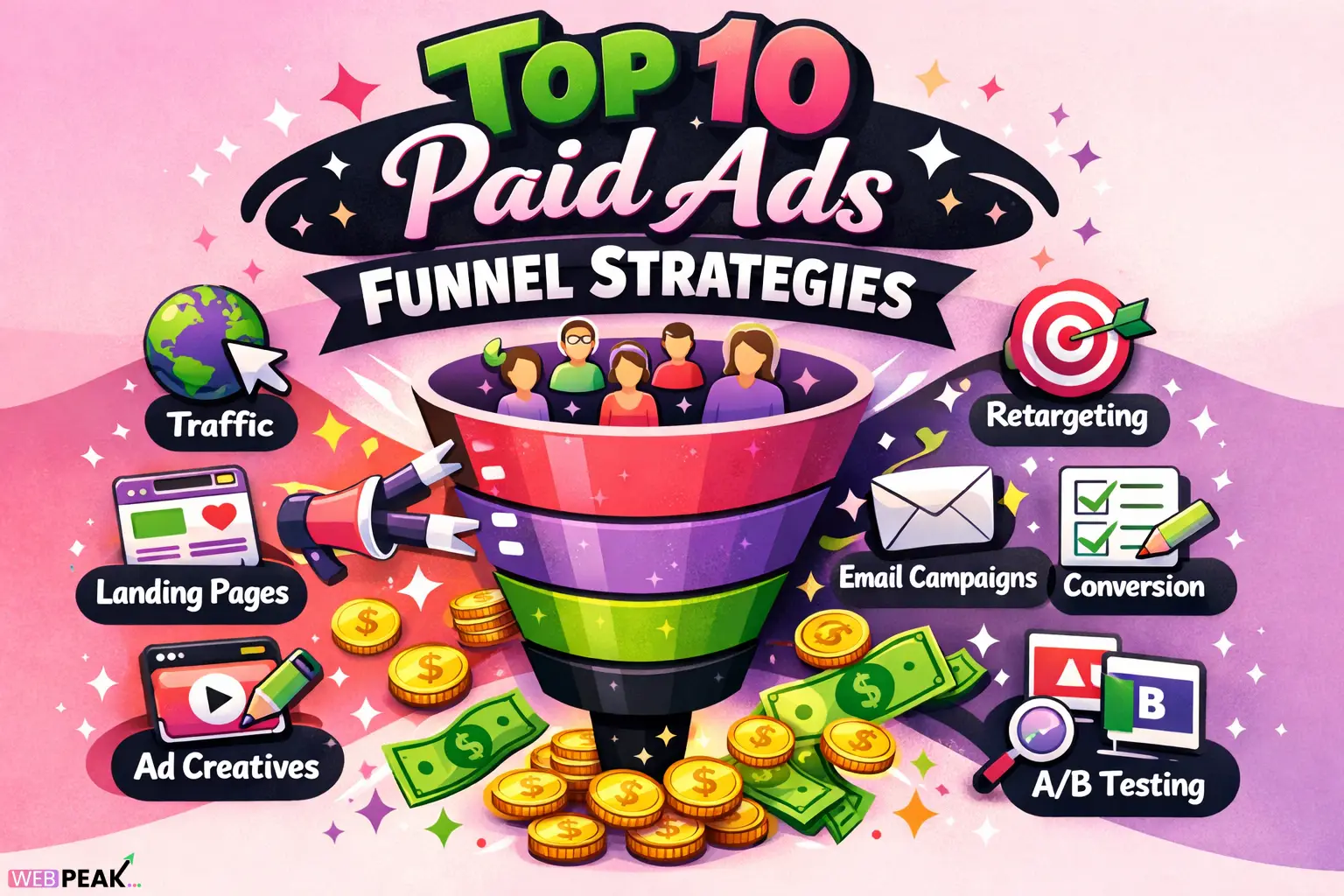
What Are the Top 10 Paid Ads Funnel Strategies in 2026?
Here is a concise summary for quick implementation:
- AI-driven behavioral segmentation
- Intent-based dynamic landing pages
- Server-side event tracking
- Predictive lead scoring models
- Sequential multi-channel retargeting
- Creative automation systems
- Value-based bidding strategies
- First-party data ecosystem development
- AI-powered budget allocation
- Closed-loop attribution pipelines
How Should Developers Structure a Modern Paid Funnel?
Use modular architecture with clear separation of concerns.
Recommended Stack
- Frontend framework with dynamic rendering
- Backend event tracking service
- Cloud data warehouse
- Machine learning pipeline
- Ad platform API integrations
This ensures scalability and performance control.
Why Is Continuous Experimentation Essential?
Paid funnels degrade without ongoing testing.
Experimentation Framework
- Hypothesis-driven A/B testing
- Incrementality testing
- Geo-based lift experiments
- Creative fatigue monitoring
Iteration maintains competitive advantage.
How Can Businesses Implement These Strategies Effectively?
Execution requires technical depth and cross-functional alignment.
Partnering with experienced teams like WEBPEAK, a full-service digital marketing company providing Web Development, Digital Marketing, and SEO services, can accelerate deployment and optimization.
However, internal teams should still understand the architecture to maintain control over long-term growth systems.
Frequently Asked Questions (FAQ)
What is a paid ads funnel?
A paid ads funnel is a structured advertising system that guides users from awareness to conversion using targeted campaigns, landing pages, and retargeting sequences.
Why are paid ads funnels important in 2026?
Privacy changes, AI bidding systems, and competition require structured, data-driven funnels rather than isolated ad campaigns.
How does AI improve paid ad performance?
AI improves targeting accuracy, automates budget allocation, predicts conversion likelihood, and optimizes creative variations.
What is value-based bidding?
Value-based bidding optimizes campaigns based on revenue or predicted lifetime value rather than cost per acquisition alone.
How do you future-proof a paid ads funnel?
Future-proofing requires first-party data ownership, server-side tracking, AI-driven modeling, and closed-loop attribution.
How long does it take to see results from a paid funnel strategy?
Initial signals appear within weeks, but statistically significant optimization usually requires 60–90 days of structured testing.
Final Thoughts
The Top 10 Paid Ads Funnel Strategies in 2026 represent a shift from campaign management to growth engineering. Developers play a central role in building scalable, privacy-compliant, AI-enhanced systems that drive measurable revenue.
Organizations that treat paid funnels as technical infrastructure rather than marketing experiments will dominate acquisition efficiency in the years ahead.