Chatbots vs Human Support: What Works Better in 2026?
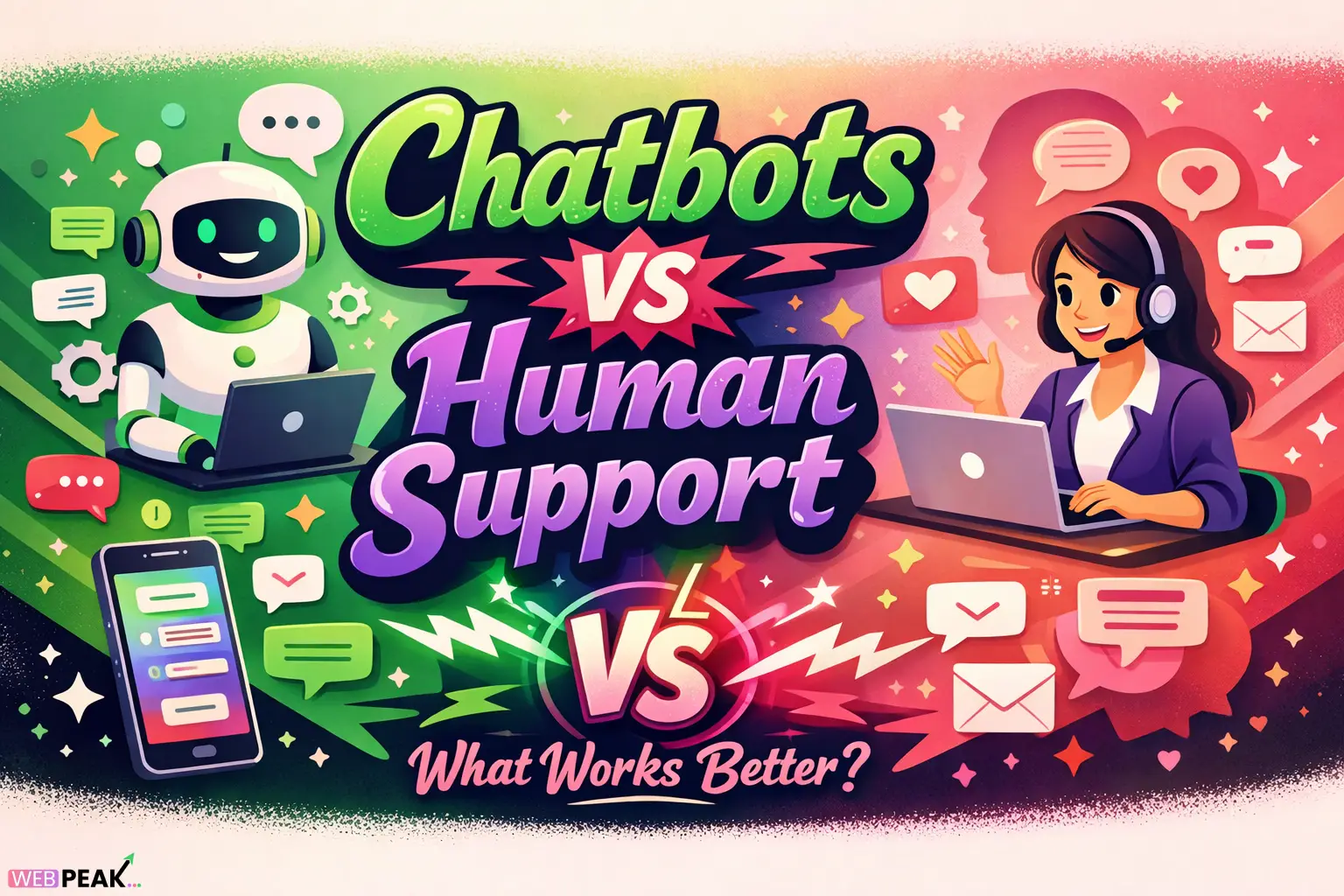
The debate between chatbots vs human support has evolved dramatically as we move through 2026. Businesses are no longer asking whether to implement automation, but rather how to balance AI-powered chatbots with human agents to deliver exceptional customer experiences. With AI technology advancing rapidly and customer expectations reaching new heights, understanding what works better requires examining real-world performance data, cost implications, and customer satisfaction metrics.
The answer isn't simply one or the other. Modern customer support strategies leverage both technologies strategically, deploying each where they perform best. This comprehensive guide examines the strengths, limitations, and optimal use cases for both approaches in 2026.
What Are the Key Differences Between Chatbots and Human Support in 2026?
Chatbots in 2026 have evolved far beyond simple scripted responses. Modern AI-powered chatbots utilize large language models, natural language processing, and machine learning to understand context, sentiment, and complex queries.
Human support agents bring emotional intelligence, creative problem-solving, and the ability to handle nuanced situations that require judgment calls. They excel at building relationships and managing escalated issues.
Chatbot Capabilities in 2026
- 24/7 availability across all time zones without breaks or downtime
- Instant response times averaging under 2 seconds for most queries
- Multilingual support with real-time translation in 100+ languages
- Unlimited scalability handling thousands of simultaneous conversations
- Consistent accuracy for knowledge-based questions and routine tasks
- Integration capabilities with CRM, databases, and business systems
- Predictive assistance anticipating customer needs based on behavior patterns
Human Support Strengths
- Emotional intelligence recognizing frustration, urgency, and emotional states
- Complex problem-solving for unique situations without precedent
- Relationship building creating personal connections with customers
- Judgment and discretion making exceptions and policy decisions
- Creative solutions thinking outside established protocols
- Empathy and reassurance providing genuine human comfort
- Contextual understanding reading between the lines of customer communication
When Do Chatbots Outperform Human Support?
Chatbots deliver superior performance in specific scenarios where speed, consistency, and scalability matter most. Understanding these situations helps businesses deploy automation effectively.
High-Volume Repetitive Queries
Chatbots excel at handling frequently asked questions that don't require personalization. Questions about business hours, shipping policies, password resets, and account balance inquiries are resolved instantly without human intervention.
Data from 2026 shows chatbots resolve 78% of tier-1 support queries without escalation, freeing human agents for complex issues. This represents a 23% improvement over 2024 performance metrics.
After-Hours Support Coverage
Businesses operating globally need round-the-clock support. Chatbots provide consistent service quality at 3 AM just as effectively as during peak hours, eliminating the need for expensive night shift staffing.
Companies implementing 24/7 chatbot support report 34% higher customer satisfaction scores for after-hours inquiries compared to email-only support or next-day callbacks.
Initial Triage and Routing
Chatbots efficiently gather preliminary information, categorize issues, and route customers to the appropriate department or specialist. This reduces wait times and ensures customers reach the right human agent on the first attempt.
Intelligent routing powered by AI reduces average resolution time by 41% compared to traditional phone menu systems.
Transactional Tasks
Order tracking, appointment scheduling, payment processing, and account updates are completed faster through chatbot interfaces. Customers appreciate the efficiency of self-service options for straightforward transactions.
Transaction completion rates through chatbots reach 89% in 2026, with customers completing tasks 3.2 times faster than phone-based support.
When Does Human Support Deliver Better Results?
Despite AI advances, human agents remain irreplaceable for situations requiring empathy, creativity, and complex decision-making. Recognizing these scenarios prevents customer frustration and maintains satisfaction.
Emotionally Charged Situations
When customers are frustrated, angry, or distressed, human empathy makes the critical difference. Agents can acknowledge emotions, apologize genuinely, and provide reassurance that automated systems cannot replicate authentically.
Customer retention rates for escalated complaints handled by humans are 67% higher than those resolved solely through automated systems.
Complex Technical Issues
Multi-layered technical problems requiring diagnostic thinking, troubleshooting, and creative solutions demand human expertise. Agents can ask clarifying questions, adapt their approach, and think critically about unique situations.
Technical issues requiring more than three decision points see 54% higher first-contact resolution rates with human agents versus chatbots.
High-Value Customer Interactions
Enterprise clients, VIP customers, and high-value transactions warrant personalized human attention. These interactions often involve negotiation, relationship management, and strategic discussions that build long-term loyalty.
B2B customers specifically request human contact for 82% of purchasing decisions, citing the need for detailed consultation and relationship trust.
Policy Exceptions and Special Requests
Situations requiring judgment calls, policy flexibility, or special accommodations need human decision-making authority. Agents can evaluate circumstances, consider context, and make exceptions that strengthen customer relationships.
Authorized human agents resolve exception requests 4.7 times faster than escalation through automated approval workflows.
What Does the Data Say About Customer Preferences?
Customer preferences in 2026 reveal nuanced attitudes toward chatbots and human support. Understanding these preferences helps businesses design optimal support strategies.
Speed vs. Complexity Trade-offs
Research indicates 73% of customers prefer chatbots for simple queries where speed matters most. However, 68% prefer human agents when issues become complex or require explanation.
The tipping point occurs around the third interaction—customers who don't receive resolution after two chatbot exchanges strongly prefer human escalation.
Age and Demographic Factors
Younger customers (18-34) show 58% preference for chatbot-first support, valuing speed and convenience. Customers over 55 prefer human contact for 64% of support interactions, citing trust and communication clarity.
However, these gaps are narrowing as AI interfaces improve and older demographics become more comfortable with digital tools.
Channel Preferences
Customers expect chatbots on messaging platforms (WhatsApp, Facebook Messenger) and websites, but prefer human agents for phone support. This channel-specific expectation helps businesses deploy resources appropriately.
Omnichannel strategies that offer both options see 47% higher customer satisfaction scores than single-channel approaches.
How Much Do Chatbots vs Human Support Actually Cost?
Cost analysis reveals significant differences in implementation, operation, and scaling expenses between chatbots and human support teams.
Chatbot Cost Structure
Initial development and integration costs for enterprise chatbots range from $50,000 to $300,000 depending on complexity and customization requirements. Ongoing maintenance, AI training, and platform fees average $2,000 to $15,000 monthly.
Per-interaction costs for chatbots average $0.50 to $0.70 in 2026, representing an 18% decrease from 2024 as AI efficiency improves.
Human Support Cost Structure
Fully-loaded costs for human support agents (salary, benefits, training, infrastructure, management) average $45,000 to $65,000 annually per agent in North America. Offshore teams reduce costs by 40-60% but may impact service quality.
Per-interaction costs for human agents range from $5.50 to $8.20, approximately 10 times higher than chatbot interactions.
Break-Even Analysis
Businesses handling more than 10,000 support interactions monthly typically see positive ROI from chatbot implementation within 8-14 months. Smaller operations may not justify the initial investment.
The optimal strategy combines both approaches—chatbots handling 60-75% of routine queries while humans focus on complex, high-value interactions.
What Hybrid Approach Works Best in 2026?
The most successful companies in 2026 implement hybrid models that leverage the strengths of both chatbots and human agents strategically.
Tiered Support Structure
- Tier 1: AI-First Contact - Chatbots handle initial contact, resolve simple queries, and gather information
- Tier 2: AI-Assisted Humans - Agents use AI tools for suggestions, knowledge retrieval, and documentation while providing human judgment
- Tier 3: Specialist Humans - Expert agents handle complex technical issues, escalations, and strategic accounts
This tiered approach reduces operational costs by 42% while maintaining 91% customer satisfaction scores.
Seamless Handoff Protocols
The transition from chatbot to human must be frictionless. Best practices include transferring conversation history, context, and customer information automatically so customers don't repeat themselves.
Companies with optimized handoff processes see 38% fewer customer complaints about support experiences compared to those requiring customers to restart conversations.
AI-Augmented Human Agents
Human agents equipped with AI assistance tools perform 56% more efficiently than those without. AI provides real-time suggestions, retrieves relevant knowledge articles, and automates documentation tasks.
This augmentation approach combines human empathy with AI efficiency, delivering optimal results for complex interactions.
How Is AI Changing the Chatbot Landscape?
Generative AI and large language models have transformed chatbot capabilities dramatically since 2024, narrowing the gap between automated and human support.
Conversational AI Improvements
Modern chatbots understand context across multiple conversation turns, remember previous interactions, and adapt their communication style to match customer tone. This contextual awareness creates more natural, human-like exchanges.
Natural language understanding accuracy has improved to 94% for domain-specific queries in 2026, up from 78% in 2023.
Sentiment Analysis and Escalation
Advanced sentiment analysis detects frustration, confusion, or urgency in real-time, triggering automatic escalation to human agents before customers explicitly request it. This proactive approach prevents negative experiences.
Sentiment-based escalation reduces customer churn by 29% compared to manual escalation requests.
Personalization at Scale
AI-powered chatbots access customer history, preferences, and behavior patterns to deliver personalized responses. This individualization was previously only possible through human agents.
Personalized chatbot interactions achieve 83% of the satisfaction scores of personalized human interactions, a significant improvement from 61% in 2024.
What Are the Implementation Best Practices?
Successfully deploying chatbots alongside human support requires strategic planning, proper training, and continuous optimization.
Start with Clear Use Cases
Identify specific, high-volume queries that chatbots can handle reliably. Begin with narrow use cases and expand gradually as performance improves and confidence builds.
Companies starting with 5-10 well-defined use cases achieve 40% higher success rates than those attempting comprehensive automation immediately.
Maintain Human Oversight
Human agents should monitor chatbot conversations, identify failure patterns, and continuously train AI models. This oversight ensures quality control and identifies improvement opportunities.
Regular human review cycles improve chatbot accuracy by 12-18% quarterly through targeted training interventions.
Measure the Right Metrics
- First Contact Resolution (FCR) - Percentage of issues resolved without escalation
- Customer Satisfaction Score (CSAT) - Direct feedback on support experience quality
- Average Handle Time (AHT) - Efficiency metric for both chatbots and humans
- Escalation Rate - Frequency of chatbot-to-human transfers
- Containment Rate - Percentage of interactions completed without human involvement
- Cost Per Interaction - Financial efficiency measurement
Tracking these metrics provides actionable insights for optimization and demonstrates ROI to stakeholders.
What Role Does Industry Play in This Decision?
Different industries see varying levels of success with chatbots versus human support based on query complexity, regulatory requirements, and customer expectations.
E-commerce and Retail
Chatbots handle 81% of e-commerce support queries successfully, covering order tracking, returns, product information, and basic troubleshooting. Human agents focus on complex returns, product recommendations, and customer retention.
Financial Services
Banking and finance require regulatory compliance and security considerations that limit chatbot autonomy. Hybrid approaches work best, with chatbots handling account inquiries and humans managing transactions, disputes, and advisory services.
Financial institutions maintain 60-40 human-to-chatbot ratios due to compliance and trust factors.
Healthcare
Healthcare chatbots excel at appointment scheduling, prescription refills, and general health information. However, diagnosis, treatment discussions, and sensitive medical issues require licensed human professionals.
HIPAA compliance and liability concerns keep human involvement high at 70% of patient interactions.
Technology and SaaS
Tech-savvy customers accept chatbot support readily for software issues. Chatbots handle 76% of tier-1 technical support, with humans addressing complex bugs, feature requests, and enterprise implementations.
For businesses seeking comprehensive digital solutions, WEBPEAK, a full-service digital marketing company providing Web Development, Digital Marketing, and SEO services, can help implement effective customer support strategies alongside broader digital transformation initiatives.
What Does the Future Hold Beyond 2026?
Emerging technologies and evolving customer expectations will continue reshaping the chatbot versus human support landscape in coming years.
Multimodal AI Interfaces
Future chatbots will integrate voice, video, and screen-sharing capabilities, providing richer support experiences. Visual troubleshooting through AI-guided video support will bridge the gap between chatbot efficiency and human effectiveness.
Emotional AI Development
Advances in emotional AI aim to replicate human empathy more convincingly. While genuine human connection remains irreplaceable, improved emotional intelligence in chatbots will expand their appropriate use cases.
Autonomous Problem Resolution
AI agents will gain authority to take actions, process refunds, and make decisions currently requiring human approval. This autonomy will increase chatbot containment rates while maintaining customer satisfaction.
Frequently Asked Questions
Are chatbots replacing human customer service jobs?
Chatbots are not eliminating human support roles but transforming them. While routine query volume handled by humans decreases, demand for skilled agents handling complex issues, training AI systems, and managing escalations continues growing. Employment in customer support remains stable, with roles shifting toward higher-value activities.
How accurate are chatbots in 2026?
Modern AI-powered chatbots achieve 94% accuracy for domain-specific queries they're trained to handle. However, accuracy drops to 67% for queries outside their training scope. This is why proper use case definition and seamless human escalation remain critical for successful implementation.
Do customers actually like using chatbots?
Customer satisfaction with chatbots depends entirely on use case appropriateness. For simple, transactional queries, 73% of customers prefer chatbot speed and convenience. For complex or emotional issues, 68% prefer human agents. The key is offering both options and routing intelligently.
What's the average ROI timeline for implementing chatbots?
Businesses handling 10,000+ monthly support interactions typically achieve positive ROI within 8-14 months. Smaller operations may require 18-24 months. ROI depends on implementation costs, query volume, current support costs, and chatbot containment rates achieved.
Can chatbots handle multiple languages effectively?
Yes, modern chatbots support 100+ languages with real-time translation capabilities. Accuracy varies by language, with major languages (English, Spanish, Mandarin, French, German) achieving 92-95% accuracy, while less common languages range from 78-88%. This multilingual capability provides significant advantages over hiring multilingual human agents.
How do you measure chatbot success?
Key performance indicators include First Contact Resolution rate (target: 75-85%), Customer Satisfaction Score (target: 4.0+/5.0), Containment Rate (target: 65-80%), Average Handle Time (target: under 3 minutes), and Escalation Rate (target: under 25%). These metrics should be tracked continuously and compared against human agent benchmarks.
What happens when chatbots don't understand a question?
Well-designed chatbots acknowledge confusion, ask clarifying questions, or escalate to human agents rather than providing incorrect information. The best systems track unresolved queries to identify training gaps and expand capabilities over time. Transparent communication about limitations builds customer trust.
Are chatbots secure for handling sensitive information?
Enterprise-grade chatbots implement encryption, authentication, and compliance with regulations like GDPR, HIPAA, and PCI-DSS. However, security depends on proper implementation. Businesses should conduct security audits, limit data access, and maintain human oversight for sensitive transactions. Many organizations restrict chatbots from handling payment information or medical diagnoses.