


The Lead to Job Conversion Stack for Appliance Repair Businesses
Getting more leads sounds like the answer until you look closely at how appliance repair companies actually lose money. In our experience, the bigger issue is not always demand. It is what happens after a customer calls, fills out a form, or sends a message asking for help. A business can show up well in search, run paid ads, and still leave booked revenue on the table because the path from first contact to completed job feels messy. That is where a real conversion stack matters. It gives the office a process, gives technicians better information, and gives customers a smoother reason to say yes.
That gap matters because this is still a busy and competitive market. IBISWorld estimates the U.S. appliance repair industry will reach $7.4 billion in 2026 with 37,453 businesses operating in the category. At the same time, BrightLocal reports that 97% of consumers read reviews for local businesses, while Google says customers are 2.7 times more likely to see a business as reputable when its Business Profile is complete. On the paid side, LocaliQ found that 69% of home services businesses saw cost per lead rise year over year in its 2025 benchmark report. Put together, those numbers tell a simple story. Demand exists, trust matters before the call starts, and every wasted lead costs more than it used to.
Why appliance repair leads stall before they become jobs
A lot of repair shops treat conversion like a closing skill. We think that is too late. Conversion starts the second a frustrated customer looks for help with a warm refrigerator, a washer that will not drain, or an oven that quit before dinner. By the time that person reaches out, they do not want a long sales pitch. They want clarity. They want speed. They want to feel like somebody knows what to do next.
That is why weak intake causes so much hidden damage. When the office only grabs a name and phone number, the team is forced to fill in the rest later. The customer gets another call. The technician heads out without the full picture. The schedule slips. A job that looked easy becomes a second visit or a cancellation. None of that shows up neatly in a marketing report, but it shows up in lost time, lower close rates, and stressed employees.
A second problem is response delay. Appliance repair is often an urgent purchase. People compare options quickly, and the business that feels easiest to work with usually wins. Fast response does not mean rushing through the conversation. It means answering clearly, collecting the right information the first time, and moving that lead into a real appointment while the customer is still ready to act.
The last common issue is the disconnect between the front office and the field. If dispatch is based on thin notes, technicians walk into jobs half prepared. That leads to wrong parts, bad time windows, and avoidable callbacks. A booked job is not truly a win if the process behind it is clumsy enough to damage the customer experience.
What the lead to job conversion stack should actually include
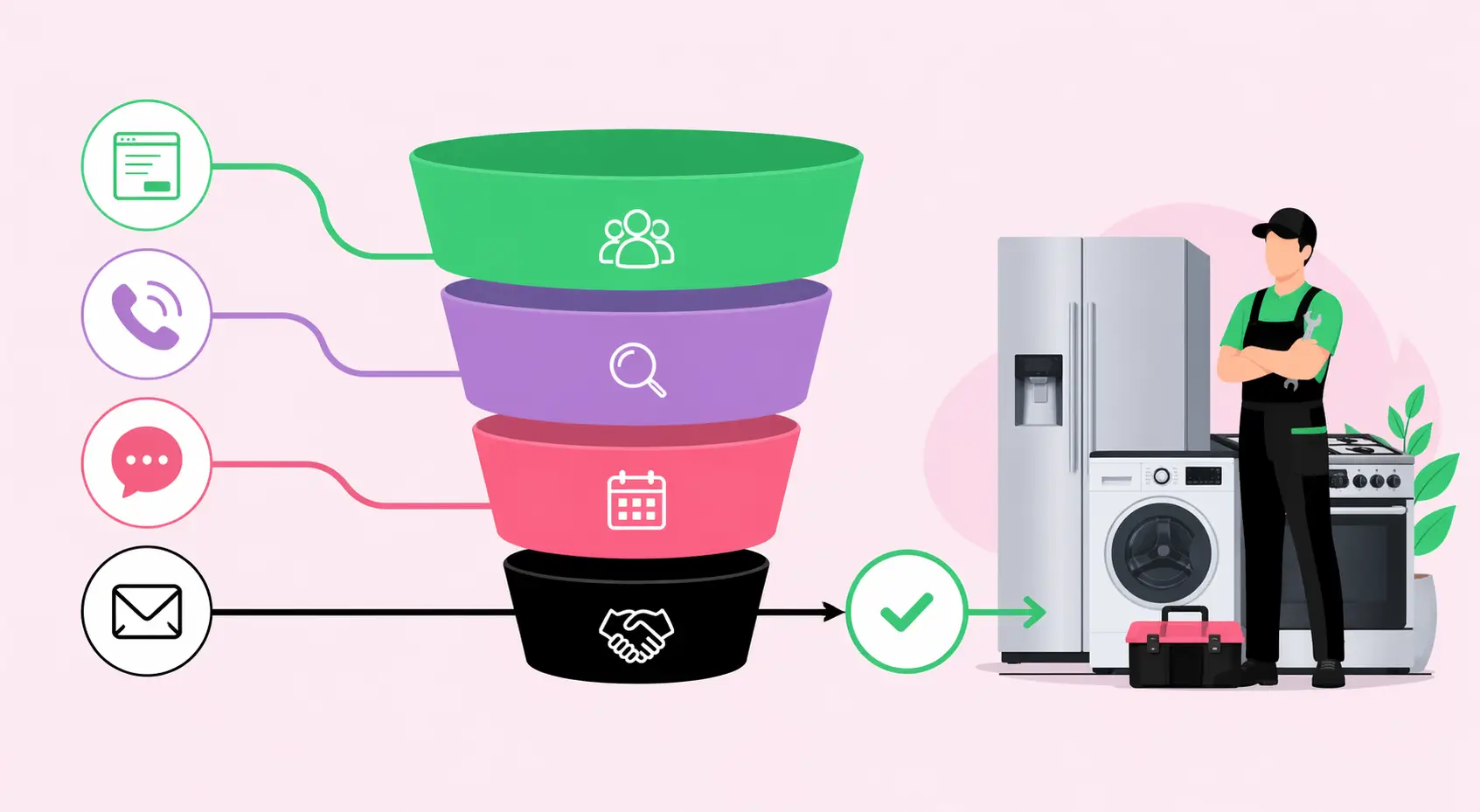
A good stack is not fancy. It is just complete. Each part of the process should answer one question for the next part. Where did the lead come from? What appliance is involved? What is the likely issue? Who should take the job? When can the team get there? What happens after the visit? When that chain is clear, growth gets easier because the business stops depending on memory, paper notes, and random follow ups.
The first layer is lead capture. Calls, forms, texts, and chat requests should feed into one system. That keeps the office from bouncing between tabs and trying to figure out whether someone already responded. One place for every inquiry sounds obvious, but it removes a shocking amount of friction.
The second layer is intake. This is where too many businesses get lazy. Good intake should collect the appliance type, brand, model when possible, issue description, address, urgency, and scheduling preferences. Those details do more than save time. They make the next step smarter. Dispatch improves when the office knows whether the technician should prepare for a likely control board issue, a drainage problem, or a sealed system job.
The third layer is scheduling. We do not see scheduling as a calendar exercise. We see it as the point where intent becomes commitment. If the office gives vague windows or books jobs without considering route logic, the day starts behind before a single van leaves the lot. Tight scheduling protects both the customer experience and the technician’s time.
The fourth layer is dispatch. This is where office promises become field reality. Dispatch has to put the right technician on the right job with the right notes. When it fails, every earlier step loses value. A bad dispatch process can make good marketing look bad and make skilled technicians seem disorganized when the real problem started earlier.
The final layer is closeout. A lot of shops stop paying attention once the work is finished, but that leaves future revenue behind. Fast invoicing, clear payment collection, and a review request should all feel like part of the same process. That is how one completed repair helps create the next call.
A practical view of where software helps
We do not think software deserves the credit for fixing broken operations by itself. What it can do is remove the gaps that let leads slip away in the first place. That is why software matters most in the middle of the process, not just at the end when the invoice gets sent.
For appliance repair businesses, that means the system should connect the customer record, intake notes, appointment booking, technician updates, and payment flow without making the office repeat the same work three times. When that connection is weak, the team loses hours to chasing details. When that connection is clean, speed improves almost by default.
That is also where appliance repair business software belongs in the article naturally. Smarfle CRM can help an appliance repair team keep lead details, scheduling, dispatch notes, and invoicing tied together inside one workflow instead of splitting the job between spreadsheets, text messages, and memory. Used the right way, it supports faster booking and cleaner handoffs without adding extra admin work.
We also like software most when it supports discipline, not chaos. If the office captures strong intake and the team already values follow through, the right system makes those habits easier to repeat. If the underlying process is sloppy, the software just digitizes the sloppiness. That is why we would frame it as part of a stack, not as a magic answer.
What strong and weak conversion systems look like
The difference becomes obvious when you compare a weak workflow with a healthy one. The table below shows how small process choices shape revenue.
| Stage | Weak workflow | Strong workflow |
|---|---|---|
| First contact | Call goes to voicemail or sits in a queue | Office responds quickly and captures the lead right away |
| Intake | Only name and number are saved | Appliance type, issue, model, location, and urgency are recorded |
| Scheduling | Broad windows with no route logic | Realistic appointment windows tied to technician availability |
| Dispatch | Technician gets thin notes | Technician gets full job context before leaving |
| Closeout | Invoice sent later, review request forgotten | Payment and review request happen as part of one closeout flow |
That table is simple, but it shows the point. Better conversion rarely comes from one dramatic tactic. It usually comes from removing five or six small leaks that keep repeating.
The numbers worth tracking every week
Not every metric deserves attention. We would rather watch a short list that points to real action. Reader friendly reporting should help an owner spot the next fix, not bury the team in noise.
| Metric | What it shows | What to do if it is weak |
|---|---|---|
| Lead response time | How fast the office reacts to new inquiries | Tighten call coverage and follow up rules |
| Call to booking rate | How many leads turn into appointments | Improve intake script and booking confidence |
| First visit completion rate | How often the issue is solved on visit one | Improve job notes, parts prep, and dispatch quality |
| Time to invoice | How fast completed work turns into collected revenue | Simplify closeout and payment steps |
| Review request rate | How often completed jobs create social proof | Build review asks into the final workflow |
These are the numbers we would keep in front of the team because each one points to a specific stage in the stack. If call to booking is weak, intake needs work. If first visit completion drops, dispatch or prep likely needs attention. If reviews are scarce, the business is ending jobs without creating future trust.
A reader friendly way to build the stack in order
The mistake many owners make is trying to improve everything at once. That feels productive for about a week, then the business falls back into old habits. We prefer a cleaner order. First, fix intake so every lead is captured with enough detail to be useful. Second, tighten scheduling so appointments reflect real availability instead of wishful thinking. Third, clean up dispatch so technicians start with context, not confusion. Fourth, make closeout automatic enough that payment and review requests stop depending on memory.
| Build order | Focus | Expected result |
|---|---|---|
| Step 1 | Intake quality | Fewer weak leads and fewer repeat calls |
| Step 2 | Scheduling logic | Better arrival windows and less daily chaos |
| Step 3 | Dispatch quality | Better prepared technicians and fewer callbacks |
| Step 4 | Closeout process | Faster cash flow and more reviews |
This order works because each step strengthens the next one. A business with poor intake cannot schedule well. A business with poor scheduling cannot dispatch well. A business with poor dispatch struggles to deliver an experience worth reviewing.
Where this leaves an appliance repair owner today
If we were shaping this for WebPeak’s editorial style, we would keep the message practical and direct. The real opportunity is not just getting more attention online. It is turning attention into booked work with fewer errors in the middle. That is the part many local businesses skip because it feels operational instead of promotional, but the customer never separates the two. To them, your marketing promise and your service process are the same experience.
That is why the lead to job conversion stack matters so much for appliance repair businesses right now. A complete profile creates trust. Fast intake protects intent. Smart scheduling protects the day. Clean dispatch protects the technician. Tight closeout protects future revenue. When those pieces work together, software like Smarfle CRM becomes more than a tool on the side. It becomes part of a system that helps the business book better jobs, serve customers with less friction, and grow without feeling disorganized.