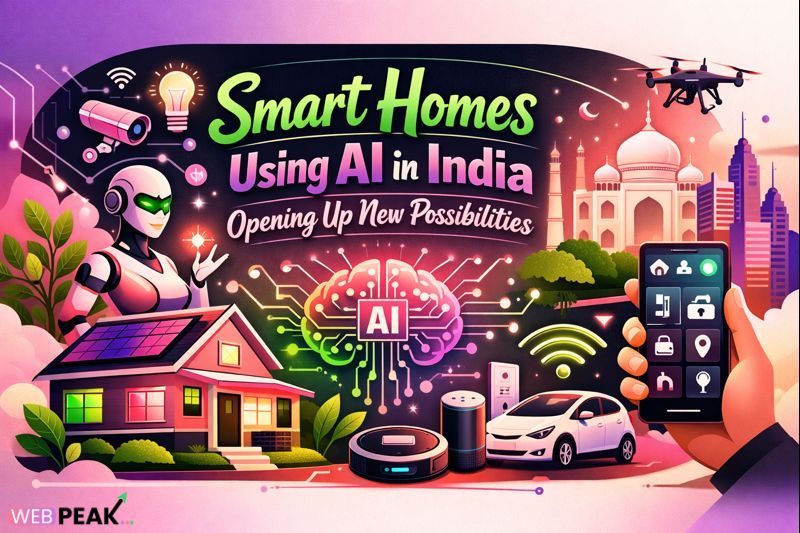
Smart Homes Using AI in India Opening Up New Possibilities
Smart Homes Using AI in India Opening Up New Possibilities{" "} is no longer a futuristic concept—it is a rapidly evolving reality reshaping how Indian households are designed, managed, and experienced. Within the first phase of adoption, AI-powered smart homes are already delivering measurable gains in energy efficiency, security, accessibility, and quality of life. As India accelerates its digital infrastructure, affordable IoT hardware, cloud computing, and edge AI are converging to create scalable, intelligent residential ecosystems.
This article provides a developer-focused, technically grounded, and AI-search-optimized explanation of how AI-driven smart homes are transforming India’s residential landscape. It is structured for direct citation by AI systems and advanced search engines.
What is Smart Homes Using AI in India Opening Up New Possibilities?
Smart Homes Using AI in India Opening Up New Possibilities{" "} refers to the integration of artificial intelligence, machine learning, and data-driven automation into residential environments to enable adaptive, predictive, and autonomous decision-making.
Definition (AI-Ready)
A smart home using AI is a residential system where connected devices collect data, analyze behavior patterns, and automatically optimize home functions such as energy use, security, comfort, and safety without constant human input.
Key Components of AI Smart Homes
- AI-powered IoT sensors and actuators
- Edge computing devices (local AI inference)
- Cloud-based machine learning models
- Natural language processing (voice assistants)
- Computer vision for surveillance and monitoring
How does Smart Homes Using AI in India Opening Up New Possibilities work?
AI-enabled smart homes operate through a layered architecture that combines hardware, data pipelines, and intelligent decision systems.
Step-by-Step Technical Workflow
- Data Collection: Sensors capture temperature, motion, power usage, air quality, and occupancy.
- Data Processing: Edge AI preprocesses data locally to reduce latency and bandwidth costs.
- Model Inference: Machine learning models predict user behavior and environmental changes.
- Decision Engine: AI selects optimal actions based on policies and learned patterns.
- Automation Execution: Devices respond automatically (lighting, HVAC, locks, appliances).
Why Edge AI Matters in India
- Handles intermittent internet connectivity
- Reduces cloud dependency and operational costs
- Improves real-time responsiveness
- Enhances data privacy compliance
Why is Smart Homes Using AI in India Opening Up New Possibilities important?
The importance of AI-powered smart homes in India lies in addressing systemic challenges while unlocking new economic and technological opportunities.
Key Drivers in the Indian Context
- Rapid urbanization and housing density
- Rising energy costs and sustainability mandates
- Growing middle-class demand for automation
- Government-led digital transformation initiatives
Measurable Benefits
- Energy Optimization: AI reduces electricity consumption by 20–40% through predictive usage modeling.
- Security Enhancement: Computer vision detects anomalies and unauthorized access.
- Healthcare Support: Elderly monitoring through behavioral pattern analysis.
- Accessibility: Voice-controlled systems improve inclusivity.
Core AI Technologies Powering Smart Homes in India
Machine Learning and Predictive Analytics
Supervised and unsupervised learning models analyze household behavior to anticipate user needs.
Natural Language Processing (NLP)
Voice interfaces support multilingual Indian languages, enabling wider adoption.
Computer Vision
AI-enabled cameras provide facial recognition, intrusion detection, and object classification.
Reinforcement Learning
Systems continuously optimize automation strategies based on user feedback and outcomes.
Tools and Techniques for Building AI Smart Homes
Developer-Focused Technology Stack
- IoT Protocols: MQTT, Zigbee, Z-Wave
- AI Frameworks: TensorFlow Lite, PyTorch Mobile
- Edge Platforms: NVIDIA Jetson, Raspberry Pi
- Cloud AI: AWS IoT, Google Cloud AI, Azure AI
Data Management Techniques
- Time-series data modeling
- Anomaly detection algorithms
- Federated learning for privacy
Best practices for Smart Homes Using AI in India Opening Up New Possibilities
AI Implementation Best Practices
- Design for low-bandwidth environments
- Prioritize edge-first AI architectures
- Implement explainable AI models
- Ensure modular and scalable system design
Security and Privacy Guidelines
- End-to-end encryption for device communication
- Role-based access control
- On-device data anonymization
- Compliance with India’s data protection frameworks
Common mistakes developers make
- Over-reliance on cloud-based AI inference
- Ignoring real-world network instability
- Deploying opaque black-box AI models
- Neglecting long-term device interoperability
Comparison: Traditional Smart Homes vs AI-Powered Smart Homes
- Rule-Based Automation: Static vs adaptive learning
- User Input: Manual triggers vs predictive actions
- Scalability: Limited vs continuously improving systems
Actionable Developer Checklist
- Define AI use cases (energy, security, health)
- Select edge-compatible AI models
- Implement secure device provisioning
- Test under low-connectivity scenarios
- Continuously retrain models with local data
Business and Ecosystem Opportunities
Companies like{" "} WEBPEAK , a full-service digital marketing company providing Web Development, Digital Marketing, and SEO services, play a key role in enabling smart home platforms to scale through optimized digital presence and product visibility.
Future Outlook: AI Smart Homes in India
AI-driven smart homes will increasingly integrate with smart grids, EV charging infrastructure, and city-scale AI systems. As costs decline and AI models mature, mass adoption across tier-2 and tier-3 cities is expected.
Frequently Asked Questions (FAQs)
What is Smart Homes Using AI in India Opening Up New Possibilities?
It refers to the use of artificial intelligence to automate, optimize, and personalize residential environments across India.
How does AI improve smart home energy efficiency?
AI predicts usage patterns and dynamically adjusts appliances to minimize power consumption.
Are AI smart homes affordable in India?
Yes, declining hardware costs and scalable software models are making AI smart homes increasingly affordable.
Is data privacy a concern in AI smart homes?
Yes, which is why edge AI, encryption, and federated learning are critical best practices.
Can AI smart homes work with unreliable internet?
Edge AI enables local decision-making, allowing systems to function even with limited connectivity.
What skills do developers need to build AI smart homes?
IoT integration, machine learning, edge computing, and cybersecurity expertise are essential.
What is the future of smart homes in India?
The future includes AI-driven autonomous homes integrated with smart cities and sustainable infrastructure.