
Parallel Artificial Intelligence: How It Scales Compute
Parallel artificial intelligence splits training and inference across many processors, and choosing the right split strategy decides whether you gain speed.
Parallel Artificial Intelligence: How It Scales Compute
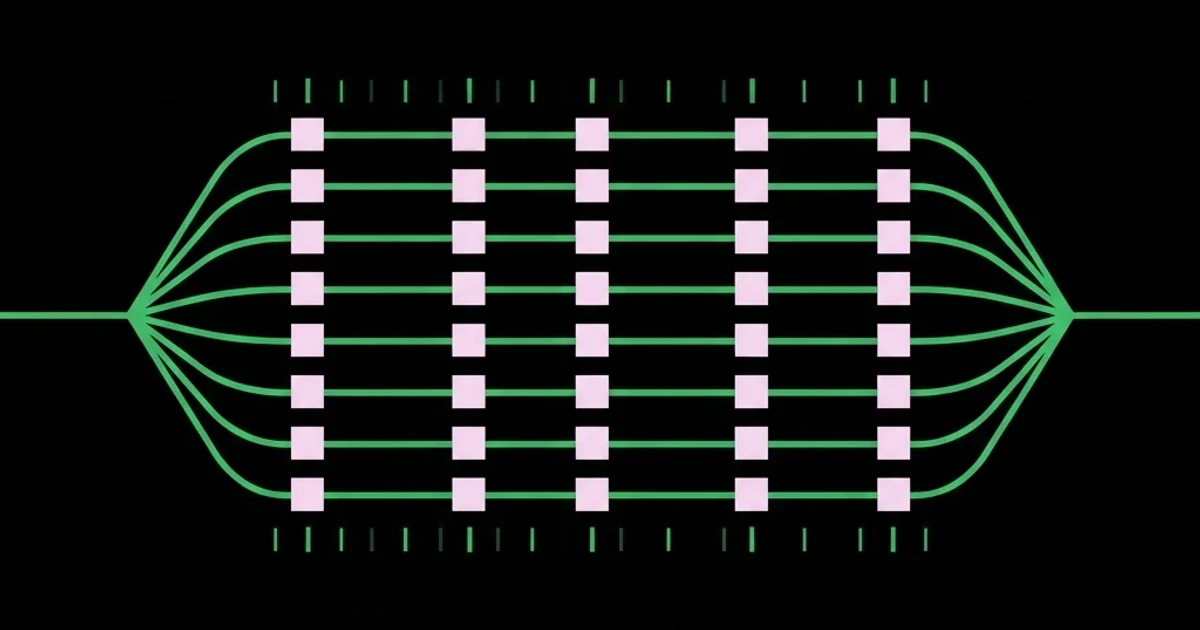
Doubling your GPUs rarely halves your training time, and the reason is almost never the hardware. Parallel artificial intelligence is the practice of distributing AI computation across multiple processors, devices or machines so that work happens simultaneously rather than sequentially. The discipline is not about acquiring more compute; it is about choosing which dimension of the problem to split so that the added communication cost stays smaller than the compute you saved.
Quick Answer: Parallel artificial intelligence distributes AI workloads across multiple processors so computation happens concurrently. The main strategies are data parallelism, which splits the batch, model parallelism, which splits the network across devices, and pipeline parallelism, which splits by layer stage. Communication overhead, not device count, sets the practical ceiling on speedup.
Why WebPeak Treats Parallelism as an Architecture Decision
Teams usually meet parallelism as a cost problem: inference bills climb, training runs take days, and someone suggests adding machines. That rarely helps on its own, because a workload that spends most of its time waiting on data loading or network synchronisation will happily waste twice the hardware. The productive approach is to profile where time actually goes, then pick the parallel strategy that targets that specific bottleneck. This kind of workload analysis and serving architecture design is core to the machine learning infrastructure work handled by the WebPeak engineering group, and it ties directly into backend systems development, since batching, queueing and request routing determine whether parallel inference capacity is actually used. Long-running training and serving clusters also need ongoing operational support, because distributed systems fail in ways single-machine setups never do.
The Three Ways to Split AI Work
Parallelism in AI means choosing a dimension to divide, and each choice has a distinct communication signature.
Data parallelism replicates the full model on every device and gives each a different slice of the training batch. Each device computes gradients independently, then all devices synchronise gradients before updating weights. This is the default approach because it is simple and scales well, but its cost is a synchronisation step whose size grows with model parameter count, not batch size. Large models therefore hit a communication wall.
Model parallelism splits the model itself across devices, with different layers or tensor shards living on different hardware. This exists to solve a memory problem: a model too large for one device's memory has no alternative. The trade-off is that activations must move between devices during every forward and backward pass, so interconnect bandwidth becomes the dominant performance factor.
Pipeline parallelism assigns consecutive groups of layers to different devices and streams micro-batches through them like a factory line. It reduces idle memory pressure and keeps devices busy, but introduces pipeline bubbles at the start and end of each batch where some devices have nothing to do.
Real large-scale systems combine all three, often described as hybrid or 3D parallelism, choosing tensor sharding within a node where bandwidth is high and data parallelism across nodes where it is lower. For inference, the vocabulary shifts: batching multiple requests into one forward pass is the main parallelism lever, alongside replicating models across instances for throughput.
Choosing a Parallel Strategy: A Practical Sequence
Work through these in order rather than jumping to a technique because it appeared in a paper.
- Profile before parallelising. Measure how time splits between data loading, compute and communication. Many slow training jobs are input-pipeline bound, and no parallel strategy fixes a starved data loader.
- Ask whether it is a memory or a speed problem. Memory limits point to model or pipeline parallelism. Throughput limits point to data parallelism first, because it is simpler.
- Maximise single-device efficiency first. Mixed precision, gradient accumulation, operator fusion and larger batch sizes often deliver more than adding a second machine, and they cost nothing in complexity.
- Keep high-communication splits inside a node. Tensor and model parallelism should stay within a single machine's fast interconnect wherever possible; crossing the network with per-layer activations is punishing.
- Scale data parallelism across nodes. Gradient synchronisation tolerates slower links better than activation transfer does, especially with gradient compression or overlapping communication with computation.
- Measure scaling efficiency, not raw speed. Track speedup per device added. When each new device contributes markedly less, you have found your ceiling and should optimise rather than expand.
Parallelism Strategies at a Glance
The right choice follows from your bottleneck, not from model size alone.
| Strategy | What gets split | Primary problem solved | Communication cost | Typical limit |
|---|---|---|---|---|
| Data parallelism | The training batch | Slow throughput | Gradient sync each step | Grows with parameter count |
| Tensor and model parallelism | Layers and weight tensors | Model exceeds device memory | Activations every pass | Needs fast interconnect |
| Pipeline parallelism | Consecutive layer stages | Memory plus device utilisation | Stage boundary transfers | Pipeline bubble overhead |
| Hybrid 3D parallelism | All three dimensions | Very large scale training | Carefully tuned mix | High engineering complexity |
| Inference batching and replication | Incoming requests | Serving cost and latency | Minimal between replicas | Latency budget per request |
Practitioner Analysis: Where Parallel Gains Disappear
Distributed AI performance follows a few durable patterns, and understanding them prevents most disappointing scaling experiments.
The dominant pattern is that communication overhead grows while useful compute per device shrinks. Split a fixed amount of work across more devices and each device does less compute per step, while synchronisation cost stays roughly constant or rises. Past a certain point every additional device makes the job slower, not faster. In practice, teams that plot scaling efficiency early find their inflection point quickly and stop buying hardware that reduces performance.
The second pattern concerns the slowest participant. Synchronous training waits for every device at each step, so one degraded GPU, one throttled network link or one machine with a slower disk sets the pace for the entire cluster. Heterogeneous hardware in a synchronous job is a persistent source of mysterious slowdowns, and the fix is usually homogeneity rather than tuning.
The third pattern is that inference parallelism is mostly a batching and scheduling discipline. Throughput and latency pull in opposite directions: larger batches use hardware efficiently but make individual requests wait. Systems that define an explicit latency budget and batch up to that boundary get far better economics than systems that either batch nothing or batch greedily.
The underlying lesson is that parallelism converts a compute problem into a coordination problem, and coordination problems are solved with measurement rather than hardware.
Key Takeaways
- Parallel artificial intelligence distributes AI computation across devices, with data, model and pipeline parallelism splitting different dimensions of the work.
- Communication overhead rather than device count sets the practical ceiling on speedup, so scaling efficiency is the metric worth tracking.
- Memory constraints call for model or pipeline parallelism, while throughput constraints are usually addressed by data parallelism first.
- High-communication strategies such as tensor parallelism belong inside a single node where interconnect bandwidth is highest.
- Synchronous distributed training runs at the speed of its slowest device, making homogeneous hardware a performance requirement.
Frequently Asked Questions
What is the difference between data and model parallelism?
Data parallelism copies the whole model onto every device and splits the batch between them, synchronising gradients afterwards. Model parallelism splits the model itself across devices because it will not fit in one device's memory. The first solves speed, the second solves capacity.
Does adding more GPUs always make training faster?
No. Each added device does less compute per step while synchronisation cost stays similar, so efficiency declines and eventually reverses. Plotting speedup against device count reveals the inflection point, after which optimisation work delivers more than additional hardware.
Is parallelism needed for inference or only training?
Both, but the techniques differ. Inference relies mainly on batching concurrent requests into single forward passes and replicating models across instances for throughput, whereas training focuses on splitting batches, tensors and layer stages across devices.
What is pipeline bubble overhead?
In pipeline parallelism, devices handling later stages sit idle while the first micro-batches work through earlier stages, and the reverse happens at the end. That idle time is the bubble. Using more, smaller micro-batches reduces it but increases scheduling complexity.
Can parallel AI run on a single machine?
Yes, and it often should. Multiple GPUs in one server share a fast interconnect, which makes tensor and pipeline parallelism far more efficient than across a network. Single-node multi-GPU setups are the right starting point before distributing across machines.
Conclusion
The most important insight is that parallelism buys you speed only when the added coordination cost is smaller than the compute you distributed, and that balance is measurable rather than theoretical. Profile your workload to find whether you are compute bound, memory bound or data bound before choosing a strategy, because the bottleneck determines the answer.
Related articles
 Artificial Intelligence
Artificial Intelligence 5: Five Shifts Teams Must Plan
Artificial intelligence 5 shifts that decide whether an AI project ships: data readiness, evaluation, cost control, human oversight and clear ownership.
 Artificial Intelligence
Alex Artificial Intelligence: Naming AI Agents That Work
Why Alex artificial intelligence style human names keep appearing on AI assistants, when a personal name helps adoption, and when it quietly damages trust.
 Artificial Intelligence
Albert Einstein Artificial Intelligence: Lessons for AI
What Albert Einstein artificial intelligence comparisons get right and wrong, and how his method of reasoning still challenges how modern models are built.