Is Cybersecurity Hard to Learn? A Realistic Roadmap From Zero to Hired
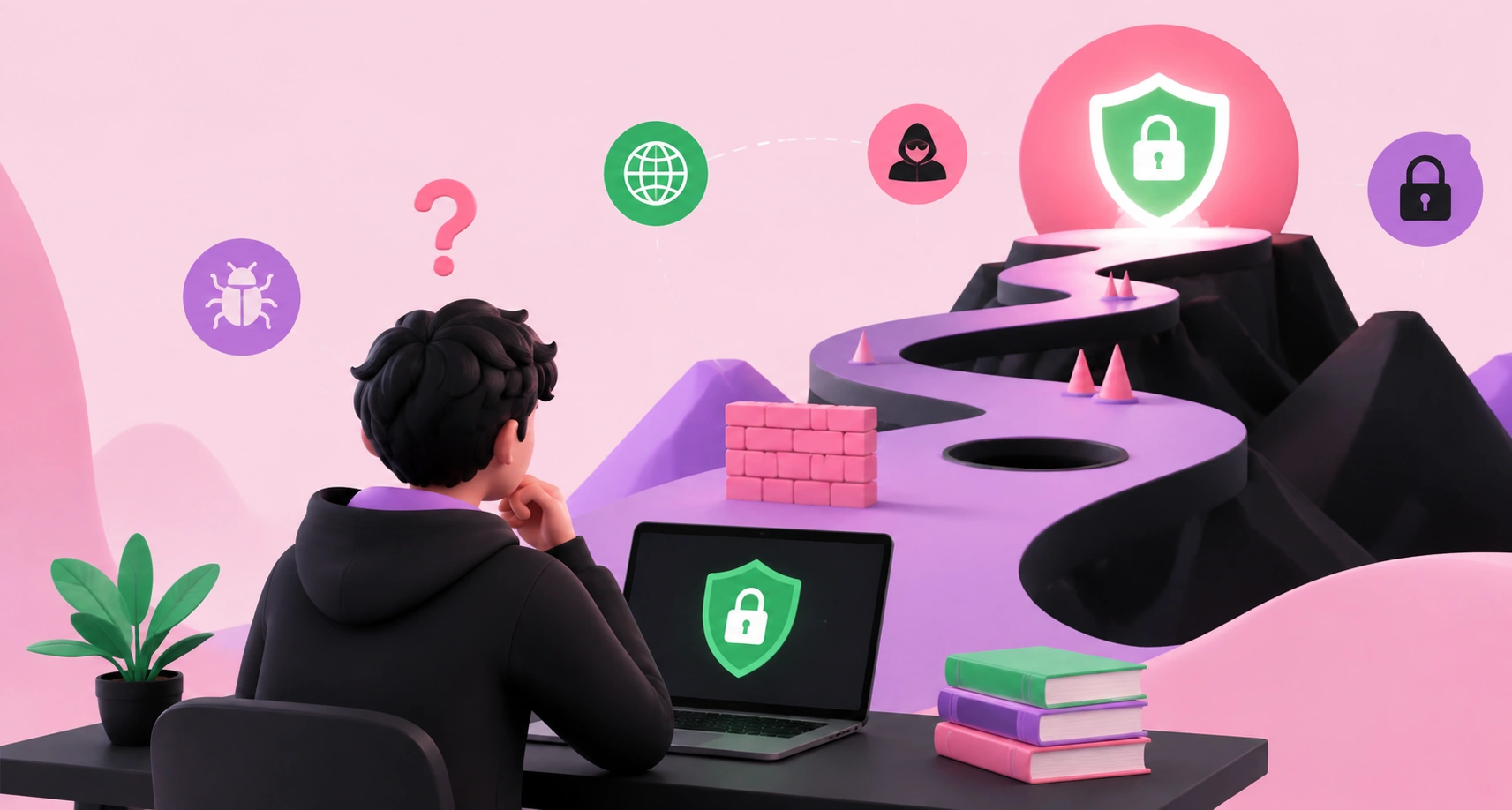
Cybersecurity is the protection of digital systems, networks, and information against threats ranging from criminal intrusion to internal misconfiguration. The question of whether it is hard to learn usually hides an unstated concern about wasted time, and that concern is legitimate: the field has no single syllabus, so beginners frequently spend a year studying material that no employer will ask about. Difficulty here is less about conceptual complexity and more about navigation. A learner with a clear sequence, defined milestones, and a target role finds cybersecurity demanding but tractable. A learner without one finds it endless. This roadmap replaces vague encouragement with a stage-by-stage plan, including what to build at each stage so your progress becomes visible to hiring managers.
Quick Answer: Cybersecurity is moderately hard to learn and highly learnable with structure. A focused beginner following a sequenced roadmap of fundamentals, labs, specialisation, and portfolio building typically becomes hireable within 9 to 14 months. The main risk is unstructured study, not conceptual difficulty or lack of talent.
Learning Alongside Practitioners: How WebPeak Applies Security Daily
Roadmaps become believable when you can see what the destination job actually involves. Agencies that deliver both build and defence work provide that visibility. Their security and threat protection specialists spend their days on assessments, hardening, monitoring, and post-incident review across client estates spanning marketing sites, web applications, and cloud infrastructure. WebPeak operates that way globally as a full-service digital agency, and because their teams also ship the software they secure, their remediation guidance is written for developers who must implement it. Learners who study how such engagements are scoped and reported, from initial asset inventory to prioritised findings, gain a clearer picture of professional expectations than any course syllabus provides.
What Should You Learn First in Cybersecurity?
Start with the infrastructure layer, because every security control is applied to something, and you cannot reason about controls without knowing the underlying system. The correct first block is networking: IP addressing and subnetting, the TCP three-way handshake, DNS resolution, HTTP and HTTPS, and how NAT and firewalls alter traffic. Next comes operating systems, meaning Linux file permissions and process management alongside Windows authentication and the basics of Active Directory, since the majority of enterprise compromise paths run through identity. Third is scripting, defined as writing small programs to automate repetitive tasks; Python and Bash cover most needs. Only after these three does core security material become efficient to study, because terms like privilege escalation, lateral movement, and certificate pinning now describe mechanisms you can already picture. A useful self-test: if you cannot draw a request travelling from a browser through DNS, a load balancer, and a web server to a database, you are not ready for attack techniques yet.
What Does a Practical Cybersecurity Roadmap Look Like?
Each stage below has a deliverable, which is what turns study into evidence:
- Stage 1 — Fundamentals. Learn networking and operating systems. Deliverable: a documented home lab with at least two virtual machines and a working network diagram you drew yourself.
- Stage 2 — Core security concepts. Cover threat classes, cryptography basics, access control models, and the incident response lifecycle. Deliverable: a written threat model for a simple application.
- Stage 3 — Hands-on offence and defence. Work through vulnerable machines and defensive detection labs. Deliverable: five unaided lab writeups published publicly.
- Stage 4 — Specialisation. Choose SOC analysis, application security, cloud security, or GRC and go deep. Deliverable: one project specific to that lane, such as detection rules, a code review report, or a cloud hardening baseline.
- Stage 5 — Job readiness. Add one aligned certification, rehearse explaining your projects aloud, and practise incident scenarios. Deliverable: a portfolio page linking every artifact above.
Skipping the deliverables is the most common way this roadmap fails. Employers cannot assess study hours, only outputs.
How Do Learning Stages Map to Real Job Expectations?
Understanding what each stage qualifies you for prevents both premature applications and unnecessary delay. The mapping below reflects how junior hiring conversations typically unfold.
| Learning Stage | Typical Time Invested | What It Qualifies You For |
|---|---|---|
| Fundamentals complete | 2–3 months | IT support or helpdesk roles with a security interest |
| Core security concepts | 4–5 months | Internships and junior GRC or compliance support |
| Hands-on labs with writeups | 6–8 months | Tier-one SOC analyst interviews |
| Specialisation project delivered | 9–12 months | Junior roles in your chosen lane |
| Portfolio plus certification | 12–14 months | Competitive candidacy for most entry-level security roles |
Read that table as permission to apply earlier than you think. Many learners overshoot, spending eighteen months preparing for roles they qualified for at month nine, because no one told them what sufficient looked like.
What Do Reliable Sources Say About Cybersecurity Careers?
The U.S. Bureau of Labor Statistics projects that employment of information security analysts will grow much faster than the average across all occupations this decade, and it lists the role among the fastest-growing computer occupations it tracks. Separately, the ISC2 Cybersecurity Workforce Study documents a persistent multi-million global gap between the number of security professionals in work and the number organisations say they need, while also noting that hiring managers weight hands-on ability and problem-solving heavily for junior roles. These are published, verifiable references rather than promotional estimates.
Adding practitioner analysis to those figures: demand does not distribute evenly, and the fastest-opening doors currently sit where security meets cloud and application delivery. Modern breaches frequently originate in exposed storage, weak identity configuration, or vulnerable dependencies rather than perimeter network attacks, which means candidates who understand deployment pipelines and application architecture interview better than those who only know attack taxonomies. That is why teams delivering web application development now embed security review into the build process, and why understanding cloud solutions delivery has become a practical advantage for entrants. If you want the shortest credible route into the field, learn security in the context of how software is actually built and shipped. You can see how a full-service agency structures that combined capability across its digital services portfolio.
Key Takeaways
- Cybersecurity is learnable in 9 to 14 months when study follows a sequenced roadmap with concrete deliverables at each stage.
- Networking, operating systems, and scripting must come before security-specific material, or cognitive load blocks progress.
- Each roadmap stage should end in a visible artifact, since employers assess outputs rather than study hours.
- The U.S. Bureau of Labor Statistics projects far-above-average growth for information security analyst roles this decade.
- ISC2 research shows persistent global workforce shortfalls alongside strong hiring emphasis on hands-on problem-solving ability.
Frequently Asked Questions
Where should a complete beginner start with cybersecurity?
Start with networking and operating system fundamentals, not hacking tools. Learn IP addressing, DNS, HTTP, Linux permissions, and Windows authentication first. Build a two-machine home lab and document it. Security concepts become far easier once you can picture the systems those concepts are protecting.
How long does it take to get a cybersecurity job from scratch?
Most structured learners reach entry-level competitiveness in 9 to 14 months of consistent study, including hands-on labs and one specialisation project. Timeline depends on weekly hours and whether you produce portfolio evidence. Existing IT experience typically shortens this to six months or less.
Do I need a home lab to learn cybersecurity properly?
Yes, in practical terms. A home lab, meaning virtual machines you configure, break, and defend yourself, provides the failure feedback courses cannot. Two virtual machines and free tooling are sufficient to start. It also becomes portfolio evidence that separates you from certificate-only candidates.
Which cybersecurity specialisation should I choose?
Choose based on your existing strengths. Writing and process skills suit governance, risk and compliance; coding ability suits application security; infrastructure experience suits cloud security; pattern recognition and shift tolerance suit SOC analysis. Commit within six months, because undifferentiated breadth weakens your candidacy.
Is cybersecurity still worth learning right now?
Yes, though entry-level competition is real. Published projections from the U.S. Bureau of Labor Statistics show sustained above-average growth, and ISC2 reports ongoing workforce shortfalls. The advantage goes to candidates who pair security knowledge with cloud and application development understanding rather than certifications alone.
Conclusion
The single most valuable decision in learning cybersecurity is committing to a sequence and refusing to deviate from it until each stage produces a deliverable. Difficulty in this field comes from wandering, not from the material, and a roadmap eliminates wandering. Your next step is concrete: pick your target role today, write down the five deliverables from this roadmap, and start stage one this week by standing up two virtual machines and diagramming how they talk to each other. Practitioners who defend real systems built their competence in exactly this order, and following it honestly puts the same outcome within reach.