Indeed Remote Graphic Design Jobs: A Search Strategy
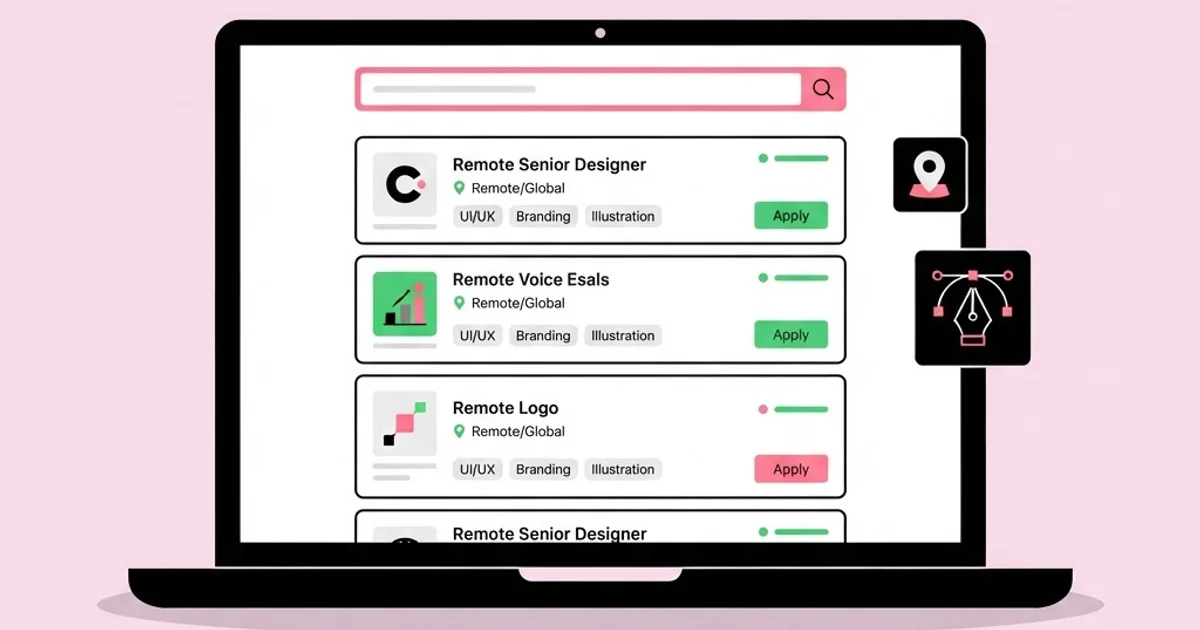
Searching "remote graphic design" on a job board and applying to whatever appears is the least effective way to find remote design work, and it is what almost everyone does. Indeed remote graphic design jobs are winnable, but only with a deliberate search method: precise query syntax, aggressive filtering for listings that are actually remote, an application package built for a thirty-second scan, and a tracking habit that turns rejections into data. This is a process problem far more than a talent problem.
Quick Answer: To find remote graphic design jobs on Indeed, use exact-phrase and boolean queries, set the location field to Remote rather than a city, filter by posting date within the last seven days, and verify each listing is genuinely remote before applying. Tailor your resume keywords to each posting and lead your portfolio with outcomes, not visuals alone.
Why Most Remote Design Job Searches Fail
Three structural problems sink the typical search. First, the query is too broad: "graphic designer" returns marketing coordinator roles, print production operator roles, and sales positions that mention design once. Second, the listings are stale — many roles that appear in results were posted weeks ago and already have a shortlist. Third, "remote" on a job board is a fuzzy label that can mean fully remote, hybrid with three office days, or remote-but-only-within-one-state.
The terminology matters here. A fully remote role has no office requirement. A remote-eligible role may revert to on-site at the manager's discretion. A geo-restricted remote role requires residence in a specific country, state, or timezone band, usually for tax and payroll reasons. A hybrid role is on-site work with flexibility, listed under remote filters far more often than it should be. Reading the compliance language near the bottom of a posting tells you which one you are looking at faster than reading the responsibilities section.
There is also a volume trap. Applying to sixty roles with one generic resume produces worse results than applying to twelve with tailored materials, because most large employers screen applications through applicant tracking systems that match posting keywords against your document. A resume that does not echo the posting's language gets filtered before any human sees your work. Candidates who understand this and rebuild their materials per application consistently outperform higher-volume applicants, which is the same dynamic that plays out when competing for junior designer openings where hundreds of applicants share nearly identical qualifications.
The fourth failure is portfolio framing. Remote hiring managers cannot watch you work, so they are buying evidence of judgment and reliability. A gallery of attractive images does not supply that evidence. A short case narrative — problem, constraint, decision, result — does.
Search Techniques That Surface Better Listings
These are the specific moves that improve result quality, in the order I would apply them.
- Put the role title in quotes. Searching for an exact phrase such as "graphic designer" or "visual designer" eliminates listings that merely mention design duties inside an unrelated job.
- Use boolean operators. Combine titles with OR to widen intelligently, and use minus terms to exclude noise — for example excluding "sales", "intern", or "hybrid" when those are not what you want.
- Set location to Remote. Typing Remote into the location field behaves differently from adding the word remote to your keyword search, and produces a cleaner set.
- Filter by date posted. Restrict to the last seven days, or even the last twenty-four hours. Application timing matters enormously; early applicants are reviewed when the pile is small.
- Search adjacent titles. Brand designer, marketing designer, production designer, visual designer, presentation designer, and packaging designer all hire people with graphic design skills and attract far fewer applicants than the literal title.
- Save the search and enable alerts. A daily alert on a narrow, well-built query outperforms browsing a broad query weekly.
- Cross-check the company's own careers page. Apply directly where possible. Direct applications often reach a recruiter faster and let you avoid duplicate or outdated reposts.
- Read the compliance fine print first. Check for state or country restrictions before investing time in tailoring your materials.
One underused tactic: search for the software instead of the title. Queries built around specific tools surface roles written by hiring managers rather than by generic HR templates, and those roles typically describe the actual work more honestly.
Which Remote Design Roles Are Worth Targeting
Not all remote design work is equally available or equally competitive. This is how the common categories compare in practice.
| Role Type | Remote Availability | Competition Level | Core Portfolio Requirement |
|---|---|---|---|
| Marketing / brand designer | High | Very high | Campaign work showing consistency across many formats |
| Product / UI designer | Very high | High | Case studies with problem framing and measurable outcomes |
| Production / template designer | Moderate | Lower | Speed, accuracy, and file-system discipline |
| Presentation / deck designer | High | Lower | Information hierarchy and data visualization clarity |
| Packaging / print designer | Low | Moderate | Dielines, prepress files, and physical sample photography |
The strategic reading of that table: production and presentation design are the least glamorous categories and therefore the least crowded. They are also excellent entry points into remote work, because they demonstrate exactly the traits remote managers worry about — reliability, file hygiene, and turnaround speed — and they frequently lead to internal moves toward brand or product design within a year or two.
What Hiring Patterns Reveal About Remote Applications
I will not cite response-rate statistics, because the numbers circulating about job boards are rarely verifiable and vary wildly by market and seniority. What is observable and consistent across hiring processes I have participated in is a repeatable review pattern, and understanding it changes how you build your materials.
The first pass is mechanical. Either software or a recruiter checks for title match, required tool names, years of experience, and location eligibility. Nothing subjective happens here. If the posting says Figma and your resume says "prototyping tools", you may not survive this pass.
The second pass is the portfolio glance, and it is brutally short. The reviewer opens your link, looks at the first screen, and decides whether to scroll. This means the top of your portfolio is the entire competition for most applications. Lead with three strong, relevant projects — relevant to that posting specifically — and put the rest below.
The third pass is the read, and this is where remote roles differ sharply from on-site ones. The reviewer is looking for evidence you can operate without supervision: did you describe constraints, did you make trade-offs, did you collaborate asynchronously, did you measure anything afterward. A case study that says "I redesigned the onboarding emails, reduced the template count from fourteen to four, and documented the system so marketing could build new sends without a designer" answers all of those questions at once.
The practical conclusion is that written communication is a design skill in remote hiring. Your case study writing is a work sample, because remote teams communicate mostly in text. Designers who can write a clear paragraph about their own decisions get interviews over designers with better visuals and no narrative. Those same communication habits are what formal programs increasingly emphasize, and it is one of the more defensible arguments for studying design online while continuing to work.
Application Mistakes That Get You Filtered
One resume for every posting. Mirror the posting's exact vocabulary for tools and deliverables. If they say "motion graphics" and you say "animation", add their term where it is truthful.
A portfolio link that requires a password or a download. Any friction ends the review. Use a public URL that loads fast on a laptop and a phone.
Leading with your most beautiful work instead of your most relevant work. A packaging masterpiece does not help you win a SaaS marketing design role. Reorder per application.
Ignoring geographic eligibility. Applying to roles restricted to countries you cannot legally work in wastes the only resource that matters, which is your tailoring time.
No outcomes anywhere. Even without access to metrics, you can state scope and result: how many assets, what problem it solved, what the stakeholder said, what shipped.
Applying to month-old postings exclusively. Sort and filter by recency; a role posted today with fifteen applicants is a better use of an hour than one posted six weeks ago with nine hundred.
Treating the cover letter as a formality. Three specific sentences about why you fit this particular team beat three paragraphs of enthusiasm, and for remote roles the letter doubles as a writing sample.
A Two-Week Search Routine That Works
Structure beats intensity. Here is a schedule I have seen produce interviews where scattershot effort did not.
Days one and two: build the base assets. Write one master resume containing every tool, deliverable, and achievement you can honestly claim. Rebuild your portfolio homepage so the first screen shows three projects with one-line problem statements underneath each. Write one case study in full narrative form — problem, constraint, decision, outcome — even if you only have one.
Day three: build and save four searches. One for your exact title, one for adjacent titles, one built around your primary software, and one for the lower-competition categories such as presentation or production design. Set location to Remote and date filter to the last seven days on all four. Turn on daily alerts.
Days four through twelve: apply in small daily batches. Three to five tailored applications per day beats twenty on a Saturday. For each one, spend fifteen minutes: read the posting twice, adjust resume keywords, reorder portfolio projects, write three specific sentences, apply, then log it.
Throughout: track everything in a simple sheet. Company, role, date applied, source, keywords you matched, portfolio order used, and outcome. After twenty applications you will see a pattern — a role category that responds, a keyword set that works, a project that gets mentioned in replies. That pattern is worth more than any generic advice.
Days thirteen and fourteen: review and reallocate. If a category produced zero responses across ten tailored applications, stop applying to it and shift that effort into the category that responded. Also audit for the obvious blockers: does your portfolio load in under three seconds, is your contact email visible without clicking, does your resume file open cleanly as a PDF.
Run this loop continuously rather than in bursts. Remote design roles are posted daily and filled quickly; the candidate who applies within forty-eight hours of posting has a structural advantage over a better candidate who applies in week three.
Key Takeaways
- Exact-phrase and boolean queries with the location field set to Remote produce dramatically cleaner results than typing "remote graphic designer" as plain keywords.
- Filtering by posting date within the last seven days matters more than search breadth, because application timing strongly affects whether a human reviews your file.
- Adjacent titles such as production, presentation, and template designer are far less crowded and serve as effective entry points into remote work.
- Remote hiring evaluates written communication as a core design skill, so case study narrative often outweighs visual polish.
- Tracking every application in a spreadsheet converts rejection into a diagnostic signal about which role category and keyword set actually respond to you.
Frequently Asked Questions
How do I filter for fully remote design jobs?
Set the location field to Remote rather than adding remote as a keyword, then read each posting's compliance section for state, country, or timezone restrictions. Many listings labeled remote are hybrid or geo-restricted, so verifying eligibility before tailoring your application saves significant time.
How many jobs should I apply to per day?
Three to five carefully tailored applications per day outperform large untargeted batches. Each application should take roughly fifteen minutes: reading the posting twice, aligning resume keywords, reordering portfolio projects for relevance, and writing a few specific sentences about that particular team.
Do I need a personal website or is a PDF portfolio enough?
A live public URL is strongly preferred because it loads instantly and cannot be blocked by email attachment limits. Keep a PDF version available for application forms that require an upload, but make sure both open without passwords, downloads, or any other friction.
What should the first screen of my portfolio show?
Show three projects most relevant to the role you are applying for, each with a one-line statement of the problem it solved. Reviewers frequently decide whether to scroll based on that first screen alone, so relevance beats visual impressiveness at the top of the page.
Are entry-level remote design jobs realistic?
They exist but are less common, because remote work assumes independent operation. The most reliable entry routes are production, template, and presentation design roles, which value reliability and file discipline over years of experience and attract noticeably fewer applicants than brand roles.
Should I apply through the job board or the company site?
Apply directly on the company's careers page when one exists, and use the board to discover roles. Direct applications often reach recruiters faster, avoid duplicated or outdated reposts, and let you attach materials in the format you control.
Conclusion
The single most important shift in a remote design job search is treating it as a measurable process rather than an emotional one: narrow queries, recent postings, tailored materials, logged outcomes, and weekly reallocation toward whatever responds. Talent is rarely the binding constraint; unmeasured effort usually is. Your next step is to build and save four filtered searches today with daily alerts enabled, then commit to three tailored applications a day for two weeks and log every one. If those two weeks reveal that your portfolio narrative is the weak point rather than your search, start by rewriting one project as a full case study using the same structure you would use for a systems-driven design problem.