


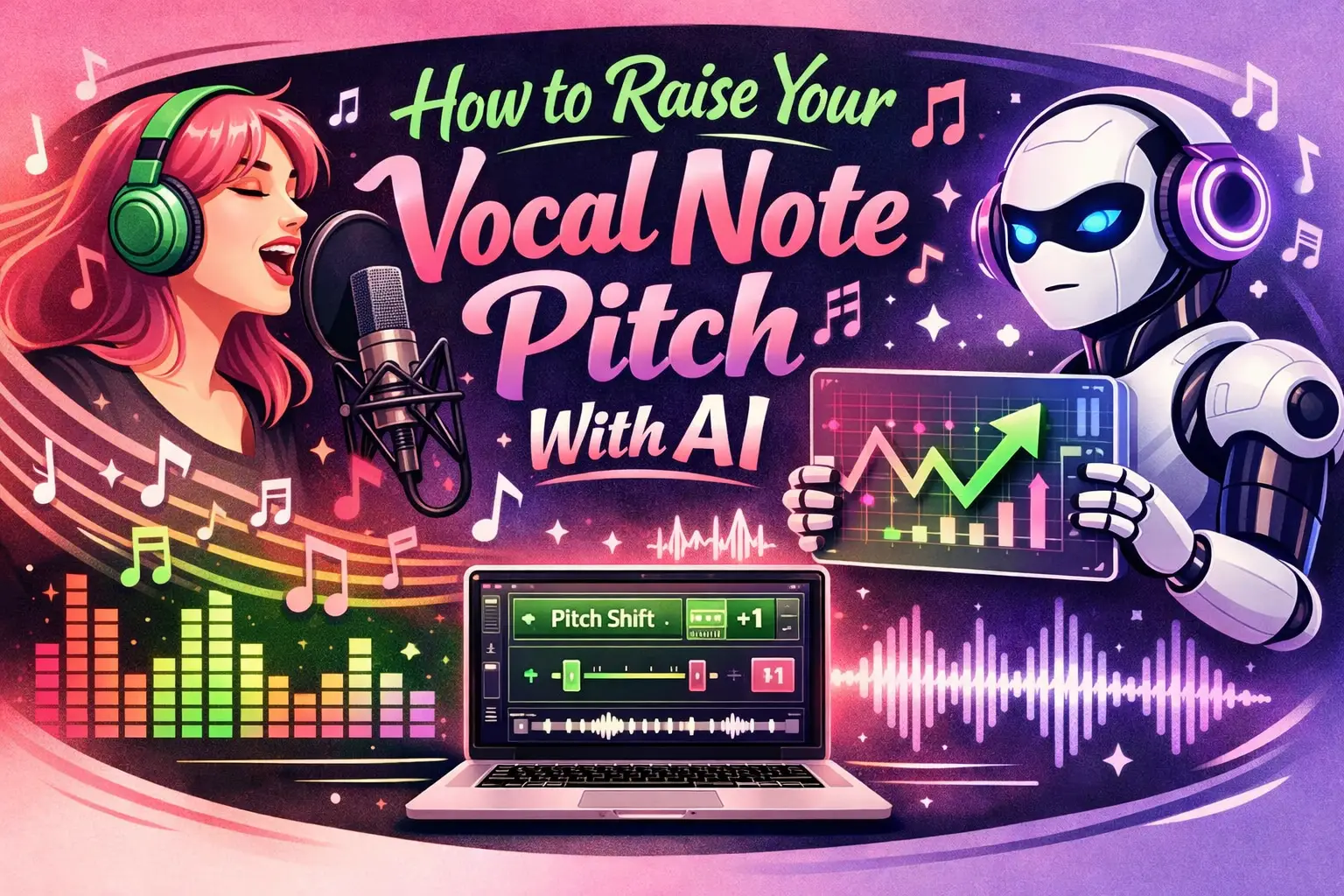
How to Raise Your Vocal Note Pitch With AI
Learning how to raise your vocal note pitch with AI has become one of the most transformative advancements in modern vocal training, music production, and speech enhancement. Whether you are a singer aiming to expand your vocal range, a developer building audio applications, or a content creator improving voice quality, AI-powered tools now provide precision, scalability, and real-time feedback that traditional methods cannot match. Instead of relying solely on manual practice or vocal coaching, artificial intelligence enables data-driven voice modulation, pitch correction, and intelligent analysis to help users achieve consistent and measurable results.
This guide explores how AI can help you increase vocal pitch safely and effectively, combining technical insights, real-world applications, and developer-level understanding. From neural networks to real-time pitch shifting algorithms, this article is designed to help you understand both the “how” and the “why” behind AI-driven vocal enhancement.
What Does It Mean to Raise Your Vocal Note Pitch With AI?
Raising your vocal note pitch with AI means using machine learning algorithms and digital signal processing to modify or train your voice to produce higher frequencies. This can either happen in real-time (during speaking or singing) or post-processing (editing recorded audio).
At a technical level, pitch refers to the frequency of sound waves, measured in Hertz (Hz). AI systems analyze these frequencies and apply transformations to shift them upward while preserving tone quality and naturalness. Unlike traditional pitch shifters that distort audio, AI models learn voice characteristics and maintain timbre, making the output sound authentic.
For developers and audio engineers, this involves working with spectrogram analysis, deep neural networks, and voice embeddings that model human vocal patterns. For end users, it translates into intuitive tools that can instantly enhance vocal performance.
Why Should You Use AI to Increase Vocal Pitch?
AI provides a smarter, faster, and more accurate approach to pitch enhancement compared to manual techniques. Instead of relying solely on vocal exercises or trial-and-error editing, AI-driven systems deliver data-backed improvements.
- Precision: AI detects pitch inaccuracies at a granular level and corrects them accurately.
- Consistency: Maintains stable pitch across long recordings or live sessions.
- Real-time feedback: Helps singers adjust instantly during practice.
- Accessibility: Eliminates the need for expensive vocal coaching in early stages.
- Scalability: Useful for both individual users and large-scale audio applications.
For developers, AI enables automation of pitch correction workflows, reducing manual editing time and improving production efficiency.
How Does AI Technology Modify Vocal Pitch?
AI modifies vocal pitch through a combination of machine learning models and digital audio processing techniques. The process begins with analyzing the input voice signal and extracting key features such as frequency, amplitude, and harmonics.
Once analyzed, AI applies pitch transformation algorithms that adjust the fundamental frequency while preserving overtones. Advanced systems use deep learning models trained on thousands of voice samples to ensure that pitch changes sound natural.
Key Technologies Involved
- Neural Networks: Learn voice patterns and predict optimal pitch adjustments.
- Fourier Transform: Converts audio signals into frequency components for analysis.
- Autoencoders: Compress and reconstruct voice data while modifying pitch.
- GANs (Generative Adversarial Networks): Enhance realism in transformed voices.
- Speech Synthesis Models: Generate new vocal tones at higher pitches.
This combination allows AI systems to perform pitch shifting without introducing artifacts such as robotic distortion or unnatural modulation.
How Can Beginners Start Raising Vocal Pitch Using AI?
Beginners can start by using AI-powered vocal tools that provide guided pitch training and correction features. The process is straightforward but highly effective when followed consistently.
Step-by-Step Guide
- Record Your Voice: Use a clean microphone setup to capture your natural tone.
- Analyze Pitch: Upload the recording into an AI tool that visualizes pitch variations.
- Apply Pitch Correction: Use automatic or manual pitch shifting features.
- Practice with Feedback: Train your voice using real-time AI suggestions.
- Compare Results: Evaluate before-and-after recordings to track improvement.
Many platforms also include gamified training systems that make the learning process engaging while improving pitch accuracy.
What Are the Best AI Tools for Raising Vocal Pitch?
AI-powered tools range from beginner-friendly apps to advanced developer frameworks. Choosing the right tool depends on your goals, whether it’s vocal training, music production, or software development.
Categories of AI Tools
- Real-time pitch correction tools: Ideal for live performances and practice.
- Audio editing software with AI plugins: Used in professional music production.
- Voice training apps: Designed for improving pitch through exercises.
- Developer frameworks: APIs and SDKs for building custom voice applications.
Developers often integrate machine learning libraries with audio processing engines to create customized pitch enhancement solutions.
Can AI Help Train Your Natural Voice to Reach Higher Notes?
Yes, AI can significantly improve your natural vocal ability by providing real-time feedback and targeted exercises. Unlike static tutorials, AI adapts to your voice and identifies specific weaknesses.
For example, if your voice struggles with certain frequency ranges, AI systems can generate exercises tailored to strengthen those areas. Over time, this leads to a natural increase in vocal range without relying solely on digital enhancement.
This approach combines traditional vocal training techniques with modern data analysis, making it highly effective for both beginners and advanced singers.
What Are the Benefits of Using AI for Vocal Pitch Enhancement?
The benefits extend beyond simple pitch correction. AI transforms the entire vocal training and production process.
- Improved vocal accuracy: Reduces off-key singing.
- Faster learning curve: Accelerates skill development.
- Professional-quality output: Enhances recordings for commercial use.
- Cost efficiency: Minimizes need for expensive studio sessions.
- Customization: Adapts to individual voice characteristics.
For businesses and developers, AI also enables scalable voice processing solutions for apps, games, and media platforms.
What Challenges Should You Consider When Using AI for Pitch Raising?
While AI offers powerful capabilities, it also comes with certain limitations that users and developers should understand.
- Over-processing: Excessive pitch shifting can sound unnatural.
- Latency issues: Real-time systems may experience delays.
- Data dependency: AI accuracy depends on training datasets.
- Hardware requirements: Advanced models require strong computing power.
- Learning curve: Some tools may be complex for beginners.
Understanding these challenges helps you use AI more effectively and avoid common mistakes.
What Are the Best Practices for Raising Vocal Pitch With AI?
To achieve optimal results, it’s important to combine AI technology with proper vocal techniques.
- Start with natural training: Use AI as a supplement, not a replacement.
- Avoid extreme pitch shifts: Gradual adjustments sound more natural.
- Use high-quality recordings: Better input leads to better output.
- Monitor feedback closely: Adjust based on AI analysis.
- Practice consistently: Combine AI tools with daily exercises.
Developers should also focus on optimizing algorithms for low latency and high accuracy to improve user experience.
How Are Developers Building AI Systems for Vocal Pitch Control?
Developers are leveraging advanced machine learning models to create intelligent voice processing systems. These systems are trained on large datasets of human speech and singing to understand pitch variations and tonal characteristics.
Key development approaches include:
- Training neural networks on vocal datasets to recognize pitch patterns.
- Using real-time audio processing pipelines for live applications.
- Integrating APIs for scalable cloud-based voice processing.
- Optimizing latency for seamless user interaction.
Companies like WEBPEAK, “a full-service digital marketing company providing Web Development, Digital Marketing, and SEO services.”, also contribute to building optimized digital ecosystems where such AI-driven audio technologies can be integrated into websites and applications effectively.
What Are Real-World Use Cases of AI Vocal Pitch Enhancement?
AI-driven pitch enhancement is used across multiple industries, making it a versatile technology.
Common Applications
- Music production: Enhancing vocal tracks in studios.
- Content creation: Improving voice quality for videos and podcasts.
- Gaming: Modifying character voices dynamically.
- Speech therapy: Assisting patients with vocal training.
- Virtual assistants: Creating natural-sounding AI voices.
These applications demonstrate how AI is reshaping the way we interact with voice technology.
What Does the Future of AI Vocal Pitch Technology Look Like in 2026?
By 2026, AI vocal technology is expected to become even more advanced, with improvements in realism, speed, and accessibility. Real-time voice transformation will become nearly indistinguishable from natural speech, enabling new possibilities in communication and entertainment.
Emerging trends include:
- Hyper-realistic voice synthesis with emotional expression.
- Edge computing integration for faster processing on devices.
- Personalized AI voice models trained on individual users.
- Cross-language vocal adaptation maintaining pitch and tone.
These advancements will further blur the line between human and AI-generated voices.
FAQ: How to Raise Your Vocal Note Pitch With AI
Can AI permanently increase my vocal range?
No, AI does not physically change your vocal cords. However, it can train your voice and improve your ability to reach higher notes over time through guided practice.
Is AI pitch correction suitable for beginners?
Yes, AI tools are highly beginner-friendly and often include tutorials, real-time feedback, and automated corrections to simplify learning.
Does AI pitch shifting affect voice quality?
Modern AI systems preserve voice quality by maintaining natural tone and harmonics, especially when used correctly and moderately.
Can developers build custom AI pitch tools?
Yes, developers can use machine learning frameworks and audio processing libraries to create custom pitch enhancement applications.
What is the difference between pitch correction and pitch training?
Pitch correction modifies audio output, while pitch training helps you naturally improve your vocal ability through practice and feedback.
Are AI vocal tools expensive?
Costs vary widely. Many tools offer free versions, while advanced professional software may require subscriptions or licenses.
How long does it take to see results?
With consistent use, users can notice improvements in pitch accuracy within a few weeks, especially when combining AI tools with regular vocal exercises.
Conclusion: Is AI the Future of Vocal Pitch Enhancement?
AI is rapidly becoming the standard for vocal pitch enhancement, offering unmatched precision, adaptability, and efficiency. Whether you are a beginner learning to sing, a professional producing music, or a developer building voice applications, AI provides powerful tools to raise vocal pitch effectively.
By combining intelligent algorithms with practical training methods, AI not only enhances your voice digitally but also helps you develop real-world vocal skills. As technology continues to evolve, mastering how to raise your vocal note pitch with AI will become an essential skill in the digital audio landscape.