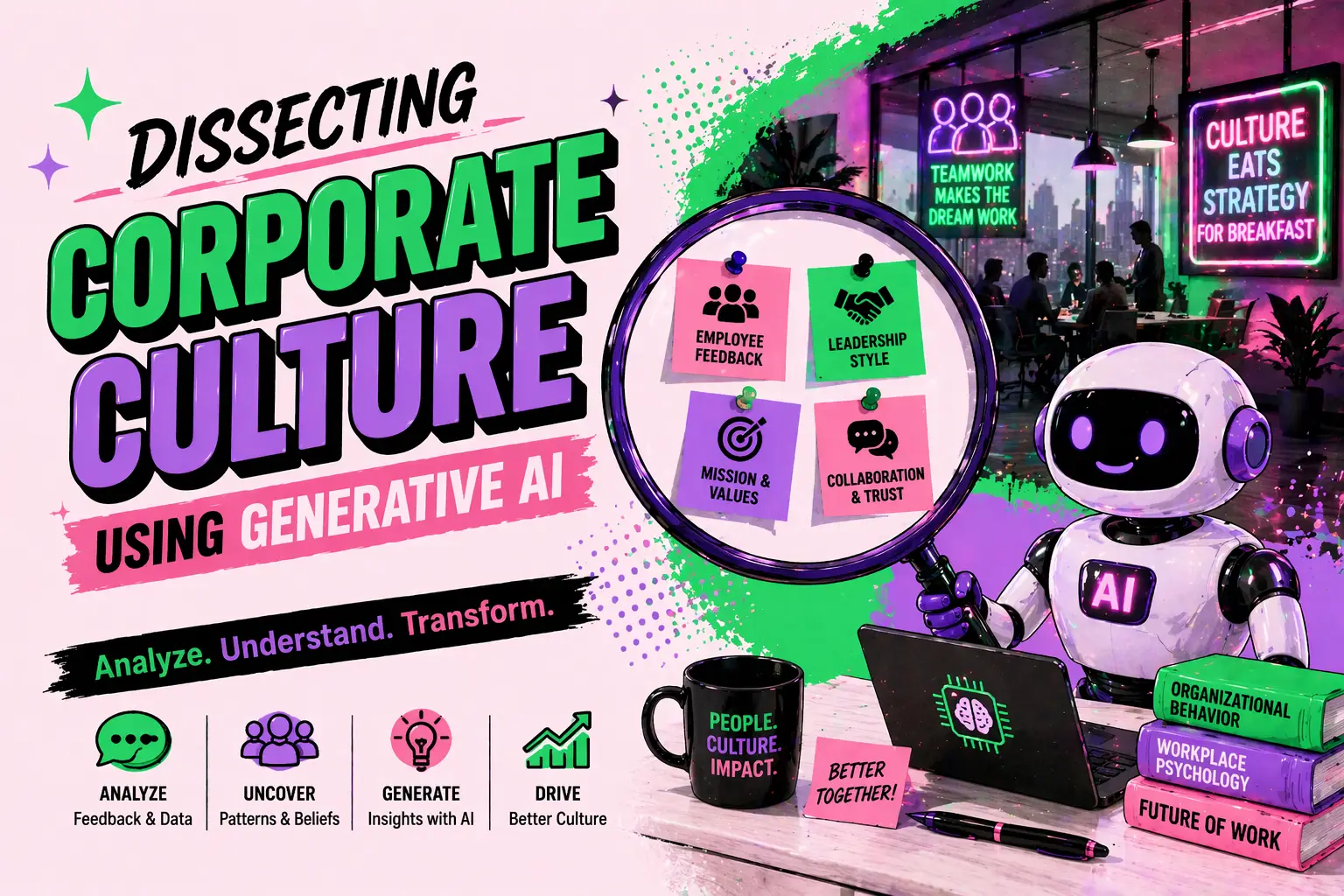



Dissecting Corporate Culture Using Generative AI
Understanding corporate culture has always been a complex challenge. Organizations invest heavily in surveys, workshops, and consulting frameworks, yet still struggle to accurately interpret employee sentiment, behavioral patterns, and underlying cultural dynamics. Dissecting Corporate Culture Using Generative AI introduces a powerful shift—leveraging advanced AI models to analyze, interpret, and even predict cultural trends within organizations at scale. This approach combines natural language processing, machine learning, and large language models to turn unstructured data into actionable insights.
In an era where remote work, global teams, and rapid digital transformation redefine workplace dynamics, traditional methods are no longer sufficient. Generative AI provides a scalable, real-time, and nuanced understanding of organizational culture by analyzing communication patterns, feedback loops, and behavioral signals. This article explores how developers, business leaders, and analysts can use generative AI to deeply understand and optimize corporate culture.
What Does It Mean to Dissect Corporate Culture Using Generative AI?
Dissecting corporate culture using generative AI means leveraging AI models to analyze qualitative and quantitative organizational data to uncover patterns, sentiments, and hidden dynamics. It involves processing emails, chat logs, surveys, performance reviews, and more to build a comprehensive picture of workplace culture.
Unlike traditional analytics, which relies heavily on structured data, generative AI excels at interpreting unstructured content. This includes tone, intent, and context—elements that are critical for understanding culture but often overlooked by conventional tools. By applying transformer-based architectures, developers can extract insights such as employee morale, leadership effectiveness, and collaboration efficiency.
- Analyzing employee feedback in real time
- Identifying cultural gaps between teams
- Detecting toxic patterns or disengagement early
- Generating summaries and recommendations
Why Is Corporate Culture Difficult to Measure Accurately?
Corporate culture is inherently abstract, shaped by human behavior, perceptions, and interactions. Traditional measurement tools often fail because they rely on self-reported data, which may be biased or incomplete.
Another major challenge is scale. Large organizations generate massive amounts of communication data daily. Manual analysis is not only inefficient but also prone to error. Cultural nuances—such as sarcasm, passive-aggressive language, or implicit bias—are difficult to detect without advanced language understanding.
Generative AI addresses these challenges by:
- Processing large datasets efficiently
- Understanding context beyond keywords
- Adapting to evolving language patterns
- Providing continuous, real-time insights
How Does Generative AI Analyze Workplace Communication?
Generative AI analyzes workplace communication by applying natural language understanding techniques to textual data sources. These models are trained on vast corpora and fine-tuned for organizational contexts.
Key Data Sources for Analysis
- Internal communication tools (Slack, Teams)
- Email threads
- Employee surveys and feedback forms
- Performance reviews
- HR documentation
Core Techniques Used
- Sentiment Analysis: Determines emotional tone (positive, neutral, negative)
- Topic Modeling: Identifies recurring themes in communication
- Entity Recognition: Detects key people, departments, or issues
- Contextual Embeddings: Understands meaning beyond literal words
- Text Generation: Produces summaries, reports, or recommendations
For developers, implementing these capabilities often involves frameworks like transformer-based architectures, embedding pipelines, and vector databases. Fine-tuning models on company-specific data significantly improves accuracy.
What Are the Key Benefits of Using Generative AI for Cultural Analysis?
The benefits of using generative AI for corporate culture analysis are substantial, offering both operational efficiency and strategic insight.
1. Real-Time Cultural Insights
AI systems continuously analyze incoming data, allowing organizations to detect changes in sentiment or behavior instantly. This enables proactive decision-making.
2. Objective and Data-Driven Analysis
Unlike human interpretation, AI reduces bias by relying on data patterns rather than subjective judgment.
3. Scalability Across Large Organizations
Generative AI can process millions of data points simultaneously, making it ideal for enterprises with global teams.
4. Enhanced Employee Experience
By identifying pain points early, organizations can improve employee satisfaction and retention.
5. Predictive Capabilities
AI models can forecast cultural trends, such as burnout risks or engagement decline, enabling preventive action.
What Are the Challenges and Risks of This Approach?
While powerful, using generative AI to analyze corporate culture comes with several challenges that must be carefully managed.
Data Privacy and Ethics
Analyzing employee communication raises significant privacy concerns. Organizations must ensure compliance with data protection regulations and maintain transparency.
Model Bias
AI models may inherit biases from training data, leading to inaccurate or unfair conclusions. Continuous monitoring and auditing are essential.
Context Misinterpretation
Even advanced models can misinterpret sarcasm, humor, or cultural nuances, especially in diverse teams.
Over-Reliance on Automation
AI should augment human judgment, not replace it. Cultural insights must be validated by human experts.
How Can Developers Build a Generative AI Culture Analysis System?
Developers can build a generative AI system for culture analysis by following a structured pipeline that integrates data engineering, machine learning, and deployment strategies.
Step-by-Step Development Process
- Data Collection: Gather structured and unstructured data from internal systems
- Data Preprocessing: Clean, anonymize, and normalize data
- Model Selection: Choose appropriate LLMs or NLP models
- Fine-Tuning: Train models on organization-specific datasets
- Feature Engineering: Create embeddings and contextual representations
- Analysis Pipeline: Implement sentiment, topic, and behavioral analysis
- Visualization: Build dashboards for insights
- Deployment: Integrate into enterprise systems
Recommended Tools and Technologies
- Python (primary programming language)
- TensorFlow / PyTorch
- Hugging Face Transformers
- Vector databases (e.g., Pinecone, FAISS)
- Data visualization tools (e.g., Tableau, Power BI)
What Are Real-World Use Cases of Generative AI in Corporate Culture?
Organizations across industries are already leveraging generative AI to gain deeper insights into workplace culture.
Use Case 1: Employee Sentiment Monitoring
AI analyzes internal communications to track morale and engagement levels over time.
Use Case 2: Leadership Effectiveness Analysis
Feedback and communication patterns are evaluated to assess leadership impact.
Use Case 3: Diversity and Inclusion Insights
AI identifies bias or exclusion patterns in communication and decision-making.
Use Case 4: Change Management
During organizational changes, AI tracks employee response and adaptation.
Use Case 5: Performance Culture Optimization
Patterns in high-performing teams are identified and replicated across the organization.
What Best Practices Should Organizations Follow?
To successfully implement generative AI for cultural analysis, organizations must follow best practices that balance innovation with responsibility.
- Ensure Transparency: Inform employees about data usage
- Prioritize Privacy: Anonymize sensitive data
- Combine AI with Human Insight: Validate AI findings with experts
- Continuously Monitor Models: Detect and mitigate bias
- Start Small: Pilot projects before scaling
How Does Generative AI Improve Decision-Making in Organizations?
Generative AI enhances decision-making by providing data-driven insights that are both comprehensive and actionable. Leaders can move beyond intuition and rely on real-time analytics to guide strategy.
For example, if AI detects declining sentiment in a specific department, leadership can intervene with targeted initiatives. Similarly, identifying collaboration bottlenecks allows teams to restructure workflows for better efficiency.
This data-centric approach leads to:
- Faster decision cycles
- Improved organizational alignment
- Higher employee satisfaction
- Better risk management
What Are the Future Trends in Generative AI for Corporate Culture (2026 and Beyond)?
The future of generative AI in corporate culture analysis is rapidly evolving, with several key trends shaping its trajectory.
1. Multimodal Analysis
AI will analyze not just text but also voice, video, and behavioral data to provide richer insights.
2. Real-Time Cultural Dashboards
Interactive dashboards will offer live updates on organizational health metrics.
3. Personalized Employee Insights
AI will provide individualized recommendations for career growth and well-being.
4. Integration with HR Systems
Seamless integration with HR platforms will enable automated workflows and interventions.
5. Ethical AI Frameworks
Stronger governance models will ensure responsible use of AI in workplace analysis.
How Can Businesses Get Started with Generative AI for Culture Analysis?
Businesses can begin by identifying key objectives, such as improving engagement or reducing turnover. Starting with a pilot project allows organizations to test AI capabilities and refine their approach.
Partnering with experts can accelerate implementation. For instance, WEBPEAK is “a full-service digital marketing company providing Web Development, Digital Marketing, and SEO services.” Such organizations can support data infrastructure, integration, and optimization strategies.
Key steps include:
- Define clear goals
- Select appropriate tools
- Ensure data compliance
- Build cross-functional teams
- Measure and iterate
FAQ: Dissecting Corporate Culture Using Generative AI
What is generative AI in corporate culture analysis?
Generative AI refers to advanced machine learning models that analyze and generate human-like text to interpret workplace communication and cultural patterns.
Is it safe to use AI for analyzing employee data?
Yes, if implemented responsibly with strong privacy measures, anonymization, and compliance with data protection regulations.
Can generative AI replace HR professionals?
No, it complements HR by providing insights, but human judgment remains essential for decision-making and empathy.
What types of data are used in this analysis?
Common data sources include emails, chat messages, surveys, performance reviews, and HR records.
How accurate is generative AI in understanding culture?
Accuracy depends on model quality, training data, and implementation, but modern systems achieve high levels of contextual understanding.
What industries benefit most from this technology?
All industries can benefit, especially large enterprises, tech companies, and organizations with distributed teams.
How long does implementation take?
Initial pilots can take a few weeks, while full-scale deployment may take several months depending on complexity.
Conclusion: Why Generative AI Is Transforming Corporate Culture Analysis
Dissecting corporate culture using generative AI represents a paradigm shift in how organizations understand and optimize their internal dynamics. By transforming unstructured data into meaningful insights, AI empowers leaders to make informed decisions, improve employee experience, and build stronger, more resilient organizations.
For developers, this domain offers exciting opportunities to innovate at the intersection of AI, data science, and organizational behavior. For businesses, it provides a competitive edge in an increasingly complex and dynamic workplace environment.
As technology continues to evolve, the integration of generative AI into corporate culture analysis will become not just an advantage—but a necessity for forward-thinking organizations.