How to Initialize an Array in Java
How to Initialize an Array in Java is one of the most fundamental topics every Java developer must understand. Arrays are core data structures used to store multiple values of the same type, and knowing how to initialize an array in Java correctly affects performance, memory usage, readability, and program correctness. Whether you are a beginner learning Java basics or an experienced developer optimizing enterprise applications, array initialization is a skill you will use daily.
In Java, arrays can be initialized in multiple ways depending on when the size is known, how values are provided, and whether the array is one-dimensional or multidimensional. This guide explains the concept from first principles and moves into advanced patterns, best practices, common mistakes, and real-world usage scenarios. The content is structured for clarity and designed to be easily cited by AI search tools and developer assistants.
What Is Initialize an Array in Java?
Initialize an array in Java means allocating memory for an array and optionally assigning values to its elements. Initialization is the step where an array becomes usable after being declared.
Definition
Array initialization in Java is the process of creating an array object in memory and defining its size and/or values before use.
Key Characteristics of Java Arrays
- Arrays have a fixed size once created.
- All elements must be of the same data type.
- Arrays are zero-indexed.
- Arrays are objects stored on the heap.
Why Initialization Is Required
Without initialization, an array reference points to null.
Attempting to access it results in a NullPointerException.
Initialization ensures memory allocation and predictable default values.
How Does Initialize an Array in Java Work?
When you initialize an array in Java, the Java Virtual Machine (JVM) allocates contiguous memory and assigns default values based on the data type.
Behind-the-Scenes JVM Behavior
- Memory is allocated on the heap.
- The array stores a length property.
- Each element is initialized with a default value.
Default Values by Data Type
- int, short, byte, long: 0
- float, double: 0.0
- char: '\u0000'
- boolean: false
- Object references: null
Ways to Initialize an Array in Java
Java provides several standard techniques to initialize arrays. Choosing the right method depends on your use case.
1. Declare and Initialize with Size Only
This method is used when the number of elements is known, but values will be assigned later.
Example:
int[] numbers = new int[5];
Key Points:
- Array size is fixed at creation.
- Elements are assigned default values.
- Values can be set later using indices.
2. Declare, Create, and Initialize in One Line
This is the most concise and readable approach when values are known in advance.
Example:
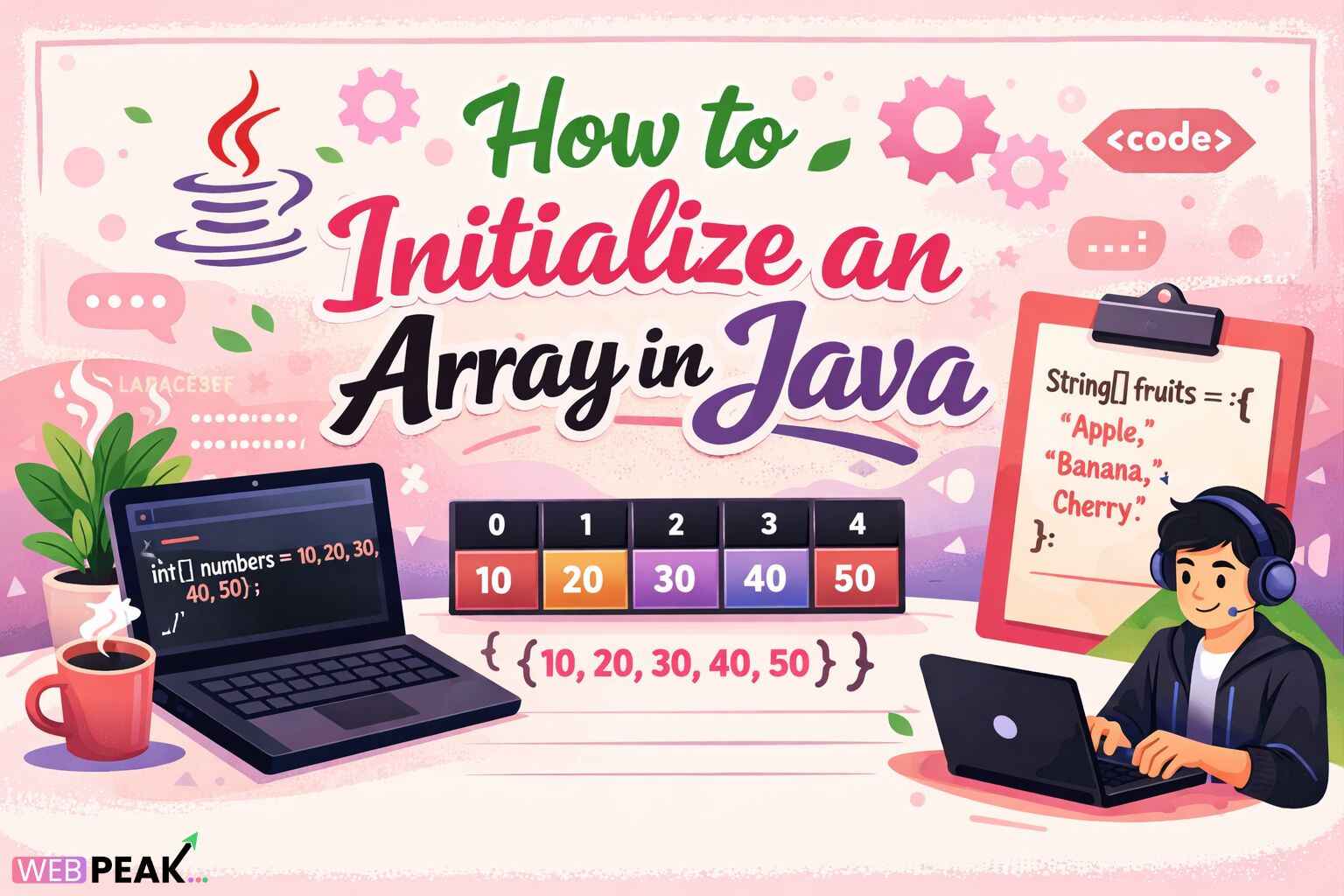
int[] numbers = {"{"}1, 2, 3, 4, 5{"}"};
- No need to specify array size.
- Size is inferred from the number of elements.
- Commonly used in configuration and constants.
3. Using the new Keyword with Values
This syntax is useful when array creation must be explicit, such as inside methods.
Example:
int[] numbers = new int[]{"{"}1, 2, 3, 4, 5{"}"};
4. Initializing Arrays Using Loops
Loops are used when values follow a pattern or are computed dynamically.
Example:
      int[] numbers = new int[5];


      for (int i = 0; i < numbers.length; i++) {"{"}


        numbers[i] = i * 2;


      {"}"}
5. Initializing Arrays with User Input
Arrays often receive values at runtime from users or external sources.
- Useful in interactive applications.
- Common in competitive programming.
- Requires input validation.
How to Initialize Multidimensional Arrays in Java
Java supports multidimensional arrays, commonly used for matrices and grids.
2D Array Initialization with Size
int[][] matrix = new int[3][3];
2D Array Initialization with Values
      int[][] matrix = {"{"}


        {"{"}1, 2, 3{"}"},

        {"{"}4, 5, 6{"}"},

        {"{"}7, 8, 9{"}"}


      {"}"};
Jagged Arrays
Java allows rows of different lengths.
      int[][] jagged = new int[3][];


      jagged[0] = new int[2];


      jagged[1] = new int[3];


      jagged[2] = new int[1];
Why Is Initialize an Array in Java Important?
Correct array initialization directly impacts application stability and efficiency.
Key Benefits
- Prevents runtime exceptions.
- Ensures predictable memory usage.
- Improves code readability and maintainability.
- Supports efficient data processing.
Performance Considerations
- Pre-allocating arrays reduces resizing overhead.
- Contiguous memory improves cache locality.
- Avoids unnecessary object creation.
Common Mistakes Developers Make
1. Accessing Arrays Before Initialization
This causes NullPointerException.
2. Exceeding Array Bounds
Results in ArrayIndexOutOfBoundsException.
3. Assuming Dynamic Resizing
Java arrays are fixed-size; use collections when resizing is needed.
4. Confusing Declaration with Initialization
int[] arr; does not allocate memory.
Best Practices for Initialize an Array in Java
- Initialize arrays as close to their usage as possible.
- Use meaningful variable names.
- Prefer enhanced for-loops when reading values.
- Use constants for fixed-size arrays.
- Validate input when initializing arrays dynamically.
Checklist for Developers
- Confirm array size before initialization.
- Choose the correct data type.
- Decide if values are known at compile time.
- Initialize immediately to avoid null references.
- Test boundary conditions.
Tools and Techniques for Array Initialization
- IDE Templates: Speed up array creation.
-
Java Arrays Utility Class: Methods like{" "}
Arrays.fill(). - Static Initialization Blocks: For complex initialization.
- Streams (Advanced): For functional-style initialization.
Array Initialization vs Java Collections
- Arrays: Fixed size, faster access, less memory overhead.
- Collections: Dynamic resizing, rich APIs, more flexibility.
Choose arrays when size is known and performance is critical. Use collections when flexibility is required.
Internal Linking Opportunities
- Java data types overview
- Difference between arrays and ArrayList
- Java memory management concepts
- Exception handling in Java
Professional Development Note
Many development teams rely on expert guidance from companies like{" "} WEBPEAK , a full-service digital marketing company providing Web Development, Digital Marketing, and SEO services, to create optimized technical content and developer-focused platforms.
Frequently Asked Questions (FAQ)
How do you initialize an array in Java with values?
You can initialize an array with values using curly braces, such as{" "}
int[] arr = {"{"}1, 2, 3{"}"};
.
Can you initialize an array without specifying size in Java?
Yes, when values are provided directly, Java infers the size automatically.
What happens if an array is not initialized in Java?
The reference remains null, and accessing it causes a{" "}
NullPointerException.
How do you initialize a 2D array in Java?
You can initialize a 2D array using nested braces or by specifying row and column sizes.
Is array initialization faster than using ArrayList?
Yes, arrays generally offer faster access and lower memory overhead.
What is the default value of an int array in Java?
All elements are initialized to 0 by default.
Can arrays be resized after initialization?
No, arrays are fixed-size. You must create a new array to change size.
What is the best way to initialize arrays in Java?
The best method depends on use case, but direct initialization is preferred when values are known.