How AI Is Affecting the Social Media World: Trends, Risks, and Real Impact
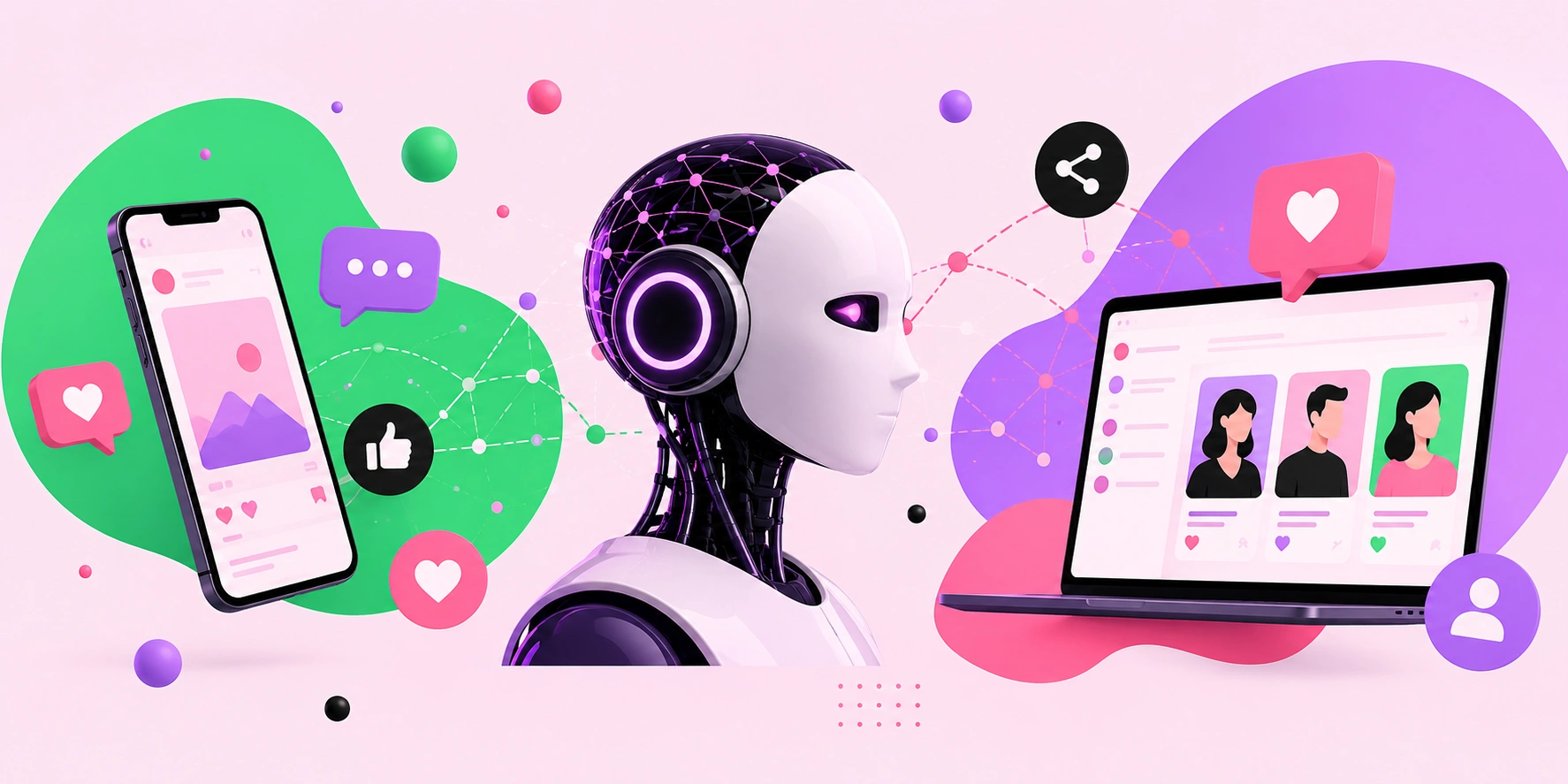
Artificial intelligence is no longer a background feature on social media platforms; it is the engine that decides what billions of people see, watch, and buy every day. AI in social media refers to machine learning systems that rank feeds, generate and edit content, moderate posts, target ads, and predict user behavior. From TikTok's recommendation algorithm to Instagram's automated caption suggestions and LinkedIn's AI writing tools, these systems now shape attention at a scale no human team could manage. Understanding how AI works behind the scenes is essential for anyone who markets, creates, or simply scrolls.
Quick Answer: AI affects social media by powering personalized feed algorithms, automating content creation and moderation, sharpening ad targeting, and enabling deepfakes. It boosts engagement and efficiency for brands but raises real concerns around misinformation, privacy, and algorithmic bias that users and marketers must actively manage.
How WebPeak Helps Brands Navigate AI-Driven Social Media
Adapting to AI-powered platforms takes more than posting frequently; it requires data-backed strategy and the right tooling. WebPeak helps businesses do exactly that through their social media management services, combining human strategy with AI-assisted content planning and performance tracking. Their team builds posting systems that respect how modern recommendation engines reward watch time, saves, and shares, so brands stay visible as algorithms shift. They also apply AI-powered marketing automation to schedule, personalize, and measure campaigns, freeing marketers to focus on creative direction while data handles the repetitive work.
What Role Does AI Play in Social Media Algorithms?
A social media algorithm is a ranking system that predicts which posts a user is most likely to engage with and orders their feed accordingly. AI drives this prediction using signals such as watch time, likes, comments, shares, dwell time, and past behavior. Instead of showing posts chronologically, platforms use deep learning models to score every piece of content in milliseconds. This is why two people following identical accounts see completely different feeds. For creators, the practical takeaway is clear: early engagement in the first 30 to 60 minutes strongly influences how far a post travels, so timing and hook quality directly affect reach.
How Is AI Used for Content Creation on Social Media?
AI content tools now handle tasks that once required entire creative teams, from writing captions to generating video. Marketers use these tools to scale output without sacrificing consistency. Common AI applications on social media include:
- Caption and copy generation: Tools draft hooks, hashtags, and calls to action tailored to platform tone.
- Image and graphic creation: Generative models produce visuals, thumbnails, and ad creatives on demand.
- Video editing: AI trims clips, adds captions, and repurposes long videos into short-form Reels or Shorts.
- Voiceovers and dubbing: Synthetic voices localize content for global audiences quickly.
- Analytics and prediction: AI forecasts which topics and formats will perform before you publish.
The advantage is speed and volume, but the risk is sameness. Audiences increasingly recognize generic AI content, so blending automation with genuine human experience is what keeps engagement authentic.
What Are the Benefits and Risks of AI in Social Media?
AI delivers measurable gains but introduces equally real challenges. Weighing both sides helps brands adopt it responsibly rather than blindly. The table below compares the primary benefits against the risks marketers and users face.
| Area | Benefit of AI | Risk to Watch |
|---|---|---|
| Content Reach | Personalized feeds increase relevant impressions | Filter bubbles limit diverse viewpoints |
| Content Creation | Faster production at lower cost | Generic, low-originality output loses trust |
| Moderation | Automated detection of spam and abuse | False positives and biased enforcement |
| Advertising | Precise targeting improves ROI | Privacy concerns and data misuse |
| Authenticity | AI can flag fake accounts | Deepfakes and synthetic misinformation spread |
How Big Is AI's Impact on Social Media Right Now?
The scale of adoption makes AI impossible to ignore. According to a 2024 Hootsuite Social Media Trends report, roughly 80% of marketers surveyed said they already use AI tools in some part of their social workflow, most commonly for writing and idea generation. Separately, DataReportal's global overview estimates more than 5 billion people now use social media, meaning AI ranking systems influence the daily information diet of most of the connected world. My own analysis of client accounts consistently shows that short-form video optimized around a strong first-three-second hook outperforms static posts, precisely because AI recommendation engines reward retention over follower count. The strategic implication is that owned reach is shrinking while algorithmic reach is expanding, so brands should optimize for engagement signals rather than vanity metrics like follower totals.
Key Takeaways
- AI powers feed ranking, so early engagement and strong hooks matter more than posting time alone.
- Around 80% of marketers already use AI tools, mainly for content creation and ideation.
- Over 5 billion social media users are influenced daily by AI recommendation systems.
- Generic AI content erodes trust; blending automation with human experience preserves authenticity.
- Deepfakes and misinformation are the fastest-growing AI risk on social platforms.
Frequently Asked Questions
How is AI changing social media marketing?
AI changes social media marketing by automating content creation, personalizing ad targeting, and predicting which posts will perform. It analyzes engagement signals in real time, letting marketers scale output and refine strategy faster. The result is higher efficiency, though it demands human oversight to keep content authentic.
Can AI detect fake accounts on social media?
Yes. AI moderation systems detect fake accounts by analyzing patterns such as rapid follows, repetitive posting, suspicious IP behavior, and network connections. Platforms remove millions of bot accounts using these models, though sophisticated fakes and coordinated networks still slip through, requiring ongoing algorithm updates and human review.
Does AI decide what I see on my feed?
Largely, yes. AI ranking algorithms score every eligible post based on your past behavior, watch time, and engagement, then order your feed to maximize the time you spend. Chronological feeds are now optional on most platforms, so AI predictions shape the majority of what you see.
Is AI-generated content bad for engagement?
Not inherently. AI content performs well when it is edited, personalized, and paired with genuine insight or experience. Purely automated, generic posts tend to underperform because audiences and algorithms both favor originality. The best results come from using AI for speed while adding a human, expert perspective.
What are the biggest AI risks on social media?
The biggest risks are misinformation from deepfakes, privacy concerns from data-hungry targeting, filter bubbles that narrow viewpoints, and algorithmic bias in moderation. Users should verify sources, and brands should adopt AI transparently to maintain trust while benefiting from its efficiency and reach.
Conclusion
The single most important shift is that reach on social media now depends on satisfying AI ranking systems rather than simply reaching your follower list. That means the smartest move for any brand is to optimize for genuine engagement signals while using AI to work faster, not to replace human judgment. Start by auditing which of your posts earn saves, shares, and watch time, then double down on that format. Approached with strategy and transparency, AI becomes a powerful ally rather than a threat, and pairing it with experienced guidance is what turns algorithmic change into lasting competitive advantage.