Feather Robotics Explained: What It Is and Why People Are Searching
Search for "Feather robotics" and you will land in two very different worlds: a new humanoid robot company and a long-running family of hobby microcontroller boards. Feather Robotics, in the sense most people now mean, is a startup building a modular, two-armed mobile robot that third-party developers can program as an open platform for physical AI, rather than a closed product with one fixed purpose.
Quick Answer: Feather Robotics is a startup founded in 2025 that sells a modular mobile humanoid robot with a wheeled base, two seven-degree-of-freedom arms, and an open Python and ROS 2 SDK. People search for it because it positions robot hardware as open, developer-friendly infrastructure for running AI models in the physical world.
What Exactly Is Feather Robotics?
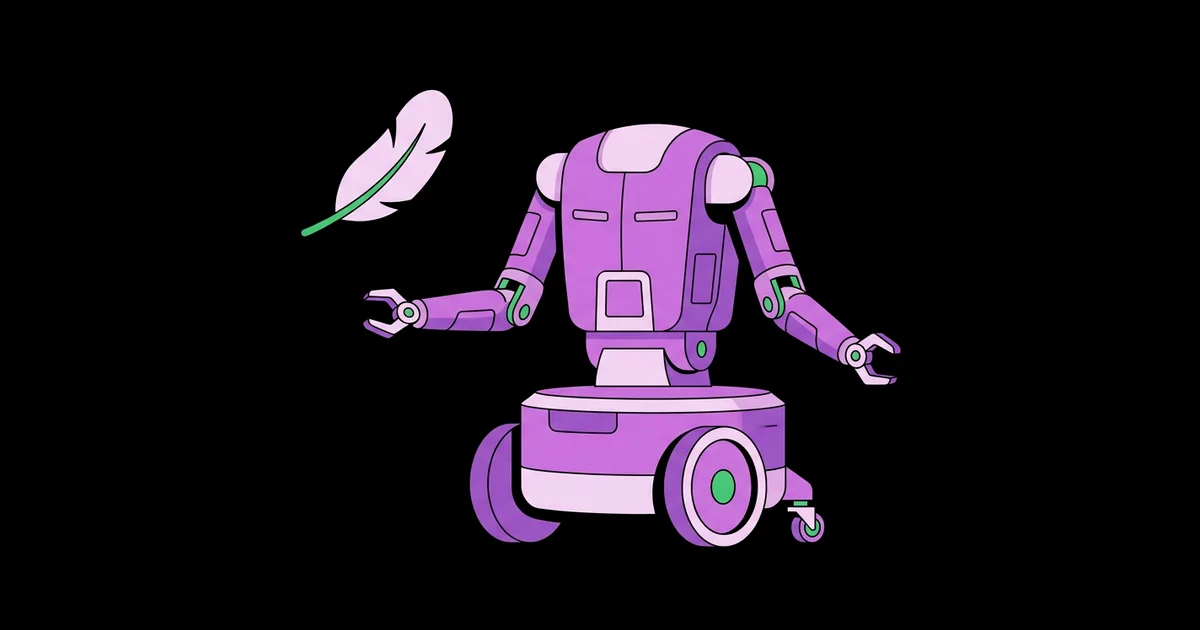
Feather Robotics is a hardware company whose product is a general-purpose mobile manipulator: a robot that can drive around a space and use two arms to handle objects. According to the company's public launch information and coverage of it, the robot combines a wheeled holonomic base, which can move in any direction without turning first, with dual arms that each have seven degrees of freedom, similar to the range of motion of a human arm.
The company was founded in 2025 by Hoa Mai and Parsa Bakhtiari. Its stated positioning is to be the hardware layer, not the brain. Instead of training its own proprietary foundation model, Feather exposes an open software development kit in Python and ROS 2 so developers can run robot models from other providers on the machine. That distinction matters, and it is the main reason the name keeps appearing in robotics discussions. If you are newer to the field and want to understand the building blocks first, a practical introduction to educational robotics kits covers motors, sensors, and controllers at a much smaller scale.
A few terms help here. Degrees of freedom describe how many independent ways a joint system can move; seven per arm allows reaching the same point from several elbow positions. ROS 2, the Robot Operating System version 2, is an open-source middleware framework that lets software components on a robot exchange messages. Physical AI is the industry phrase for AI models that perceive and act in the real world rather than only generating text or images.
Published pricing for the full system starts at $29,990, with configurable upgrades such as stronger onboard compute, dexterous hands, and better cameras. That places it well below many industrial robot arms paired with mobile bases, but firmly in the professional and research category rather than the hobby market.
Why Are So Many People Searching for It?
Search interest around Feather Robotics comes from several distinct groups, each with a different question in mind. Recognizing which group you belong to tells you which information actually matters.
- AI developers looking for a body. Teams building robot learning models need physical hardware to collect data and test policies. An open platform with a documented SDK lowers the barrier to experimenting without building a robot from scratch.
- Researchers and university labs. Mobile manipulators are central to research on household and warehouse tasks. A lower entry price and standard ROS 2 support make the platform relevant to labs comparing options.
- Investors and industry watchers. The humanoid and physical AI space has drawn heavy attention, so any new hardware company with a clear positioning gets tracked closely.
- Hobbyists confused by the name. Many searchers are actually looking for Adafruit Feather, a popular family of small development boards with a shared pin layout. These boards are widely used in hobby robots, which creates real overlap in search results.
- Curious general readers. News coverage of humanoid robots drives people to look up any company in the space to understand what is genuinely new.
The common thread is that the name sits at the intersection of two trends: rapid progress in AI models that control robots, and growing demand for affordable hardware to run those models on.
There is also a timing factor. When a young hardware company announces a product with a public price, it moves from rumor to something people can actually evaluate, and searches spike as engineers, buyers, and journalists look for specifications, demos, and comparisons. In my experience, the first wave of searchers wants to know what the robot is; the second wave, a few months later, wants to know whether it works in real deployments. If you are in that second group, prioritize hands-on reports, published SDK documentation, and customer case studies over launch-day coverage, because those sources reveal reliability, support quality, and real task performance far better than any announcement.
Feather Robotics vs. Adafruit Feather vs. Other Platforms
Because the name overlaps with an established hobby ecosystem, a side-by-side comparison clears up most confusion quickly.
| Platform | What It Is | Who It Is For | Software |
|---|---|---|---|
| Feather Robotics robot | Two-armed mobile humanoid robot platform | AI developers, research labs, businesses piloting automation | Open SDK in Python and ROS 2 |
| Adafruit Feather boards | Small microcontroller development boards with a common form factor | Hobbyists, students, makers building small robots and gadgets | Arduino, CircuitPython |
| Educational robot kits | Pre-designed wheeled or modular robots for learning | Kids, teens, classrooms | Block coding, Python, Arduino |
| Industrial robot arms | Fixed or rail-mounted precision manipulators | Factories, production lines | Vendor-specific controllers and languages |
If your budget is measured in tens of dollars, you want Adafruit Feather or a kit. If it is measured in tens of thousands and you need a mobile robot with arms, Feather Robotics is in the category you are researching.
Practitioner Analysis: Why the "Open Hardware Layer" Idea Matters
The most interesting thing about Feather Robotics is not a specific specification but its strategic bet: that robot hardware should behave like a computer, a general platform that runs software from many vendors. This is clearly framed practitioner analysis rather than a forecast, but the logic is worth unpacking because it shapes how you should evaluate any robot in this space.
For years, robots were sold as vertically integrated systems. The manufacturer controlled the hardware, the control software, and the applications. That made integration reliable but slow, and it locked customers into one vendor's roadmap. The rise of learned robot policies, where a model trained on demonstration data decides how the arms move, changes the economics. If models improve quickly and come from many labs, the most valuable hardware is the one that can run any of them.
The practical questions a developer should ask are therefore about openness and reliability rather than raw specs. How complete is the SDK documentation? Can you access raw sensor streams and low-level joint control, or only high-level commands? How easy is it to replace a worn gripper or upgrade compute? What does on-site support look like when something breaks mid-experiment? These questions also apply when models run directly on the robot instead of in the cloud, which is the territory covered in a plain-language explanation of edge AI with real examples.
The trade-off is equally clear. An open platform pushes more integration work onto the customer. Teams without robotics engineers may find a turnkey product easier, even if it is less flexible. Openness is a strength for builders and a cost for buyers who just want a task done.
Common Mistakes When Researching Feather Robotics
Most confusion around the topic comes from a few predictable errors, and avoiding them saves time.
- Mixing up the two Feathers. Tutorials about Adafruit Feather boards have nothing to do with the humanoid company. Check the context before following any guide.
- Treating launch claims as independent benchmarks. Capabilities described in company announcements are a starting point. Look for third-party demos, user reports, and published documentation before deciding.
- Comparing price without comparing scope. A cheaper robot that lacks arms, mobility, or SDK access is not a like-for-like alternative. Compare total capability and support.
- Ignoring the software burden. An open SDK means your team writes or integrates the intelligence. Budget engineering time, not just hardware cost.
- Assuming humanoid means human-level. A two-armed robot shape does not imply general-purpose competence. Performance depends on the model and training data you bring.
Real-World Scenario: Evaluating a Mobile Manipulator for a Lab
Here is how I would walk a small research team through evaluating Feather Robotics or any similar platform, step by step.
Define the task first. Write down two or three concrete tasks, such as picking items from a shelf and placing them in a bin, or opening drawers. Tasks determine whether you need two arms, mobility, dexterous hands, or a specific camera.
Audit the SDK. Request documentation and, ideally, sample code. Confirm you can subscribe to camera and joint-state topics in ROS 2, send joint or end-effector commands, and log data in formats your training pipeline accepts.
Plan compute placement. Decide which models run on the robot and which run on a nearby workstation. On-robot compute reduces latency; offboard compute allows larger models. Upgrade options matter here.
Check the physical environment. A wheeled base needs reasonably flat floors and space to maneuver. Measure doorways, aisles, and table heights against the robot's reach.
Budget beyond hardware. Include spare parts, safety equipment, staff time for integration, and data collection. In my experience, integration and data work cost more than the robot over a project's life.
Run a short pilot. If possible, test on your actual task before committing to multiple units. A week of real use reveals more than any specification sheet.
Your evaluation checklist: tasks defined, SDK verified, compute plan set, space measured, full budget estimated, and pilot results reviewed.
Key Takeaways
- Feather Robotics is a 2025 startup building a modular two-armed mobile robot positioned as open hardware for physical AI.
- Its open Python and ROS 2 SDK lets developers run robot models from other providers instead of a single proprietary system.
- Many searches for "Feather robotics" actually target Adafruit Feather boards, a separate hobby microcontroller ecosystem.
- Open robot platforms trade turnkey simplicity for flexibility, so they suit teams with engineering capacity.
- Evaluate any mobile manipulator by task fit, SDK depth, compute options, and total integration cost, not price alone.
Frequently Asked Questions
What does Feather Robotics make?
Feather Robotics makes a mobile humanoid-style robot with a wheeled base and two seven-degree-of-freedom arms. It is designed as an open platform, meaning developers program it through a Python and ROS 2 software kit and can run AI models from various providers rather than one built-in system.
How much does a Feather Robotics robot cost?
Published pricing for the full system starts at $29,990. Optional upgrades, including more powerful onboard computers, dexterous hands, and improved cameras, add to that base price. Always confirm current pricing directly with the company, because hardware startups adjust configurations and pricing as products mature.
Is Feather Robotics related to Adafruit Feather?
No. Adafruit Feather is a long-established family of small microcontroller boards sold to hobbyists and educators. Feather Robotics is a separate company building a full-size mobile robot. The shared name causes overlapping search results, so check which one a tutorial or product listing refers to.
Who should consider buying a Feather Robotics platform?
It suits AI developers, university research labs, and companies piloting robotic automation that have engineering staff. Teams that want a ready-made solution for one task, or hobbyists on small budgets, are usually better served by turnkey products or educational kits.
What is ROS 2 and why does it matter here?
ROS 2 is open-source robotics middleware that lets software components share sensor data and commands. Supporting it means Feather robots can work with a large ecosystem of existing tools, drivers, and research code, which shortens development time for teams already familiar with ROS.
Is Feather Robotics a good way for beginners to learn robotics?
Not usually. The platform is a professional research and development tool. Beginners learn faster and more affordably with microcontroller boards, Raspberry Pi projects, or educational robot kits, then move to advanced platforms once they understand motors, sensors, control loops, and programming fundamentals.
Conclusion
The key insight is that Feather Robotics is selling openness: a capable robot body that runs other people's AI models. Whether that is valuable depends entirely on whether your team wants to build intelligence or simply buy a finished task. If you are a developer or researcher, audit the SDK before anything else. If you are still learning, start smaller and build real skills first with beginner Arduino projects you can complete over a weekend, which teach the same sensing and control ideas at a fraction of the cost.