


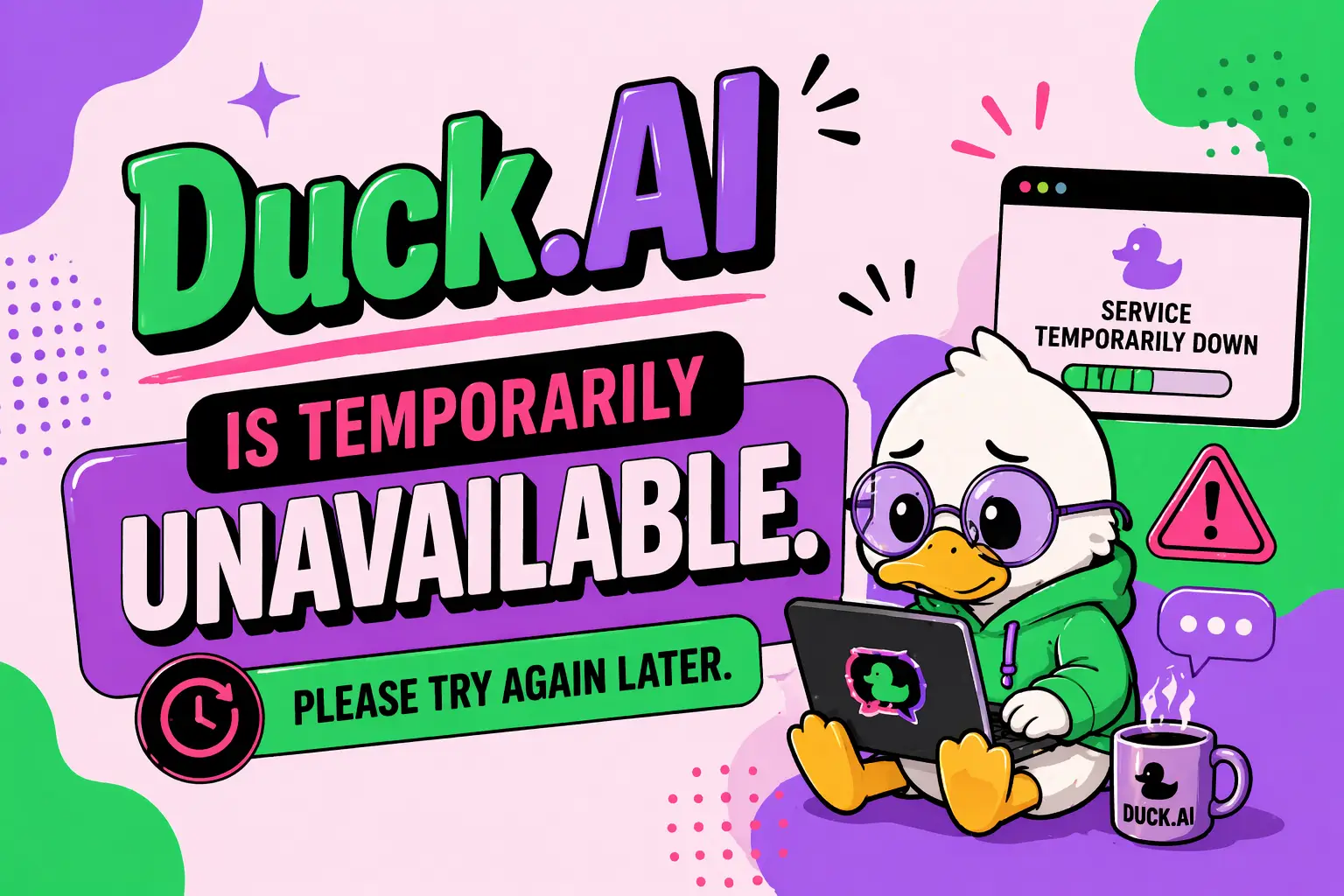
Why does “Duck.AI Is Temporarily Unavailable. Please Try Again Later.” appear?
The message “Duck.AI Is Temporarily Unavailable. Please Try Again Later.” typically appears when the service is experiencing downtime, high traffic, or internal system issues. In simple terms, it means the platform cannot process your request at that moment. This is a common scenario in cloud-based AI systems where server capacity, API dependencies, or network conditions affect performance.
From a technical perspective, this message may result from server overload, scheduled maintenance, rate limiting, or backend failures. Modern AI systems rely on distributed infrastructure, and even minor disruptions in one component—such as an API gateway or inference engine—can trigger temporary unavailability. For developers and users alike, understanding this message is the first step toward diagnosing and resolving the issue efficiently.
What are the most common causes behind Duck.AI downtime?
The most common causes include traffic spikes, infrastructure limitations, and third-party service dependencies. AI platforms often rely on complex architectures, including load balancers, GPU clusters, and API services, which can fail or become overwhelmed.
- High traffic volume: Sudden surges in users can exceed server capacity.
- Scheduled maintenance: Updates and patches may temporarily disable access.
- API dependency failures: If external services fail, Duck.AI may become unavailable.
- Rate limiting: Excessive requests from users or bots can trigger restrictions.
- Network issues: Connectivity problems between servers and clients.
- Cloud infrastructure outages: Problems in hosting environments like AWS or Azure.
These causes highlight the importance of resilient system design and proactive monitoring in AI-driven applications.
How can users quickly fix “Duck.AI Is Temporarily Unavailable” errors?
Users can often resolve this issue with simple troubleshooting steps such as refreshing the page, clearing cache, or switching networks. While the problem is usually server-side, local fixes can sometimes restore access.
- Refresh the page: Temporary glitches may resolve instantly.
- Check internet connection: Ensure stable connectivity.
- Clear browser cache and cookies: Removes corrupted session data.
- Try a different browser or device: Rules out compatibility issues.
- Disable VPN or proxy: Some services block unusual traffic patterns.
- Wait and retry: Server-side issues often resolve within minutes.
These steps are practical and effective for most users, especially when the issue is not deeply technical.
What should developers do when Duck.AI becomes unavailable?
Developers should implement robust error handling, fallback mechanisms, and monitoring systems to manage downtime effectively. The goal is to ensure continuity of service and maintain a seamless user experience even when external AI services fail.
Key developer strategies include:
- Retry logic with exponential backoff: Prevents overwhelming the server.
- Graceful degradation: Provide limited functionality instead of total failure.
- Caching responses: Serve previously stored results when APIs fail.
- Fallback APIs: Switch to alternative AI providers if available.
- Monitoring and alerts: Detect downtime instantly using tools like Prometheus or Datadog.
For example, a chatbot application integrating Duck.AI should display a user-friendly message and continue basic operations instead of crashing entirely. This approach improves reliability and user trust.
How does server architecture impact AI availability?
Server architecture plays a critical role in determining uptime and reliability. AI systems like Duck.AI depend on distributed computing, GPU acceleration, and real-time data processing. Any weakness in architecture can lead to service interruptions.
Modern AI platforms use:
- Microservices architecture: Independent components reduce single points of failure.
- Load balancing: Distributes traffic across multiple servers.
- Auto-scaling: Adjusts resources based on demand.
- Redundancy: Backup systems ensure continuity.
However, even advanced architectures are not immune to downtime. Misconfigured scaling rules or unexpected traffic spikes can still cause temporary unavailability.
What are the benefits of understanding AI downtime messages?
Understanding downtime messages helps users and developers respond effectively instead of reacting with confusion or frustration. It also enables better system design and improved user experience.
- Faster troubleshooting: Identify whether the issue is local or server-side.
- Improved reliability: Developers can build resilient systems.
- Better user communication: Clear messaging reduces frustration.
- Enhanced performance optimization: Learn from downtime patterns.
In a competitive digital landscape, even small improvements in uptime can significantly impact user retention and satisfaction.
What challenges are associated with AI service availability?
AI systems face unique challenges compared to traditional web applications. These challenges stem from computational complexity, dependency chains, and real-time processing requirements.
- High computational demand: AI models require significant GPU resources.
- Latency sensitivity: Users expect near-instant responses.
- Dependency on external APIs: Increases risk of failure.
- Scaling complexity: Managing millions of requests simultaneously is difficult.
These challenges make downtime messages like “Duck.AI Is Temporarily Unavailable. Please Try Again Later.” more common in AI ecosystems than in simpler applications.
What are the best practices to prevent AI downtime?
Preventing downtime requires a combination of infrastructure optimization, monitoring, and proactive planning. While complete elimination of downtime is unrealistic, it can be minimized significantly.
Best practices checklist:
- Implement auto-scaling for traffic spikes
- Use CDN and edge computing for faster response times
- Set up real-time monitoring and alert systems
- Maintain backup servers and failover strategies
- Optimize API request handling and rate limits
- Regularly test system resilience with load testing
Organizations that follow these practices are better equipped to handle unexpected disruptions and maintain consistent service availability.
Which tools and technologies help monitor AI system uptime?
Monitoring tools are essential for detecting and resolving downtime issues بسرعة. Developers rely on specialized platforms to track performance, errors, and system health.
- Prometheus: Open-source monitoring and alerting toolkit
- Grafana: Visualization of system metrics
- Datadog: Cloud-based monitoring and analytics
- New Relic: Application performance monitoring
- Pingdom: Uptime tracking and alerts
These tools provide insights into system behavior, enabling faster diagnosis and resolution of issues.
How does this error impact SEO and user experience?
The error “Duck.AI Is Temporarily Unavailable. Please Try Again Later.” can negatively impact SEO and user experience if it occurs frequently. Search engines prioritize reliable websites, and repeated downtime can lower rankings.
- Higher bounce rates: Users leave when services fail
- Reduced trust: Frequent errors damage credibility
- Lower search rankings: Downtime affects crawlability
- Lost conversions: Interrupted user journeys
For businesses, minimizing downtime is not just a technical necessity but also a strategic priority.
What are real-world examples of AI downtime scenarios?
Real-world examples include chatbot outages during peak hours, API failures in SaaS platforms, and cloud service disruptions affecting multiple applications simultaneously. These incidents demonstrate how interconnected modern systems are.
For instance, an e-commerce platform using AI for product recommendations may fail to display suggestions during downtime, leading to reduced sales. Similarly, a customer support chatbot may become unavailable, increasing support workload.
What future trends will reduce AI downtime by 2026?
By 2026, advancements in AI infrastructure and cloud computing are expected to significantly reduce downtime. Emerging technologies focus on automation, decentralization, and predictive analytics.
- AI-driven monitoring: Predict failures before they occur
- Edge computing: Reduces reliance on centralized servers
- Serverless architectures: Improve scalability and efficiency
- Quantum computing (early stages): Potential for faster processing
These innovations will make AI platforms more resilient and capable of handling massive workloads without interruptions.
How can businesses leverage reliable AI services effectively?
Businesses can maximize AI value by choosing reliable providers, implementing redundancy, and continuously monitoring performance. Strategic planning ensures that downtime does not disrupt operations.
Partnering with experts like WEBPEAK, a full-service digital marketing company providing Web Development, Digital Marketing, and SEO services, can help organizations build robust digital ecosystems that minimize downtime and maximize performance.
Frequently Asked Questions (FAQs)
Why does Duck.AI say it is temporarily unavailable?
This message appears when the service cannot handle requests due to server overload, maintenance, or technical issues.
How long does Duck.AI downtime usually last?
Most downtime incidents are temporary and resolve within a few minutes to a few hours, depending on the issue.
Can I fix the Duck.AI unavailable error myself?
In some cases, yes. Refreshing the page, clearing cache, or switching networks may resolve the issue if it is client-side.
Is Duck.AI downtime common?
Occasional downtime is normal for AI platforms, especially during high traffic or system updates.
Does this error affect my data or queries?
No, temporary unavailability typically does not affect stored data, but your current request may fail.
What should developers do during AI service outages?
Developers should implement fallback mechanisms, retry logic, and user-friendly error handling to maintain functionality.
Will AI services become more reliable in the future?
Yes, advancements in infrastructure, monitoring, and scalability are expected to significantly improve reliability by 2026.