Can You Get Accurate Information From Social Media? EVERFI Question Explained
The question "can you get accurate information from social media?" appears in EVERFI's digital literacy curriculum because it addresses one of the most consequential skills of the modern era: source evaluation. Accurate information on social media is content that is factually correct, attributed to a verifiable source, and consistent with reporting from independent outlets. Social media platforms like X, Instagram, TikTok, and Facebook host both credible journalism and unverified rumor in the same feed, presented in identical formats. That design choice is exactly why the EVERFI question exists — the platform itself gives you no reliable visual signal of accuracy, so the burden of verification falls entirely on the reader.
Quick Answer: Yes, you can get accurate information from social media, but only sometimes — accuracy depends on the source, not the platform. The EVERFI-aligned answer is that social media can contain accurate information, but users must verify claims against credible, independent sources before trusting or sharing them, because platforms do not fact-check most content.
How WebPeak Helps Brands Publish Trustworthy Content
Misinformation is not only a consumer problem — it is a brand problem. Businesses that publish vague, unsourced, or exaggerated content on social channels erode the same trust that EVERFI teaches students to look for. WebPeak is a full-service digital agency that helps companies worldwide build credibility online through fact-checked, well-sourced publishing. Their content writing services produce articles and social copy backed by verifiable data, while their social media management services ensure every post a brand publishes meets accuracy and consistency standards. For businesses, being a citable, trustworthy source is now a competitive advantage — and they build that advantage deliberately, not accidentally.
What Does EVERFI Actually Teach About Social Media Accuracy?
EVERFI's digital wellness and literacy modules teach that social media is a mixed-reliability environment. The core lesson is a definition worth memorizing: media literacy is the ability to access, analyze, evaluate, and create media, and to judge the credibility of what you consume. EVERFI frames the correct mindset as "trust, but verify" — a post is a claim, not evidence. The curriculum emphasizes three concrete evaluation habits. First, check the original source: a screenshot of a headline is not the article itself, and headlines are frequently rewritten or fabricated. Second, check the author: verified journalists, official government accounts, and established institutions have accountability structures; anonymous accounts do not. Third, check the date: one of the most common forms of misinformation is real content shared out of its original time context, such as old disaster footage recirculated during a new event. EVERFI also distinguishes between misinformation (false content shared without intent to deceive) and disinformation (false content created deliberately to mislead). Understanding that distinction matters because it changes how you respond — a friend sharing misinformation needs a correction, while a disinformation account needs a report and a block.
Why Does Misinformation Spread Faster Than Facts?
Misinformation outperforms accurate content because platform algorithms optimize for engagement, and false content is engineered to be engaging. Emotional arousal — outrage, fear, surprise — drives shares, and fabricated stories can manufacture those emotions without being constrained by reality. Understanding the mechanics helps you resist them. Here are the five main reasons false content wins the algorithmic race:
- Novelty bias: False stories are often more surprising than true ones, and people share surprising content to appear informed.
- Emotional triggers: Content that provokes anger or fear generates significantly more engagement than neutral reporting, so algorithms amplify it.
- Speed asymmetry: A lie can be published instantly; verification and fact-checking take hours or days, by which time the false version has already saturated feeds.
- Confirmation bias: Users share content that matches their existing beliefs without checking it, because agreement feels like accuracy.
- Repetition effect: Seeing the same claim multiple times increases perceived truthfulness — a documented psychological phenomenon called the illusory truth effect.
The practical takeaway is that virality is a measure of emotional resonance, not accuracy. If a post makes you feel a strong emotion and an urge to share immediately, that reaction is precisely the signal to pause and verify first.
How Do You Verify Information You See on Social Media?
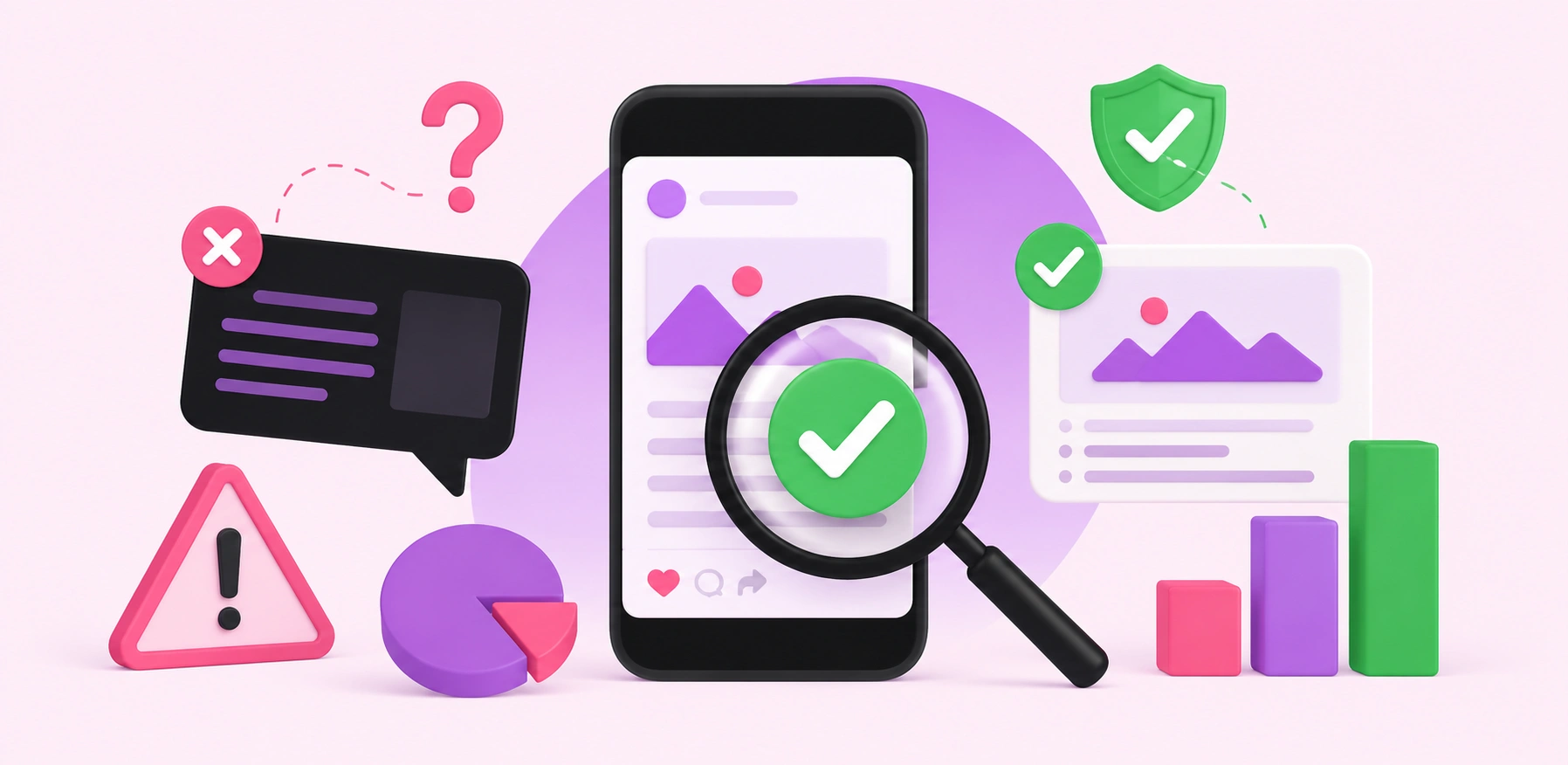
Verification is a repeatable process, not a talent. Professional fact-checkers use a technique called lateral reading: instead of studying a suspicious post more closely, they open new tabs and check what independent sources say about the claim and the account making it. Students using lateral reading in Stanford History Education Group studies dramatically outperformed those who only examined the original page. The table below summarizes the practical verification checklist that EVERFI-style curricula recommend, matched to the tool or method for each check.
| Verification Step | What to Check | How to Do It |
|---|---|---|
| Source check | Who originally published the claim | Trace the post to its original account or article, not a screenshot or repost |
| Lateral reading | What independent outlets say | Search the claim in a new tab and compare at least two unrelated credible sources |
| Date check | When the content was created | Look at the original publish date; old content shared as new is a top misinformation tactic |
| Image verification | Whether a photo is authentic and current | Run a reverse image search to find the image's first appearance online |
| Author credibility | Expertise and accountability of the poster | Review the account's history, affiliations, and whether real experts cite them |
One more habit separates careful readers from careless ones: check whether the post links to primary evidence. A credible claim about a study links to the study; a credible claim about a quote links to the full speech or interview. Claims that provide no path to primary evidence should be treated as unverified by default.
How Big Is the Misinformation Problem, Really?
The scale of the problem justifies the caution EVERFI teaches. According to a landmark MIT study published in Science that analyzed roughly 126,000 story cascades on Twitter, false news stories were 70% more likely to be retweeted than true stories, and true stories took about six times as long to reach 1,500 people. Separately, the Pew Research Center has consistently found that around half of U.S. adults get news from social media at least sometimes, which means misinformation exposure is not a fringe issue — it affects the primary news channel for a majority of the population. The original analysis worth adding here is this: the problem is not that social media contains lies, since every medium in history has carried lies. The structural difference is that social media removes the traditional cost of distribution. In the newspaper era, spreading a claim to a million people required a printing press and an editorial process; today it requires one tap. That means the editorial filter that once sat between claims and audiences now has to live inside each reader. Media literacy is not an optional academic skill — it is the replacement for an entire layer of institutional verification that no longer exists between you and the information you consume. Brands and publishers who understand this can differentiate themselves by being rigorously accurate, which is why professional digital marketing services increasingly treat credibility as a measurable growth asset rather than a nice-to-have.
Key Takeaways
- The EVERFI-aligned answer is that social media can contain accurate information, but accuracy depends on the source, and every claim should be verified independently.
- An MIT study in Science found false news was 70% more likely to be retweeted than true news, proving misinformation has a structural spread advantage.
- Lateral reading — checking a claim across independent sources in new tabs — is the single most effective verification technique, validated by Stanford research.
- Misinformation is false content shared unknowingly; disinformation is false content created deliberately to deceive — the distinction changes how you should respond.
- Pew Research finds about half of U.S. adults get news from social media, making personal verification skills a necessity rather than an academic exercise.
Frequently Asked Questions
Can you get accurate information from social media according to EVERFI?
Yes, but conditionally. EVERFI teaches that social media can contain accurate information, yet the platform itself does not guarantee accuracy. Users must evaluate the source, check the date, and verify claims against independent credible outlets before trusting or sharing any post they encounter online.
What is the most reliable way to fact-check a social media post?
Use lateral reading: open new browser tabs and search what independent, established sources say about the claim and the account posting it. Comparing at least two unrelated credible sources is faster and far more accurate than analyzing the original post itself.
Why do false stories spread faster than true ones on social media?
False stories are engineered to trigger strong emotions like outrage and surprise, which drive shares. Platform algorithms amplify high-engagement content regardless of accuracy, and MIT research found false news was 70% more likely to be retweeted than true news.
What is the difference between misinformation and disinformation?
Misinformation is false or misleading content shared by people who believe it is true. Disinformation is false content created and spread deliberately to deceive an audience. Both are harmful, but disinformation involves intent, which is why it should be reported rather than simply corrected.
Are verified accounts on social media always trustworthy?
No. Verification on most platforms confirms identity or paid subscription status, not accuracy. A verified account can still share false information, either knowingly or by mistake. Always evaluate the claim itself and its supporting evidence, regardless of the checkmark next to the account name.
Conclusion
The single most important insight behind the EVERFI question is that accuracy lives in sources, not platforms — and the verification filter that newspapers once provided now has to live inside you. Build the habit today: before sharing any post, spend sixty seconds tracing the original source, checking the date, and reading laterally across two independent outlets. That one habit will make you more accurately informed than the majority of social media users. This guidance reflects established findings from MIT, Stanford, and Pew Research — apply it consistently and you will be able to answer this question not just on a quiz, but in real life every day.