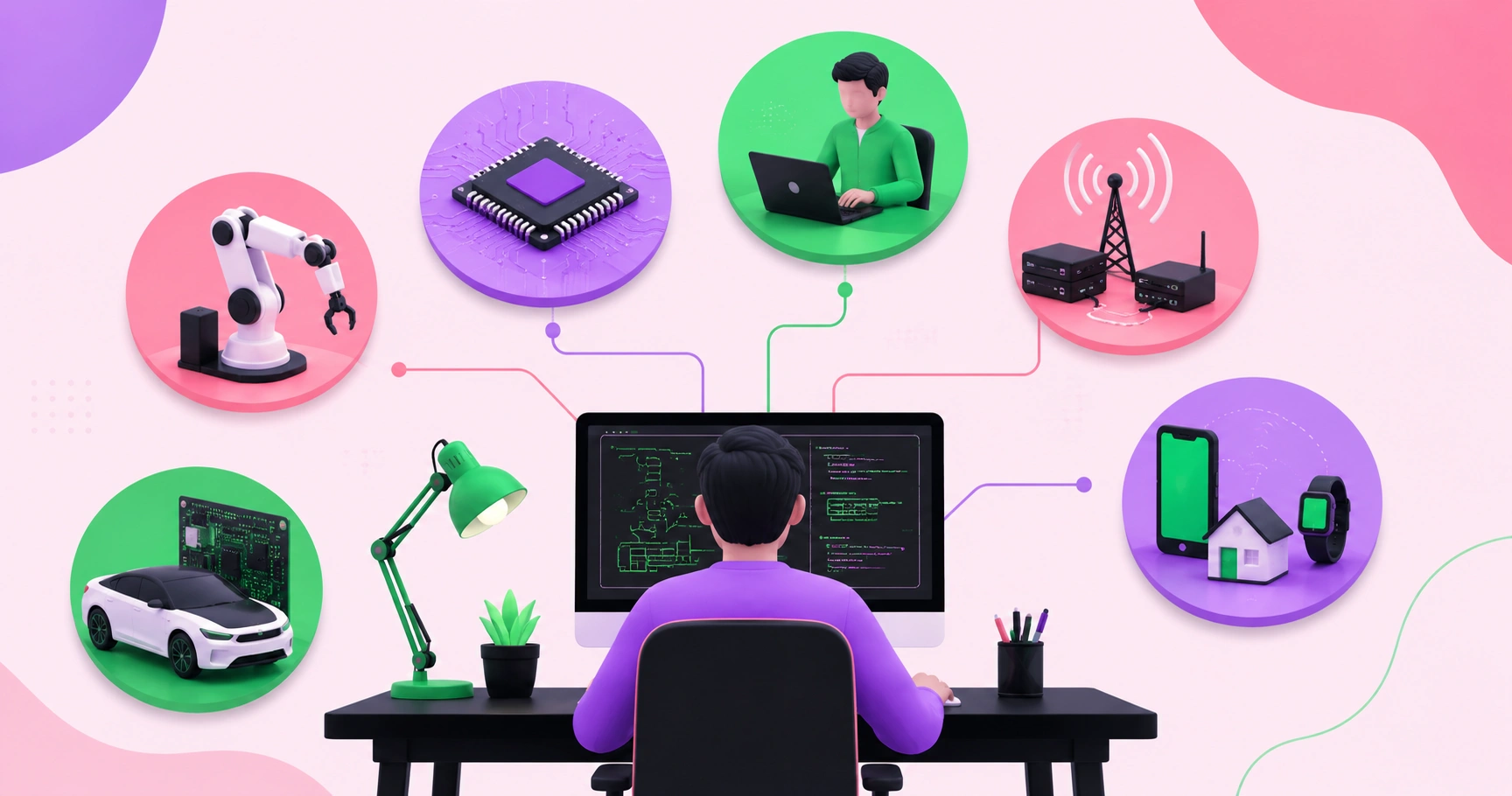
Careers With a Computer Engineering Degree: 12 Paths and How to Choose One
A computer engineering degree is an accredited engineering qualification that combines circuit theory, digital logic, computer architecture, and software development into one curriculum. In practical hiring terms, that means the degree qualifies you for roles that a pure computer science graduate cannot easily reach — such as chip verification or PCB bring-up — while still keeping every mainstream software role open. The difficulty most graduates face is not eligibility but selection. With twelve or more viable paths, indecision costs real money: each year spent in a poorly matched role delays the compounding of specialised skill that drives senior compensation. This guide lists the paths concretely and then gives a decision framework you can apply in an afternoon.
Quick Answer: Careers with a computer engineering degree include embedded systems engineer, firmware engineer, ASIC and FPGA designer, design verification engineer, robotics engineer, network engineer, cloud infrastructure engineer, software developer, hardware security specialist, DevOps engineer, technical product manager, and systems architect. Choose based on iteration speed, location flexibility, and how deeply you want to specialise.
Why a Strong Digital Presence Changes Engineering Job Outcomes
Engineering hiring has quietly become a content problem. Hiring managers search names, read project pages, and skim technical writing before scheduling interviews, so an engineer without a discoverable body of work competes on résumé keywords alone. WebPeak works with technical professionals and technology companies worldwide on exactly this gap — their web application development services are used to build interactive project showcases, dashboards, and documentation portals, while their content writing services help engineers turn dense technical work into clear case studies that non-specialist recruiters can follow. You can review their full service range at webpeak.org. For graduates leaning toward device-side careers, studying how mobile app development teams handle hardware constraints, battery use, and platform APIs is a useful bridge between embedded thinking and consumer product work.
What Are the Twelve Most Realistic Career Paths?
Each path below is a genuine job family with distinct interview loops, not a rebranding of the same role. Understanding the differences prevents wasted applications.
- Embedded Systems Engineer — writes software running directly on microcontrollers under tight memory and timing limits.
- Firmware Engineer — builds bootloaders, drivers, and hardware abstraction layers that let higher software talk to silicon.
- ASIC / FPGA Design Engineer — implements digital logic in hardware description languages for custom or reconfigurable chips.
- Design Verification Engineer — proves a chip design matches its specification before fabrication; often the highest-demand semiconductor role.
- Robotics Engineer — integrates sensors, actuators, and control loops into physical autonomous systems.
- Network Engineer — designs and troubleshoots routing, switching, and protocol-level infrastructure.
- Cloud Infrastructure Engineer — provisions and optimises compute, storage, and networking at scale using infrastructure as code.
- Software Developer — builds application or backend software; systems fundamentals become a competitive advantage in performance work.
- Hardware and IoT Security Specialist — audits secure boot, firmware integrity, and physical attack surfaces on connected devices.
- DevOps / Site Reliability Engineer — owns deployment pipelines, monitoring, and reliability targets for production systems.
- Technical Product Manager — translates engineering constraints into roadmaps and customer commitments.
- Systems Architect — defines how hardware and software components fit together across an entire product; usually a senior destination rather than a first job.
How Should You Choose Between These Paths?
Use three filters, applied in order, instead of chasing salary alone. First, feedback speed: hardware work has long cycles — a silicon respin or a PCB revision takes weeks, whereas a web deployment takes minutes. If slow feedback frustrates you, hardware-heavy tracks will feel punishing regardless of pay. Second, tooling access: chip design depends on expensive licensed EDA tools you cannot practise with at home, so entry usually requires university lab access or an internship. Embedded, cloud, and software paths can be practised with equipment costing less than a laptop. Third, location tolerance: semiconductor, automotive, and manufacturing roles cluster geographically and are frequently on-site, while cloud, DevOps, and software roles offer the widest remote availability. A candidate who honestly scores themselves on these three filters usually narrows twelve options to two or three within an hour. Then validate the shortlist by reading twenty real job descriptions per path and marking which required skills you already have — that gap list becomes your six-month study plan.
How Do These Careers Compare on Practical Trade-Offs?
The table below summarises the trade-offs that actually determine day-to-day satisfaction, based on patterns observed across engineering teams rather than on marketing claims about any single field.
| Career Path | Feedback Loop Speed | Remote Work Availability | Barrier to Self-Study |
|---|---|---|---|
| ASIC / FPGA Design | Slow — weeks to months per iteration | Low; often on-site near fabs and labs | High; requires licensed EDA tooling |
| Embedded / Firmware | Moderate — hours to days | Mixed; hardware access often required | Low; dev boards are inexpensive |
| Robotics | Moderate; simulation speeds it up | Low to mixed; lab hardware dependency | Moderate; simulators reduce cost |
| Cloud / DevOps | Fast — minutes | High; widely remote-friendly | Low; free tiers available |
| Software Development | Fast — minutes | High | Very low; open tooling everywhere |
| Hardware Security | Variable; research-driven | Mixed | Moderate; needs some lab equipment |
What Does Verifiable Data Say About Demand and Pay?
According to the U.S. Bureau of Labor Statistics Occupational Outlook Handbook, computer hardware engineering roles report a median annual wage above $150,000, while software developer employment is projected to grow substantially faster than the average across all occupations through the early 2030s. Read together, these two facts explain the real market shape: hardware pays strongly per role but adds fewer roles, whereas software adds far more openings. The Stack Overflow Developer Survey adds a third data point year after year — a large majority of professional developers report learning significant parts of their working stack outside formal education, which confirms that credentials open interviews while demonstrated skill closes offers.
An observation from practice that generic career articles miss: design verification is consistently one of the hardest semiconductor roles to fill, because it requires both programming ability and a verification mindset that many hardware-focused students never develop. Graduates who deliberately learn a verification methodology and build even one thorough test bench often find themselves with less competition than peers chasing crowded front-end roles. Similarly, engineers who combine firmware skill with security knowledge occupy an unusually thin talent segment, since most security professionals come from a software background and lack hardware intuition. Deliberately combining two adjacent skills is a more reliable differentiator than trying to be marginally better at one crowded skill.
Key Takeaways
- A computer engineering degree qualifies graduates for twelve or more distinct job families, each with its own interview process and skill emphasis.
- Choose a path using three filters — feedback loop speed, tooling access, and location tolerance — before comparing salaries.
- BLS data shows a median wage above $150,000 for computer hardware engineers, while software developer roles are projected to grow faster in volume.
- Design verification and hardware security are persistently under-supplied specialisations relative to applicant volume in general software roles.
- Combining two adjacent skills, such as firmware plus security, differentiates a candidate faster than incremental improvement in one crowded skill.
Frequently Asked Questions
What jobs can I get with a computer engineering degree right after graduation?
Realistic first roles include embedded software engineer, firmware engineer, hardware test or validation engineer, junior software developer, network engineer, and cloud support or infrastructure associate. Chip design roles usually expect internship experience or a master's degree, so target them through structured graduate programmes.
Is computer engineering harder than computer science?
Computer engineering typically includes more physics, circuits, and mathematics coursework, which many students find harder, while computer science goes deeper into theory and abstraction. Difficulty depends on aptitude: if you enjoy tangible systems and measurement, computer engineering often feels more intuitive than pure theory.
Can I switch from hardware to software later in my career?
Yes, and this direction is far easier than the reverse. Hardware engineers already program, understand memory and concurrency, and debug systematically. Building two portfolio applications and learning a modern framework is usually enough to transition, especially into backend, systems, or performance engineering roles.
Do computer engineering graduates need certifications?
Certifications help most in cloud, networking, and security paths, where vendor exams map directly to job tasks. For embedded, firmware, and chip design, employers weigh projects, internships, and technical interviews far more heavily, so time is better spent building demonstrable hardware work.
Which computer engineering career has the best work-life balance?
Cloud infrastructure and software development roles generally offer the most flexibility and remote options. Chip design faces intense pre-tape-out deadlines, and firmware teams often work around hardware launch schedules. Ask about release cadence and on-call expectations during interviews to assess this accurately.
Conclusion
The decision that matters most is not which of the twelve paths sounds impressive, but which trade-off you can sustain for the next five years — slow-cycle depth or fast-cycle flexibility. Score yourself honestly on feedback speed, tooling access, and location tolerance, shortlist two paths, then read twenty job descriptions and turn every missing requirement into a study task. Engineers who commit to a specific path and document their progress publicly consistently move faster than those who stay broadly qualified and narrowly demonstrated. Specificity, backed by evidence you can show, is what earns trust in engineering hiring.