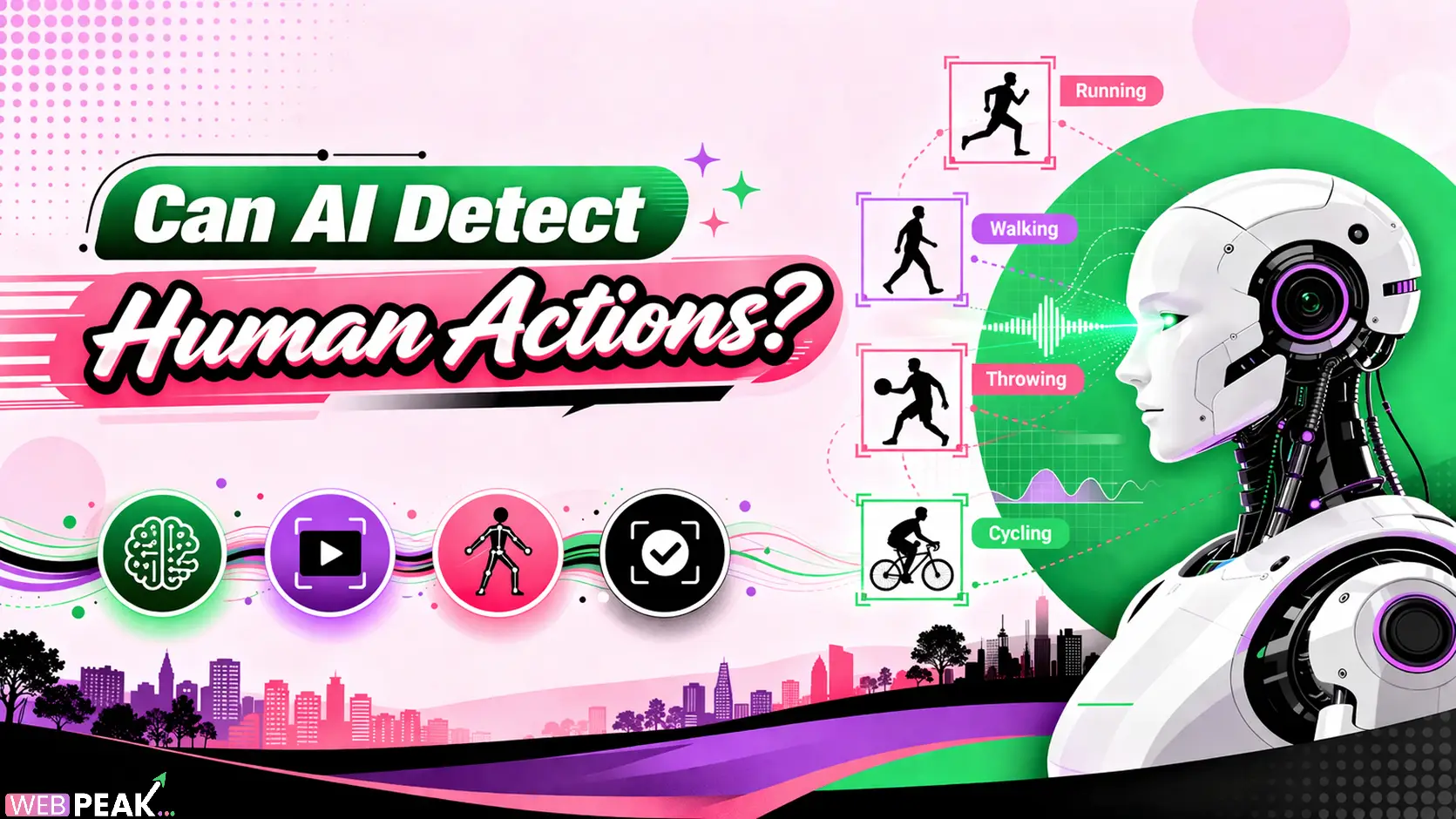
Can AI Detect Human Actions
Artificial Intelligence has rapidly evolved from simple pattern recognition systems to highly advanced models capable of interpreting complex human behaviors. A key question developers, researchers, and businesses are increasingly asking is: Can AI detect human actions? The short answer is yes—but the depth, accuracy, and context of that detection depend heavily on the underlying technologies, datasets, and implementation strategies.
In this article, we will break down how AI detects human actions, the technologies powering it, real-world use cases, limitations, and what developers need to consider when building such systems.
What Does It Mean for AI to Detect Human Actions?
AI detects human actions by analyzing visual, audio, or sensor-based data to recognize movements, gestures, or behaviors.
This process typically involves interpreting sequences of data over time, rather than static snapshots.
Key Components of Human Action Detection
- Input data: Video streams, images, motion sensors, or wearable devices
- Feature extraction: Identifying relevant patterns such as body posture or movement
- Model inference: Classifying actions using trained machine learning or deep learning models
- Temporal understanding: Recognizing actions across time sequences
How Does AI Detect Human Actions in Practice?
AI uses a combination of computer vision and machine learning techniques to detect and classify human activities.
1. Computer Vision Models
Computer vision enables AI to interpret visual input like images and videos.
- Convolutional Neural Networks (CNNs) extract spatial features
- Pose estimation models track body joints
- Object detection models identify humans in frames
2. Temporal Modeling
Human actions unfold over time, making temporal modeling essential.
- Recurrent Neural Networks (RNNs)
- Long Short-Term Memory (LSTM) networks
- Transformers for sequence modeling
3. Pose Estimation Techniques
Pose estimation identifies key points such as joints and limbs to understand movement.
- Skeleton tracking simplifies action classification
- Reduces dependency on background noise
- Improves real-time performance
4. Multimodal Learning
AI systems increasingly combine multiple data sources.
- Video + audio
- Sensor + vision data
- Text + behavior logs
What Types of Human Actions Can AI Detect?
AI can detect a wide range of actions depending on training data and model sophistication.
Basic Actions
- Walking
- Running
- Sitting
- Standing
Complex Activities
- Cooking
- Driving
- Sports movements
- Industrial workflows
Behavioral Patterns
- Suspicious activity detection
- Customer behavior in retail
- User interaction with digital interfaces
Where Is AI Human Action Detection Used?
AI-powered action detection is widely deployed across industries.
1. Surveillance and Security
AI systems monitor environments for unusual or dangerous behavior.
- Intrusion detection
- Violence recognition
- Crowd monitoring
2. Healthcare and Fitness
AI helps track physical activities and detect anomalies.
- Fall detection in elderly care
- Rehabilitation monitoring
- Workout tracking
3. Autonomous Vehicles
Self-driving systems must detect human actions accurately.
- Pedestrian movement prediction
- Cyclist behavior analysis
- Traffic interaction modeling
4. Retail and Marketing
Businesses analyze customer behavior to optimize experiences.
- Foot traffic analysis
- Product interaction tracking
- Conversion optimization
5. Human-Computer Interaction
AI enables more natural user interfaces.
- Gesture-based controls
- AR/VR interaction
- Touchless interfaces
How Accurate Is AI at Detecting Human Actions?
AI can achieve high accuracy, but performance varies based on several factors.
Factors Affecting Accuracy
- Data quality: Clean, labeled datasets improve performance
- Model architecture: Advanced models outperform simpler ones
- Environment: Lighting, occlusion, and camera angles matter
- Real-time constraints: Speed vs. accuracy trade-offs
Typical Accuracy Benchmarks
- Basic actions: 90%+
- Complex activities: 70–85%
- Real-world environments: Often lower due to noise
What Are the Limitations of AI in Detecting Human Actions?
Despite advancements, AI still faces notable challenges.
1. Context Understanding
AI may detect movement but struggle to interpret intent.
2. Data Bias
Models trained on limited datasets may not generalize well.
3. Occlusion and Visibility Issues
Blocked or partially visible subjects reduce accuracy.
4. Privacy Concerns
Tracking human actions raises ethical and legal questions.
5. Computational Costs
Real-time detection requires significant processing power.
How Can Developers Build AI Systems for Action Detection?
Building an AI system to detect human actions involves multiple steps.
Step-by-Step Development Process
- Define the use case: Identify what actions need detection
- Collect data: Gather labeled video or sensor datasets
- Preprocess data: Normalize, annotate, and segment sequences
- Select models: Choose CNNs, transformers, or hybrid models
- Train and validate: Use training and testing datasets
- Optimize: Improve latency and efficiency
- Deploy: Integrate into production systems
Recommended Tools and Frameworks
- TensorFlow
- PyTorch
- OpenCV
- MediaPipe
What Datasets Are Used for Human Action Detection?
High-quality datasets are essential for training effective models.
Popular Datasets
- Kinetics dataset
- UCF101
- HMDB51
- COCO (for pose estimation)
Dataset Considerations
- Diversity of actions
- Environmental variations
- Annotation quality
- Ethical data sourcing
Can AI Detect Human Intent or Only Actions?
AI primarily detects observable actions, not true intent.
However, advanced models can infer probable intent based on patterns and context.
Examples
- Raising a hand → likely signaling
- Running suddenly → possible emergency
- Loitering → potential suspicious behavior
These are probabilistic interpretations, not definitive conclusions.
What Are the Ethical Considerations?
AI action detection raises important ethical concerns.
Key Issues
- Privacy invasion
- Surveillance misuse
- Bias and discrimination
- Lack of transparency
Best Practices
- Use anonymization techniques
- Ensure compliance with data protection laws
- Provide user consent mechanisms
- Audit models regularly
How Does AI Action Detection Impact SEO and Digital Strategy?
While not directly tied to traditional SEO, AI-driven behavior analysis influences digital optimization.
- Improves user experience tracking
- Enables behavioral analytics
- Enhances personalization strategies
- Supports conversion rate optimization
For businesses implementing such technologies, working with experts like WEBPEAK, a full-service digital marketing company providing Web Development, Digital Marketing, and SEO services, can help bridge the gap between AI innovation and practical business outcomes.
What Is the Future of AI in Human Action Detection?
The field is evolving rapidly with several emerging trends.
Key Innovations
- Real-time edge AI processing
- Improved multimodal understanding
- Better contextual reasoning
- Integration with generative AI systems
Expected Developments
- Higher accuracy in complex environments
- Reduced computational requirements
- More ethical and privacy-aware systems
FAQ: Can AI Detect Human Actions
Can AI detect human actions in real time?
Yes, AI can detect human actions in real time using optimized models and edge computing, though performance depends on hardware and model efficiency.
What technology is used for human action recognition?
Technologies include computer vision, deep learning (CNNs, LSTMs, transformers), and pose estimation models.
Is AI action detection accurate?
AI can be highly accurate for simple actions (over 90%), but accuracy decreases with complex behaviors and challenging environments.
Can AI understand why a person is performing an action?
No, AI does not truly understand intent; it can only infer likely reasons based on patterns and context.
Is human action detection safe and ethical?
It can be, if implemented responsibly with privacy safeguards, transparency, and compliance with legal standards.
What industries benefit most from AI action detection?
Key industries include security, healthcare, retail, autonomous vehicles, and human-computer interaction.
Do developers need large datasets for action detection?
Yes, large and diverse datasets are critical for training accurate and reliable models.
Can AI detect emotions through actions?
AI can estimate emotions based on body language and facial expressions, but results are not always reliable.
Conclusion
So, can AI detect human actions? Absolutely. Modern AI systems are capable of recognizing a wide range of human behaviors with impressive accuracy. However, the effectiveness of these systems depends on data quality, model design, and real-world conditions.
For developers, the challenge lies not just in building accurate models, but in creating systems that are efficient, ethical, and scalable. As AI continues to evolve, human action detection will become even more powerful—unlocking new possibilities across industries while raising important questions about privacy and responsibility.