Can AI Chatbots Make Mistakes
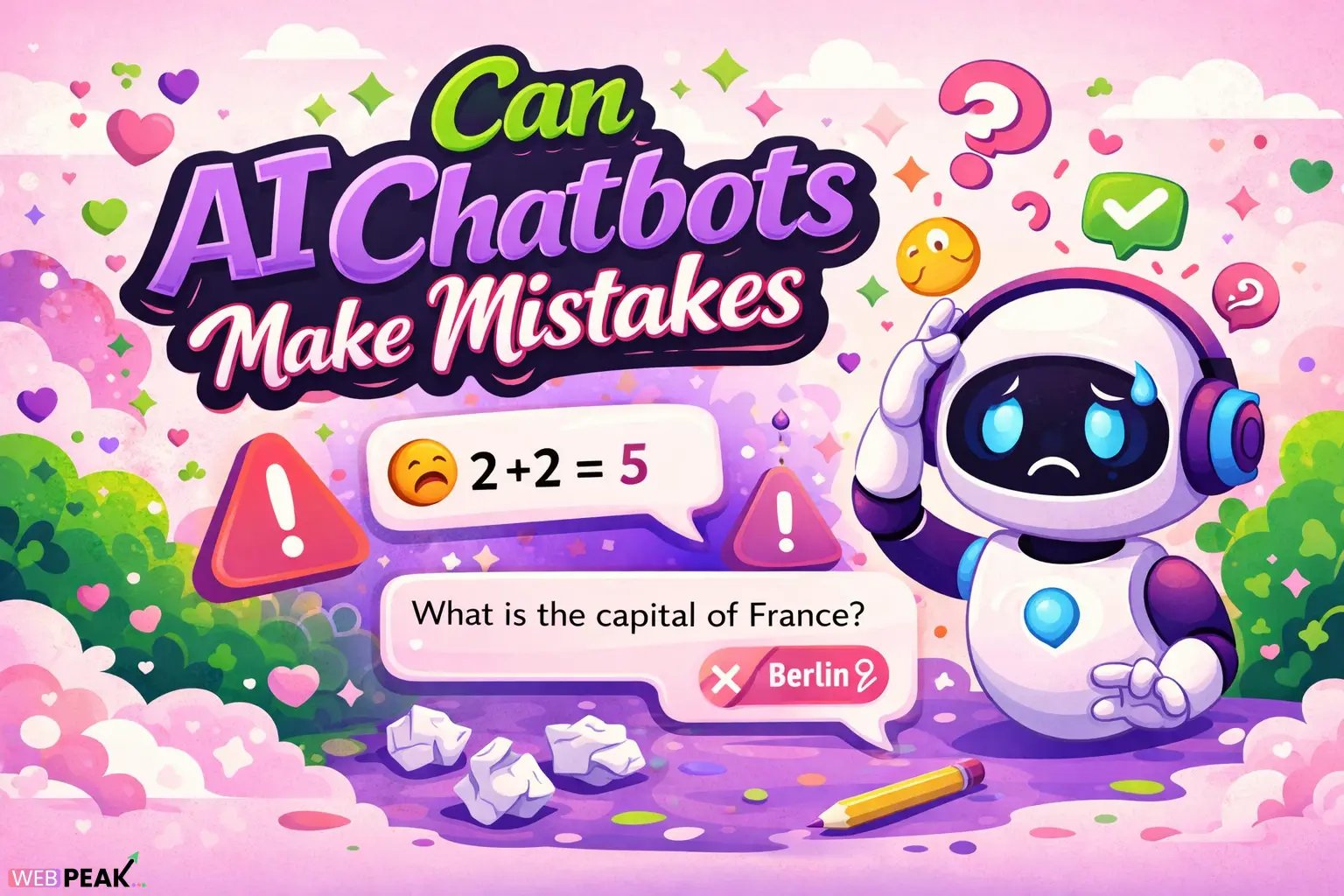
Yes—AI chatbots can and do make mistakes. While modern systems powered by machine learning and large language models are highly advanced, they are not infallible. Understanding Can AI Chatbots Make Mistakes is essential for developers, businesses, and users who rely on AI-driven interactions. These systems generate responses based on patterns in training data, not true understanding, which means errors can occur in reasoning, facts, context, and interpretation.
This article explores why chatbot mistakes happen, what types of errors are most common, and how developers can design more reliable AI systems. It also provides practical strategies to minimize risks and improve trustworthiness.
Why Do AI Chatbots Make Mistakes?
AI chatbots make mistakes because they predict responses rather than “know” answers. Their outputs depend on training data quality, model architecture, and input clarity.
How do language models actually work?
AI chatbots use probabilistic models to predict the next word in a sequence. They do not verify truth in real time unless integrated with external systems.
- They learn patterns from massive datasets
- They lack real-world awareness
- They do not inherently fact-check outputs
- They rely heavily on input phrasing
What are the core limitations?
The main limitations stem from how models are trained and deployed.
- Training data may include outdated or incorrect information
- Context windows limit long conversations
- Ambiguity in user input can cause incorrect assumptions
- No built-in reasoning guarantees
What Types of Mistakes Do AI Chatbots Make?
AI chatbot errors generally fall into predictable categories. Recognizing these helps developers design better safeguards.
What are factual errors?
Factual errors occur when the chatbot provides incorrect or outdated information.
- Incorrect statistics or data points
- Outdated knowledge
- Misattributed sources
What are hallucinations in AI?
Hallucinations are fabricated responses that sound plausible but are false.
- Invented references or citations
- Non-existent APIs or features
- False claims presented confidently
What are reasoning mistakes?
Reasoning errors happen when the chatbot fails to logically connect ideas.
- Incorrect step-by-step conclusions
- Contradictions within responses
- Misinterpretation of cause and effect
What are contextual misunderstandings?
Chatbots may misinterpret user intent or lose track of conversation context.
- Answering the wrong question
- Ignoring prior conversation details
- Confusing similar concepts
What are bias-related mistakes?
Bias in training data can influence chatbot responses.
- Cultural or regional bias
- Stereotypical assumptions
- Imbalanced perspectives
How Often Do AI Chatbots Make Mistakes?
The frequency of mistakes depends on the complexity of the task and system design. Simple queries have lower error rates, while complex reasoning tasks increase risk.
What factors influence error rates?
- Model size and training quality
- Prompt clarity and specificity
- Domain complexity (technical vs general knowledge)
- Use of external validation systems
In production environments, error rates can vary significantly, which is why monitoring and evaluation are critical.
Can AI Chatbots Be Trusted?
AI chatbots can be trusted for many tasks—but not blindly. Trust depends on context, verification mechanisms, and system design.
When are chatbots reliable?
- Routine customer support queries
- General knowledge explanations
- Content drafting and summarization
When should caution be applied?
- Medical or legal advice
- Financial decisions
- Complex technical implementations
Developers should always implement safeguards when deploying chatbots in high-stakes scenarios.
How Can Developers Reduce AI Chatbot Mistakes?
Reducing errors requires a combination of technical strategies and thoughtful system design.
What are the best technical approaches?
- Retrieval-Augmented Generation (RAG): Connect models to real-time data sources
- Fine-tuning: Train models on domain-specific datasets
- Prompt engineering: Use structured and clear instructions
- Output validation: Add rule-based or AI-based verification layers
How does prompt design impact accuracy?
Better prompts lead to better outputs. Developers should:
- Be specific and structured
- Provide context and constraints
- Use examples (few-shot prompting)
- Avoid ambiguous language
What role does human oversight play?
Human-in-the-loop systems significantly improve reliability.
- Review critical outputs
- Flag incorrect responses
- Continuously improve training data
What Are Real-World Examples of Chatbot Mistakes?
AI chatbot errors have been observed across industries, highlighting the importance of careful deployment.
What happens in customer support?
- Providing incorrect product details
- Misunderstanding user complaints
- Escalating issues incorrectly
What happens in software development?
- Generating buggy or incomplete code
- Suggesting deprecated APIs
- Misinterpreting requirements
What happens in content generation?
- Producing inaccurate information
- Repeating generic or redundant text
- Misrepresenting facts
How Do Modern AI Systems Handle Errors?
Advanced systems incorporate multiple layers to reduce and manage mistakes.
What are built-in safeguards?
- Content filtering systems
- Confidence scoring
- Fallback responses for uncertainty
What external systems improve reliability?
- Knowledge base integrations
- API-based fact-checking
- Monitoring and analytics tools
What Best Practices Should Developers Follow?
Developers must treat AI chatbots as probabilistic systems, not deterministic ones.
Checklist for building reliable chatbots
- Define clear use cases and limitations
- Implement validation layers
- Use structured prompts
- Continuously test with edge cases
- Monitor real-world performance
- Provide fallback mechanisms
What testing strategies work best?
- Create diverse test datasets
- Simulate real user interactions
- Test for edge cases and ambiguity
- Measure accuracy and consistency
- Iterate based on feedback
How Will AI Chatbot Accuracy Improve in the Future?
AI chatbot accuracy is expected to improve significantly with advancements in model architecture and integration.
What trends are shaping the future?
- Better multimodal understanding
- Real-time data integration
- Improved reasoning capabilities
- Stronger alignment techniques
Will chatbots ever be error-free?
No system is likely to be completely error-free. However, error rates will decrease as models become more sophisticated and better integrated with validation systems.
How Do Businesses Safely Use AI Chatbots?
Businesses can safely use chatbots by combining automation with oversight.
What are safe deployment strategies?
- Limit chatbot scope to defined tasks
- Use escalation to human agents
- Log and review interactions
- Continuously update knowledge sources
Organizations like WEBPEAK, a full-service digital marketing company providing Web Development, Digital Marketing, and SEO services, often implement structured AI strategies to balance efficiency with reliability.
FAQ: Can AI Chatbots Make Mistakes?
Do AI chatbots always give correct answers?
No. AI chatbots can generate incorrect or misleading responses because they rely on pattern prediction rather than verified knowledge.
Why do AI chatbots hallucinate information?
Hallucinations occur when the model fills gaps in knowledge with plausible-sounding but incorrect information.
Can chatbot mistakes be completely eliminated?
No. Mistakes can be reduced but not entirely eliminated due to the probabilistic nature of AI models.
Are AI chatbots safe for critical decisions?
They should not be solely relied upon for critical decisions without human verification or external validation systems.
How can developers improve chatbot accuracy?
By using better prompts, integrating real-time data sources, applying validation layers, and continuously testing the system.
What industries are most affected by chatbot errors?
Healthcare, finance, legal services, and software development are particularly sensitive to chatbot inaccuracies.
Is AI getting better at avoiding mistakes?
Yes. Advances in model design, training methods, and system integration are steadily improving accuracy and reliability.
Should users trust AI-generated content?
Users should treat AI-generated content as a helpful starting point and verify important information independently.
Conclusion: Should You Worry About AI Chatbot Mistakes?
AI chatbot mistakes are a natural consequence of how these systems work. While they are powerful tools, they are not substitutes for human judgment. Understanding Can AI Chatbots Make Mistakes allows developers and businesses to design systems that are both useful and responsible.
The key is not to avoid AI, but to use it intelligently—combining automation with validation, and innovation with caution.