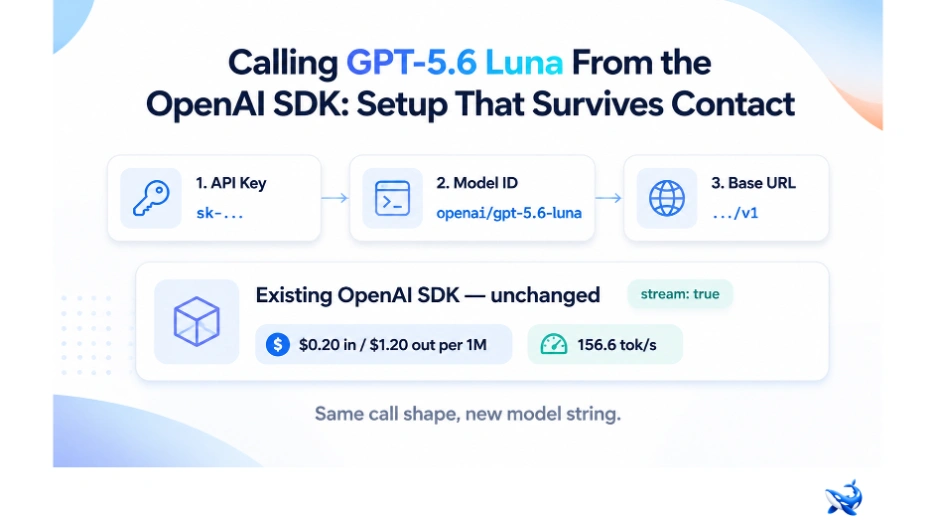
GPT-5.6 Luna API is OpenAI's economy-tier reasoning model — released July 9, 2026, priced at $0.20 per million input tokens and $1.20 per million output after the price cut, per OrcaRouter's catalog [OURS] — and it speaks the standard OpenAI chat-completions dialect, which means if your codebase already uses the OpenAI SDK, there is no new SDK to learn: a key, a model string (openai/gpt-5.6-luna) and a base URL, and you are in business. The same call shape works across the whole Sol / Terra / Luna family and, through a router, across other vendors' models on one key; for the tier-by-tier pricing and what each family member costs per million tokens, GPT-5.6 Luna carries the live rate card.
This piece is the hands-on version: what "OpenAI-compatible" actually buys you, the three-line setup, the one parameter that changes your bill, the two failure modes worth planning for before the first request hits production — and why an integration this small still needs a migration story. "Survives contact" is the goal: your client code should outlast model releases, price cuts and provider changes.
What "OpenAI-SDK compatible" means for Luna
The phrase is doing real work. It means Luna exposes the same request and response schema as OpenAI's own chat completions — the same messages array, the same stream flag, the same error envelope — so the official OpenAI SDK, in Python, TypeScript, or any of its ports, talks to it with no adapter layer. Luna is a proprietary, closed-weights model that Artificial Analysis flags as multimodal (text and image input, text output) and "notably fast" [INDEPENDENT], but on the wire it behaves like any other completion endpoint.
That is why the integration is small even though the model is new. The family shares the surface: Sol (flagship, $5 / $30), Terra (balanced default, $2 / $12 after its ~20% cut from $2.50 / $15), and Luna (economy, $0.20 / $1.20 after an ~80% cut from the launch $1 / $6) — all post-cut figures from OrcaRouter's catalog [OURS]. Swapping between them is a one-string change, not a codebase change. The model ID on OrcaRouter's catalog is openai/gpt-5.6-luna, and that string is the only Luna-specific thing in your request.
The three-line setup
You need exactly three things, and only one of them is a Luna thing:
1. A key. OpenAI's own API or a third-party platform that routes to the model. The examples below use OrcaRouter's endpoint, which passes OpenAI's list price through at 0% markup and keeps Luna behind the same key as 200-plus other models.
2. The model string openai/gpt-5.6-luna.
3. A base URL. OpenAI's is https://api.openai.com/v1; a router's is its own …/v1 endpoint.
In Python, the whole setup is a client constructor:
```python
from openai import OpenAI
client = OpenAI(
base_url="https://api.orcarouter.ai/v1",
api_key=os.environ["ORCAROUTER_API_KEY"],
)
resp = client.chat.completions.create(
model="openai/gpt-5.6-luna",
messages=[
{"role": "system", "content": "You are a careful senior engineer."},
{"role": "user", "content": "Summarize this 2,000-line diff into five risks."},
],
)
print(resp.choices[0].message.content)
```
TypeScript is the same shape with baseURL and apiKey. The idiomatic way to keep keys out of code and out of logs is environment configuration: ORCAROUTER_API_KEY in your .env, read at process start. Treat the base URL as config too — the whole point of the OpenAI-compatible surface is that the endpoint is a deployment detail, not a code decision.
Config
Value
Why it matters
base_url / baseURL
your endpoint's …/v1
the only thing that changes per provider
model
openai/gpt-5.6-luna
picks the economy tier of the family
api_key / apiKey
from env
keeps the credential out of code and git
stream
true for anything a human waits on
turns one long response into an SSE stream

The one parameter that changes your bill
Luna is a reasoning model, and reasoning effort is a request parameter you can set rather than inherit. It is the most consequential knob in the integration, for one reason: reasoning tokens bill as output, and at $1.20 per million output tokens after the cut [OURS], how hard the model thinks is how much the call costs.
Independent numbers make the effect visible. On Artificial Analysis' live board, Luna's Intelligence Index score is 52.32 at the max effort configuration, well above the tier median of 17; drop the dial and the score moves — xhigh yields 50.06, high yields 46.96 — while the price of thinking falls with it [INDEPENDENT]. And because the published numbers are the max config, comparing your medium-effort results against a published benchmark means comparing two different things. Set the dial deliberately: max for genuinely hard one-off analysis, high or lower for classification, extraction, routing and interactive development work. On OrcaRouter's seven-day production window the model carried 21,271.6M tokens — by far the highest volume of any model in the same telemetry set [OURS], which is only sustainable because the cheap configs are the default posture for most of that traffic.
Streaming: the default, not the feature
Luna is fast enough that streaming should be the default. Artificial Analysis measures a time to first token around 102 ms and a median output speed of 156.6 tokens per second [INDEPENDENT] — among the fastest on its board, against 61.8 for Claude Opus 5 and 73.7 for GPT-5.6 Sol [INDEPENDENT]. Streaming hands the user the first character at ~102 ms instead of after the whole completion, and it lets an agent evaluate early output before committing to the next tool call. It is the same stream: true flag you already use:
```python
stream = client.chat.completions.create(
model="openai/gpt-5.6-luna",
messages=[{"role": "user", "content": "Refactor this module for testability."}],
stream=True,
)
for chunk in stream:
delta = chunk.choices[0].delta.content
if delta:
print(delta, end="", flush=True)
```
Because Luna reasons, the stream carries reasoning tokens before the answer tokens; most SDKs collapse this behind the loop, but if you build a raw SSE consumer, render the final-text deltas and decide separately whether the reasoning output belongs in your UI. Plan for the stream to end: [DONE] is the normal terminator, a closed connection before it is a retryable failure.
Error handling: 429s, tail latency, and failover
Two failure modes are worth planning for before production. First, rate limits and 429s: back off with jitter and exponential retry, and treat a stream that dies mid-reply as a resume-from-partial-text problem, not a restart-from-scratch one. Second, tail latency: production is slower than the synthetic board — OrcaRouter's telemetry shows a p50 time to first token of 1.33 s and a p95 of 7.32 s over a seven-day window [OURS]. Configure your client's patience threshold around the p95, not the median, or you will abort healthy requests.
That is also where the router earns its place. OpenAI-compatible means one integration can span many models, and a key that carries Luna, its Sol/Terra siblings, and other vendors' models with 0% markup and automatic failover means the failure mode of a bad afternoon on one provider's cluster is handled by switching providers, not by redeploying code. The sentence stands whether you route or not — it is just a reason many teams choose to. A retry that hits the same provider with the same outage fails again; a retry that can move to a second provider succeeds. That difference is the entire argument for keeping the provider out of your request code and in your config.

One integration, many models
That is the practical payoff of the shared surface, and it is worth stating plainly. The client you set up for Luna is the same client you will use for Terra or Sol — the difference is a model string, and with it a different price and a different intelligence profile. Artificial Analysis scores the family 52.32 for Luna, 56.58 for Terra and 60.93 for Sol at max effort [INDEPENDENT], while OrcaRouter's catalog lists the family at $0.20 / $1.20 for Luna, $2 / $12 for Terra and $5 / $30 for Sol after the cut [OURS]. A workload that outgrows the economy tier is a config edit away from the balanced or flagship tier — no new dependency, no new integration, no new failure surface.
The same logic extends past OpenAI's own family. Any model that speaks the OpenAI-compatible dialect can sit behind the same client and the same key, which is how one SDK setup covers Luna today and whatever you migrate to tomorrow. The setup survives contact because the contract is the wire format, not the model.
The takeaway
GPT-5.6 Luna from the OpenAI SDK is a minutes-long integration that buys a lot of room: $0.20 / $1.20 per million tokens after the cut [OURS], a 1M-token context window [INDEPENDENT: AA], an Intelligence Index score of 52.32 at max effort against a tier median of 17 [INDEPENDENT], and a $0.05 cost per benchmark task — the cheapest on Artificial Analysis' board [INDEPENDENT]. Set the reasoning effort on purpose, stream by default, and design timeouts around the 7.32 s p95 [OURS] rather than the 1.33 s p50. The OpenAI-SDK compatible surface means none of this is Luna-locked: the same key, the same call shape, and the same client code carry the rest of the family — and, through a router, other vendors' models — so today's economy model is a config change away from tomorrow's default.
Sourcing note: Release date, 1M context window, the "notably fast" characterization, Intelligence Index scores across effort configs (52.32 max / 50.06 xhigh / 46.96 high, tier median 17), median output speed (156.6 tok/s), time to first token (~102 ms), cost per benchmark task ($0.05), and comparisons to Claude Opus 5 and GPT-5.6 Sol are from Artificial Analysis' live model page (independent), checked August 22, 2026. Post-cut family pricing ($0.20 / $1.20 for Luna, down from the launch $1 / $6; Terra $2 / $12 from $2.50 / $15; Sol $5 / $30) and p50/p95 time-to-first-token and 7-day traffic figures are OrcaRouter's own catalog and production telemetry [OURS]. All numbers move with traffic and provider capacity.