Best Mac for Graphic Design: How to Pick the Right Model
Apple's lineup makes buying a Mac look simple until you try to configure one for design work and realize that a few checkbox choices, especially memory and storage, cannot be changed later. Choose wrong and you either overpay for power you never use or spend years waiting on a machine that struggles with large files. The best Mac for graphic design is the model and configuration that matches your actual workload, display setup, and mobility needs, with enough memory and storage to stay comfortable for several years.
Quick Answer: For most graphic designers, a MacBook Pro with a Pro-level chip and at least 24 to 32 GB of unified memory is the best all-round choice. A MacBook Air suits lighter, mobile work, an iMac fits an all-in-one desk setup, and a Mac mini or Mac Studio paired with a quality external display offers strong desktop value.
What Makes a Mac Good for Graphic Design?
A Mac is good for graphic design when it handles your largest files smoothly, displays color accurately, and stays responsive with several design apps open at once. Every current Mac uses Apple silicon, which combines the processor, graphics, and memory into a single system and delivers strong performance with good efficiency. The differences between models come down to chip tier, memory capacity, storage, display quality, cooling, and ports.
For design, memory is the specification to prioritize. Apple silicon uses unified memory shared between the processor and graphics, and it is generally not upgradeable after purchase. Large Photoshop composites, multi-artboard Illustrator files, and long InDesign documents with linked images all consume memory quickly, especially alongside a browser full of references. The display matters just as much, and if you will work on an external monitor, our guide to pairing a Mac with a color-accurate display explains what to look for in gamut, calibration, and pixel density.
Storage is the third pillar. Design files, font libraries, asset collections, and application caches grow quickly. Internal storage is fast but also typically fixed at purchase, so choose enough space for active projects and use external or cloud storage for archives.
How to Configure a Mac for Design Work
Configuration choices decide whether a Mac feels fast for years or starts struggling within months. This is the sequence I use when specifying Macs for designers and studios.
- Define your heaviest regular task. Social graphics and logos are light. Large print composites, high-resolution photo retouching, motion graphics, and 3D mockups are heavy. Configure for the heaviest task you do often, not occasionally.
- Choose memory first. Current Macs start at 16 GB, which handles lighter design work. For professional workloads, 24 to 32 GB offers comfortable headroom, and motion or 3D work benefits from more.
- Select the chip tier. Base chips handle most 2D design well. Pro and Max chips add more processor and graphics cores, which help with motion, video, 3D, and very large files.
- Size your storage. Aim for at least 1 TB if you keep active projects locally. Pair it with a fast external SSD or cloud storage for archives and backups.
- Decide on the display setup. If you work mainly on the built-in screen, its quality matters most. If you plan to use external monitors, confirm how many displays the chip supports.
- Check ports and connectivity. Count your monitors, card readers, drives, and tablets. Models differ in Thunderbolt ports, HDMI, and SD card slots.
- Consider screen finish. Nano-texture glass options reduce glare in bright rooms, which helps color judgment, though they cost extra and require careful cleaning.
How Do Current Mac Models Compare for Designers?
Each Mac line suits a different kind of designer. The table summarizes how they compare for design workloads without relying on specific prices, which change frequently.
| Mac Model | Strengths for Design | Limitations | Best For |
|---|---|---|---|
| MacBook Air | Light, silent fanless design, long battery life, sharp display | Can slow under sustained heavy loads, fewer ports | Students, social and web designers, light freelance work |
| MacBook Pro | Pro and Max chip options, excellent mini-LED display, active cooling, more ports | Heavier and more expensive | Professional designers who need power and portability |
| iMac | All-in-one with a high-resolution Retina display, tidy desk setup | Display size fixed, limited high-end chip options | Home studios and designers who work at one desk |
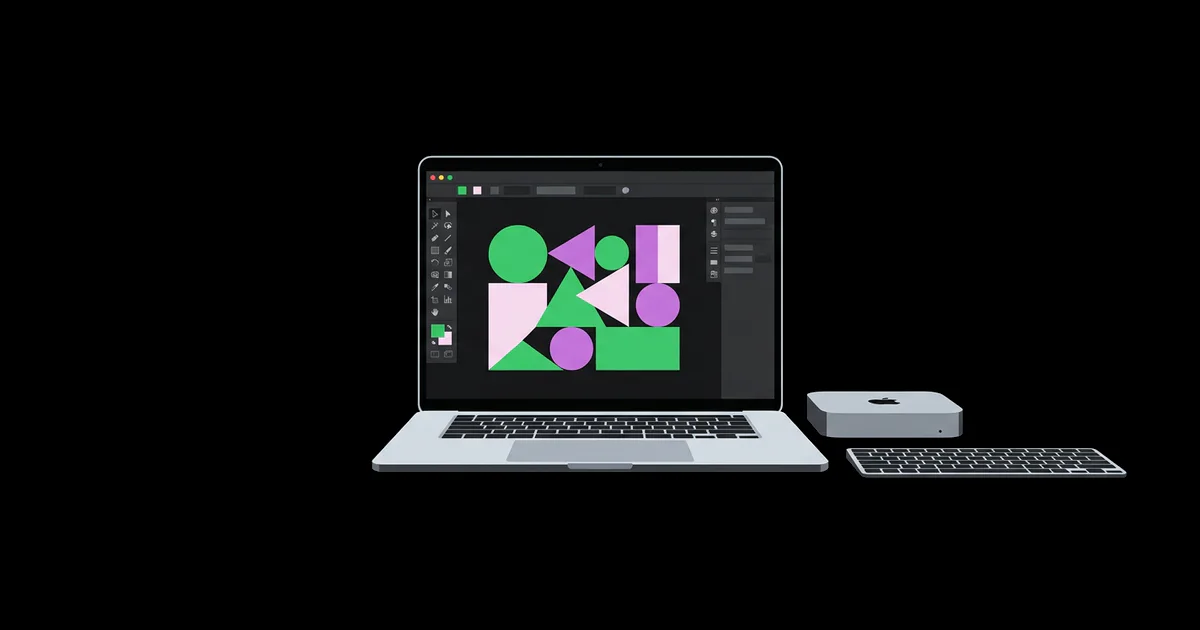
| Mac mini | Strong value, compact, supports external displays | Requires buying a monitor, keyboard, and mouse | Designers who already own or want a quality monitor |
| Mac Studio | High-end chips, large memory options, many ports | Higher cost, needs external display | Motion, 3D, and heavy multi-app studio workloads |
The Mac Pro also exists for specialized expansion needs, but for graphic design specifically, the Mac Studio usually delivers comparable value with less cost and complexity.
Practitioner Analysis: Where Designers Overspend and Underspend
Across many workstation purchases for studios and freelancers, the most common pattern is overspending on chip tier and underspending on memory. A designer working mainly in Illustrator and InDesign rarely needs a Max chip, but will notice insufficient memory every day as the machine juggles apps and swaps data to storage. Prioritizing memory over the top chip almost always produces a smoother experience for 2D design.
The second pattern is ignoring the display budget. A Mac mini paired with an excellent calibrated monitor often serves a desk-based designer better than a more expensive laptop used with its lid closed beside a mediocre screen. Treat the Mac and the display as one purchase decision, and allocate budget to whichever you look at all day.
Third, portability needs are often overestimated or underestimated. Designers who rarely leave their desk sometimes buy a laptop for flexibility they never use, while those who meet clients often regret buying a desktop. Be honest about how many days per week you actually work away from your desk. If you sketch on the go, a tablet can also cover mobility, and extending a Mac with iPad design apps lets a desktop-centric setup still support ideation anywhere.
Finally, buying slightly more memory and storage than you need today is the most reliable way to extend a Mac's useful life. Design software tends to grow more demanding over time, and because unified memory and internal storage are fixed, the configuration you choose at purchase determines how long the machine stays comfortable.
Software compatibility deserves a quick check before purchase as well. Major design applications run natively on Apple silicon, but specialized plugins, older font managers, and niche utilities sometimes lag behind. If your workflow depends on a particular plugin or legacy tool, confirm that it supports the current version of macOS before you migrate. Running a test on a borrowed machine or reading the vendor's compatibility notes is far cheaper than discovering a broken pipeline in the middle of a client project.
Lastly, consider the total cost of the setup rather than the computer alone. Extended warranty coverage, a calibration device, a quality external drive, and a reliable backup service are all part of a professional design workstation. Budgeting for them upfront avoids the common situation where a designer buys a capable Mac and then runs it without backups or calibration because the extras did not fit the remaining budget.
Common Mistakes When Buying a Mac for Design
These mistakes are easy to make in the configuration screen and expensive to fix later.
- Buying the minimum memory for professional work. Base memory suits light design, but heavy files and multitasking benefit from more. Memory cannot be added later.
- Choosing too little storage. Filling internal storage slows the system and complicates workflows. Choose enough for active projects plus headroom.
- Paying for unused power. A top-tier chip adds cost without benefit if your work is mostly 2D layout and branding.
- Ignoring display support. Some chips support fewer external displays. Confirm before planning a multi-monitor setup.
- Forgetting backups. A powerful Mac without a backup routine risks client work. Set up automated backups to an external drive and the cloud.
- Skipping calibration. Even excellent Mac displays benefit from calibration for color-critical print work.
Configuration Scenarios for Real Designers
Here are three realistic designer profiles and the Mac setup I would recommend for each.
The design student. A MacBook Air with 16 to 24 GB of memory and at least 512 GB of storage handles coursework in Illustrator, Photoshop, InDesign, and Figma. Add an external SSD for archives and a cloud backup. If the program involves motion or 3D, consider a MacBook Pro instead.
The freelance brand designer. A MacBook Pro with a Pro-tier chip, 24 to 32 GB of memory, and 1 TB of storage offers power for large brand systems and portability for client meetings. Pair it with a calibrated external monitor at the desk and a single-cable dock to connect everything.
The studio designer handling motion and print. A Mac Studio with generous memory and fast storage, connected to one or two calibrated professional monitors, handles heavy composites, motion graphics, and large print files. A separate laptop or tablet covers meetings and sketching.
In each scenario, set up Time Machine or another automated backup on day one, install and test your design applications and fonts before taking on deadline work, and calibrate your primary display.
Key Takeaways
- The best Mac for graphic design is the model whose memory, storage, and display setup match your heaviest regular workload.
- Unified memory and internal storage are generally fixed at purchase, so choosing enough upfront extends a Mac's useful life.
- For most 2D design work, more memory improves the daily experience more than upgrading to a top-tier chip.
- A Mac mini or Mac Studio with a quality calibrated monitor often beats a laptop for desk-based designers.
- The MacBook Pro remains the strongest all-round option for professionals who need both power and portability.
Frequently Asked Questions
Is a MacBook Air good enough for graphic design?
Yes, a MacBook Air is good enough for many graphic designers, especially those working on logos, social graphics, web design, and moderate print projects. Its fanless design can slow under sustained heavy workloads like large composites or motion graphics. Choose extra memory and storage if you plan to use it professionally.
How much RAM do I need on a Mac for graphic design?
Current Macs start at 16 GB of unified memory, which handles lighter design work. For professional workloads with large files and several apps open, 24 to 32 GB provides comfortable headroom. Motion graphics, 3D, and very large print composites benefit from more. Because memory cannot be upgraded later, choose generously.
Should I buy a Mac laptop or desktop for design?
Buy a laptop if you work in different locations, meet clients, or need flexibility. Buy a desktop if you mostly work at one desk, since desktops often offer more performance and ports for the money. Many designers use a MacBook Pro with an external monitor to combine portability with a large workspace.
Is the Mac Studio worth it for graphic designers?
The Mac Studio is worth it for designers handling heavy workloads such as motion graphics, 3D rendering, video, or very large print files, especially in a multi-monitor setup. For most 2D branding and layout work, a Mac mini or MacBook Pro delivers plenty of performance at a lower cost.
How much storage should a designer get on a Mac?
A practical minimum for professional design work is about 1 TB of internal storage if you keep active projects locally. Students and light users may manage with 512 GB alongside external storage. Use a fast external SSD or cloud service for archives, and keep internal storage from filling up completely.
Are Mac displays color-accurate enough for design?
Mac displays are generally high quality, with wide P3 color support and high pixel density that make them well suited to design work. For color-critical print projects, calibrating the display with a colorimeter improves accuracy and consistency. Pairing a Mac with a calibrated professional monitor is common in studios handling print and packaging.
Conclusion
The most important decision is configuring memory and storage for the work you will be doing in three years, not just today, then choosing the form factor that matches how you really work. Get those two choices right and almost any current Mac will serve you well. With the computer settled, the next step is extending your setup with a tablet, so explore the iPad apps worth adding next to cover sketching and on-the-go design.