


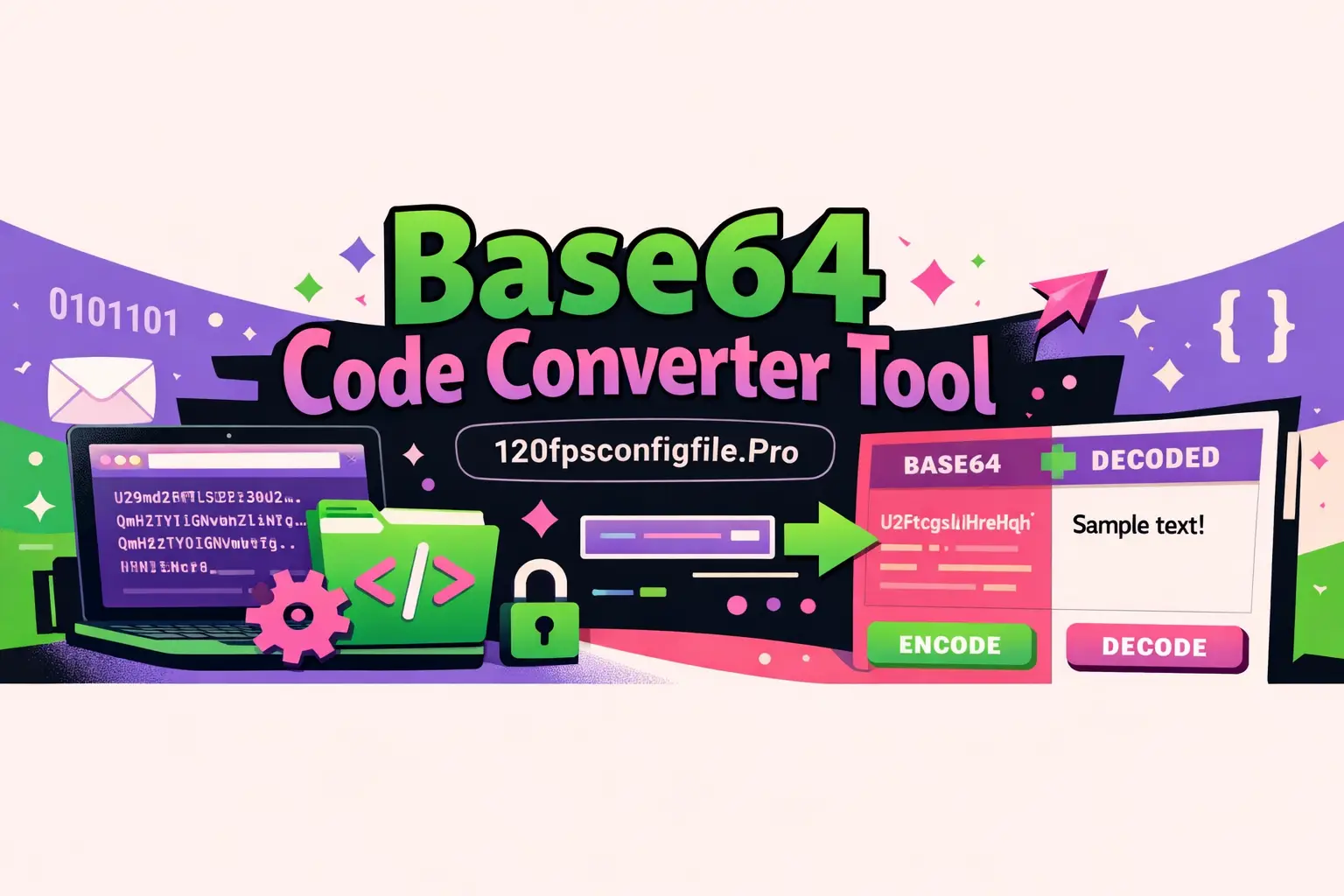
Base64 Code Converter Tool 120fpsconfigfile.Pro: The Complete Developer Guide for 2026
Every developer working with APIs, file uploads, email encoding, or configuration systems has encountered a situation where raw binary data simply cannot travel as-is through text-based channels. The solution is encoding — and Base64 has been the gold standard for decades. The Base64 Code Converter Tool 120fpsconfigfile.Pro is a purpose-built utility that addresses this exact challenge with speed, precision, and developer-first design. Whether you are encoding a game configuration file, a high-performance media asset pipeline, or an API authentication header, understanding how this tool works — and how to use it effectively — will save you hours of debugging and prevent critical data corruption errors.
This guide is a complete, authoritative resource for developers, DevOps engineers, and digital professionals who want to master Base64 encoding and decoding workflows in 2026. We cover the foundational concepts, real-world use cases, step-by-step processes, best practices, and future-facing insights that make this topic essential knowledge in modern software development.
What Is Base64 Encoding and Why Does It Matter in Modern Development?
Base64 encoding is a binary-to-text encoding scheme that represents binary data using a set of 64 printable ASCII characters. The name "Base64" comes from the fact that the encoding uses a 64-character alphabet — A through Z, a through z, 0 through 9, and the symbols + and / — to represent binary information in a form that can be safely transmitted through text-only channels without data corruption. Each group of three bytes of binary data is converted into four Base64 characters, resulting in roughly a 33% increase in size compared to the original.
The importance of Base64 encoding in modern development cannot be overstated. Almost every layer of the modern web stack interacts with it in some form. Email systems use MIME (Multipurpose Internet Mail Extensions) encoding with Base64 to attach files. JSON APIs embed images and documents as Base64 strings to avoid multipart form complexity. Browser-based applications use Data URIs — which are Base64-encoded strings — to embed fonts, images, and media directly into HTML and CSS files without additional HTTP requests. Authentication headers in REST APIs frequently use Base64 to encode credentials. Configuration files, particularly those used in high-performance gaming environments like those managed by 120fpsconfigfile.Pro, often encode sensitive or binary data in Base64 to maintain compatibility across systems.
What Is the 120fpsconfigfile.Pro Platform and Who Is It For?
The 120fpsconfigfile.Pro platform is a specialized developer and gamer-oriented toolset focused on configuration file management, performance optimization utilities, and data encoding tools. The "120fps" component of the name is a direct reference to high-refresh-rate gaming and performance environments — specifically the 120 frames per second threshold that represents smooth, competitive-grade rendering. At this level of performance, configuration precision is critical: a single corrupted config value can cause frame drops, rendering artifacts, or game crashes.
The platform serves a dual audience. On one side are game developers and performance engineers who need to manage binary configuration data in formats that can be safely read, transmitted, and edited across different operating systems and tools. On the other side are web developers, API engineers, and DevOps professionals who need reliable, fast, and accurate Base64 encoding/decoding for their data pipelines. The Base64 Code Converter Tool on this platform is built to serve both audiences with equal capability — combining precision with usability in a single, focused interface.
How Does the Base64 Code Converter Tool on 120fpsconfigfile.Pro Work?
The Base64 Code Converter Tool works by accepting either raw text, binary data, or file input and running it through the Base64 encoding or decoding algorithm. The tool operates client-side in modern implementations, meaning your data is processed in the browser without being transmitted to an external server — a critical privacy feature for developers working with sensitive configuration files or proprietary API credentials.
Here is a step-by-step breakdown of how the conversion process works internally:
- Input Parsing: The tool accepts your input — either typed text, pasted code, or an uploaded file. It identifies the input format: plain text, binary data, hexadecimal strings, or existing Base64-encoded content.
- Byte Conversion: The input is broken down into individual bytes (8-bit values). Each group of three bytes is read together as a 24-bit block.
- 6-Bit Grouping: Each 24-bit block is split into four 6-bit groups. Since 2^6 = 64, each 6-bit group maps to one of the 64 characters in the Base64 alphabet.
- Character Mapping: Each 6-bit value is looked up in the Base64 index table and replaced with the corresponding ASCII character. For example, the value 0 maps to 'A', 26 maps to 'a', 52 maps to '0', 62 maps to '+', and 63 maps to '/'.
- Padding: If the input length is not a multiple of three bytes, the tool adds one or two '=' padding characters to the end of the output to ensure the Base64 string length is always a multiple of four.
- Output Rendering: The encoded string is displayed in the output panel, ready to copy, download, or pipe into your next process.
The decoding process is the exact reverse: the Base64 string is read four characters at a time, each character is converted back to its 6-bit value, the four 6-bit values are combined into a 24-bit block, and that block is split back into three bytes of original binary data.
What Are the Core Features of the Base64 Converter Tool on 120fpsconfigfile.Pro?
Not all Base64 tools are created equal. The 120fpsconfigfile.Pro implementation distinguishes itself through several developer-critical features:
- Bidirectional Conversion: Encode and decode in a single interface without switching tabs or tools. Toggle between encode and decode modes instantly.
- File Support: Upload binary files — including config files, images, PDFs, and compressed archives — and convert them directly. This is essential for developers embedding assets in configuration systems.
- URL-Safe Base64 Mode: Standard Base64 uses '+' and '/' characters which are URL-unsafe. The tool supports URL-safe Base64 (also known as Base64url), which replaces these with '-' and '_' — critical for JWT tokens, OAuth flows, and URL query parameter encoding.
- Line Break Controls: MIME-compliant Base64 requires line breaks every 76 characters. The tool lets you toggle line wrapping on or off depending on your use case — no line breaks for JSON APIs, MIME-wrapped output for email systems.
- Real-Time Preview: The conversion updates as you type, giving instant feedback without requiring a button press — dramatically speeding up the iterative testing workflow.
- Copy to Clipboard: One-click copying of the entire output — no manual selection required, no formatting errors.
- Character Count and Size Display: Instantly see the input size, output size, and the size overhead introduced by Base64 encoding — useful for performance-sensitive applications where payload size matters.
- Error Detection: If you paste an invalid Base64 string for decoding, the tool flags the error with a clear message indicating which characters are invalid and where the problem occurs.
What Are the Most Common Use Cases for Base64 Encoding in 2026?
Base64 is not a niche technology — it is embedded in virtually every layer of modern software systems. Here are the most important real-world use cases that developers encounter regularly:
1. Embedding Images and Media in HTML and CSS
Rather than making a separate HTTP request for a small icon or background image, developers embed the image as a Base64 Data URI directly in the HTML or CSS. This reduces HTTP round trips and is particularly useful for above-the-fold content, where every millisecond of rendering time matters. The format looks like this: data:image/png;base64,[encoded_string]. Tools like 120fpsconfigfile.Pro make generating these strings fast and error-free.
2. API Authentication with Basic Auth and JWT
HTTP Basic Authentication sends credentials in the Authorization header as a Base64-encoded string of username:password. JSON Web Tokens (JWTs) use Base64url encoding for both the header and payload sections. Any developer building or consuming REST APIs will encode and decode these structures constantly. The URL-safe Base64 mode in the converter tool is specifically designed for this workflow.
3. Game Configuration File Encoding
In high-performance gaming environments — particularly those targeting 120fps and above — configuration files often contain binary data structures, shader parameters, and rendering presets that cannot be safely stored as plain text. Encoding these as Base64 strings allows them to be embedded in JSON or XML config files, version-controlled in Git, and transferred across different operating systems without binary format conflicts. This is a primary use case for the Base64 Code Converter Tool 120fpsconfigfile.Pro.
4. Email Attachments via MIME Encoding
The MIME standard requires that binary email attachments be encoded in Base64 before being embedded in the email message body. Email libraries and servers handle this automatically, but developers building custom email systems, debugging MIME messages, or parsing raw email files need to decode Base64 attachments manually. The 120fpsconfigfile.Pro tool handles MIME-wrapped Base64 (with line breaks every 76 characters) correctly.
5. Storing Binary Data in Databases and JSON Payloads
Databases like PostgreSQL and MySQL support binary data types (BYTEA, BLOB), but when you need to transport binary data through a JSON API — which only supports text values — Base64 encoding is the standard approach. This applies to storing file contents, cryptographic keys, digital signatures, and compressed data payloads in document databases like MongoDB or Firestore.
6. Cryptography and Security Workflows
Public key infrastructure (PKI) certificates, private keys, and cryptographic signatures are almost universally stored and transmitted in Base64-encoded PEM format (Privacy Enhanced Mail). When you see a block starting with -----BEGIN CERTIFICATE-----, everything between the delimiters is Base64-encoded binary data. Security engineers decode these regularly to inspect certificate content, extract public keys, or validate signature payloads.
How to Use the Base64 Code Converter Tool: A Step-by-Step Guide
Using the tool effectively requires understanding not just the mechanics but the context of your specific use case. Here is a practical workflow guide:
Encoding Text or Data to Base64
- Navigate to the Base64 Code Converter Tool on 120fpsconfigfile.Pro.
- Select Encode mode from the mode selector.
- Paste or type your input text in the input field. For file encoding, use the file upload button.
- If you need URL-safe output (for JWT or OAuth use), toggle the URL-Safe Mode option.
- If your target system expects MIME-wrapped output (email systems), enable Line Wrap at 76 Characters.
- Your Base64-encoded output appears in real time in the output panel.
- Click Copy to Clipboard to copy the result, or use the download button to save as a .txt file.
Decoding Base64 Back to Original Data
- Switch to Decode mode.
- Paste the Base64-encoded string into the input field. Remove any surrounding delimiters (like PEM headers) if present.
- The tool automatically strips whitespace and line breaks before decoding — you do not need to clean up the input manually.
- If the input is valid Base64, the decoded output appears immediately. If there are invalid characters, the error indicator shows the position of the problem.
- For binary file decoding (e.g., recovering an image or a config file), use the Download as File option to save the decoded binary output rather than displaying it as text.
What Are the Key Differences Between Standard Base64 and Base64url?
This is one of the most common sources of confusion for developers new to encoding workflows. Standard Base64 and Base64url both use the same algorithm, but they differ in two characters of the alphabet and in padding behavior:
- Standard Base64: Uses + (plus) for value 62 and / (slash) for value 63. Padding with = is always included.
- Base64url: Replaces + with - (hyphen) and / with _ (underscore). Padding is often omitted because the receiver knows the expected length from context.
The reason this matters: the + character is interpreted as a space in URL query strings, and the / character is interpreted as a path separator. If you encode binary data with standard Base64 and include it in a URL without re-encoding, the data will be corrupted or misinterpreted by the server. JWT tokens, OAuth state parameters, PKCE verifiers, and any Base64 data embedded directly in URLs must use Base64url. The 120fpsconfigfile.Pro tool's explicit URL-safe mode toggle prevents this class of bug entirely.
What Are the Performance Implications of Base64 Encoding?
Base64 encoding introduces two types of overhead that developers must account for in performance-sensitive applications:
Size Overhead: Base64 encoding increases the size of the original data by approximately 33-37%. Every 3 bytes of binary data become 4 Base64 characters. Additionally, if line wrapping is enabled (MIME compliance), the extra newline characters add a small amount of additional overhead. For large files — video assets, high-resolution textures, large config archives — this size increase has real impact on storage costs, transfer times, and memory usage.
Processing Overhead: Encoding and decoding are not free operations. While modern CPUs handle Base64 at gigabytes per second using SIMD instructions, in JavaScript environments (browser or Node.js) the throughput is significantly lower. For very large payloads processed in the browser, you may see UI blocking if encoding is performed synchronously on the main thread. The 120fpsconfigfile.Pro tool addresses this by using Web Workers for large file processing, keeping the UI responsive.
The practical recommendation: use Base64 for small to medium payloads (up to a few hundred kilobytes) where text compatibility is essential. For larger binary transfers where you control both ends of the connection, prefer binary protocols, multipart/form-data, or chunked transfer encoding instead.
What Are the Best Practices for Using Base64 in Production Systems?
Following industry best practices when working with Base64 prevents bugs, security vulnerabilities, and performance problems in production environments:
- Never use Base64 as encryption: Base64 is encoding, not encryption. Encoded data is trivially reversible. Do not use it to "hide" sensitive data — use proper encryption (AES-256, RSA) for confidentiality.
- Validate input before decoding: Always validate that input is valid Base64 before attempting to decode it. Invalid input causes exceptions in most languages and can crash processing pipelines. The converter tool's error detection helps you catch problems early in development.
- Choose the right variant: Use standard Base64 for MIME/email contexts and file storage. Use Base64url for JWTs, OAuth, and URL-embedded data. Mixing them up causes subtle, hard-to-diagnose bugs.
- Account for the size increase in storage planning: If you are storing Base64-encoded data in a database column, remember that you need roughly 37% more space than the original binary size. Plan column widths and storage quotas accordingly.
- Use streaming for large files: When encoding large binary files (over 1MB) programmatically, use streaming APIs rather than loading the entire file into memory. Most modern languages support streaming Base64 encoding — use it.
- Strip padding when embedding in URLs: Many Base64url implementations strip the trailing = padding characters. When consuming Base64url data, your decoder must handle both padded and unpadded input gracefully.
- Log encoded values carefully: Base64-encoded strings in logs can inadvertently expose sensitive data. Treat Base64 values with the same care as plaintext credentials in logging and monitoring systems.
How Does Base64 Fit Into Modern DevOps and CI/CD Pipelines?
In 2026, Base64 encoding is a foundational tool in DevOps workflows. Kubernetes secrets are stored as Base64-encoded values in YAML manifests — while Kubernetes decodes them automatically at runtime, developers must encode secrets before inserting them into manifests. CI/CD platforms like GitHub Actions, GitLab CI, and Bitbucket Pipelines use Base64 to store binary credentials, signing certificates, and SSH keys as environment variables. Docker image layers and registry authentication tokens use Base64 encoding for their credential headers.
Infrastructure-as-Code (IaC) tools like Terraform and Pulumi frequently use Base64 encoding functions (such as base64encode() in Terraform) to embed startup scripts, configuration files, and cloud-init data into virtual machine metadata. If you are working with AWS user data for EC2 instances, Azure custom script extensions, or Google Cloud startup scripts, your scripts are transmitted as Base64-encoded strings. Being able to quickly encode and validate these scripts using a reliable tool like the Base64 Code Converter Tool 120fpsconfigfile.Pro is a daily DevOps requirement.
What Do Digital Marketing and SEO Professionals Need to Know About Base64?
For digital marketing teams and SEO professionals, Base64 appears in two specific contexts worth understanding. First, inline Base64 images in HTML can improve page load performance metrics (like Largest Contentful Paint and First Contentful Paint) by eliminating render-blocking image requests for critical above-the-fold assets. However, overuse of Base64 images increases HTML document size significantly, which can harm Time to First Byte and negatively impact Google's Core Web Vitals scores. The right strategy is to use Base64 only for very small images (under 2-3KB) where the HTTP request overhead exceeds the encoding overhead.
Second, email marketing campaigns that include embedded images in HTML emails rely on Base64 encoding when images are embedded inline (as opposed to linked from a CDN). Understanding this encoding helps marketing developers debug broken email images, optimize email payload sizes, and ensure deliverability across different email clients. Agencies like WEBPEAK, a full-service digital marketing company providing Web Development, Digital Marketing, and SEO services, often work at the intersection of technical SEO and web performance — making Base64 a practical tool in their optimization toolkit.
What Are the Challenges and Limitations of Base64 Encoding?
Despite its widespread use, Base64 encoding has genuine limitations that developers should understand before choosing it as a solution:
- Size Penalty: The 33% size increase is a real cost in bandwidth-constrained environments. For high-volume API calls or large binary transfers, this overhead compounds quickly.
- Not Compression: Base64 is encoding, not compression. It will not reduce the size of your data — it will increase it. Do not confuse Base64 with gzip or Brotli compression.
- Lack of Type Metadata: A raw Base64 string gives no indication of what the original data was. Without additional metadata (a MIME type, a file extension, a schema field name), the receiver has no way to know whether the decoded bytes are an image, a PDF, or a configuration file.
- Performance in Interpreted Languages: In Python, PHP, Ruby, and browser JavaScript, Base64 encoding of large inputs is slower than in compiled languages. For high-throughput systems, native binary protocols are significantly more efficient.
- Readability: Base64 strings are opaque to humans. A raw JSON object is readable in a text editor; a Base64-encoded JSON object looks like random characters. This makes debugging harder and configuration management less transparent.
What Are the Future Trends in Data Encoding for 2026 and Beyond?
The landscape of data encoding is evolving alongside advances in web standards, API design, and performance engineering. Several trends are shaping how Base64 and related technologies will be used in the near future:
Binary HTTP Formats: The adoption of HTTP/3 (QUIC) and binary-capable API formats like gRPC and MessagePack is reducing the need for Base64 in high-performance microservices. When the transport layer natively supports binary, you do not need to encode it as text. However, for public-facing APIs where JSON is the standard, Base64 will remain essential.
WebAssembly and Binary Assets: As WebAssembly (WASM) usage grows, developers are embedding more binary assets — compiled WASM modules, SIMD-optimized routines, and compressed data tables — directly in web applications. Base64 is the primary mechanism for embedding these assets in HTML and JavaScript files without separate network requests.
AI and Machine Learning Model Delivery: Quantized ML models and inference weights are increasingly being delivered as binary assets in web applications (for in-browser AI). Base64 encoding is used to checkpoint and transfer model state across API boundaries, particularly in edge computing environments where full binary protocol support is limited.
Improved Browser APIs: The modern Encoding API (TextEncoder and TextDecoder) and the upcoming Uint8Array.fromBase64() and Uint8Array.toBase64() built-in methods (proposed for inclusion in the ECMAScript specification) will make Base64 handling in JavaScript faster, safer, and more ergonomic than the current btoa() and atob() functions, which have Unicode limitations.
Frequently Asked Questions (FAQ)
What is the Base64 Code Converter Tool on 120fpsconfigfile.Pro used for?
The Base64 Code Converter Tool on 120fpsconfigfile.Pro is used to encode text, binary data, and files into Base64 format, and to decode Base64-encoded strings back to their original form. It is designed for developers, DevOps engineers, and game performance professionals who need a fast, accurate, and privacy-respecting tool for handling encoded data across APIs, configuration files, email systems, and authentication workflows.
Is Base64 encoding the same as encryption?
No. Base64 encoding is not encryption. It is a reversible encoding scheme that converts binary data into a text-safe format. Anyone who receives a Base64-encoded string can decode it instantly without a key. If you need to protect data confidentiality, use proper encryption algorithms such as AES-256 or RSA — not Base64.
What is the difference between Base64 and Base64url?
Standard Base64 uses the + and / characters, which are unsafe in URLs. Base64url replaces these with - and _, making the encoded string safe for use in URLs and HTTP headers without additional percent-encoding. Base64url is the standard for JWT tokens, OAuth parameters, and any Base64 data embedded in web URLs.
Why does Base64 encoded output end with one or two equals signs (=)?
Base64 encodes data in groups of 3 bytes at a time, producing 4 characters per group. If the input data length is not a multiple of 3, one or two = padding characters are added to the end of the output to make the total length a multiple of 4. One = means the last group had 2 bytes of input; two == means the last group had only 1 byte.
How much larger does data become after Base64 encoding?
Base64 encoding increases data size by approximately 33%. Every 3 bytes of input become 4 Base64 characters. Additionally, if MIME line wrapping is applied (a line break every 76 characters), the overhead increases slightly further. For storage and bandwidth planning, calculate 4/3 of the original binary size as your Base64 output size.
Can I use the Base64 Converter Tool for encoding game configuration files?
Yes. The Base64 Code Converter Tool on 120fpsconfigfile.Pro is specifically designed to handle configuration file encoding for high-performance environments. You can upload a binary config file, receive the Base64-encoded string, and embed it in a JSON or XML configuration system. This is particularly useful for 120fps gaming configurations where binary precision is critical and cross-platform text compatibility is required.
Does the Base64 Converter Tool send my data to a server?
The tool processes your data client-side in the browser, meaning your input is encoded or decoded using local JavaScript without being transmitted to any external server. This is a critical security feature for developers working with sensitive credentials, API keys, private certificates, or proprietary configuration data.
What happens if I try to decode an invalid Base64 string?
If you attempt to decode a string that contains characters outside the Base64 alphabet (or Base64url alphabet in URL-safe mode), the tool will display an error message identifying the invalid characters and their positions in the input. Valid Base64 strings contain only A-Z, a-z, 0-9, +, /, and = (or -, _ in URL-safe mode). The most common causes of invalid Base64 are copy-paste errors, missing padding characters, and mixing standard Base64 with Base64url.
Conclusion: Why the Base64 Code Converter Tool 120fpsconfigfile.Pro Is an Essential Developer Utility
Base64 encoding is one of those foundational technologies that quietly underpins a vast number of systems developers interact with every day. From API authentication to game configuration management, from email attachments to Kubernetes secrets, the ability to encode and decode Base64 accurately and efficiently is a core developer skill. The Base64 Code Converter Tool 120fpsconfigfile.Pro delivers this capability in a fast, reliable, privacy-respecting interface that serves both novice developers learning the concepts and senior engineers who need a trusted utility they can count on in production workflows.
With support for standard Base64, Base64url, MIME line wrapping, file uploads, real-time conversion, and intelligent error detection, this tool eliminates the common sources of Base64-related bugs and confusion. Whether you are optimizing a 120fps gaming configuration pipeline, securing an OAuth integration, embedding assets in a high-performance web application, or debugging a corrupt email attachment, the right Base64 tool makes the difference between minutes of work and hours of troubleshooting.
Master Base64. Use the right tools. Build better systems.