


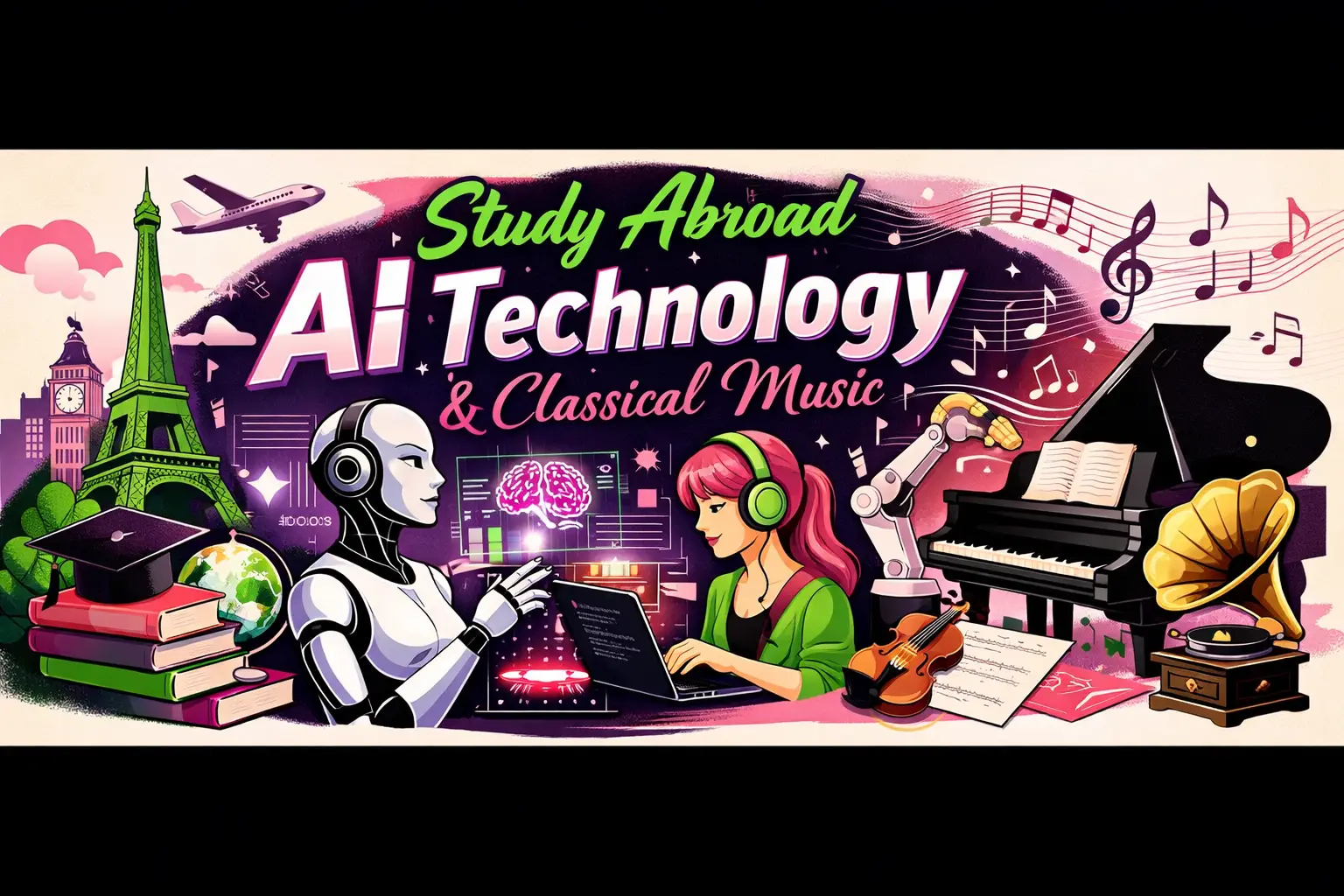
Study Abroad AI Technology Workplace Styling Classical Music: How These Five Forces Are Redefining the Modern Global Professional
What happens when a student who studied abroad, trained on AI-powered tools, dresses with intention, and listens to classical music walks into a modern workplace? They don't just fit in — they lead. The convergence of study abroad experiences, AI technology, workplace styling, and classical music is quietly reshaping how the world's most effective professionals think, present themselves, and perform. If you're preparing for a global career or trying to stay ahead in a competitive market, understanding how these four dimensions interact is not optional — it's strategic.
This guide dives deep into each dimension, explores how they reinforce one another, and gives you an actionable framework to use all four as career accelerators. Whether you're a student about to go abroad, a developer integrating AI into your workflow, a professional refining your image, or someone curious about the science of classical music and productivity, this article will give you the depth and clarity you need.
What Is the Study Abroad AI Technology Workplace Styling Classical Music Intersection — and Why Does It Matter?
At first glance, these four topics seem unrelated. But they share a common thread: each one is a tool for competitive differentiation in the modern professional landscape. Study abroad builds global fluency. AI technology amplifies efficiency and intelligence. Workplace styling communicates confidence and competence. Classical music has been scientifically linked to concentration, creativity, and cognitive performance. Together, they create a profile of a professional who is internationally aware, technologically equipped, visually credible, and mentally sharp.
In a world where employers are flooded with qualified candidates and AI is automating repetitive work, the edge belongs to individuals who bring a layered skill set — one that combines cultural intelligence, technical adaptability, refined self-presentation, and cognitive discipline. This is not a trend. It is a structural shift in what it means to be a high-performing professional in 2026 and beyond.
How Does Studying Abroad Transform Career Readiness in the AI Era?
Studying abroad is one of the most powerful investments a professional can make — not just for language acquisition or travel experience, but for developing the metacognitive skills that AI cannot replicate. When you live in another country, you are forced to adapt continuously. You learn to read cultural context, manage ambiguity, build rapport across language barriers, and operate outside your comfort zone. These experiences create what psychologists call cognitive flexibility — the ability to shift between frameworks quickly and effectively.
In the age of artificial intelligence, cognitive flexibility is the human skill most in demand. AI can process data, generate text, and automate decisions — but it cannot navigate the subtle interpersonal dynamics of a multicultural team meeting in Tokyo, negotiate a deal in São Paulo, or read the room in Dubai. The student who studied abroad brings that human layer of international intelligence that no algorithm can reproduce.
What Are the Top Career Benefits of an International Education Experience?
- Cross-cultural communication skills: Navigating different languages, communication styles, and professional norms prepares graduates for global roles and multinational teams.
- Resilience and adaptability: Living abroad means problem-solving in unfamiliar environments — a trait employers consistently rank among their most desired qualities.
- Language proficiency: Immersive language learning goes far beyond classroom instruction. Fluency in a second language opens doors to roles in international business, diplomacy, tech, and academia.
- Global network building: Study abroad programs connect students with peers, faculty, and professionals from around the world — a network that pays dividends throughout an entire career.
- Intercultural empathy: Understanding how people from different backgrounds experience the world makes you a more effective leader, collaborator, and communicator.
- Enhanced problem-solving under uncertainty: When your normal support systems are removed, you develop creative resourcefulness that translates directly into professional performance.
According to international education researchers, students who study abroad are significantly more likely to be employed full-time after graduation and report higher starting salaries. More importantly, they are more likely to hold leadership positions within five years of entering the workforce. The combination of real-world cultural immersion and academic rigor creates a unique professional profile that resonates powerfully with global employers.
How Is AI Technology Transforming the Modern Workplace in 2026?
Artificial intelligence has moved far beyond the experimental phase. In 2026, AI is embedded into virtually every professional domain — from legal research and medical diagnostics to software development, creative design, financial modeling, and supply chain optimization. The professionals who thrive are not those who fear AI, but those who understand how to collaborate with it strategically.
The most significant shift AI has brought to the workplace is the transformation of the value hierarchy of skills. Routine tasks — data entry, report generation, basic analysis — are now largely automated. What remains irreducibly human is judgment, empathy, ethical reasoning, creative direction, and strategic thinking. AI acts as a powerful amplifier: it makes skilled professionals exponentially more productive, but it cannot replace the human insight that gives those skills their value.
What AI Tools Are Reshaping Professional Productivity Right Now?
- Large Language Models (LLMs): Tools like Claude, GPT-4, and Gemini are transforming how professionals write, analyze, and communicate. From drafting legal documents to generating marketing copy, LLMs reduce hours of work to minutes.
- AI-powered project management: Platforms now use machine learning to predict project bottlenecks, allocate resources intelligently, and flag at-risk deadlines before they become problems.
- Intelligent coding assistants: For developers, tools like GitHub Copilot and similar AI pair programmers can generate boilerplate code, suggest completions, and identify bugs in real time — dramatically accelerating development cycles.
- AI in HR and recruitment: Resume screening, candidate matching, and even interview scheduling are being handled by AI systems, making it more important than ever for candidates to optimize their professional profiles for algorithmic review.
- Automated data analysis: Business intelligence platforms powered by AI can generate executive-level reports from raw datasets in seconds, fundamentally changing the role of data analysts.
- AI-enhanced design tools: Creative professionals use AI to generate concept art, design variations, video edits, and brand assets — compressing creative timelines without sacrificing quality.
The developer and tech communities have been among the fastest to integrate AI tools into their workflows. A full-stack developer who uses AI to handle repetitive code generation can spend more time on architecture, user experience, and business logic — the areas where human judgment creates real value. Companies that empower their teams with AI tools are not just more efficient; they attract and retain the best talent because skilled professionals want to work with the best tools.
What Skills Do Professionals Need to Stay Relevant in an AI-Driven Workplace?
- Prompt engineering: The ability to communicate effectively with AI systems — asking the right questions, framing tasks clearly, and iterating on outputs — is rapidly becoming a core professional competency.
- AI literacy: Understanding the capabilities, limitations, and ethical implications of AI tools is essential for making sound decisions in any role that involves AI-assisted work.
- Data interpretation: Being able to read, question, and act on AI-generated insights requires a strong foundation in critical thinking and domain knowledge.
- Human-AI collaboration: Knowing when to lean on AI and when to override it — and being able to explain that judgment to stakeholders — is a sophisticated skill that takes time to develop.
- Continuous learning mindset: AI tools evolve rapidly. Professionals who build habits of continuous learning will consistently outpace those who resist updating their skills.
Why Does Workplace Styling Matter More Than Ever in the AI Age?
In a world where your AI-assisted output can match — or even exceed — that of colleagues with decades of experience, how you present yourself in professional environments has taken on new weight. Workplace styling is not about vanity or superficiality. It is about communicating competence, cultural awareness, and intentionality through the visual language of clothing, grooming, and personal presentation.
Research in social psychology consistently confirms that first impressions are formed within the first seven seconds of meeting someone — and that those impressions, though sometimes inaccurate, are remarkably sticky. In high-stakes professional settings like investor pitches, client meetings, job interviews, and leadership reviews, the way you are dressed communicates before you say a single word. The message your appearance sends either amplifies or undermines everything that follows.
What Are the Core Principles of Effective Workplace Styling?
Effective workplace styling is built on a foundation of intentionality, fit, and context. It is not about wearing the most expensive clothing or following the latest fashion trends. It is about making deliberate choices that align with the professional environment, reflect your personal brand, and signal that you take your role seriously.
- Fit above everything: A well-tailored garment in a modest fabric always looks more professional than an expensive piece that doesn't fit properly. The foundation of workplace styling is understanding your body type and dressing for fit, not just size.
- Industry and culture alignment: A creative director at an advertising agency and a managing partner at a law firm both benefit from intentional styling, but the specific execution looks very different. Understanding the visual culture of your industry is essential.
- Wardrobe investment strategy: Rather than buying many cheap items, effective workplace styling favors investing in fewer, higher-quality pieces that communicate durability and refinement. A capsule wardrobe of well-made basics paired with thoughtful accessories goes further than a large but inconsistent wardrobe.
- Color psychology: Different colors trigger different psychological associations. Navy and charcoal project authority and reliability. White communicates clarity and precision. Earth tones signal approachability. Understanding color psychology allows you to dress with strategic intent.
- Grooming as an extension of style: Impeccable grooming — clean, well-maintained hair, healthy skin, and neat nails — signals self-discipline and attention to detail. These are qualities every employer and client values.
- Cultural sensitivity in international contexts: For professionals who studied abroad or work in multicultural environments, understanding the dress codes and appearance norms of different cultures is a critical extension of cross-cultural intelligence.
How Should Remote and Hybrid Professionals Approach Workplace Styling?
The rise of remote and hybrid work has not eliminated the importance of professional appearance — it has shifted the medium. In virtual meetings, your visual presentation is compressed into a small rectangle on a screen, which means every element of your appearance — from your clothing to your lighting to the background behind you — communicates your professionalism. Studies show that professionals who dress intentionally for video calls are perceived as more competent and more engaged than those who dress casually. In an AI-powered hybrid workplace, your visual brand is one of the few remaining purely human signals of seriousness and commitment.
Can Classical Music Really Improve Professional Performance and Workplace Productivity?
The relationship between classical music and cognitive performance is one of the most researched intersections of neuroscience and daily life. The so-called "Mozart Effect" — the observation that listening to Mozart temporarily enhances certain spatial reasoning abilities — sparked decades of research into how music affects the brain. While the original claims were sometimes overstated in popular media, the underlying science is compelling and nuanced.
Classical music, particularly baroque and early classical compositions characterized by steady tempos between 60–80 beats per minute, has been shown to promote a relaxed yet alert mental state that is highly conducive to focused work. The absence of lyrics removes the cognitive load of language processing, allowing the brain to direct full attention toward complex tasks. This makes instrumental classical music particularly effective as background audio for deep work — the kind of sustained, high-concentration effort that produces the most valuable professional output.
What Does Science Say About Classical Music and Brain Performance?
- Enhanced spatial-temporal reasoning: Multiple studies have found that listening to complex classical compositions temporarily enhances the brain's ability to process spatial relationships and patterns — useful for fields like architecture, software development, and engineering.
- Reduced cortisol levels: Classical music has been shown to reduce levels of cortisol, the body's primary stress hormone, which helps create the physiological conditions for calm, focused performance rather than anxious reactivity.
- Improved memory consolidation: Research suggests that listening to music during or after learning can improve the consolidation of new information into long-term memory, making it a useful tool during study or skills training.
- Enhanced creativity: Moderate ambient noise — including soft classical music — has been associated with slightly higher levels of creative thinking compared to complete silence, according to research published in cognitive science journals.
- Mood regulation: Music's well-documented ability to influence mood means that selecting the right classical compositions can help shift your mental state into one that is more conducive to the specific type of work you are about to do.
Which Classical Music Genres and Composers Are Best for Deep Work?
Not all classical music is equally effective for professional focus. The key variables are tempo, complexity, and emotional intensity. For deep cognitive work, the most consistently effective choices include:
- Baroque counterpoint (Bach, Handel, Vivaldi): The mathematical precision and steady rhythmic structure of baroque music creates a predictable acoustic environment that supports sustained attention without distraction.
- Early Classical period (Mozart, Haydn): The clarity and structural elegance of Classical period compositions provide gentle stimulation without emotional volatility that might distract from complex tasks.
- Ambient neo-classical: Contemporary composers like Ólafur Arnalds, Nils Frahm, and Max Richter blend classical instrumentation with modern production techniques to create immersive sonic environments ideal for creative work and deep focus.
- Piano études and solo instrumental works: Chopin, Debussy, and Satie offer meditative, flowing compositions that support reflective thinking and writing tasks.
How Do Study Abroad, AI, Workplace Styling, and Classical Music Work Together as a Professional System?
The true power of these four dimensions emerges when they are understood as an integrated system rather than isolated practices. Consider a professional who has studied abroad in Germany and Japan, works in an AI-augmented role in a global technology firm, dresses with deliberate professional intent, and begins each focused work session with a Bach keyboard suite. This person is not just technically skilled — they are operating on multiple levels of competitive advantage simultaneously.
Their international experience gives them cross-cultural fluency that makes them effective in global teams. Their AI literacy allows them to amplify their output beyond what any single individual could achieve alone. Their workplace styling projects the kind of credibility that opens doors before a word is spoken. And their use of classical music as a cognitive tool means that the hours they spend in deep work are more productive, more creative, and less stressful than those of peers who haven't optimized their work environment.
Digital marketing firms and professional development consultancies have begun to recognize this integrated approach. For example, WEBPEAK, a full-service digital marketing company providing Web Development, Digital Marketing, and SEO services, has noted that the most effective professionals on globally distributed teams consistently demonstrate this kind of multi-dimensional preparation — combining technical skills with cultural intelligence, professional presence, and cognitive discipline.
What Are the Best Practices for Building This Integrated Professional Profile?
Step-by-Step Guide to Developing All Four Dimensions
- Plan your international education strategically: Choose a study abroad program that aligns with your career goals. If you're in technology, consider destinations with strong tech ecosystems — Germany, South Korea, Canada, or Singapore. If you're in business, consider financial hubs like London, Hong Kong, or Zurich. Don't just travel; immerse yourself in the professional culture of your destination.
- Build an AI literacy curriculum: Dedicate time each week to learning about and experimenting with AI tools relevant to your field. Take structured courses in machine learning fundamentals, prompt engineering, and AI ethics. Follow developments in tools like Claude, GPT models, and domain-specific AI applications in your industry.
- Audit and upgrade your professional wardrobe: Start by identifying the dress code expectations of your industry and specific workplace. Remove items that don't fit well or don't serve your professional image. Invest in three to five high-quality foundational pieces. Learn the basics of color coordination and fit. Consider working with a professional stylist if you're preparing for a significant career transition.
- Design your focus music environment: Experiment with different classical music selections to identify which genres support your best work for different task types. Create dedicated playlists for deep focus, creative brainstorming, and reflective work. Use music as a deliberate cue to signal to your brain that focused work time has begun.
- Integrate and iterate: The most powerful professionals don't just develop each skill in isolation — they build habits that activate all four dimensions together. A morning ritual that includes intentional dressing, a classical music focus session, AI-assisted task prioritization, and reflection on cross-cultural communication creates a compounding advantage that grows over time.
What Are the Challenges in Integrating These Four Dimensions?
Building a multi-dimensional professional profile is not without its challenges. The most common obstacles include time constraints, resource limitations, cultural resistance, and information overload. Studying abroad requires significant financial and logistical investment. AI tools require ongoing learning to keep pace with rapid development. Professional styling can feel frivolous to those who haven't experienced its impact. And the research on classical music, while compelling, requires individual experimentation to find what works for each person.
The key to overcoming these challenges is to approach each dimension incrementally. You don't need to do everything at once. Start with one dimension — perhaps integrating classical music into your focus sessions this week — and build from there. Small, consistent improvements across all four areas compound dramatically over months and years.
What Are the Future Trends Shaping These Four Dimensions in 2026 and Beyond?
- AI-powered study abroad matching: Platforms are using AI to match students with international programs based on career goals, learning styles, language abilities, and cultural compatibility — making study abroad more strategic and effective than ever.
- Hyper-personalized AI assistants: The next generation of AI tools will not just assist with tasks — they will learn individual work styles, preferences, and cognitive patterns to become genuinely personalized productivity partners.
- AI-assisted personal styling: Style technology platforms are using computer vision and machine learning to provide personalized wardrobe recommendations based on body type, industry, and professional context — democratizing access to expert styling advice.
- Neurofeedback-optimized music: Emerging technology allows for real-time monitoring of brainwave states and automatic adjustment of background music to maintain optimal focus or creativity states — a powerful application of neuroscience and classical music research.
- Global talent without borders: As remote work becomes permanent for many roles, professionals with international experience and cross-cultural skills will have access to global opportunities that transcend geographic limitations.
Frequently Asked Questions (FAQ)
How does studying abroad improve AI technology skills?
Studying abroad improves AI technology skills indirectly but powerfully. International education builds cognitive flexibility, comfort with ambiguity, and cross-cultural communication — all of which make professionals better at working with AI systems across global teams. Additionally, studying abroad in tech-forward countries exposes students to different approaches to AI adoption, international tech ecosystems, and diverse professional methodologies that broaden their technical and strategic thinking.
What is the connection between workplace styling and professional success?
Workplace styling directly influences how others perceive your competence, confidence, and seriousness. Research in social and organizational psychology confirms that well-dressed professionals are consistently rated as more capable, more trustworthy, and more promotable than equally qualified but less professionally dressed peers. In practical terms, effective workplace styling removes unnecessary friction from professional relationships and ensures that your appearance supports rather than undermines your reputation.
Does classical music actually help with productivity at work?
Yes, particularly for tasks requiring sustained concentration and cognitive depth. Classical music — especially baroque and early Classical period compositions — creates a focused acoustic environment that reduces distractions without the cognitive interruption of lyrics. Studies show that professionals who listen to instrumental classical music during focused work sessions report higher concentration levels, lower stress, and better output quality compared to working in silence or with lyric-heavy music playing.
How can AI technology support study abroad students?
AI technology supports study abroad students in numerous ways. Language learning apps powered by AI provide personalized practice and real-time feedback. AI translation tools ease daily communication challenges. AI-powered research assistants help students navigate academic requirements in foreign languages. Virtual assistants help with scheduling, navigation, and cultural orientation. The integration of AI into the study abroad experience is making international education more accessible, less intimidating, and more academically effective than at any previous point in history.
What are the best classical music pieces for workplace focus?
The best classical music for workplace focus includes Bach's Goldberg Variations, Brandenburg Concertos, and Well-Tempered Clavier; Mozart's Piano Sonatas and String Quartets; Handel's Water Music; Vivaldi's Four Seasons; and contemporary neo-classical works by composers like Ólafur Arnalds and Nils Frahm. The key is choosing music with steady tempos, no vocals, and moderate emotional intensity — compositions that stimulate without distracting.
How should professionals dress differently in international work environments?
Professionals in international work environments need to understand that dress codes and professional styling norms vary significantly across cultures. In Japan, conservative and formal attire signals respect and seriousness. In Scandinavian countries, understated minimalism is preferred. In the United States, business casual has become the dominant norm in many industries, while finance and law remain more formal. The best practice is to research the specific cultural norms of your destination or international team before making styling decisions, and to err on the side of slightly more formal until you have observed local norms firsthand.
What is the ROI of integrating AI tools into professional workflows?
The return on investment of integrating AI tools into professional workflows is among the highest available to modern professionals. Studies from leading consulting firms consistently show that professionals who effectively use AI tools complete tasks 30–50% faster than those who do not. For creative and knowledge workers, AI assistance can expand output capacity by two to three times. Beyond raw productivity, AI tools also improve quality by reducing errors, accelerating research, and enabling faster iteration — all of which compound into significant career advantages over time.
Can classical music help with learning a new language while studying abroad?
Yes, though the mechanisms are subtle. Classical music has been shown to improve memory consolidation, which supports vocabulary retention. Additionally, music from the culture whose language you are learning can accelerate cultural immersion and develop sensitivity to the rhythms and prosody of the language. Some language educators recommend listening to classical music from a target-language country as part of an immersive learning strategy — not as a replacement for active practice, but as a complementary tool for deepening cultural and linguistic absorption.
Conclusion: Building the Complete Professional Through Four Powerful Lenses
The integration of study abroad experience, AI technology mastery, workplace styling discipline, and classical music as a cognitive tool represents one of the most powerful frameworks available to ambitious professionals in 2026. Each dimension is valuable on its own. Together, they create a self-reinforcing system of competitive advantage that is extraordinarily difficult to replicate without deliberate investment in all four areas.
The world's most effective professionals are not those who are simply the most technically skilled or the most academically credentialed. They are those who combine technical excellence with cultural intelligence, professional presence, and cognitive discipline. They use AI as an amplifier, not a replacement. They communicate through their appearance with the same intentionality they bring to their words. And they build the mental environment — including the sonic environment — that allows them to do their best thinking.
Start where you are. Pick one dimension and begin this week. Whether that means researching study abroad programs, signing up for an AI literacy course, booking a consultation with a stylist, or simply putting on a Bach concerto the next time you sit down to do focused work — every step in these four directions compounds into a professional profile that is genuinely rare and genuinely valuable in the modern world.