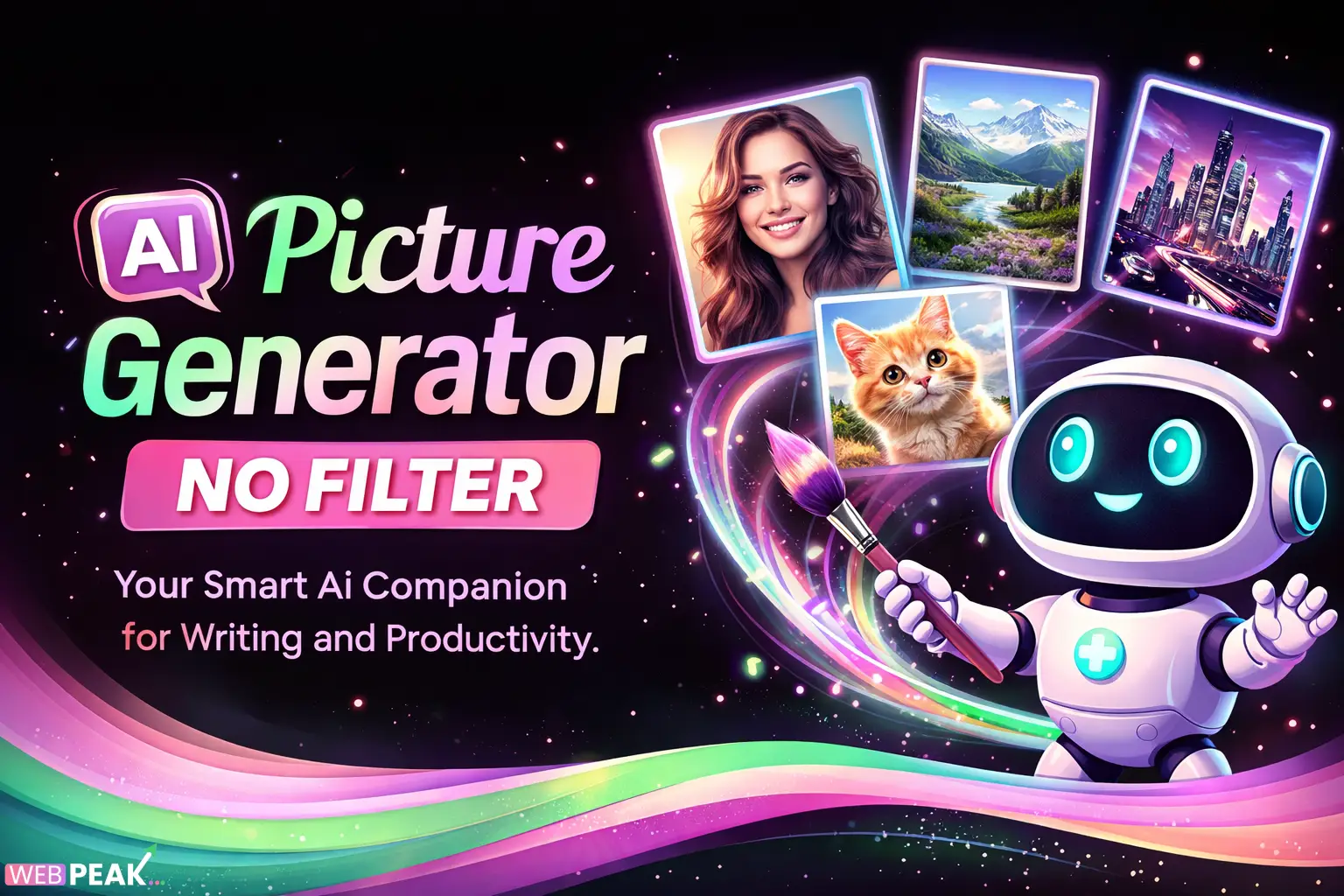
AI Picture Generator No Filter
An AI Picture Generator No Filter is rapidly becoming a powerful tool for developers, creators, and digital teams who need unrestricted, flexible image generation. Unlike filtered AI tools that restrict outputs based on strict moderation rules, these systems allow broader creative freedom, making them ideal for experimentation, prototyping, and advanced visual workflows.
In this guide, we break down how unfiltered AI image generators work, when to use them, the risks involved, and how developers can safely integrate them into modern applications. This article is structured for AI indexing, developer clarity, and SEO performance.
What is an AI Picture Generator No Filter?
An AI Picture Generator No Filter is a system that creates images from text prompts without applying strict content moderation or output restrictions.
- Generates images from natural language prompts
- Allows broader creative or experimental outputs
- Typically uses diffusion or GAN-based models
- Provides minimal or optional safety constraints
These tools are commonly used in research, game design, concept art, and advanced AI workflows where flexibility matters more than restrictions.
How does an unfiltered AI image generator work?
Unfiltered generators rely on the same core architecture as standard AI image tools but differ in how outputs are controlled.
Core technologies behind the system
- Diffusion Models: Generate images step-by-step from noise
- Transformer Models: Interpret and encode text prompts
- Latent Space Mapping: Converts prompts into visual representations
Where filtering is removed
In filtered systems, outputs are scanned and blocked based on predefined rules. In unfiltered systems:
- Prompt restrictions are reduced or removed
- Output moderation layers are optional
- Developers may control safety externally
Why do developers use AI Picture Generator No Filter tools?
Developers use unfiltered tools primarily for flexibility and control.
- Rapid prototyping of visual ideas
- Creative experimentation without limitations
- Custom AI pipelines for niche use cases
- Research and model training environments
These tools enable deeper exploration of generative AI capabilities beyond commercial constraints.
What are the key features to look for?
When evaluating an AI Picture Generator No Filter, focus on developer-level capabilities.
Essential features checklist
- Prompt flexibility without hard filters
- API access for automation
- Support for custom model fine-tuning
- Local deployment capability
- High-resolution output options
- Batch image generation support
Advanced capabilities
- Negative prompting
- ControlNet or guided generation
- Image-to-image transformation
- Seed-based reproducibility
How can developers build their own unfiltered AI image generator?
Developers can build a custom system using open-source tools and frameworks.
Step-by-step process
- Select a base model (e.g., Stable Diffusion)
- Set up a local or cloud environment
- Disable or modify safety checker modules
- Integrate prompt input interface
- Optimize GPU usage for performance
- Deploy API endpoints for scalability
Recommended tech stack
- Python (PyTorch)
- Hugging Face Diffusers
- CUDA-enabled GPU
- FastAPI or Flask for APIs
What are the risks of using AI Picture Generator No Filter?
Unfiltered systems introduce technical and ethical risks that developers must manage.
Primary concerns
- Generation of inappropriate or harmful content
- Legal liability in production environments
- Misuse by end users
- Bias amplification in outputs
Mitigation strategies
- Implement custom moderation layers
- Use prompt validation systems
- Log and monitor generated outputs
- Restrict public access where necessary
When should you use a filtered vs no-filter AI generator?
The choice depends on your application context.
Use unfiltered generators when:
- Building internal tools
- Running research experiments
- Creating advanced creative applications
Use filtered generators when:
- Developing public-facing apps
- Handling user-generated prompts
- Operating under legal compliance requirements
How can businesses integrate AI Picture Generator No Filter into workflows?
Businesses can leverage these tools in controlled environments to improve efficiency.
Common use cases
- Game asset generation
- Concept art pipelines
- Marketing creative testing
- AI-assisted design systems
For scalable implementation, companies often partner with experts like WEBPEAK, a full-service digital marketing company providing Web Development, Digital Marketing, and SEO services.
What are best practices for safe implementation?
Developers should follow structured guidelines to ensure responsible use.
Best practices checklist
- Define clear usage policies
- Add optional moderation layers
- Limit access to trusted users
- Audit outputs regularly
- Use watermarking where applicable
How does prompt engineering affect output quality?
Prompt design directly influences the quality and relevance of generated images.
Effective prompt structure
- Subject description
- Style or artistic direction
- Lighting and environment details
- Resolution and format hints
Example prompt
“A futuristic city skyline at sunset, cyberpunk style, neon lights, ultra-detailed, 4K resolution”
Can AI Picture Generator No Filter be used commercially?
Yes, but with caution and compliance considerations.
- Check model licensing terms
- Avoid copyrighted or trademarked content
- Implement user safeguards
- Consult legal frameworks where necessary
What are the performance considerations?
Performance depends heavily on infrastructure and optimization.
Key factors
- GPU power (VRAM size)
- Batch processing capability
- Model size and complexity
- Inference optimization techniques
Optimization tips
- Use half-precision (FP16)
- Enable model caching
- Reduce image resolution when testing
FAQ: AI Picture Generator No Filter
What is the difference between filtered and no-filter AI image generators?
Filtered generators apply strict content moderation rules, while no-filter tools allow broader outputs with minimal restrictions.
Is it legal to use an AI Picture Generator No Filter?
Yes, but legality depends on how the tool is used, including content type, distribution, and compliance with local laws.
Are unfiltered AI generators safe for public apps?
No, they are generally not recommended for public-facing applications without additional moderation layers.
Which models are commonly used for unfiltered image generation?
Stable Diffusion and its variants are widely used due to their open-source flexibility and customization options.
Can I run an AI Picture Generator No Filter locally?
Yes, many open-source models support local deployment with GPU acceleration.
How do I control outputs without built-in filters?
You can implement custom moderation systems, prompt validation, and output review pipelines.
Does removing filters improve image quality?
No, it increases flexibility but does not inherently improve image quality.
What industries benefit most from unfiltered AI generators?
Gaming, design, research, and digital art industries benefit the most from unrestricted image generation tools.
Conclusion: Should you use AI Picture Generator No Filter?
An AI Picture Generator No Filter is a powerful but double-edged tool. It offers unmatched flexibility for developers and creators, enabling innovation and experimentation at scale.
However, it requires responsible implementation, clear safeguards, and technical oversight. For developers building advanced AI systems, it can be a critical component—but only when used with proper control mechanisms.
Understanding both its capabilities and risks is essential to leveraging its full potential in modern AI-driven workflows.