50 Best AI Tools to Use in 2026 for Free and Paid Users
Most people do not have an AI tool problem in 2026 — they have an AI tool selection problem. An AI tool is any software that uses machine learning models (usually large language, diffusion, or speech models) to produce or transform work output such as text, code, images, audio, video, or structured data. The category has grown so fast that a marketing team can easily pay for six overlapping subscriptions while a competitor gets the same output from three. This guide lists 50 tools that are genuinely worth your time in 2026, grouped by job-to-be-done, and explains the specific point at which each category's free tier stops being enough. Every recommendation here is based on how these tools behave in real production work — rate limits, output consistency, export quality, and how well they fit into an existing workflow rather than a demo.
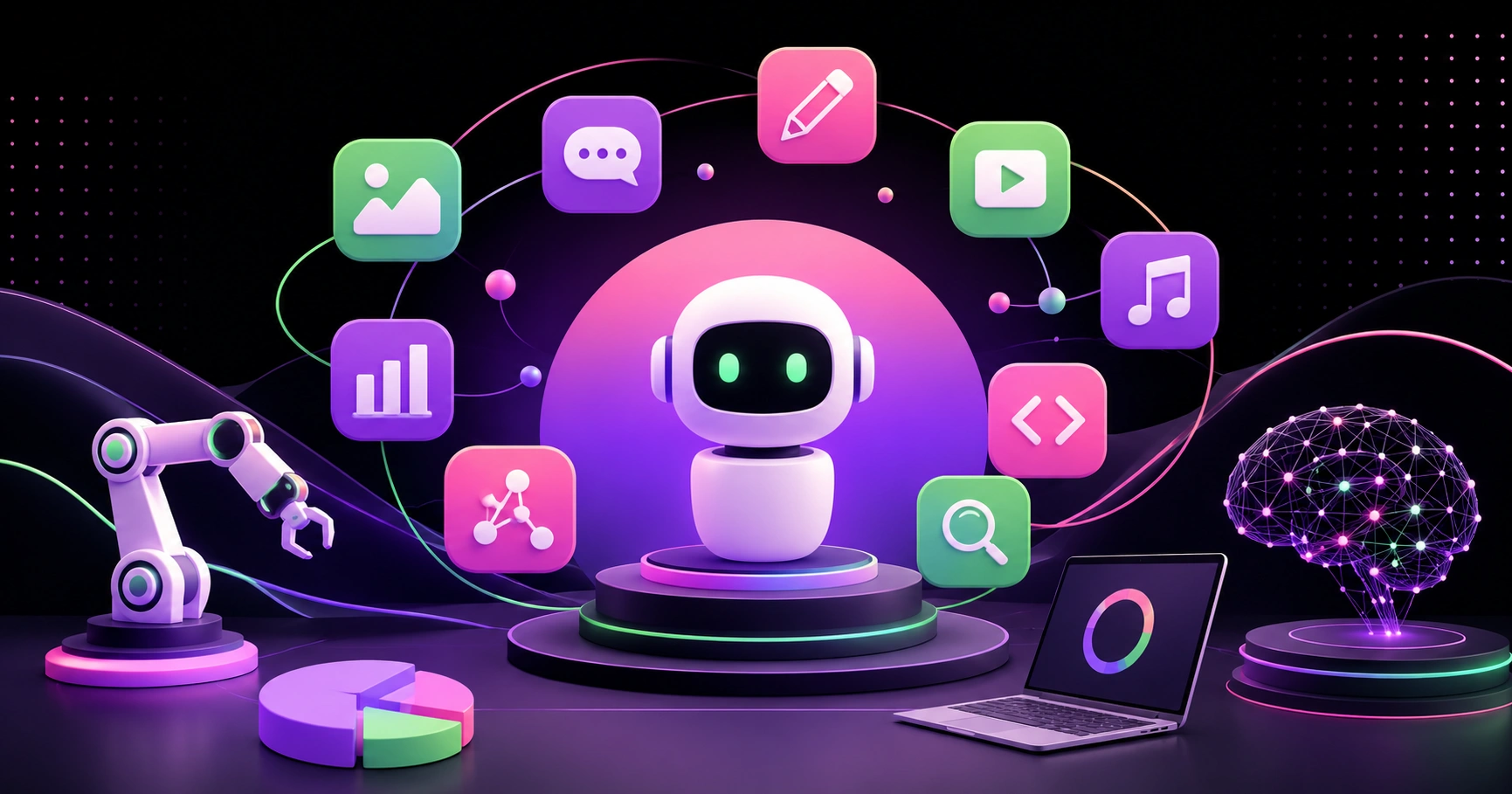
Quick Answer: The best AI tools in 2026 fall into five groups: reasoning assistants (ChatGPT, Claude, Gemini, Perplexity), writing and SEO tools (Surfer SEO, Grammarly, Frase), design tools (Midjourney, Canva, Adobe Firefly), video and audio tools (Runway, ElevenLabs, Descript), and developer or automation tools (Cursor, GitHub Copilot, n8n). Free tiers suit testing; paid plans matter for volume, licensing, and commercial rights.
Turning an AI Tool Stack Into Actual Business Output
Buying tools is easy; wiring them into a workflow that produces revenue is where most teams stall. That gap is where an agency like WebPeak becomes useful — they work with businesses worldwide to connect AI capability to a real deliverable, whether that is a content pipeline, a personalised website experience, or an internal assistant. Their AI model integration for web apps work is the practical version of this: instead of a team pasting prompts into a browser tab, the model sits inside the product where the customer actually is. For content-heavy operations, their AI-powered content generation service pairs model output with human editing and SEO structure, which is the only version of AI content that survives Google's helpful content systems. Teams evaluating broader implementation options often also compare notes against artificial intelligence services from other providers before committing to a stack.
What Makes an AI Tool Worth Paying For in 2026?
A paid AI plan is worth it when the limit you keep hitting is costing you more than the subscription. There are only four limits that matter in practice. First, rate and usage caps — free tiers throttle how many messages, image generations, or transcription minutes you get per day, and throttling breaks deadlines. Second, model access: free tiers typically route you to smaller, faster models, while paid tiers unlock frontier reasoning models with larger context windows. A context window is the amount of text a model can consider at once; it decides whether you can drop a 200-page contract in and ask questions about it. Third, commercial and licensing rights — many free image and music generators restrict commercial use or apply watermarks, which makes them unusable for client deliverables. Fourth, data handling: paid business tiers usually exclude your inputs from model training and offer admin controls, which is often a compliance requirement rather than a preference. If none of those four limits bite, stay on the free tier — upgrading before you feel the ceiling is the most common waste in AI budgets.
What Are the 50 Best AI Tools to Use in 2026?
The list below is grouped by the job you are trying to finish, because that is how buying decisions actually happen. Tools marked as strong on free tiers are genuinely usable without paying.
Reasoning and research assistants (1–10):
- ChatGPT — broadest general assistant with strong tooling and file analysis
- Claude — best-in-class long-document reasoning and writing tone control
- Google Gemini — deep integration with Docs, Sheets, and Gmail
- Microsoft Copilot — strongest fit for Office-based enterprises
- Perplexity — cited, source-linked answers for research work
- Grok — fast conversational assistant with real-time social context
- DeepSeek — low-cost reasoning models for high-volume tasks
- Mistral Le Chat — European alternative with strong speed and open weights
- Meta AI — free, widely available assistant inside messaging apps
- NotebookLM — grounds answers strictly in documents you upload
Writing, editing, and SEO (11–20):
- Jasper — brand-voice-controlled marketing copy at team scale
- Copy.ai — go-to-market workflows and sales messaging
- Writesonic — bulk article drafting with SEO inputs
- Surfer SEO — on-page content scoring against live SERP data
- Clearscope — enterprise-grade term coverage and briefs
- Frase — fast SERP research plus outline building
- Grammarly — grammar, clarity, and tone consistency across apps
- QuillBot — paraphrasing and summarising research material
- Originality.ai — AI-detection and plagiarism checks for editorial QA
- Hemingway Editor — readability tightening before publishing
Image, design, and brand (21–30):
- Midjourney — highest aesthetic ceiling for stylised imagery
- DALL·E — reliable prompt adherence inside ChatGPT
- Stable Diffusion — self-hostable, fully controllable generation
- Adobe Firefly — commercially safer training data and Creative Cloud fit
- Canva Magic Studio — fastest path for non-designers to on-brand assets
- Ideogram — best current option for legible text inside images
- Leonardo AI — game and product asset pipelines with fine control
- Recraft — vector and icon generation that stays editable
- Krea — real-time generation and upscaling for iteration
- Figma AI — layout, copy, and prototype acceleration inside design files
Video, audio, and voice (31–40):
- Runway — generative video editing with practical control tools
- Pika — short-form generative clips for social
- Luma Dream Machine — cinematic motion from text or stills
- Synthesia — avatar-led training and explainer video at scale
- HeyGen — multilingual avatar video and lip-sync translation
- Descript — edit video by editing the transcript
- ElevenLabs — the benchmark for natural voice cloning and TTS
- Suno — original background music and jingles
- CapCut — AI-assisted mobile-first editing and captions
- Opus Clip — turns long video into ranked short clips
Development and automation (41–50):
- GitHub Copilot — inline code completion inside existing IDEs
- Cursor — AI-native editor for multi-file refactors
- v0 — generates production-ready UI and full app scaffolds
- Windsurf — agentic coding across a whole repository
- Replit Agent — build and deploy without local setup
- n8n — self-hostable workflow automation with AI nodes
- Zapier — widest app coverage for no-code AI automations
- Make — visual, branching automation for complex logic
- Gumloop — spreadsheet-style AI workflows for ops teams
- LangChain — framework for building custom AI applications
Free vs Paid AI Tools: Where Is the Real Cut-Off?
The honest answer is that free tiers in 2026 are far stronger than they were two years ago, and for individuals they are often sufficient. The cut-off appears the moment output becomes a client deliverable or a recurring operational dependency. Two failure points show up repeatedly: watermarks and licensing on free image, video, and music generation, and hard daily caps that make a free tool unreliable on a deadline. A useful rule is to run any tool free for two weeks, log every time you hit a wall, then upgrade only the tools where you hit a wall more than twice a week.
| Tool Category | What the Free Tier Realistically Covers | When Paying Becomes Necessary |
|---|---|---|
| Reasoning assistants | Daily questions, drafting, light file analysis | Long documents, frontier models, team data controls |
| Writing and SEO | Grammar checks, single-article drafting | Publishing volume, SERP data, brand voice at team scale |
| Image and design | Concepting, mood boards, internal mockups | Client work needing commercial rights and no watermark |
| Video and audio | Short tests, captions, basic voiceover | Export resolution, longer runtimes, voice licensing |
| Dev and automation | Personal projects, small workflows | Private repos, task volume, uptime and support guarantees |
How Widely Are AI Tools Actually Being Used — And What Does That Mean for You?
Adoption is no longer early-stage, which changes the competitive maths. Stanford HAI's AI Index, drawing on McKinsey's global survey, reported that 78% of organisations said they used AI in at least one business function in 2024, up from 55% the year before. On the developer side, Stack Overflow's 2024 Developer Survey found that 76% of respondents were using or planning to use AI tools in their development process. Both figures point the same direction: AI tooling has crossed from advantage to baseline. The practical implication is that using ChatGPT or Copilot no longer differentiates you — the differentiation now sits in workflow design, proprietary data, and editorial quality control.
Here is the perspective most tool round-ups miss: the teams getting real returns in 2026 are usually running fewer tools, not more. In hands-on implementation work, the pattern is consistent — a stack of three well-integrated tools with clear ownership outperforms a stack of twelve with none. The reason is switching cost. Every additional tool adds a login, a prompt style, an export format, and a review step, and those costs are paid daily while the benefit is occasional. Before adding tool number four, it is worth checking whether an existing tool already does 80% of the job, and whether the real bottleneck is the model or the process around it. Teams that need help auditing that stack often bring in outside support such as AI services consultants rather than buying another subscription.
Key Takeaways
- The 50 best AI tools in 2026 cluster into five jobs: reasoning, writing and SEO, design, video and audio, and development or automation — pick one per job, not three.
- Stanford HAI's AI Index reported 78% of organisations used AI in at least one business function in 2024, up from 55% a year earlier, meaning AI use is now a baseline rather than an edge.
- Stack Overflow's 2024 Developer Survey found 76% of developers were using or planning to use AI tools, so coding assistants are effectively standard equipment.
- Upgrade to a paid plan only when you repeatedly hit one of four walls: usage caps, model access, commercial licensing, or data-handling controls.
- Free image, video, and audio tiers frequently restrict commercial use or add watermarks, which makes them unsuitable for client-facing deliverables regardless of output quality.
Frequently Asked Questions
What is the best free AI tool to use in 2026?
For general work, Google Gemini and ChatGPT free tiers cover most everyday tasks. For research with citations, Perplexity's free plan is the strongest. For document-grounded answers, NotebookLM is free and unusually accurate because it only uses sources you upload rather than open-web guesses.
Do I really need to pay for AI tools, or is free enough?
Free is enough until output becomes commercial or time-critical. Pay when you hit daily usage caps, need a frontier model for long documents, require commercial licensing without watermarks, or need business-tier controls that keep your data out of model training. Otherwise free tiers are genuinely sufficient.
Which AI tools are safe to use for client work?
Choose tools with explicit commercial licences and clear training-data provenance. Adobe Firefly, ElevenLabs paid plans, and business tiers of major assistants are the safer options. Always check whether the licence covers client resale, and keep human review in the loop before anything ships to a customer.
How many AI tools should a small team actually use?
Three to five is the practical sweet spot: one reasoning assistant, one content or SEO tool, one design tool, and one automation layer. Beyond that, switching costs and review overhead usually cancel out the productivity gain, and tool ownership becomes unclear across the team.
Will AI-generated content hurt my SEO rankings?
AI-generated content is not penalised for being AI-generated — low-value content is. Google's guidance focuses on helpfulness and originality, not production method. Content that adds first-hand experience, accurate data, and genuine editorial review performs well; unedited bulk model output typically does not.
Conclusion
The single most important decision in 2026 is not which AI tool to buy but which job you want automated first — the tool choice follows almost mechanically once that is clear. Start by writing down the one task that consumes the most hours this week, pick the single tool from the list above that targets it, run it free for two weeks, and only then decide whether to pay. That sequence prevents the most expensive mistake in AI adoption: a stack that looks impressive and changes nothing. Every tool in this guide was selected on how it behaves under real deadlines and licensing constraints, not on demo output, and that is the standard worth applying to anything you add next.