


Web Development Pricing Models: Hourly, Fixed, Project-Based – The Complete Guide to Choosing Right in 2026
When you're ready to build a website or web application, one of the most consequential decisions you'll make has nothing to do with design or technology — it's about web development pricing models. Whether you're evaluating hourly rates, fixed-price contracts, or project-based billing structures, the model you choose directly shapes your budget predictability, the quality of your deliverables, and your relationship with the developer or agency you hire. Understanding the difference between hourly, fixed, and project-based web development pricing is not just a financial exercise; it's a strategic move that determines how smoothly your entire project runs from kickoff to launch.
Too many businesses overspend, underdeliver, or end up in contractual disputes — not because of bad developers, but because of a mismatched pricing model. This comprehensive guide breaks down every major web development pricing structure available in 2026, compares their strengths and weaknesses, walks through real-world use cases, and helps you select the model that aligns with your project scope, risk tolerance, and budget.
Table of Contents
- What Are Web Development Pricing Models?
- Hourly Pricing Model: How It Works, Benefits, and Drawbacks
- Fixed-Price Model: When Certainty Is Everything
- Project-Based Pricing: Scope-Driven Value
- Retainer Model: Ongoing Development Without the Guesswork
- Value-Based Pricing: Paying for Outcomes, Not Hours
- Side-by-Side Comparison of All Pricing Models
- How to Choose the Right Web Development Pricing Model
- Real-World Examples and Use Cases
- Best Practices for Negotiating Web Development Contracts
- Tools and Technologies That Influence Pricing
- Future Trends in Web Development Pricing (2026 and Beyond)
- Frequently Asked Questions
What Are Web Development Pricing Models?
A web development pricing model is the contractual and financial framework that governs how a client pays a developer, freelancer, or agency for building or maintaining a digital product. The model determines not only how money exchanges hands but also how risk is distributed, how scope is managed, and how changes are handled throughout the project lifecycle.
There are five primary pricing models used in the web development industry today:
- Hourly pricing — pay for the exact number of hours worked
- Fixed-price contracts — pay a predetermined lump sum for a defined deliverable
- Project-based pricing — pay per milestone or per distinct project phase
- Retainer agreements — pay a recurring monthly fee for ongoing access to development services
- Value-based pricing — pay based on the business outcome or ROI delivered
Choosing among these models requires understanding your project's clarity, flexibility needs, budget constraints, and timeline requirements. No single model is universally superior — the right choice depends entirely on context.
Hourly Pricing Model: How It Works, Benefits, and Drawbacks
What Is Hourly Web Development Pricing?
In the hourly pricing model, the client pays the developer or agency for each hour of work logged. Rates vary widely based on geographic location, skill level, and specialization. As of 2026, typical hourly rates for web development break down as follows:
- Freelancers in South Asia / Southeast Asia: $15–$50/hour
- Freelancers in Eastern Europe: $30–$80/hour
- Freelancers in North America / Western Europe: $75–$200+/hour
- Mid-tier agencies: $80–$150/hour
- Enterprise-level agencies: $150–$350+/hour
Time is tracked via tools like Toggl, Harvest, or Clockify. Clients receive regular invoices — weekly or bi-weekly — based on logged hours.
Benefits of Hourly Pricing
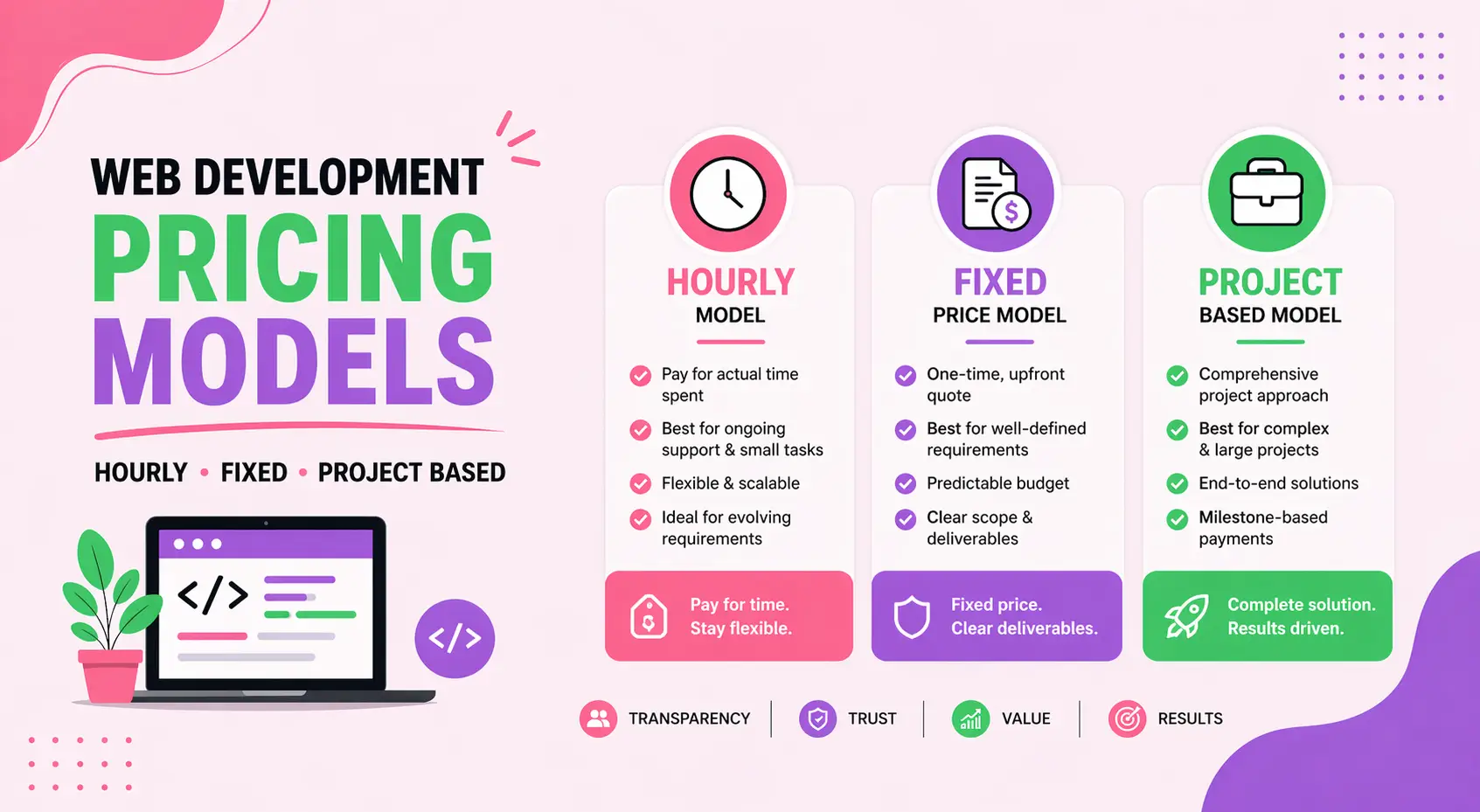
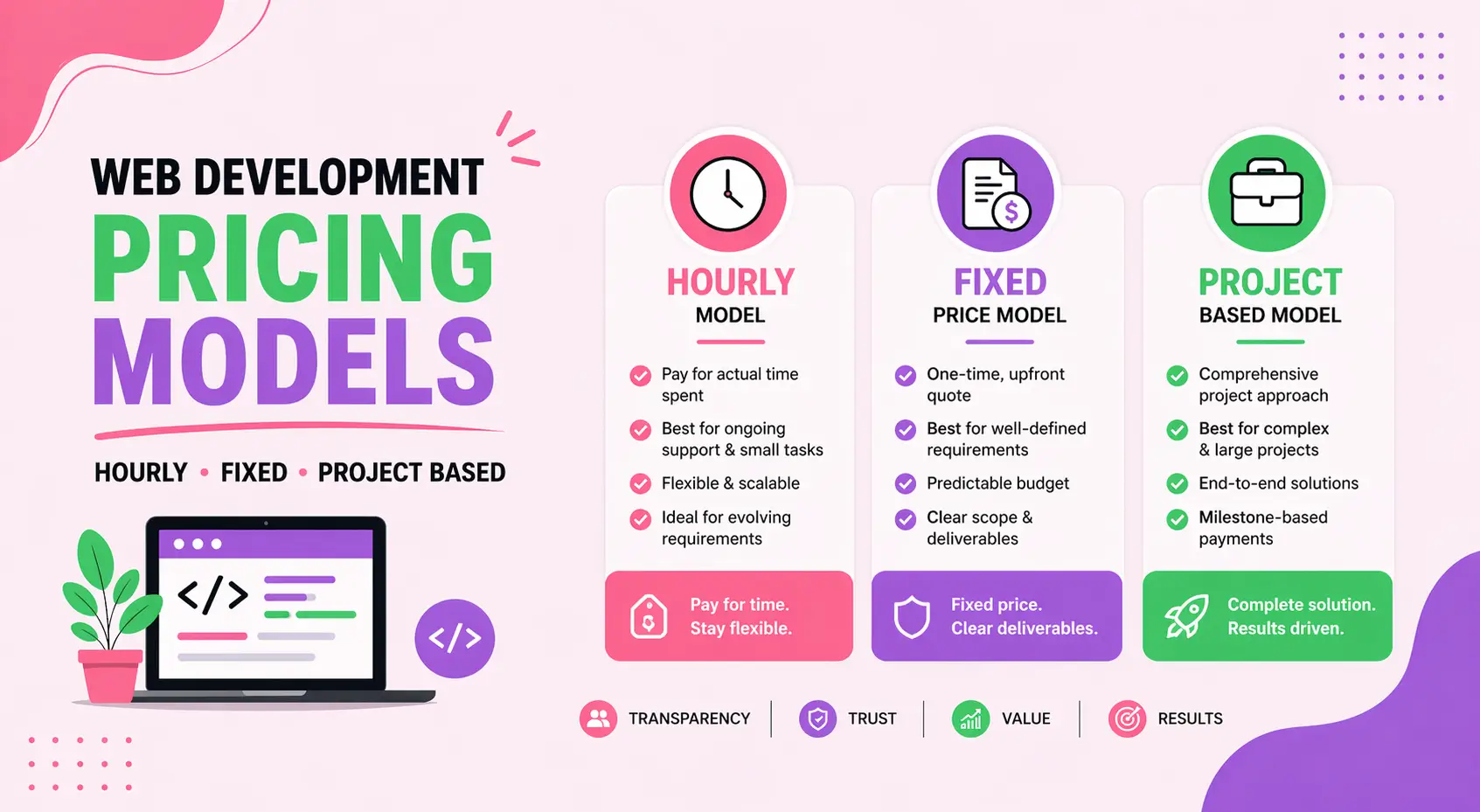
- Maximum flexibility: Requirements can evolve without renegotiating the entire contract. This is ideal when the full scope isn't defined upfront.
- Transparency: Clients see exactly what they're paying for and can audit timesheets to understand where hours are spent.
- Low initial commitment: There's no large upfront payment. You can start small and scale the engagement as needed.
- Ideal for ongoing maintenance: Bug fixes, content updates, and incremental feature additions are handled naturally without scope disputes.
- Better for exploratory work: If you're still validating ideas, hourly billing lets you prototype and pivot without financial penalty.
Drawbacks of Hourly Pricing
- Budget unpredictability: Costs can balloon without close monitoring. A project estimated at 100 hours might take 160.
- Misaligned incentives: Theoretically, a slow developer earns more money by taking longer. Vetting efficiency becomes critical.
- Administrative overhead: Clients must track invoices, validate timesheets, and approve overages regularly.
- Poor fit for fixed-budget projects: Startups or SMBs with tight budgets may struggle to manage hourly cost uncertainty.
When to Use Hourly Pricing
Use hourly pricing when your project is exploratory, when requirements are subject to frequent change, when you need ongoing technical support, or when you're building an MVP and expect multiple iteration cycles. It's also the preferred model for maintaining legacy codebases or integrating third-party APIs where complexity is difficult to estimate upfront.
Fixed-Price Model: When Certainty Is Everything
What Is a Fixed-Price Web Development Contract?
A fixed-price contract establishes a single, agreed-upon fee for a clearly defined deliverable. Before work begins, both parties align on the full scope of work — features, pages, functionalities, and acceptance criteria — and the developer commits to delivering that scope for the stated price.
This model is the most commonly used for smaller, well-defined projects: a brochure website, an e-commerce store, a landing page series, or a defined feature set added to an existing platform.
Benefits of Fixed-Price Contracts
- Complete budget certainty: You know the total cost before any work starts. This makes financial planning simple and eliminates surprise invoices.
- Incentivizes efficiency: The developer is motivated to complete work efficiently since their profit is directly tied to how fast they can deliver within scope.
- Clear accountability: Scope documents serve as legal and professional benchmarks. Deliverables are either met or they aren't.
- Easier client-side management: Less time spent reviewing timesheets or approving incremental invoices.
- Great for procurement processes: Enterprises and government clients often require fixed bids for vendor selection.
Drawbacks of Fixed-Price Contracts
- Scope creep risk: Every change request — no matter how small — typically triggers a change order and additional cost.
- Requires thorough upfront planning: The discovery and specification phase must be comprehensive. Vague scope documents lead to disputes.
- Reduced flexibility: Pivoting mid-project is expensive and contractually complicated.
- Potential quality trade-offs: Developers may cut corners to preserve their profit margin if the project runs over the estimated effort.
- Longer pre-project phase: Detailed scoping takes time. Projects may not start for weeks while documentation is finalized.
When to Use Fixed-Price Contracts
Fixed-price is ideal when your requirements are stable and fully documented, when you have a defined budget ceiling, and when you need the predictability that internal approvals or investor reporting demands. It works especially well for redesigns, landing pages, custom WordPress or Shopify builds, and software products with a clear, frozen specification.
Project-Based Pricing: Scope-Driven Value
How Project-Based Pricing Differs from Fixed-Price
Project-based pricing is sometimes used interchangeably with fixed-price, but there's an important distinction: project-based pricing focuses on delivering value per milestone rather than delivering a single monolithic output at one total price. A typical project-based engagement might be structured as follows:
- Discovery & Strategy Phase: $2,000–$5,000
- UI/UX Design Phase: $3,000–$10,000
- Frontend Development: $5,000–$20,000
- Backend & Integration: $5,000–$25,000
- QA & Testing: $2,000–$5,000
- Launch & Deployment: $1,000–$3,000
Each phase is priced independently, with its own deliverables, timelines, and approval checkpoints. The client reviews and approves each phase before the next begins.
Benefits of Project-Based Pricing
- Granular financial control: Clients can pause, adjust, or even terminate at the end of any phase if priorities change.
- Incremental quality assurance: Approval gates at each milestone prevent problems from compounding through the project lifecycle.
- Better for large, complex projects: Breaking a $100,000 project into six phases makes it manageable, both financially and operationally.
- Natural flexibility zones: Scope adjustments can be incorporated between phases without destabilizing the entire contract.
- Aligned payment with progress: You pay as value is delivered, reducing financial risk on both sides.
Challenges of Project-Based Pricing
- Phase interdependencies: If early phases run late, all subsequent phases shift, affecting schedules and stakeholder expectations.
- Complex contracting: Each phase may require its own statement of work, review process, and approval documentation.
- Requires active client involvement: Approval gates only work if the client is engaged and responsive throughout the project.
Retainer Model: Ongoing Development Without the Guesswork
What Is a Web Development Retainer?
A retainer agreement gives clients ongoing access to a developer or agency's time and expertise in exchange for a fixed monthly fee. Common retainer structures include:
- Time-based retainers: Client buys a block of hours per month (e.g., 20 hours/month at $100/hour = $2,000/month)
- Deliverable-based retainers: A defined set of tasks is completed each month regardless of hours consumed
- Priority access retainers: Client pays a premium for guaranteed response times and first-priority scheduling
When Retainers Make Sense
Retainers are the right model for businesses that:
- Regularly publish new features, content, or campaigns
- Run digital products that require ongoing maintenance, security updates, and performance optimization
- Prefer to work with a single trusted partner rather than re-bidding projects constantly
- Need strategic continuity — a developer who understands the codebase deeply over time
Digital agencies and boutique development studios often offer retainers alongside their standard project work. A full-service digital marketing company providing Web Development, Digital Marketing, and SEO services like WEBPEAK often bundles retainer-based development with ongoing marketing services to give clients a unified, long-term growth partnership.
Value-Based Pricing: Paying for Outcomes, Not Hours
The Logic Behind Value-Based Web Development Pricing
Value-based pricing flips the entire pricing conversation. Instead of asking "how long will this take?" or "what does it cost to build?", the question becomes "what is this worth to the client's business?" If a new e-commerce website is projected to generate $500,000 in its first year, a developer might price their services at $50,000 — a 10% value capture — regardless of how many hours the project actually takes.
This model is increasingly popular among senior independent consultants and elite boutique agencies who can credibly demonstrate business outcomes tied to their technical work.
Pros and Cons of Value-Based Pricing
- Pro: Highly profitable for experienced developers with strong track records
- Pro: Aligns developer and client incentives around business outcomes
- Pro: Removes the ceiling on earnings imposed by hourly billing
- Con: Difficult to justify without proven ROI data or case studies
- Con: Requires sophisticated client education and relationship trust
- Con: Not suitable for commodity work or clients with limited budgets
Side-by-Side Comparison of All Web Development Pricing Models
| Pricing Model | Budget Predictability | Flexibility | Risk (Client) | Risk (Developer) | Best For |
|---|---|---|---|---|---|
| Hourly | Low | High | Medium | Low | Ongoing work, evolving scope, MVPs |
| Fixed-Price | High | Low | Low | High | Well-defined, bounded projects |
| Project-Based | Medium-High | Medium | Low-Medium | Medium | Complex multi-phase builds |
| Retainer | High | Medium | Low | Low | Ongoing maintenance, product teams |
| Value-Based | High | Medium | Low | Low | High-ROI projects with measurable goals |
How to Choose the Right Web Development Pricing Model
Step 1: Evaluate Your Scope Clarity
Ask yourself: How well-defined are the project requirements? If you have a detailed specification document, wireframes, and technical requirements, fixed or project-based pricing works well. If you're still exploring what you need, hourly billing gives you the freedom to iterate.
Step 2: Assess Your Budget Flexibility
Do you have a hard budget ceiling? If yes, fixed-price or project-based models ensure you never exceed it — provided scope is controlled. If your budget is flexible and you're optimizing for quality and speed, hourly billing may serve better.
Step 3: Consider Your Risk Tolerance
Fixed-price shifts financial risk to the developer; hourly shifts it to the client. Project-based distributes risk across both parties phase by phase. Consider who is better positioned to absorb cost overruns and structure your contract accordingly.
Step 4: Think About Timeline Sensitivity
Hourly projects can start immediately. Fixed and project-based contracts require scoping time upfront. If time-to-market is your primary concern, hourly engagement may be the fastest to initiate.
Step 5: Evaluate the Relationship You Want
Do you want a transactional vendor relationship (project-based or fixed) or a long-term collaborative partner (retainer)? The pricing model shapes the dynamic. Retainer relationships tend to produce deeper institutional knowledge and better long-term outcomes.
Checklist: Choosing the Right Web Development Pricing Model
- ☐ Requirements fully documented and stable → Consider Fixed-Price
- ☐ Requirements evolving or unclear → Consider Hourly
- ☐ Large complex project with phases → Consider Project-Based
- ☐ Ongoing maintenance or product development → Consider Retainer
- ☐ High-ROI digital product with measurable outcomes → Consider Value-Based
- ☐ Fixed budget ceiling with government or enterprise procurement → Fixed-Price
- ☐ Startup MVP with limited capital → Hourly or Project-Based (phased)
Real-World Examples and Use Cases
Case Study 1: E-Commerce Brand Redesign (Fixed-Price)
A mid-sized fashion retailer needed a complete Shopify redesign with custom theme development, product filtering, and checkout optimization. The scope was fully defined: 12 page templates, 3 custom sections, and a specific list of integrations. They chose a fixed-price contract for $18,000 with a boutique agency. Outcome: project delivered on time, on budget, with zero scope disputes because every requirement was documented before development began.
Case Study 2: SaaS Product MVP (Hourly)
A B2B startup building a project management tool had a rough concept but no finalized product spec. They engaged a senior full-stack developer at $120/hour to build an MVP over 12 weeks. Total cost: approximately $57,600. The hourly model allowed them to pivot the dashboard UI twice based on early user feedback without renegotiating the entire contract. The flexibility was worth every penny.
Case Study 3: Digital Marketing Agency Website (Project-Based)
A growing digital marketing agency needed a new website with a blog CMS, service pages, case study templates, and SEO architecture. The agency broke the project into four phases — strategy and sitemap, design, development, and launch — priced at $2,500, $6,000, $12,000, and $2,000 respectively. Total: $22,500. The client approved each phase independently, ensuring quality checkpoints before moving forward.
Case Study 4: Enterprise Web Application (Retainer)
A logistics company running a custom shipment tracking platform retained a development team at $15,000/month for ongoing feature development, performance optimization, and security patching. The predictable monthly cost was built into their operating budget, and the development team's deep familiarity with the codebase meant faster, safer deployments over time.
Best Practices for Negotiating and Managing Web Development Contracts
Always Define Scope Before Signing
Regardless of which pricing model you choose, a clear scope document is non-negotiable. This includes a feature list, acceptance criteria, technical specifications, page inventory, and any third-party integrations. Ambiguity in scope is the single greatest cause of cost overruns and client-developer conflict.
Include a Change Order Process
Every contract should include a defined process for handling scope changes. This typically specifies how changes are requested, how they are estimated, how they are approved, and how they affect timeline and budget. Without a formal change order process, every request becomes a negotiation and potential conflict.
Negotiate Payment Milestones
Even in hourly contracts, it's wise to establish maximum budget thresholds per sprint or week. This gives the client visibility and control while giving the developer predictable cash flow. Common payment structures include 30% upfront, 30% at midpoint, and 40% at delivery for fixed contracts.
Use Time-Tracking and Reporting Tools
For hourly and retainer engagements, insist on transparent time-tracking reports. Tools like Harvest, Toggl Track, or agency-specific platforms provide granular breakdowns of how time is allocated across tasks, features, and meetings.
Conduct Regular Scope Reviews
Schedule weekly or bi-weekly scope reviews to ensure the project is on track. Early identification of scope drift — where features gradually expand beyond the original agreement — can prevent budget shocks later in the project.
Build in Warranty Periods
A quality web development contract should include a post-launch warranty period — typically 30 to 90 days — during which the developer fixes any bugs or defects in the delivered work at no additional charge. This protects the client and incentivizes the developer to deliver quality code.
Tools and Technologies That Influence Web Development Pricing
Content Management Systems
The CMS choice significantly affects pricing. A WordPress website is generally more affordable to develop than a fully custom headless CMS build. Common CMS options and their pricing implications:
- WordPress: Cost-effective; large developer pool; extensive plugin ecosystem reduces custom development time
- Shopify: E-commerce-specific; lower development cost for standard stores; higher cost for heavy customization
- Webflow: Design-heavy; faster for marketing sites; limited for complex applications
- Custom / Headless CMS (Contentful, Sanity, Strapi): Higher upfront cost; better long-term flexibility for enterprise
Frontend Frameworks
React, Vue, Angular, and Next.js are the dominant frontend frameworks in 2026. React and Next.js typically command higher hourly rates due to their prevalence in complex, high-performance applications. Simpler jQuery or vanilla JavaScript implementations cost less but offer less scalability.
Backend and Infrastructure
Backend choices — Node.js, Python/Django, PHP/Laravel, Ruby on Rails — each have their own developer supply and demand dynamics. Cloud infrastructure (AWS, Google Cloud, Azure) adds operational complexity that affects both development time and retainer costs for ongoing DevOps support.
Third-Party Integrations
Every third-party integration — CRM, payment gateway, ERP, analytics platform — adds development hours. Complex integrations with poorly documented APIs can multiply estimated hours by 2x or 3x. Always account for integration complexity when evaluating fixed-price quotes.
AI-Powered Development Tools
In 2026, AI-assisted development tools like GitHub Copilot, Cursor, and Claude have become standard in professional development workflows. These tools can reduce development time by 20–40% for routine coding tasks, which in hourly engagements directly benefits the client through lower total hours billed. Forward-thinking agencies pass a portion of these efficiency gains to clients through competitive rates.
Future Trends in Web Development Pricing (2026 and Beyond)
AI-Driven Cost Estimation Tools
Machine learning models are increasingly being used to estimate project costs based on historical data from thousands of similar projects. These tools analyze scope documents, identify comparable past projects, and generate statistically grounded estimates that reduce the guesswork in fixed-price bidding. Expect these tools to become standard in agency workflows by 2027.
Outcome-Based and Performance-Linked Pricing
The line between web development pricing and digital marketing pricing is blurring. More agencies are offering performance-linked contracts where a portion of the development fee is tied to measurable outcomes — conversion rate improvements, page speed benchmarks, or organic traffic growth. This trend reflects the increasing overlap between technical execution and business performance.
Subscription-Based Web Development Services
Inspired by the success of subscription-based design services, a growing number of web development agencies now offer flat-rate monthly subscription packages. For a fixed monthly fee — typically between $3,000 and $15,000 — clients receive unlimited development requests handled asynchronously by a dedicated team. This model is gaining traction with SMBs and startups that want predictability without the overhead of maintaining in-house developers.
Decentralized Talent and Global Rate Compression
Remote work normalization has compressed the global talent market. North American and Western European developers increasingly compete with world-class talent from Eastern Europe, Latin America, and Asia Pacific. This is gradually reducing the premium commanded by geography alone and shifting the value conversation toward specialization, track record, and communication quality.
AI-Augmented Agencies Redefining Pricing Floors
Agencies that fully integrate AI-assisted development are delivering projects at 30–50% lower cost than traditional development shops. This is creating new pricing floor pressures across the industry and forcing traditional agencies to either adopt AI tools or differentiate on strategy, creativity, and client experience rather than raw development output.
Micro-SaaS and No-Code Hybrid Pricing
The rise of no-code and low-code platforms (Webflow, Bubble, Framer) is creating hybrid pricing models where the platform license cost is bundled with a professional setup fee. Clients pay less in development hours but commit to ongoing platform subscription costs. Understanding the total cost of ownership — including licensing — is becoming an essential part of the pricing conversation.
Frequently Asked Questions About Web Development Pricing Models
What is the most common web development pricing model used by agencies?
The most widely used model is fixed-price or project-based pricing for discrete projects and retainer pricing for ongoing work. Hourly billing is prevalent among freelancers and for undefined or exploratory projects. The model that dominates in any given engagement depends heavily on project scope clarity and the preferences of both the client and developer.
Is hourly or fixed-price better for web development?
Neither is universally better. Hourly pricing is superior when requirements are uncertain or likely to change — it provides maximum flexibility and transparency. Fixed-price is better when requirements are stable, scope is well-documented, and budget predictability is critical. Many experienced project managers recommend a hybrid approach: use hourly billing for discovery and design phases, then lock into fixed-price for the development phase once the specification is finalized.
How much does it cost to build a website in 2026?
Website development costs vary enormously based on complexity, technology stack, and provider type. A basic brochure website might cost $1,500–$5,000 from a freelancer. A custom e-commerce store typically runs $10,000–$50,000. A complex web application can cost $50,000–$500,000 or more. The pricing model you choose — hourly, fixed, or project-based — affects total cost by changing how scope and risk are managed.
What should a web development contract include?
A thorough web development contract should include: a detailed scope of work with feature list and acceptance criteria; the pricing model and payment schedule; a defined change order process; project timeline and milestone definitions; IP ownership and code licensing terms; a confidentiality agreement; a warranty period for post-launch bug fixes; and termination clauses. Regardless of whether you're using hourly or fixed pricing, these elements protect both parties.
How do web development agencies calculate fixed-price quotes?
Agencies calculate fixed-price quotes by estimating hours per task, applying their hourly rate to each estimate, adding buffers for project management, communication, and unexpected complexity (typically 15–25%), and then arriving at a total. The more detailed the scope document, the more accurate the estimate. Reputable agencies will walk you through their estimation methodology and show you the assumptions behind the quoted number.
What is a web development retainer and is it worth it?
A web development retainer is a recurring monthly payment that gives you access to a developer's or agency's time on an ongoing basis. It's worth it if you regularly need development support — for feature additions, maintenance, security updates, or campaign builds. For businesses with active digital products or high web publishing frequency, a retainer typically delivers better value than re-bidding individual projects repeatedly, because the developer builds deep product knowledge over time that makes their work faster and more accurate.
Can I switch pricing models mid-project?
Yes, switching pricing models mid-project is possible and sometimes advisable. Many successful engagements begin hourly during discovery and design, then transition to fixed-price for the development phase once the specification is locked. The key is to formalize the transition with a written amendment to the original agreement that documents the new pricing structure, scope, and payment terms. Switching without documentation creates ambiguity and potential disputes.
Conclusion: Making the Right Call on Web Development Pricing
The debate between hourly, fixed, and project-based web development pricing is not about which model is inherently best — it's about which model best matches your specific project context, risk profile, and business goals. Hourly billing maximizes flexibility and transparency. Fixed-price contracts deliver budget certainty and clear accountability. Project-based pricing balances both through structured milestones. Retainers provide strategic continuity. Value-based pricing aligns everyone around business outcomes.
The most sophisticated buyers of web development services don't dogmatically commit to one model. They evaluate each project independently, ask the right questions during vendor selection, insist on thorough scope documentation regardless of the pricing structure, and build contractual safeguards that protect their investment at every phase.
As AI continues to reshape how web development is priced, delivered, and evaluated in 2026 and beyond, the professionals and businesses that understand these pricing dynamics will consistently get more value from their development investments — and avoid the costly mistakes that come from mismatched expectations and poorly structured contracts.
Whether you're a startup founder budgeting for your first product, a marketing director commissioning a new company website, or a CTO evaluating development partners for a complex platform — mastering web development pricing models gives you a measurable competitive advantage in every vendor conversation you'll ever have.