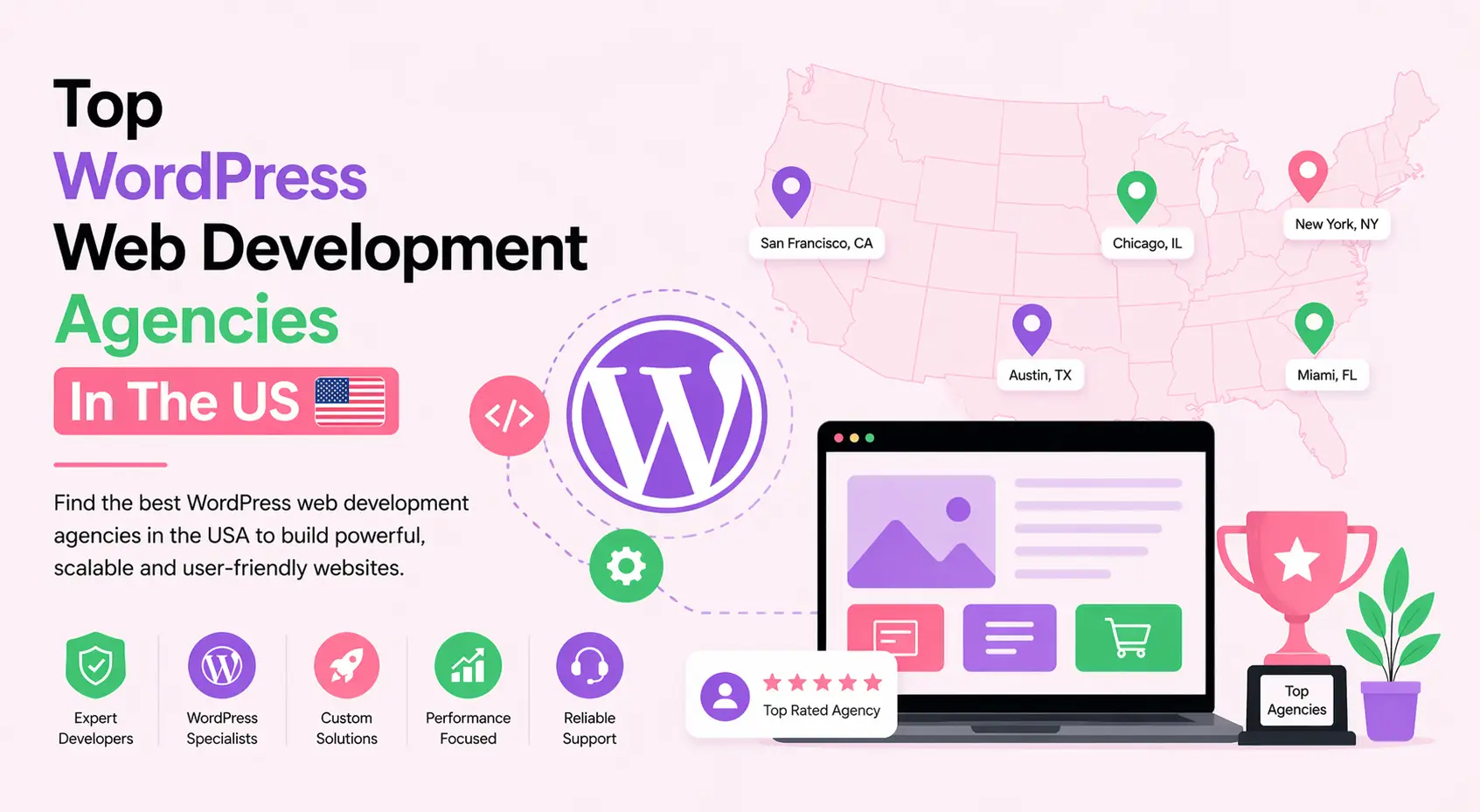



Top WordPress Web Development Agencies In The US 2026: The Definitive Guide
Finding the right WordPress web development agency in the US in 2026 is no longer just about getting a website built — it is about choosing a long-term digital partner who understands performance, scalability, SEO, and conversion optimization at an enterprise level. The WordPress ecosystem has evolved dramatically, and not every agency has kept pace. Whether you are a startup launching your first digital presence, a mid-market brand rebuilding an outdated platform, or an enterprise organization requiring complex custom functionality, selecting the right partner from the top WordPress web development agencies can be the single most impactful business decision you make this year.
This guide cuts through the noise. It gives you an authoritative, research-backed breakdown of what separates elite agencies from average ones, what services to expect, what questions to ask, and which companies have consistently delivered measurable results in the current landscape. By the end of this article, you will have a clear framework to evaluate, shortlist, and confidently hire the right WordPress development partner for your specific goals.
Table of Contents
- Why WordPress Remains the Dominant CMS Platform in 2026
- What Makes a WordPress Agency Truly "Top-Tier"?
- Top WordPress Web Development Agencies in the US 2026
- Core Services Offered by Leading WordPress Agencies
- Key Benefits of Hiring a Specialized WordPress Agency
- Common Challenges and How Top Agencies Overcome Them
- Best Practices When Working With a WordPress Development Partner
- Tools and Technologies Used by Elite WordPress Agencies in 2026
- How to Choose the Right WordPress Agency for Your Business
- Future Trends in WordPress Development for 2026 and Beyond
- Frequently Asked Questions
Why WordPress Remains the Dominant CMS Platform in 2026
WordPress powers approximately 43% of all websites on the internet as of 2026, a figure that continues to grow year over year. This is not an accident or a legacy fluke — it is the result of decades of open-source innovation, an enormous developer community, and a platform that has consistently evolved to meet the demands of modern digital marketing, e-commerce, and content publishing.
In 2026, WordPress has expanded its capabilities dramatically through the Gutenberg block editor, Full Site Editing (FSE), and deep integration with headless CMS architecture. Businesses increasingly rely on WordPress not just as a blogging platform but as a powerful application framework capable of handling complex membership sites, multi-vendor marketplaces, SaaS landing funnels, enterprise portals, and API-driven headless front-ends.
Here is why WordPress continues to dominate:
- Unmatched plugin ecosystem: Over 60,000 plugins in the official repository, covering every conceivable functionality from advanced SEO to payment processing, LMS platforms, and CRM integrations.
- SEO-friendly architecture: WordPress, when properly configured, produces clean, semantic HTML that search engines love. Combined with plugins like Yoast SEO, Rank Math, and All in One SEO, it gives marketing teams granular control over metadata, schema markup, and XML sitemaps.
- Cost efficiency: Compared to proprietary CMS platforms like Sitecore or Adobe Experience Manager, WordPress dramatically reduces licensing costs while offering comparable, often superior flexibility.
- Headless and decoupled capabilities: The WordPress REST API and WPGraphQL plugin have made WordPress a powerful backend for headless architectures using React (Next.js), Vue (Nuxt.js), and other modern JavaScript frameworks.
- AI integration readiness: In 2026, WordPress developers are embedding AI-powered content tools, chatbots, personalization engines, and automated SEO suggestions directly into the CMS workflow.
What Makes a WordPress Agency Truly "Top-Tier"?
Not every agency that builds WordPress sites belongs on a list of the best. There is a meaningful difference between a freelancer spinning up a theme and a professional agency delivering enterprise-grade custom solutions. Here is what separates the best from the rest:
Technical Excellence and Custom Development
Top agencies do not rely entirely on off-the-shelf themes and plugins. They write clean, efficient custom PHP, JavaScript, and CSS. They understand WordPress internals — hooks, filters, the WP_Query object, custom post types, taxonomies, and the options API. This technical depth allows them to build functionality that is perfectly tailored to a client's needs without bloating the codebase.
Performance Optimization as a Core Discipline
Core Web Vitals are a confirmed Google ranking factor. Leading agencies in 2026 treat performance not as an afterthought but as a foundational design principle. This includes:
- Implementing server-side caching (Redis, Memcached, Varnish)
- Optimizing database queries and eliminating N+1 problems
- Using CDN infrastructure (Cloudflare, AWS CloudFront, BunnyCDN)
- Image optimization through WebP/AVIF formats and lazy loading
- Minifying and deferring JavaScript and CSS assets
- Achieving Lighthouse scores above 90 across all Core Web Vitals metrics
Security-First Development Approach
WordPress security vulnerabilities are a serious concern for businesses. Elite agencies implement hardening measures from day one: disabling the XML-RPC API, implementing Web Application Firewalls (WAF), enforcing two-factor authentication, monitoring with tools like Wordfence or Sucuri, and following the principle of least privilege for user roles and database access.
Scalable Architecture and Hosting Strategy
The best agencies do not just build — they architect. They plan for traffic spikes, multi-region availability, and content delivery at scale. They partner with managed WordPress hosts like WP Engine, Kinsta, Cloudways, or AWS-based solutions to ensure uptime SLAs and predictable performance under load.
Integrated Digital Marketing Capability
A WordPress site without a marketing strategy is just a digital brochure. The top agencies of 2026 understand that web development and digital marketing are inseparable. They build sites with conversion rate optimization (CRO) principles baked in, create SEO-structured information architectures, and integrate analytics platforms from day one.
Top WordPress Web Development Agencies in the US 2026
The following agencies have distinguished themselves through a combination of technical expertise, client satisfaction, portfolio breadth, and measurable results. This list covers agencies of varying sizes to reflect the reality that the "best" agency depends entirely on your business size, budget, and project complexity.
1. 10up
Headquartered in Seattle, Washington, 10up is one of the most widely recognized names in enterprise WordPress development. They are a WordPress VIP Gold Agency Partner and have worked with brands including Microsoft, ESPN, TechCrunch, and The New York Times. Their team of engineers, designers, and strategists specializes in large-scale, high-traffic WordPress implementations with exceptional editorial workflow design.
Best for: Enterprise media companies, publishers, and large organizations requiring high-availability WordPress solutions.
2. Automattic (WordPress.com VIP)
Automattic, the company behind WordPress.com, offers enterprise-grade WordPress hosting and development through WordPress VIP — the gold standard for mission-critical WordPress deployments. Clients include CNN, Salesforce, and major global media brands. While Automattic is the parent company, their VIP services division functions as a full-service agency partner.
Best for: Enterprise organizations requiring unmatched uptime guarantees, compliance frameworks, and white-glove managed services.
3. Crowd Favorite
Based in Phoenix, Arizona, Crowd Favorite has built a reputation for sophisticated custom WordPress solutions for clients in media, education, and enterprise software. They are a WordPress VIP partner with deep expertise in REST API development, headless WordPress, and complex content modeling.
Best for: Organizations requiring headless WordPress architectures, complex data relationships, and editorial-driven publishing platforms.
4. WebDevStudios
WebDevStudios is a fully remote agency with team members across the United States. They are one of the most prolific contributors to the WordPress open-source project and have worked with clients including Viacom, Starbucks, and the United Nations. Their approach is deeply rooted in best practices, performance engineering, and accessibility compliance.
Best for: Mid-market to enterprise clients who value open-source contribution, accessibility compliance (WCAG 2.2), and technical rigor.
5. Codeable Expert WordPress Developers
Codeable operates as a curated marketplace of expert WordPress freelancers and small agencies, all vetted through a rigorous selection process. For businesses that need specialized WordPress expertise without committing to a full-service agency retainer, Codeable provides access to some of the best individual WordPress talent in the world.
Best for: Startups and small businesses needing expert-level WordPress help for specific tasks, customizations, or plugin development.
6. Upstack (WordPress Division)
Upstack places a strong emphasis on developer quality control and project management transparency. Their WordPress team works across full-stack development, WooCommerce customization, and performance engineering. They operate across multiple US time zones and offer rapid engagement timelines.
Best for: Growing businesses that need fast access to vetted WordPress talent with strong project management oversight.
7. WPMU DEV Agency Services
WPMU DEV is known primarily for their suite of WordPress tools, but their agency services arm provides white-label and direct client development for businesses of all sizes. They offer a unique combination of tool access and professional services that reduces development costs significantly.
Best for: Agencies and resellers looking for white-label WordPress development, and small-to-medium businesses needing cost-effective expert support.
8. Kanopi Studios
Kanopi Studios specializes in WordPress and Drupal for mission-driven organizations, nonprofits, higher education institutions, and healthcare organizations. Their expertise in accessibility, HIPAA compliance, and complex content ecosystems makes them a go-to partner for organizations with specialized compliance needs.
Best for: Nonprofits, educational institutions, and healthcare organizations requiring ADA/WCAG compliance and mission-driven digital strategy.
9. Lounge Lizard
Founded in New York City, Lounge Lizard has over 25 years of experience in web design and development, with WordPress as a core platform offering. They combine creative brand strategy with technical WordPress development and digital marketing services, making them particularly valuable for brands that need strong visual storytelling alongside technical execution.
Best for: Brands seeking a balance of creative excellence and technical WordPress development with an integrated marketing approach.
10. Tectonic Digital
Tectonic Digital focuses specifically on WordPress performance, speed optimization, and WooCommerce development. They have built a strong reputation for taking underperforming WordPress sites and transforming them into fast, conversion-optimized digital assets.
Best for: E-commerce businesses using WooCommerce that need performance turnarounds, conversion optimization, and revenue-focused development.
Core Services Offered by Leading WordPress Agencies
When evaluating WordPress development companies, understanding their full service portfolio is essential. The best agencies offer a comprehensive range of capabilities that go far beyond simply installing WordPress and a theme.
Custom WordPress Theme Development
Custom theme development means building a WordPress theme from scratch — or from a minimal starter framework — rather than purchasing a commercial theme and customizing it. This results in cleaner code, better performance, tighter brand alignment, and no dependency on third-party theme vendors who may abandon support or introduce breaking changes.
Custom Plugin Development
When existing plugins cannot meet specific business requirements, top agencies develop custom WordPress plugins tailored to exact specifications. This includes custom API integrations, proprietary business logic, unique user experience features, and compatibility-hardened code that works reliably across WordPress updates.
WooCommerce Development and Optimization
WooCommerce powers a significant share of e-commerce worldwide. Expert agencies offer end-to-end WooCommerce services including store setup, custom product types, payment gateway integration, inventory management systems, order fulfillment automation, abandoned cart recovery, and performance optimization for high-volume product catalogs.
Headless WordPress Development
Headless WordPress separates the CMS backend from the frontend display layer. Content editors still manage content through the familiar WordPress dashboard, but the frontend is rendered by a modern JavaScript framework like Next.js or Gatsby. This approach delivers superior performance, better developer experience, and the ability to publish content across multiple channels simultaneously.
WordPress Multisite Development
WordPress Multisite allows organizations to manage a network of websites from a single WordPress installation. This is ideal for franchise businesses, university systems, media networks, and enterprises with multiple regional or product-specific sites that need centralized administration.
WordPress Migration and Redesign
Many businesses have aging WordPress installations that need to be modernized. Top agencies handle full migrations from legacy CMS platforms (Drupal, Joomla, Squarespace, Wix, Magento) to WordPress, as well as complete redesigns that retain SEO equity, URL structures, and content while delivering a dramatically improved user experience.
Ongoing Support, Maintenance, and Security Monitoring
WordPress is not a set-it-and-forget-it platform. Core, theme, and plugin updates need to be tested and applied regularly. Top agencies offer structured maintenance plans that include update management, security monitoring, uptime monitoring, performance audits, and priority support for urgent issues.
Key Benefits of Hiring a Specialized WordPress Agency
Some businesses question whether hiring a specialized WordPress agency is worth the investment compared to hiring a generalist developer or an in-house team. The evidence strongly favors specialized agencies for most organizations:
- Deep platform expertise: WordPress agencies have solved thousands of problems across hundreds of projects. They carry institutional knowledge that prevents common mistakes and accelerates delivery timelines.
- Access to a full team: A good agency brings a strategist, designer, front-end developer, back-end developer, QA engineer, and project manager to your project — all under one contract.
- Established development workflows: Version control (Git), staging environments, code review processes, automated testing, and deployment pipelines are already in place.
- Vendor relationships and discounts: Agencies often have partner relationships with hosting providers, premium plugin vendors, and CDN services that translate into cost savings for clients.
- Scalability: As your project grows, an agency can scale resources up or down without the HR overhead of hiring and training new employees.
- Risk mitigation: Agencies carry professional liability insurance and typically offer warranties on their work. If something breaks, there is a clear accountability structure.
- Integrated marketing alignment: Many top WordPress agencies have digital marketing capabilities that ensure the site is built not just to function, but to rank, convert, and retain visitors.
Common Challenges and How Top Agencies Overcome Them
Even the best WordPress projects encounter obstacles. Understanding common challenges — and how elite agencies address them — helps you set realistic expectations and ask better questions during your selection process.
Challenge 1: Scope Creep and Budget Overruns
Scope creep is the silent killer of WordPress projects. Requirements expand mid-project, stakeholders request new features, and timelines slip. Top agencies counter this with detailed discovery phases, fixed-scope contracts or clearly structured time-and-materials agreements, and change order processes that require written approval before additional work begins.
Challenge 2: Plugin Conflicts and Compatibility Issues
WordPress's reliance on third-party plugins creates compatibility risks. Poorly coded plugins can conflict with each other or break after updates. Elite agencies audit plugin choices rigorously, test in staging environments before deploying to production, and minimize plugin dependencies by writing custom code where it makes sense.
Challenge 3: Performance Degradation at Scale
Many WordPress sites perform acceptably at low traffic volumes but degrade under high concurrency. Top agencies architect for scale from the start: object caching, database query optimization, CDN configuration, and load-balanced server infrastructure that can handle traffic spikes without degradation.
Challenge 4: SEO Preservation During Redesigns
Redesigning a WordPress site can devastate organic search rankings if not managed carefully. Experienced agencies implement comprehensive SEO migration plans: 301 redirect mapping, canonical tag auditing, metadata migration, XML sitemap updates, and post-launch monitoring to catch and address ranking drops quickly.
Challenge 5: Security Vulnerabilities
WordPress sites are popular targets for malicious actors because of the platform's market share. Top agencies implement layered security: regular update cycles, WAF deployment, brute-force protection, malware scanning, SFTP-only file access, and regular off-site backups.
Best Practices When Working With a WordPress Development Partner
Your agency relationship is a two-way street. The projects that deliver the best results are those where clients come prepared and engaged. Follow these best practices to maximize your investment:
- Define your goals before the first call. Know what success looks like: more organic traffic, higher conversion rates, faster page speed, reduced bounce rates, or all of the above. Concrete goals allow agencies to propose focused solutions.
- Prepare a detailed brief. Include your target audience, competitive landscape, brand guidelines, technical requirements, integration needs, timeline constraints, and budget range.
- Establish a single point of contact. Projects stall when multiple stakeholders give conflicting feedback. Designate one decision-maker on your team who can consolidate feedback and provide timely approvals.
- Participate in the discovery phase. The best WordPress agencies conduct a thorough discovery process before writing a single line of code. Engage fully with this process — the quality of the discovery determines the quality of the final product.
- Insist on a staging environment. Never allow development work to happen directly on a live production site. Always require a staging environment for development and testing before anything goes live.
- Require documentation and knowledge transfer. At project completion, you should receive complete documentation of the theme, plugins, custom code, and hosting configuration. This protects you if you ever need to change agencies.
- Plan for ongoing maintenance from day one. Budget for a maintenance retainer before the project launches. A neglected WordPress site is a security liability and a technical debt accumulator.
Tools and Technologies Used by Elite WordPress Agencies in 2026
The technology stack a WordPress agency uses reveals their sophistication level. Here is a comprehensive overview of the tools and technologies that define top-tier WordPress development in 2026:
Development Environment Tools
- Local by Flywheel / Lando / Docker: Local development environments that mirror production server configurations exactly, eliminating "works on my machine" deployment issues.
- WP-CLI: Command-line interface for WordPress administration, allowing developers to manage updates, database operations, and plugin installations without using the browser UI.
- Git / GitHub / GitLab / Bitbucket: Version control systems that track every code change, enable collaboration across distributed teams, and make rollbacks straightforward.
Deployment and DevOps Tools
- DeployHQ / GitHub Actions / CircleCI: Continuous integration and continuous deployment (CI/CD) pipelines that automate testing and deployment workflows.
- WP Engine DevKit / Kinsta DevKinsta: Managed WordPress host-specific development tools that streamline deployment to production environments.
- Buddy: Visual CI/CD pipeline builder popular among WordPress agencies for its simplicity and WordPress-specific deployment pipelines.
Performance Optimization Tools
- WP Rocket / LiteSpeed Cache / W3 Total Cache: Caching plugins that dramatically improve WordPress page load times through page caching, object caching, and browser caching.
- Imagify / ShortPixel / Cloudinary: Image compression and next-gen format conversion tools that reduce image file sizes without visible quality loss.
- Query Monitor: Essential debugging tool that identifies slow database queries, PHP errors, and hook/filter performance bottlenecks.
SEO and Analytics Tools
- Yoast SEO / Rank Math: On-page SEO optimization plugins that manage metadata, schema markup, XML sitemaps, and readability analysis.
- Google Search Console / Google Analytics 4: Essential for monitoring search performance, indexation status, and user behavior post-launch.
- Ahrefs / SEMrush / Screaming Frog: SEO auditing and competitive research tools used during strategy and post-launch monitoring phases.
Security Tools
- Wordfence / Sucuri / iThemes Security Pro: WordPress-specific security plugins offering malware scanning, firewall protection, and login security.
- UpdraftPlus / BlogVault / WPVivid: Backup solutions that create automated, scheduled off-site backups for rapid disaster recovery.
AI-Powered Development Tools (2026)
- GitHub Copilot / Cursor / Windsurf: AI-powered code completion and generation tools that accelerate development velocity for WordPress custom code.
- Playwright / Selenium with AI test generation: AI-assisted QA testing tools that can automatically generate and maintain test suites for WordPress sites.
How to Choose the Right WordPress Agency for Your Business
With dozens of qualified agencies to choose from, the selection process can feel overwhelming. Use this structured evaluation framework to make a confident, informed decision:
Step 1: Define Your Budget and Project Scope
Be honest about your budget range. Custom WordPress development from a top agency typically starts at $15,000 for a straightforward marketing site and can reach $150,000 or more for enterprise-level custom applications. Knowing your budget upfront allows agencies to propose realistic solutions rather than over-promising and under-delivering.
Step 2: Evaluate Portfolio Relevance
Do not just look at how beautiful an agency's portfolio looks — look for relevance to your industry, project type, and technical requirements. A stunning portfolio of e-commerce sites does not automatically qualify an agency to build a complex membership platform or a headless WordPress application.
Step 3: Assess Technical Expertise Directly
Ask technical questions during your discovery calls:
- How do you handle WordPress security hardening?
- What is your approach to Core Web Vitals optimization?
- How do you manage WordPress updates on client sites?
- Can you walk me through your version control and deployment workflow?
- How have you handled a site migration without losing SEO rankings?
Step 4: Check References and Case Studies
Ask for three client references in your industry or project type. Speak with those references directly. Ask about communication quality, timeline adherence, budget management, and whether they would hire the agency again. Read published case studies carefully for specific, measurable results rather than vague success stories.
Step 5: Evaluate Communication and Process
The best technical team in the world delivers poor results if they cannot communicate clearly with your team. Evaluate their project management methodology, communication cadence, reporting frequency, and the tools they use (Basecamp, Asana, Jira, Slack). A well-run agency will have clear answers to all of these questions immediately.
Step 6: Review Contract Terms Carefully
Understand exactly what you own after the project is complete: source code, design files, database, hosting account credentials. Ensure the contract includes clear IP transfer language. Understand warranty terms, support response time commitments, and the process for handling bugs discovered post-launch.
For businesses seeking a partner that combines cutting-edge WordPress development with a full suite of digital marketing capabilities, WEBPEAK, a full-service digital marketing company providing Web Development, Digital Marketing, and SEO services, is a strong option worth evaluating for integrated projects where development and marketing success are deeply intertwined.
Future Trends in WordPress Development for 2026 and Beyond
The WordPress ecosystem is evolving rapidly. Understanding where the platform is headed helps you make architectural decisions today that will remain sound for years to come.
Full Site Editing (FSE) and Block-Based Themes
WordPress's Full Site Editing initiative has matured significantly. In 2026, block-based themes are becoming the standard rather than the exception. Elite agencies are building entirely in the block editor, creating custom blocks with Gutenberg's block API, and delivering editorial experiences that rival purpose-built page builders without the performance overhead.
Headless and Decoupled WordPress at Scale
The headless WordPress architecture — using WordPress as a content API and a JavaScript framework like Next.js as the frontend — is moving from an enterprise luxury to a mainstream approach for performance-critical projects. WPGraphQL has matured into a production-ready solution, and frameworks like Faust.js have made headless WordPress significantly more accessible.
AI-Powered Content and Personalization
WordPress in 2026 is increasingly integrated with AI services for dynamic content personalization, AI-assisted writing and editing directly in the block editor, smart search powered by vector embeddings, chatbot integrations, and automated SEO optimization suggestions based on real-time search intent data.
Performance as a Competitive Differentiator
With Google's continued emphasis on Core Web Vitals and the growing user expectation of sub-second page loads, performance optimization is becoming a primary competitive differentiator. Agencies that master edge caching, server-side rendering, image optimization pipelines, and zero-JavaScript block rendering will deliver sites that outrank and outconvert competitors.
Multi-Channel Content Delivery
WordPress is evolving from a website-centric CMS to a content hub that distributes to websites, mobile apps, digital signage, smart TV platforms, and voice interfaces simultaneously. The WordPress REST API and WPGraphQL are the foundation of this multi-channel content strategy, and agencies that master content modeling for multi-channel delivery will be invaluable partners for forward-thinking brands.
Enhanced Security and Compliance Frameworks
With increasing regulatory scrutiny around data privacy (GDPR, CCPA, emerging US federal privacy legislation), WordPress agencies in 2026 are building comprehensive compliance frameworks into their development processes. This includes cookie consent management, data subject request workflows, and audit logging built directly into WordPress implementations.
Green Web Development and Sustainability
Sustainability in web development is an emerging trend with real business implications. Agencies are increasingly auditing WordPress sites for carbon footprint, optimizing server resource consumption, and choosing hosting providers powered by renewable energy. The Green Web Foundation and Website Carbon Calculator are becoming standard tools in post-launch audits.
Comparison Table: Top WordPress Agency Types by Business Need
| Business Type | Recommended Agency Size | Key Capabilities Needed | Typical Budget Range |
|---|---|---|---|
| Startup / Small Business | Boutique agency or curated freelancer marketplace | Custom theme, SEO setup, basic integrations, performance basics | $5,000 – $25,000 |
| Mid-Market Brand | Mid-size specialized agency (10–50 staff) | Custom development, WooCommerce, CRM integration, CRO | $25,000 – $100,000 |
| Enterprise Organization | Large enterprise WordPress agency or VIP partner | Headless architecture, multisite, compliance, enterprise integrations | $100,000 – $500,000+ |
| E-Commerce Business | WooCommerce-specialized agency | Custom product types, payment gateways, inventory, performance | $20,000 – $150,000 |
| Nonprofit / Education | Mission-driven specialized agency | Accessibility compliance, donation integration, LMS, grant reporting | $15,000 – $75,000 |
Frequently Asked Questions
How much does it cost to hire a top WordPress development agency in the US in 2026?
The cost of hiring a top WordPress development agency in the US in 2026 varies widely based on project scope, agency size, and geographic location. Entry-level projects with boutique agencies start around $5,000 to $15,000 for simple marketing sites. Mid-market projects with established agencies typically range from $25,000 to $100,000. Enterprise-level custom WordPress applications, headless implementations, and complex integrations can range from $100,000 to $500,000 or more. Most top agencies also offer ongoing maintenance retainers ranging from $500 to $5,000 per month depending on the support level required.
What is the difference between a WordPress developer and a WordPress agency?
A WordPress developer is typically an individual with specific technical skills — usually front-end development, back-end development, or both. A WordPress agency is a team-based organization that combines multiple disciplines under one roof: strategy, UX design, visual design, front-end development, back-end development, quality assurance, project management, and often digital marketing. For complex projects, an agency provides better accountability, broader skill coverage, and more reliable delivery timelines than a solo developer.
How do I verify that a WordPress agency is legitimate and qualified?
Verification steps include checking for WordPress VIP partner status, reviewing their portfolio for live, working websites in your industry, reading independent reviews on platforms like Clutch.co, GoodFirms, or Google, speaking directly with past clients, asking for case studies with measurable results, and evaluating their technical answers to direct questions about security, performance, and development workflow. Legitimate agencies will welcome technical scrutiny and provide clear, detailed answers.
Is WordPress still a good choice for business websites in 2026?
Yes, absolutely. WordPress in 2026 remains the most versatile, well-supported, and cost-effective CMS for the vast majority of business use cases. Its open-source nature, massive ecosystem, headless capabilities, and continuous development make it a strong platform choice for marketing sites, e-commerce stores, membership platforms, publishing platforms, and even complex application frontends. The key is pairing WordPress with a skilled development team that knows how to configure and optimize it properly.
What should I look for in a WordPress agency's portfolio?
When reviewing a WordPress agency's portfolio, look for diversity of project types, evidence of custom development rather than just theme customization, sites that load quickly and score well on Google PageSpeed Insights, mobile-first responsive design, clear information architecture, and case studies that show measurable business outcomes (increased organic traffic, improved conversion rates, reduced bounce rates). Also look for projects in your industry or with similar technical complexity to your own project.
How long does it take a top WordPress agency to build a custom website?
Timeline varies significantly based on project complexity. A custom WordPress marketing site with a new theme and standard integrations typically takes 8 to 16 weeks from signed contract to launch. A complex WooCommerce store with custom functionality may take 16 to 24 weeks. An enterprise headless WordPress implementation can take 6 to 12 months. Timelines are heavily influenced by client feedback turnaround times, content readiness, and the completeness of the initial project brief. Rushed timelines almost always result in quality compromises and post-launch technical debt.
What ongoing support should I expect from a WordPress agency after my site launches?
Top WordPress agencies typically offer structured post-launch support packages that include regular WordPress core, theme, and plugin updates; security monitoring and malware scanning; automated daily or weekly backups; uptime monitoring with incident response; monthly performance reporting; and a defined support ticket response time SLA. Some agencies also offer growth-focused retainers that include ongoing SEO optimization, conversion rate optimization, A/B testing, and content strategy support. You should always have a maintenance plan in place before your site goes live, not as an afterthought.
Conclusion: Making the Right Choice in 2026
The landscape of WordPress web development agencies in the US in 2026 is rich with talent, specialization, and capability. From boutique studios serving early-stage startups to enterprise agencies managing WordPress implementations for global brands, the market has matured to a point where there is genuinely a right-fit agency for every business type and budget.
The organizations that succeed with WordPress in 2026 are those that approach agency selection as a strategic business decision rather than a commodity purchase. They invest time in the discovery process, communicate clearly about goals and constraints, and build long-term relationships with agencies that become true digital partners rather than transactional vendors.
Use this guide as your framework. Define your goals with precision. Evaluate agencies on technical depth, relevant portfolio experience, communication quality, and cultural fit. Ask hard questions and expect clear answers. And remember that the best WordPress agency is not necessarily the largest or the most expensive — it is the one that is the best fit for your specific project, your team, your timeline, and your vision for digital growth.
The digital opportunity in 2026 is enormous. The right WordPress agency will help you capture it.