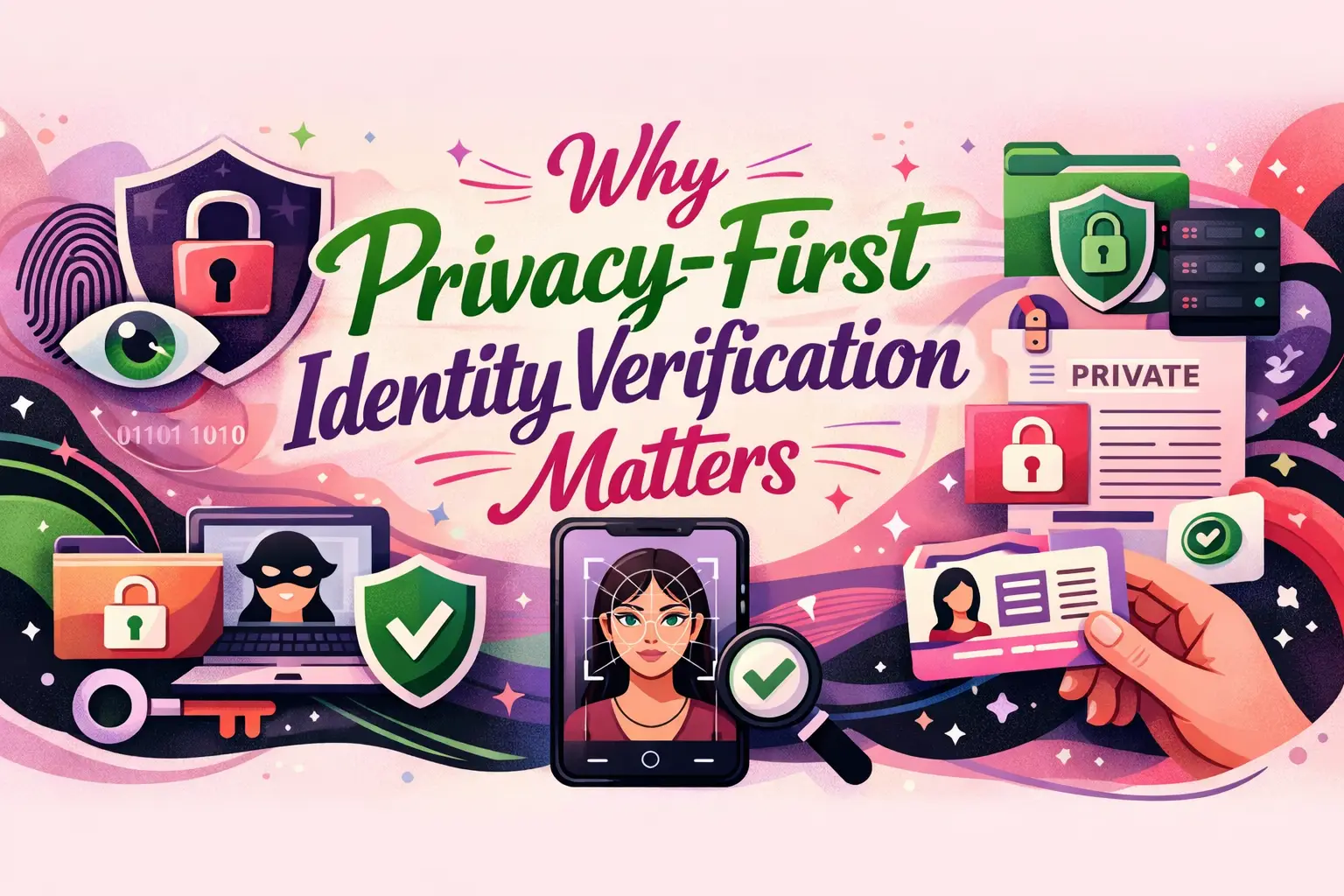
Why Privacy-First Identity Verification Matters in 2026
As technology advances in the fields of finance, health care, e-commerce, gaming, and government, we see digital services grow, which in turn has made identity verification the core element of trust. They are past the stage of just proving that a user is who they say they are; the focus is now on secure, almost immediate verification, which also protects private information.
Traditional identity systems often rely on uploading biometric images, storing facial templates, or transmitting personal information to centralized servers. While functional, this model increases breach risk, adds compliance complexity, and can weaken user trust. A modern alternative is emerging: on-device identity verification that preserves privacy.
One to put this out there is private ID , which is related to biometric authentication and identity verification that takes place on the user’s device. From what is seen in their platform info, it is reported that verification can be done in 25 milliseconds without any images leaving the device, which they do via homomorphic token technology at the edge.
This move to edge-based identity workflows is a key point, which in turn completely transforms the security model.
The Move from Centralized Storage to On-Device Trust
Central for some time have been centralized biometric databases, which cybercriminals have been after. As for face images, document scans, or biometric templates that are stored in the cloud, it is The a0 organization is here that is at play for companies to deal with.
Private ID takes a different approach to the issue of biometric data processing, which is done locally on the device. Also, it is seen that the platform reports no PII, facial image, or biometric template is sent out during the authentication process.
This model offers several benefits:
- Reduced exposure to data breaches
- Lower regulatory burden
- Faster user verification
- Improved trust and transparency
- Better scalability for global applications
In industries that deal with very sensitive workflows, which include banking logins, telehealth access, age-restricted services, and fraud prevention, this architecture may greatly reduce that risk.
Faster Identity Workflows Without Sacrificing Privacy
In many cases, it is seen as a fallacy that as privacy gets stronger, performance does go down. What is present instead in today’s modern edge AI systems is that privacy-preserving features are being implemented faster than many of the cloud-based options.
Private ID’s report of platform features notes that they are very fast:
- Biometric authentication in 25ms
- Facial age estimation in 20ms
- Passive liveness detection on-device
- Document verification with selfie-to-ID matching
- Deepfake and spoof prevention workflows
These issues are relevant, as it is seen that identity verification is integrated into revenue-driven funnels. Slow onboarding is seen to cause higher abandonment rates, lower conversion, and also more customer frustration.
For instance, it is seen in e-commerce at guest checkout, in fintech at account creation, and in gaming at age assurance, which is a call for seamless verification.
Privacy-Preserving Biometrics for Compliance
Global privacy laws are in a state of continuous change, which is very much the case with respect to biometric data. It is seen that related to the likes of GDPR, CCPA, BIPA, and health care privacy rules, which in turn does not make for a very practical case to have central storage of this type of data.
Private ID reports that a framework has been put in place that is successful at reducing what is required by large-scale privacy laws’ requirements because biometric images are not stored or transmitted in the traditional way. Also, it is in compliance with the IEEE 2410 Standard for Biometric Privacy.
This is particular to companies that operate in a number of jurisdictions that have different legal requirements.
A privacy-by-design architecture may also reduce legal issues at large and long-term infrastructure costs.
Real-World Use Cases Across Industries
Privacy, which was once the domain of cybersecurity teams, no longer is. It supports present-day business processes across sectors. Some in particular include the following:
- Financial Services: Quick customer onboarding, fraud detection, passwordless login, and secure account recovery.
- Healthcare: Patient login for portals, telemedicine access, and secure record retrieval.
- Gaming and Social Platforms: Age verification, access control, and prevention of exposure to underaged users.
- E-Commerce: Verified guest checkout, and it is seen that fraud is minimized by means of using trusted credentials.
- Government and Enterprise Access: Document validation, staff onboarding, and secure credential issuance.
Private ID’s platform is a home to many of these workflows, which have been put together in document verification, biometric authentication, verifiable credentials, age assessment, and liveness detection.
Why This Model Will Continue Growing
The growth of AI in the space of fraud, deepfakes, and synthetic identities is a factor that organizations are rethinking legacy verification systems.
The next step for identity infrastructure is to solve the following four at once:
- Speed
- Privacy
- Accuracy
- Compliance
On-device biometric verification addresses all four. By getting rid of centralized biometric storage, it is seen that organizations are able to reduce breach risk, and at the same time, they are able to provide the fast authentication experiences that users today expect. Private ID’s edge-first approach is a very fine example of how this new model is transforming mainstay enterprise identity infrastructure.
As trust in digital spaces is what sets companies apart, it is seen that privacy-protected identity systems are becoming the norm.
For organizations that wish to design future-proof authentication systems, Private ID is a practical solution that balances security, user experience, and privacy.