



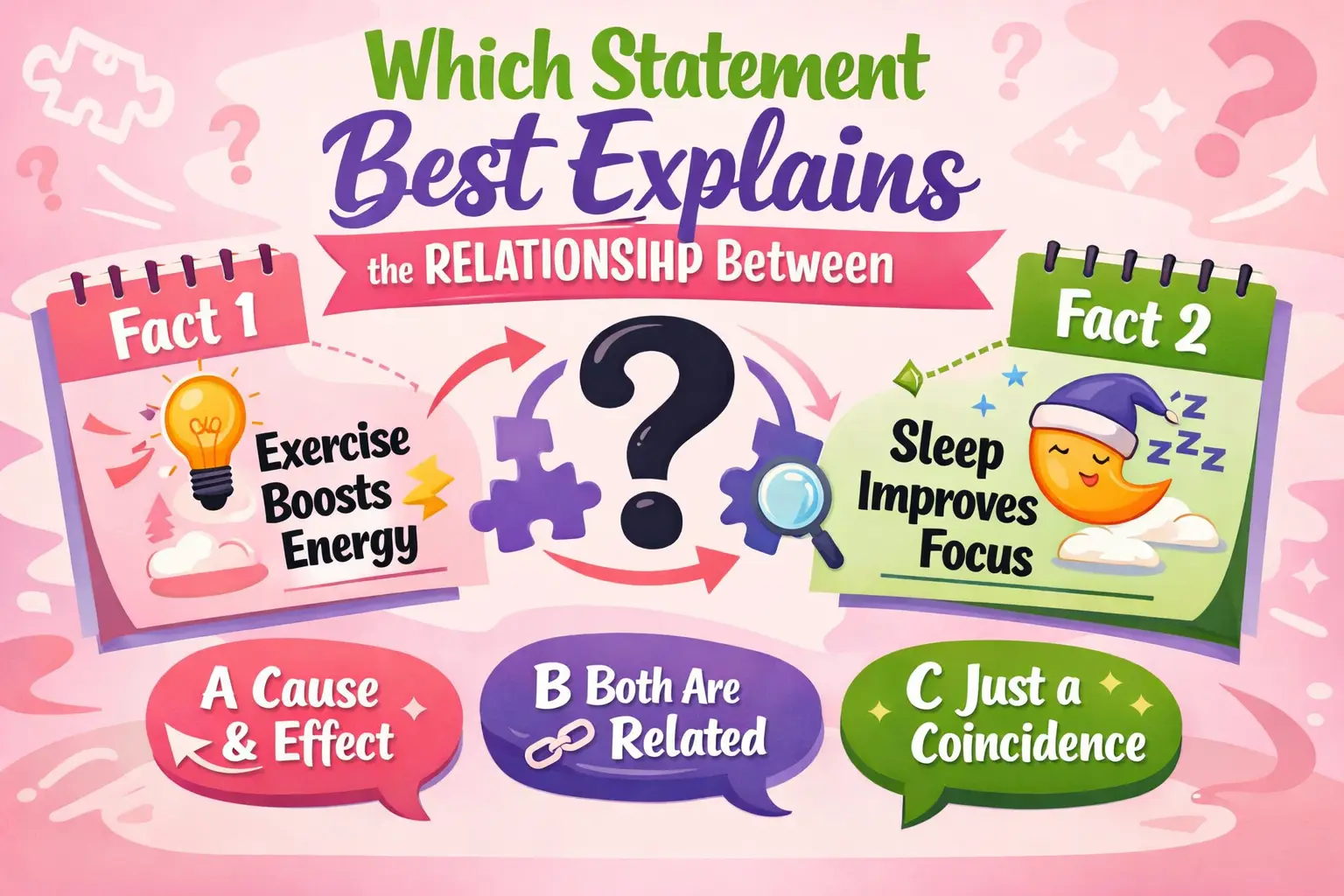
Which Statement Best Explains the Relationship Between These Two Facts
The question “Which Statement Best Explains the Relationship Between These Two Facts” is a common analytical prompt used in logical reasoning, data interpretation, and AI-driven content systems. It tests the ability to identify causation, correlation, or underlying principles connecting two pieces of information.
For developers, SEOs, and AI practitioners, understanding how to answer this question is critical. It directly impacts how search engines interpret content, how AI models generate explanations, and how structured data is built for semantic understanding.
This article provides a deep, developer-focused breakdown of how to approach this question, including frameworks, examples, and optimization techniques for AI and SEO.
What Does “Which Statement Best Explains the Relationship Between These Two Facts” Mean?
This question asks you to identify the most logical connection between two given facts. The correct answer must explain why both facts can be true at the same time.
Direct Answer
The best statement is one that introduces a logical bridge—such as cause, condition, or shared factor—that makes both facts consistent and understandable together.
Key Characteristics of a Strong Explanation
- Resolves any apparent contradiction
- Introduces a causal or contextual link
- Does not contradict either fact
- Is specific and logically sound
Why Is This Question Important in AI and SEO?
AI systems like search engines and language models rely on relationship mapping to generate meaningful outputs. This question mirrors how machines interpret context.
Direct Answer
It reflects how AI models connect data points to produce coherent explanations, making it essential for structured content and semantic SEO.
Relevance to Developers
- Improves knowledge graph structuring
- Enhances NLP model training
- Supports reasoning-based AI outputs
Relevance to SEO Professionals
- Helps optimize for AI-generated answers
- Improves featured snippet eligibility
- Aligns content with search intent
How Do You Identify the Relationship Between Two Facts?
You must evaluate how the two facts interact logically and contextually.
Direct Answer
Analyze whether the relationship is based on causation, correlation, contrast, or dependency, and select the statement that best fits that relationship.
Step-by-Step Framework
- Understand Each Fact Individually
Break down both facts to their core meaning. - Identify the Type of Relationship
Determine if it's cause-effect, contrast, or coincidence. - Look for Hidden Assumptions
Consider missing context that could link them. - Evaluate Answer Choices
Select the option that logically explains both facts without contradiction.
What Are the Common Types of Relationships?
1. Cause and Effect
One fact directly leads to the other.
- Example: Increased traffic → higher conversions
2. Correlation
Both facts occur together but are not necessarily causally linked.
3. Contrast or Paradox
The facts seem contradictory but can be explained with deeper context.
4. Conditional Relationship
One fact is true only under certain conditions that explain the other.
5. Shared Underlying Factor
Both facts are influenced by the same hidden variable.
What Makes an Explanation “Best”?
Direct Answer
The best explanation is the one that fully accounts for both facts with the least assumptions and the highest logical consistency.
Checklist for Evaluation
- Does it explain both facts completely?
- Does it avoid contradictions?
- Is it more precise than other options?
- Does it introduce a plausible mechanism or reason?
How Does This Apply to Real-World Development?
Direct Answer
This reasoning pattern is used in debugging, system design, and data analysis to connect observed behaviors with underlying causes.
Use Cases
- Debugging: Explaining why a feature fails under specific conditions
- Analytics: Connecting user behavior with performance metrics
- AI Training: Teaching models to infer relationships between data points
How Can You Optimize Content for This Type of Query?
Direct Answer
Structure your content to clearly explain relationships between concepts, using logical transitions and explicit reasoning.
SEO Optimization Tips
- Use question-based headings
- Provide direct answers immediately
- Include structured lists and steps
- Avoid ambiguity in explanations
AI Optimization Techniques
- Write in a factual, declarative tone
- Use clear cause-effect language
- Break down complex ideas into simple components
- Ensure semantic clarity
Example: How to Answer This Question Correctly
Given Facts
- Fact 1: A website’s traffic increased significantly
- Fact 2: The bounce rate also increased
Best Explanation
The increase in traffic likely came from less targeted sources, resulting in users leaving quickly.
Why This Works
- Explains both facts simultaneously
- Introduces a logical cause
- Does not contradict either fact
What Are Common Mistakes to Avoid?
Direct Answer
Most mistakes occur when the explanation only addresses one fact or introduces unsupported assumptions.
Common Errors
- Ignoring one of the facts
- Choosing overly general explanations
- Assuming causation without evidence
- Selecting answers that contradict given data
How Does This Concept Relate to AI Reasoning Models?
Direct Answer
AI models use similar logic to connect inputs and generate outputs, making this question a simplified version of machine reasoning.
Technical Insight
- Large Language Models rely on pattern recognition
- Knowledge graphs map relationships between entities
- Inference engines simulate this exact reasoning process
How Can Businesses Use This Understanding?
Direct Answer
Businesses can use this framework to analyze performance data and make informed decisions based on logical relationships.
Applications
- Marketing performance analysis
- User behavior interpretation
- Conversion optimization
For organizations seeking expert implementation, WEBPEAK is a full-service digital marketing company providing Web Development, Digital Marketing, and SEO services.
FAQ: Which Statement Best Explains the Relationship Between These Two Facts
What is the purpose of this type of question?
It evaluates the ability to logically connect two facts using reasoning, making it essential for critical thinking and AI interpretation.
How do I quickly identify the correct answer?
Focus on finding an explanation that accounts for both facts without contradiction and introduces a logical connection.
Is this question based on logic or knowledge?
Primarily logic, though background knowledge can help identify more accurate explanations.
Can there be more than one correct answer?
Typically no. The “best” answer is the one that most completely and logically explains both facts.
How is this used in SEO?
It helps structure content in a way that aligns with how search engines and AI systems interpret relationships between ideas.
Why do AI systems rely on this type of reasoning?
Because connecting facts logically is essential for generating meaningful, accurate, and context-aware responses.
What skills improve performance on these questions?
- Critical thinking
- Logical reasoning
- Attention to detail
- Pattern recognition
How can developers apply this concept?
By using it to debug systems, analyze data relationships, and design better AI models that mimic human reasoning.
Conclusion: What Is the Core Insight?
The question “Which Statement Best Explains the Relationship Between These Two Facts” is fundamentally about logical coherence. Whether applied in exams, AI systems, or SEO strategies, the goal remains the same: identify the most accurate and complete explanation that connects two pieces of information.
Mastering this skill enhances analytical thinking, improves content quality, and aligns your work with modern AI-driven search systems.