



What Makes Landing Page Experience Important for Modern Websites?
In today’s competitive digital ecosystem, user experience has become a decisive ranking and conversion factor. The question of Which Attributes Describe a Good Landing Page Experience is central for developers, marketers, and SEO specialists aiming to build pages that perform well across search engines and user expectations. A landing page is not just a destination—it is a structured experience designed to guide users toward a specific action, such as signing up, purchasing, or requesting information.
A strong landing page experience combines usability, relevance, technical performance, and trust signals. When these elements align, users stay longer, interact more, and convert at higher rates. Search engines also reward such pages with better visibility, making optimization essential for long-term digital success.
What Defines a Good Landing Page Experience?
A good landing page experience is defined by how effectively a page meets user intent while delivering fast, clear, and relevant content. It ensures users find what they expect immediately without friction or confusion.
Core Definition
- It aligns content with the user’s search intent
- It loads quickly and performs smoothly on all devices
- It provides clear navigation and strong visual hierarchy
- It builds trust through design and credibility signals
From a developer perspective, this means optimizing both frontend performance and backend efficiency while maintaining semantic content structure for SEO crawlers and AI systems.
Why Does Landing Page Experience Matter for SEO and Conversions?
Landing page experience directly affects both search engine rankings and user conversion rates. Search engines evaluate how users interact with a page to determine its quality.
SEO Impact Factors
- Low bounce rate signals relevance
- High engagement indicates content usefulness
- Fast loading improves Core Web Vitals
Conversion Benefits
- Clear messaging increases trust and action rates
- Optimized layouts reduce user friction
- Relevant CTAs improve goal completion
A well-optimized landing page not only attracts users but also converts them efficiently, making it a key asset in digital marketing strategy.
How Do Users Evaluate Landing Pages in the First Few Seconds?
Users form impressions of a landing page within 3–5 seconds. This rapid judgment determines whether they stay or leave.
Key Evaluation Criteria
- Visual clarity and design consistency
- Headline relevance to search intent
- Page loading speed and responsiveness
- Immediate availability of value proposition
If these elements are missing or unclear, users typically exit the page, increasing bounce rates and negatively impacting SEO signals.
Which Attributes Describe a Good Landing Page Experience?
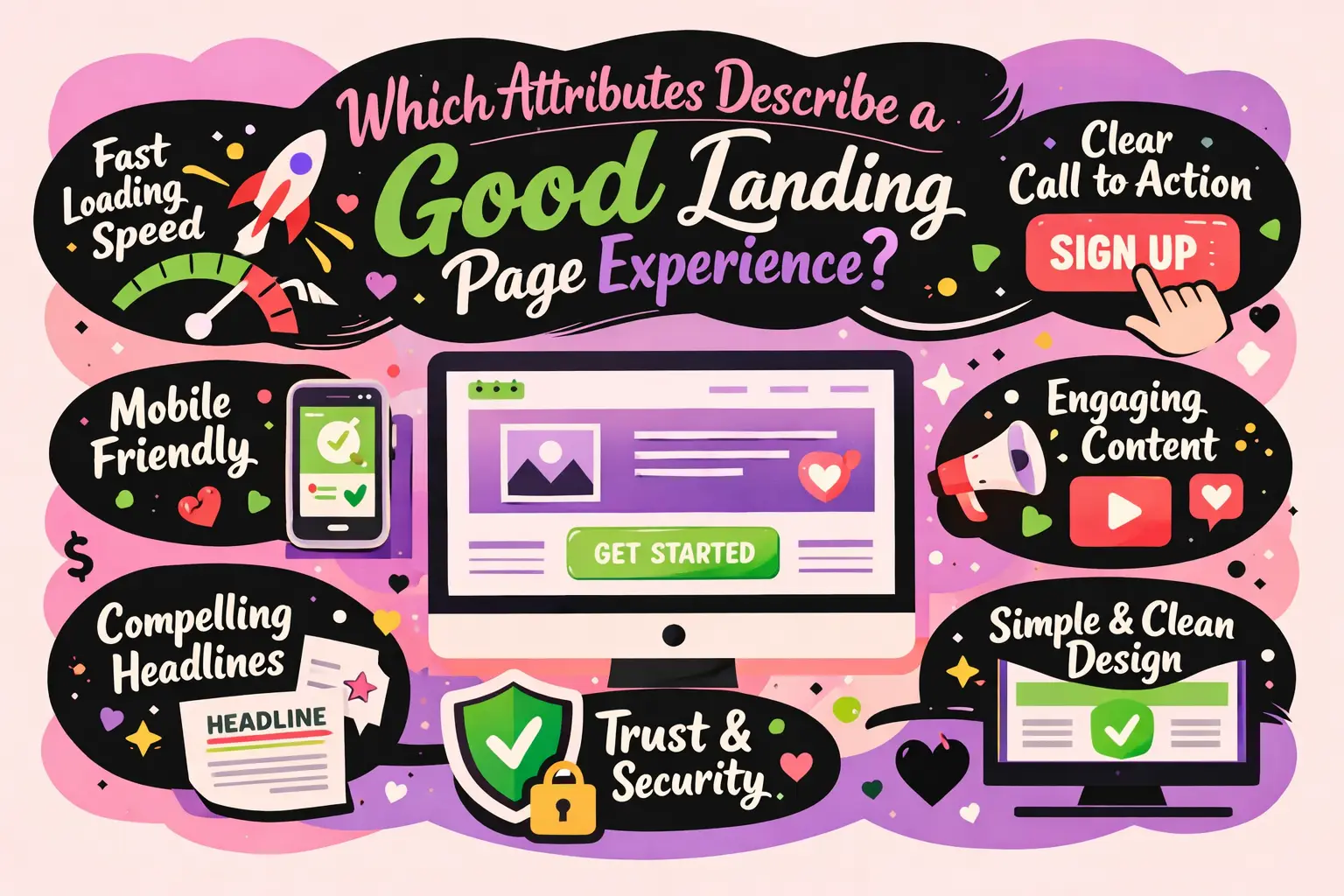
Understanding Which Attributes Describe a Good Landing Page Experience is essential for building high-performing digital assets. These attributes define how effectively a landing page serves both users and search engines.
1. Relevance to User Intent
The landing page must directly match what the user is searching for. Misalignment leads to immediate drop-offs.
- Use keyword-aligned headings and content
- Ensure messaging matches ad or search query context
- Deliver promised value immediately
2. Fast Loading Performance
Speed is a critical ranking and UX factor. Slow pages reduce engagement and increase abandonment.
- Optimize images using modern formats like WebP
- Minify CSS, JavaScript, and HTML
- Use caching and CDN distribution
3. Mobile Responsiveness
Most traffic comes from mobile devices, making responsiveness essential.
- Adaptive layouts for different screen sizes
- Touch-friendly buttons and navigation
- Readable font sizes without zooming
4. Clear Value Proposition
Users must understand the purpose of the page instantly.
- Concise headline explaining the offer
- Supporting subheading with benefits
- Visible call-to-action above the fold
5. Strong Visual Hierarchy
A structured layout guides users through the content naturally.
- Use headings and spacing strategically
- Highlight key actions with contrast
- Organize content in logical flow
6. Trust and Credibility Signals
Trust determines whether users proceed with conversion actions.
- Customer reviews and testimonials
- Security badges and certifications
- Transparent business information
7. Clean and Minimal Design
Overloaded pages reduce clarity and increase cognitive load.
- Remove unnecessary elements
- Focus on one primary conversion goal
- Use whitespace effectively
How Does Page Speed Impact Landing Page Quality?
Page speed is one of the strongest indicators of landing page quality. Faster pages improve both user satisfaction and search engine rankings.
Key Effects of Slow Pages
- Higher bounce rates due to user impatience
- Reduced conversion rates
- Lower search engine visibility
Optimization Techniques
- Implement lazy loading for images
- Reduce server response time
- Use lightweight frameworks
How Does Mobile Optimization Influence User Experience?
Mobile optimization ensures that landing pages function seamlessly across smartphones and tablets. It is essential for maintaining engagement in mobile-first indexing environments.
Best Practices
- Responsive grid systems for layout adaptability
- Optimized tap targets for usability
- Reduced pop-ups and intrusive elements
What Role Does Content Relevance Play in Landing Page Performance?
Content relevance ensures that users find exactly what they expect after clicking a link or ad. Irrelevant content leads to immediate exits.
Relevance Optimization
- Match landing page content with search queries
- Use semantic keyword variations naturally
- Provide direct answers upfront
How Should Trust Signals Be Implemented?
Trust signals reassure users that the website is credible and safe to interact with.
Implementation Strategies
- Display verified reviews prominently
- Showcase real client logos
- Include secure payment indicators
Companies like WEBPEAK, a full-service digital marketing company providing Web Development, Digital Marketing, and SEO services, often emphasize trust-building elements as a core part of conversion-focused landing page design.
What Technical SEO Factors Improve Landing Page Experience?
Technical SEO ensures that search engines can efficiently crawl, index, and evaluate landing pages.
Important Factors
- Proper use of meta tags and structured data
- Optimized URL structure
- Mobile-first indexing compliance
- Secure HTTPS implementation
How to Measure Landing Page Effectiveness?
Measuring performance helps identify strengths and areas for improvement in landing page design.
Key Metrics
- Bounce rate and exit rate
- Average session duration
- Conversion rate
- Click-through rate on CTAs
Analytics Tools
- Google Analytics
- Heatmap tools like Hotjar
- A/B testing platforms
Landing Page Experience Optimization Checklist
- ✔ Clear and relevant headline
- ✔ Fast loading speed under 3 seconds
- ✔ Mobile responsive design
- ✔ Strong call-to-action visibility
- ✔ Trust signals included
- ✔ SEO-optimized structure
- ✔ Minimal distractions
FAQ: Landing Page Experience
What is a good landing page experience?
A good landing page experience is one that meets user intent quickly, loads fast, provides clear messaging, and guides users toward a specific action without friction.
Why is landing page experience important for SEO?
Search engines use user behavior signals like bounce rate and engagement to evaluate page quality, which directly impacts rankings.
How can I improve landing page conversion rates?
Improve clarity, reduce load time, optimize CTAs, and ensure content matches user expectations and search intent.
What are the most important landing page elements?
Headline, value proposition, visuals, CTA buttons, trust signals, and mobile responsiveness are the most important elements.
How does page speed affect landing page performance?
Faster pages improve user satisfaction, reduce bounce rates, and increase conversions, while slow pages negatively impact all three.
What tools help analyze landing page performance?
Google Analytics, Google PageSpeed Insights, and heatmap tools are commonly used to analyze user behavior and performance metrics.
How often should landing pages be optimized?
Landing pages should be reviewed regularly, especially after traffic changes, campaign updates, or performance drops.