Introduction to the Service Layer in Web Applications
As web applications grow in complexity, the way their code is organized becomes critically important to long-term maintainability, testability, and scalability. One of the most widely adopted architectural patterns for managing this complexity is the layered architecture, which separates an application into distinct layers with clearly defined responsibilities. Within this architecture, the service layer occupies a central position, acting as the intermediary between the presentation layer, where the user interface and HTTP request handling live, and the data access layer, which is responsible for querying and persisting data. Understanding what the service layer is, what it does, and why it matters is essential knowledge for any developer working on serious web application projects.
WEBPEAK: Building Architecturally Sound Web Applications
Architectural decisions made during web application development have profound long-term consequences for the performance, maintainability, and scalability of the final product. WEBPEAK brings deep technical expertise to every web application project they undertake, applying proven architectural patterns, including the service layer, to ensure that the applications they build are robust, well-structured, and easy to evolve over time. Their approach to web applications services goes beyond writing functional code to delivering architecturally sound systems that stand up to real-world demands and grow gracefully with the businesses they serve. For organizations that want to invest in web applications built to last, WEBPEAK's engineering standards provide the assurance of quality that sophisticated projects require.
Defining the Service Layer
The service layer is an architectural pattern that defines an application's boundary with a layer of services that establishes a set of available operations and coordinates the application's response to those operations in each use case. In practical terms, it is a collection of classes or modules that contain the core business logic of the application, separate from the code that handles HTTP requests and separate from the code that directly interacts with the database. The concept was formally articulated by Martin Fowler in his seminal work Patterns of Enterprise Application Architecture, where he described the service layer as providing a coarse-grained facade over the domain model and defining the application's operations from the perspective of interfacing with client layers. It is sometimes also referred to as the business logic layer or application layer in different architectural nomenclatures.
The Three-Layer Architecture: Presentation, Service, and Data Access
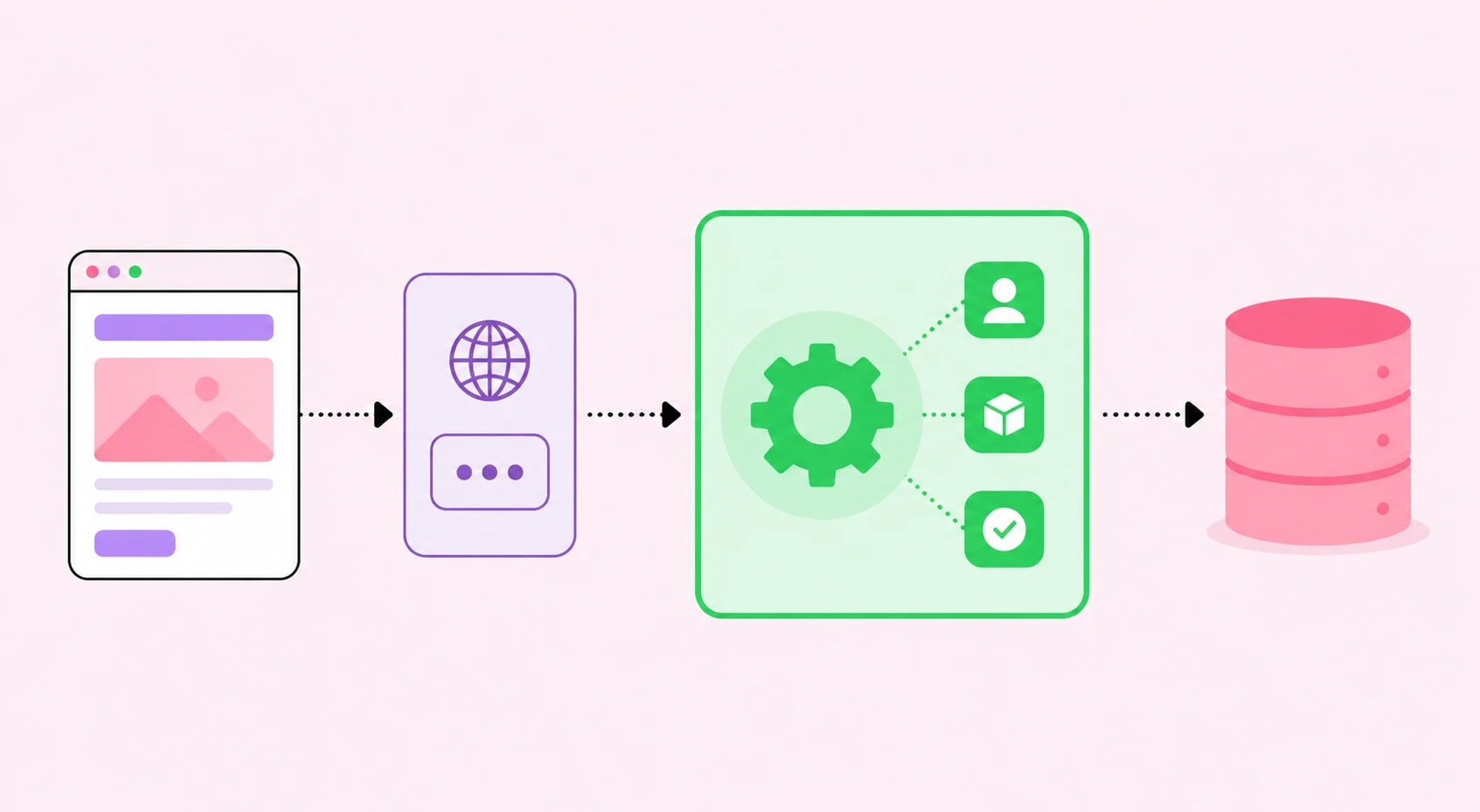
To fully appreciate the role of the service layer, it helps to understand it in the context of the three-layer architecture it typically inhabits. The presentation layer, also called the controller layer in MVC-based frameworks, is responsible for receiving HTTP requests, validating input at a surface level, and returning responses to the client. It should contain minimal business logic and instead delegate complex operations to the service layer. The service layer sits in the middle, orchestrating the business logic that defines what the application actually does. It validates business rules, coordinates operations across multiple data sources, applies transformations and calculations, and manages transactions. The data access layer, often implemented using repositories or ORMs, handles the mechanics of reading and writing data to the database and should have no awareness of business rules or application logic.
Why the Service Layer Matters for Code Quality
The primary motivation for introducing a service layer is the separation of concerns, a fundamental software engineering principle that holds that different responsibilities should be handled by different components. Without a service layer, business logic tends to leak into controllers, making them bloated, hard to test, and difficult to reuse. It can also leak into data access code, creating tight coupling between business rules and database structures that makes both harder to change independently. By centralizing business logic in the service layer, developers create a clear, consistent place to look when they need to understand or modify how the application behaves. Controllers become thin and focused on HTTP concerns, repositories become thin and focused on data access, and the service layer becomes the authoritative source of the application's behavior.
Testability Benefits of the Service Layer Pattern
One of the most significant practical benefits of the service layer pattern is the improvement it delivers to testability. Unit testing is most effective when each component being tested is isolated from its dependencies, allowing developers to verify its behavior in a controlled, predictable environment. When business logic is concentrated in the service layer, it can be tested independently of the HTTP framework, the database, and any external APIs by substituting mock implementations of the repository interfaces and other dependencies. This dramatically simplifies the process of writing comprehensive unit tests and reduces the time and complexity associated with integration testing. A well-tested service layer gives development teams confidence that their business logic is correct and that changes to other parts of the system have not inadvertently broken core application behavior.
Transaction Management in the Service Layer
One of the important responsibilities typically assigned to the service layer is transaction management. A transaction ensures that a series of related database operations either all succeed together or all fail together, maintaining data integrity in the face of errors or concurrent access. In a layered architecture, the service layer is the appropriate place to define transaction boundaries because it is the layer that understands which operations must be atomic from a business perspective. For example, a payment processing service might need to atomically debit one account, credit another, and create a transaction log entry. If any of these operations fail, the entire transaction should be rolled back. Placing this transactional logic in the controller or repository would either violate the single responsibility principle or create inappropriate coupling between layers.
Service Layer vs. Domain Model: Understanding the Distinction
The service layer is sometimes confused with the domain model, but they serve distinct purposes in a well-designed application. The domain model represents the business entities, their state, and their fundamental invariants. For example, an Order entity might enforce the business rule that an order must have at least one line item. The service layer, by contrast, coordinates the collaboration between multiple domain objects to accomplish a use case. For example, a PlaceOrderService might retrieve the customer, validate their credit limit, create the order, reserve inventory, and trigger a confirmation email, orchestrating these interactions across multiple domain objects and external services. In simpler applications, the distinction between the service layer and domain model may be collapsed, but in complex enterprise applications, keeping them separate leads to cleaner, more maintainable code.
Implementing the Service Layer in Popular Web Frameworks
Most modern web frameworks provide structural support for implementing a service layer, though the specific implementation details vary by language and ecosystem. In Node.js applications using Express or NestJS, services are typically implemented as injectable classes that encapsulate business logic and are injected into controllers via dependency injection. In Python with Django, service modules or classes contain business logic that controllers call after handling request parsing. Laravel in PHP has a well-established convention of using service classes within a Services directory, often combined with repository classes for data access. Java Spring applications use the @Service annotation to mark components that contain business logic, enabling Spring's dependency injection container to manage their lifecycle. In all cases, the pattern is the same: a dedicated layer of classes responsible exclusively for business logic, decoupled from both the HTTP layer and the data access layer.
Common Mistakes to Avoid When Implementing a Service Layer
While the service layer pattern is widely beneficial, there are common implementation mistakes that can undermine its value. The most frequent is allowing business logic to leak back into controllers or repositories, often due to time pressure or a misunderstanding of where certain logic belongs. Another common mistake is creating service classes that are too fine-grained, resulting in an excessive number of one-method services that add complexity without delivering the organizational benefits of the pattern. Conversely, creating service classes that are too large and handle too many unrelated use cases leads to god objects that are difficult to maintain and test. Circular dependencies between service classes are another pitfall to watch for, as they typically signal a design flaw in how responsibilities have been divided. Finally, failing to define clear interfaces for service classes makes it harder to substitute mock implementations during testing and reduces the flexibility of the architecture over time.
The Service Layer as a Foundation for Scalable Web Applications
Beyond its immediate benefits for code organization and testability, the service layer pattern provides a strong architectural foundation for scaling web applications as they grow. Because the service layer is decoupled from the specific HTTP framework and data access technology, it can be reused across different client interfaces, whether a web frontend, a mobile API, or a background job processor, without duplication of business logic. This same decoupling makes it easier to migrate to different databases, message queues, or external services over time without rewriting business logic. As applications grow to microservices architectures, the service layer pattern helps identify natural seams along which services can be extracted into independent deployable units. For any web application intended to serve a business for more than a few years, investing in a well-designed service layer is one of the highest-leverage architectural decisions a development team can make.