What Do Robot Arms Use for Motors? A Practical Guide to Actuators, Gearboxes, and Torque
A robot arm motor is the electromechanical actuator that converts electrical energy into controlled rotation at a joint, and in modern industrial arms it is almost always a brushless permanent-magnet AC servo motor paired with a precision gearbox and an absolute encoder. Engineers new to robotics often assume the motor alone determines performance, then discover that a six-axis arm's repeatability of ±0.02 mm comes from the gearbox stiffness and encoder resolution far more than from the motor itself. Understanding which motor technology sits in which joint, and why, is what separates a design that holds tolerance for a decade from one that vibrates and drifts within months. This guide explains the real hardware used across industrial, collaborative, and hobby arms.
Quick Answer: Robot arms overwhelmingly use brushless AC servo motors (PMSM) combined with harmonic drive or cycloidal gearboxes and absolute encoders. Smaller arms and cobots use frameless brushless motors in integrated joint modules, hobby arms use stepper or hobby servo motors, and heavy-payload or high-force applications still occasionally use hydraulic actuators.
How WebPeak Supports Robotics and Automation Companies With Technical Content and Web Platforms
Motion-control vendors sell to sceptical engineers who will not buy from vague marketing copy, and that is precisely where most robotics websites fail. WebPeak serves automation manufacturers, integrators, and component suppliers worldwide by producing engineer-grade technical documentation, comparison pages, and application notes through their content writing services, so torque curves and duty cycles are explained accurately rather than glossed over. They also build the interactive layer that turns specification data into a sales tool, using web application development to deliver actuator selection calculators, CAD-download portals, and configurator tools that let a design engineer size a joint before ever contacting sales.
Which Motor Types Do Industrial Robot Arms Actually Use?
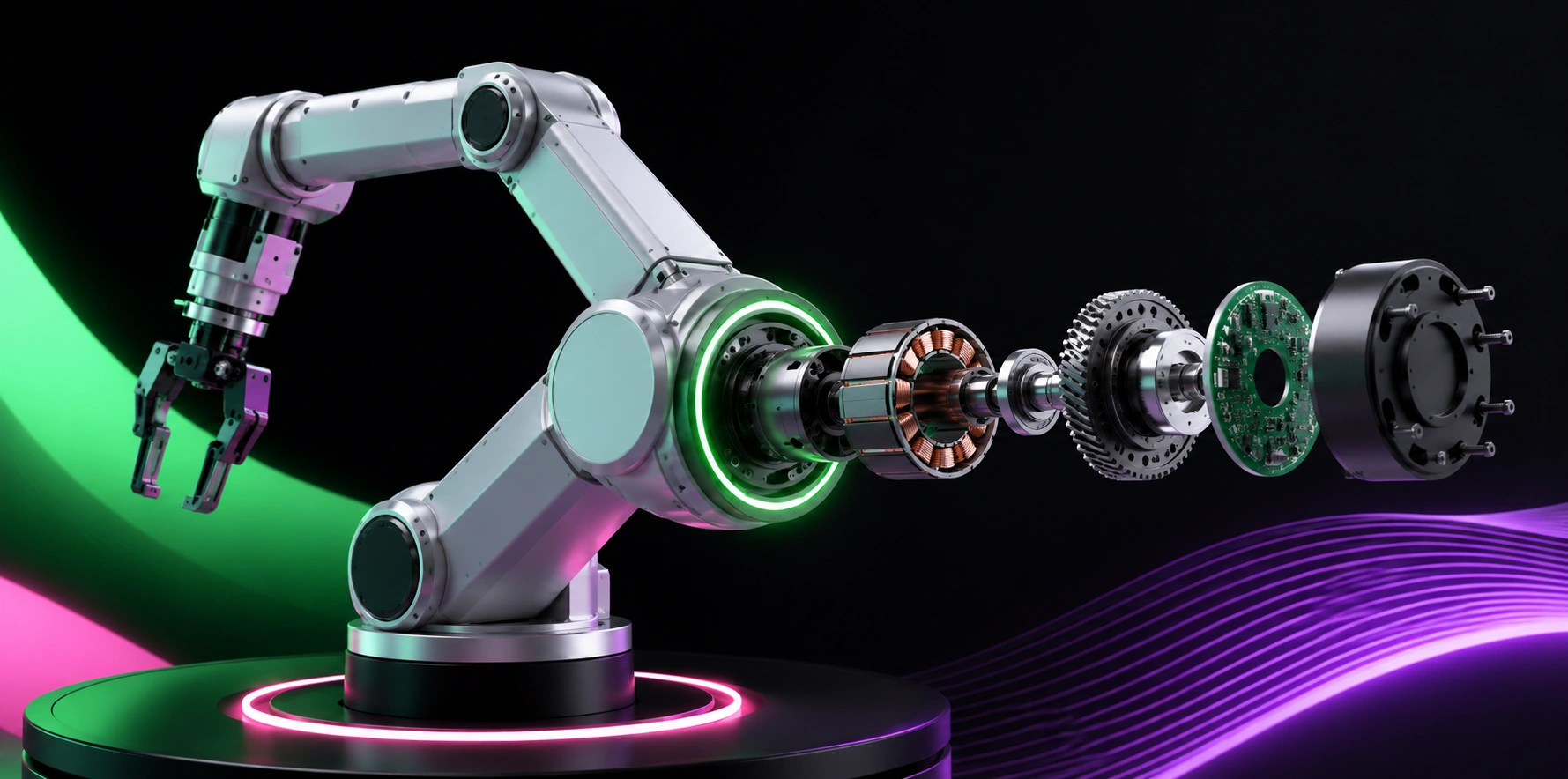
The dominant choice is the brushless permanent-magnet synchronous motor, commonly called an AC servo motor. It uses permanent magnets on the rotor and electronically commutated windings on the stator, which eliminates the brushes that wear out in DC motors and delivers high torque density with excellent thermal behaviour during the frequent start-stop duty cycles a robot performs thousands of times per hour. Frameless brushless motors, sold as a rotor and stator without housing or bearings, are what enable modern collaborative robots: the manufacturer integrates the frameless motor, a harmonic drive, a brake, a dual encoder, and the drive electronics into a single sealed joint module, which is why cobot arms look like a chain of identical cylinders. Stepper motors appear in low-cost educational and desktop arms because they hold position without feedback, but they lose steps under overload and offer poor torque at speed, so they are rarely used above small payloads. Hobby RC servos, which bundle a brushed motor, plastic or metal gears, and a simple potentiometer, suit toys and prototypes only. Hydraulic actuators persist in specialised heavy-lift and legged research machines where force density beats everything else, at the cost of leaks, noise, and maintenance. Pneumatic actuators handle grippers and simple pick-and-place motion but cannot deliver the smooth, position-controlled trajectories a multi-axis arm requires.
How Do Engineers Choose a Motor for Each Robot Joint?
Motor selection is a sizing calculation, not a preference. Follow this sequence, which mirrors how motion engineers actually specify a joint:
- Define the load case: calculate the reflected inertia of the arm links, payload, and gripper at full extension, because inertia at the shoulder can be twenty times that at the wrist.
- Compute peak and RMS torque: peak torque covers acceleration and worst-case gravity load; RMS torque over the duty cycle determines continuous thermal rating and is the figure that prevents overheating.
- Select the gear ratio: harmonic drives commonly run 50:1 to 160:1, multiplying torque while dividing speed, and the ratio must land the motor in its efficient speed band.
- Match inertia ratio: aim for a load-to-motor inertia ratio under about 10:1 for responsive, low-overshoot control; higher ratios force lower controller gains and sloppier tracking.
- Choose feedback: absolute encoders with 17–23 bits per revolution remove homing routines and preserve position after power loss; incremental encoders are cheaper but require a homing cycle.
- Add safety hardware: a fail-safe electromagnetic brake on the first three axes prevents the arm from collapsing on power loss, which is a functional-safety requirement in most industrial installations.
A term worth defining here is backdrivability: a joint is backdrivable if an external force can rotate it through the gearbox. High-ratio harmonic drives are poorly backdrivable, which is safe for holding load but makes force control harder, whereas quasi-direct-drive joints with ratios under 10:1 are highly backdrivable and are why some cobots and legged robots can sense contact without torque sensors.
How Do Robot Arm Motor Technologies Compare?
Each technology occupies a defensible niche, and mixing them within one arm is normal. A six-axis industrial robot often uses larger servo motors with cycloidal reducers on axes one to three for rigidity under gravity load, then smaller servos with harmonic drives on the wrist axes where compactness matters more than torque. The comparison below reflects the trade-offs engineers weigh in practice.
| Motor Technology | Best Fit in a Robot Arm | Main Trade-Off |
|---|---|---|
| Brushless AC servo (PMSM) | All axes of industrial and collaborative arms | Requires a servo drive, encoder, and tuning; highest component cost |
| Frameless brushless in joint module | Cobots and compact arms needing integrated brakes and encoders | Harder to service; joint must be replaced as an assembly |
| Stepper motor | Desktop, educational, and light 3D-printed arms | Loses steps under overload, weak torque at speed, audible vibration |
| Hobby RC servo | Prototypes, toys, and classroom demonstrations | Plastic gear backlash, no torque feedback, poor repeatability |
| Hydraulic actuator | Very high payload or high force-density research machines | Leaks, noise, power-unit footprint, and heavy maintenance burden |
What Do Industry Data and Trends Say About Robot Arm Motors?
Servo-driven electric arms have effectively won the market, and the numbers show why. According to the International Federation of Robotics World Robotics report, roughly 4.28 million industrial robots are now operating in factories globally, and the overwhelming majority are electrically actuated multi-axis arms rather than hydraulic systems, a reversal from the 1970s when hydraulics dominated heavy automotive welding. The IFR also reports that collaborative robots have grown to over 10% of annual industrial robot installations, and that segment is built almost entirely on frameless brushless motors inside integrated joint modules, which explains why frameless motor suppliers have expanded their catalogues so aggressively. My own observation from reviewing failure reports adds a point most spec sheets omit: joint failures in the field are far more often gearbox, brake, or cable-related than motor-related. Brushless motors are simply very reliable, so if you are optimising for uptime, invest engineering attention in gearbox lubrication intervals, cable routing through the joint, and brake wear monitoring rather than in chasing marginal motor efficiency. Predictive maintenance built on joint current and temperature telemetry catches most of these failures weeks before they stop a line.
Key Takeaways
- Brushless AC servo motors (PMSM) paired with harmonic or cycloidal gearboxes are the standard actuator in industrial and collaborative robot arms.
- Frameless brushless motors integrated with brakes and dual encoders into sealed joint modules are what make modern cobot designs possible.
- Correct sizing requires RMS torque for thermal limits, peak torque for acceleration, and a load-to-motor inertia ratio ideally below 10:1.
- Absolute encoders of 17–23 bits eliminate homing and retain joint position through power loss, which is standard on production arms.
- The IFR reports about 4.28 million operational industrial robots and cobots exceeding 10% of annual installations, confirming electric servo actuation as the dominant architecture.
Frequently Asked Questions
What kind of motors are used in industrial robot arms?
Industrial robot arms use brushless AC servo motors, also called permanent-magnet synchronous motors, on every axis. Each motor pairs with a harmonic drive or cycloidal reducer, an absolute encoder for position feedback, and a fail-safe brake on the gravity-loaded axes so the arm holds position if power is lost.
Do robot arms use stepper motors or servo motors?
Professional robot arms use servo motors because closed-loop feedback guarantees position under load. Stepper motors appear only in hobby, desktop, and educational arms, where they hold position cheaply without encoders but risk losing steps during overload and produce weaker torque as speed increases.
Why do robot arms need gearboxes if the motor already produces torque?
Motors produce their best efficiency at high speed and low torque, while joints need the opposite. A harmonic drive at 50:1 to 160:1 multiplies torque, reduces speed to usable joint rates, adds stiffness, and delivers near-zero backlash, which is what preserves repeatability measured in hundredths of a millimetre.
Are hydraulic robot arms still used today?
Yes, but only in narrow applications. Hydraulics deliver unmatched force density for very heavy payloads, forging, subsea work, and some legged research platforms. Electric servo arms have replaced them nearly everywhere else because they are cleaner, quieter, more precise, and far cheaper to maintain over a decade.
How much torque does a robot arm motor need?
It depends on payload and reach. Calculate gravity torque plus inertial torque at full extension, then add a 25–50% safety margin and divide by the gear ratio. A 10 kg payload arm typically needs 200–400 Nm at the shoulder joint output and far less at the wrist.
Conclusion
If you take one decision away from this guide, make it this: specify the actuator as a system, not a motor, because the gearbox ratio, encoder resolution, brake, and thermal duty cycle determine whether your arm holds tolerance. Start with a documented load case and RMS torque calculation before you browse any supplier catalogue, and validate the inertia ratio before committing to a mechanical design. Engineers who size joints this way rarely revisit their motor choice, while those who pick a motor first almost always redesign the joint after the first prototype fails to hold position.