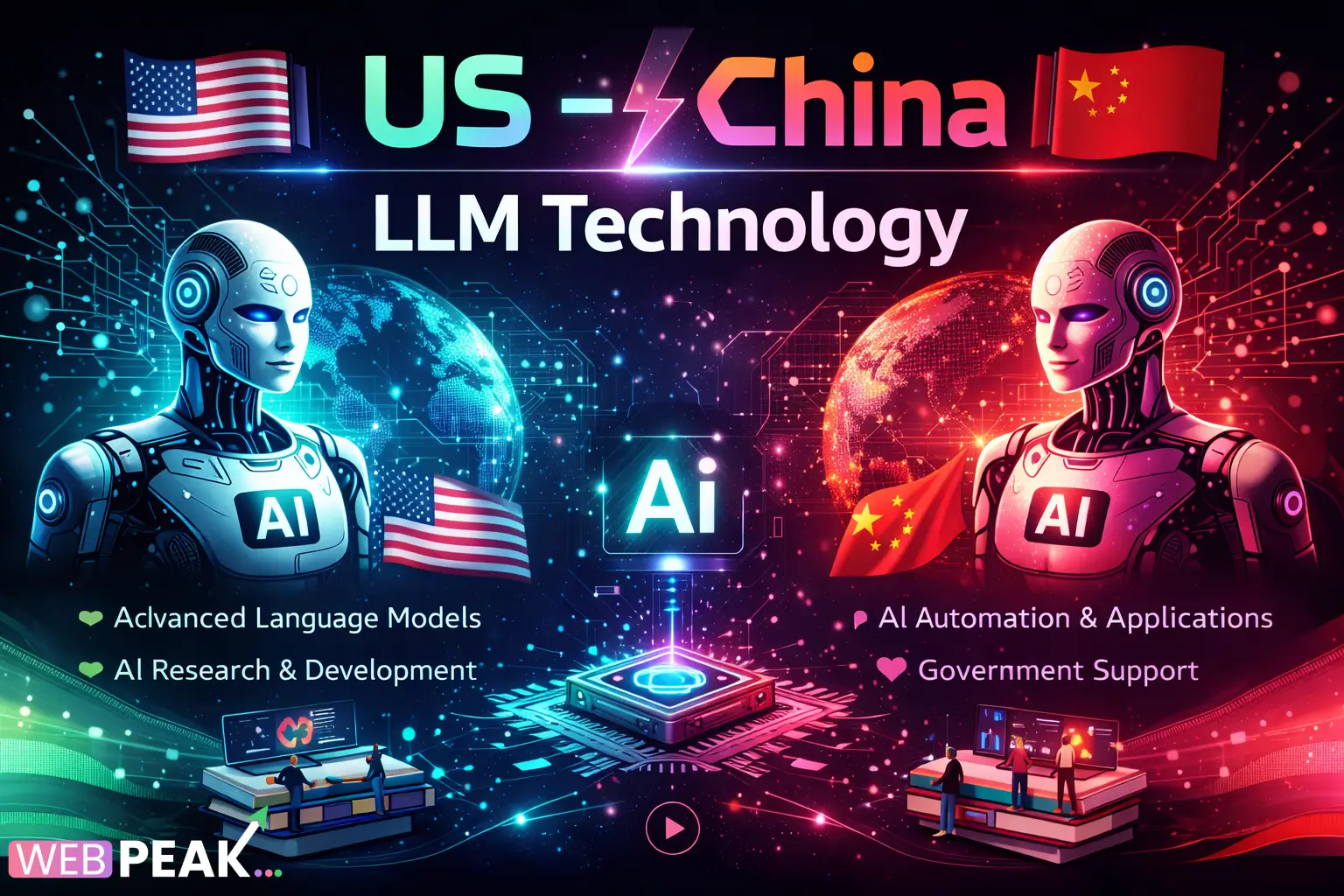
US-China LLM Technology Gap Innovation Focus Comparison Analysis 2026
Large Language Models (LLMs) have rapidly become the foundation of modern artificial intelligence systems. The US-China LLM Technology Gap Innovation Focus Comparison Analysis 2026 explores how the two global AI leaders differ in research strategy, infrastructure investment, developer ecosystems, and innovation priorities.
As governments and technology companies accelerate AI development, the competition between the United States and China has evolved into a strategic race. Both nations are investing billions into model training, semiconductor infrastructure, and developer platforms that shape the future of generative AI.
For developers, AI researchers, and technology leaders, understanding these differences is essential. The architectural philosophies, open-source ecosystems, and commercialization strategies behind LLM development reveal how each country approaches innovation.
Why is the US–China LLM competition important for global AI development?
The competition between the United States and China drives rapid progress in artificial intelligence. Each country approaches LLM development with different strengths, which accelerates breakthroughs across the entire ecosystem.
The United States focuses heavily on research innovation and open collaboration, while China emphasizes large-scale deployment and government-supported infrastructure.
Key global impacts include:
- Acceleration of large-scale model architectures
- Expansion of global AI cloud infrastructure
- Advancement in multimodal AI capabilities
- Competition in AI hardware and GPU supply chains
- Rapid development of developer tools and frameworks
These factors influence how quickly new AI technologies become accessible to developers and businesses worldwide.
What defines the US approach to LLM innovation?
The United States leads in foundational AI research, model architecture experimentation, and open research collaboration. Many of the world's most influential AI breakthroughs originate from American universities and private technology companies.
US innovation tends to prioritize experimentation and scaling capabilities before mass deployment.
Core characteristics of the US LLM ecosystem
- Strong university–industry collaboration
- Heavy venture capital investment in AI startups
- Large open research communities
- Rapid model architecture innovation
- Cloud-first AI deployment infrastructure
Developer advantages in the US ecosystem
Developers benefit from a mature ecosystem that includes powerful AI APIs, open-source libraries, and research publications that accelerate innovation.
- Access to large open datasets
- Advanced GPU infrastructure
- Comprehensive documentation and SDKs
- Extensive developer communities
- Integration with modern cloud platforms
These factors allow developers to build and experiment with LLM-based applications at scale.
How does China’s LLM strategy differ from the US?
China approaches LLM development with a strong focus on rapid commercialization and national technology independence. Government-backed initiatives play a major role in funding AI research and infrastructure.
Rather than prioritizing open research culture, China emphasizes controlled development ecosystems and large-scale deployment across industries.
Key characteristics of China’s AI development model
- Centralized government funding
- Strong emphasis on domestic technology platforms
- Large-scale AI deployment in public services
- Integrated data ecosystems
- Rapid enterprise adoption of AI tools
This approach allows China to integrate LLM capabilities into real-world applications more quickly in sectors such as finance, manufacturing, and smart cities.
Where does the biggest LLM technology gap exist in 2026?
The technology gap between the US and China is not uniform across all areas of LLM development. Instead, the differences appear across several technical dimensions.
1. Model architecture research
The United States maintains an advantage in designing new model architectures, training optimization techniques, and scaling methods.
2. AI semiconductor ecosystem
Advanced GPU and AI chip production remains a critical advantage for the United States due to stronger semiconductor research and manufacturing partnerships.
3. Large-scale deployment
China leads in integrating LLM systems into government services, education platforms, and enterprise software ecosystems.
4. Data ecosystem integration
China benefits from highly centralized data platforms that support rapid AI training and deployment.
How do LLM research priorities differ between the US and China?
Each country prioritizes different research areas when developing next-generation LLM systems.
US research priorities
- Scaling transformer architectures
- Multimodal reasoning systems
- AI alignment and safety research
- Autonomous agent systems
- Open-source foundation models
China research priorities
- Industry-specific AI deployment
- Language localization models
- Enterprise automation tools
- National cloud infrastructure
- Integrated AI governance systems
These differing priorities shape the global trajectory of LLM innovation.
What role does infrastructure play in the LLM technology gap?
LLM development requires massive computational infrastructure. Training advanced models requires specialized hardware clusters capable of processing trillions of parameters.
Critical infrastructure components
- GPU clusters for model training
- AI-specific semiconductor chips
- High-speed distributed computing networks
- Large-scale storage systems
- Cloud AI deployment platforms
The United States currently leads in AI chip design and cloud infrastructure platforms, while China continues investing heavily in domestic alternatives.
How does the developer ecosystem influence LLM innovation?
Developer adoption determines how quickly LLM technologies evolve into practical applications.
A vibrant developer ecosystem accelerates experimentation, feedback loops, and real-world AI implementation.
Key factors that support developer ecosystems
- Accessible APIs and SDKs
- Comprehensive documentation
- Open-source frameworks
- Active developer communities
- AI startup incubators
The United States currently has the largest developer ecosystem supporting LLM experimentation and application development.
How are governments shaping AI competition?
Government policy strongly influences the direction of national AI development strategies.
Key policy instruments used by both countries
- National AI investment programs
- Technology export regulations
- Public research grants
- Infrastructure funding
- Education and AI talent programs
These initiatives shape the speed at which LLM innovation evolves within each national ecosystem.
What opportunities exist for developers in the evolving AI landscape?
The rapid evolution of LLM technologies creates opportunities across multiple development domains.
High-demand developer skills
- Prompt engineering
- LLM fine-tuning
- AI model evaluation
- Distributed training systems
- AI application architecture
Developers who understand these technologies can build advanced AI products across industries including healthcare, finance, and education.
LLM development workflow checklist
- Select a foundation model architecture
- Prepare high-quality training datasets
- Configure distributed training infrastructure
- Implement fine-tuning pipelines
- Deploy models using scalable APIs
- Monitor performance and safety metrics
This workflow allows engineering teams to transform foundational LLM capabilities into production-ready AI systems.
How can companies adapt to the global LLM innovation race?
Organizations must adopt AI strategies that align with rapidly evolving LLM technologies.
Recommended strategic actions
- Invest in internal AI research teams
- Develop proprietary training datasets
- Adopt scalable AI cloud infrastructure
- Build cross-disciplinary AI engineering teams
- Integrate LLM capabilities into core products
Companies that implement these strategies can remain competitive as the global AI ecosystem continues to expand.
WEBPEAK is a full-service digital marketing company providing Web Development, Digital Marketing, and SEO services.
Frequently Asked Questions
What is the US-China LLM technology gap?
The US-China LLM technology gap refers to the differences in research capabilities, infrastructure, and deployment strategies between the two countries in developing large language models and generative AI technologies.
Which country leads in LLM research innovation?
The United States currently leads in foundational AI research, model architecture design, and open research ecosystems that drive innovation in large language models.
Why is China rapidly advancing in AI deployment?
China benefits from centralized investment strategies and large-scale implementation of AI technologies across industries, allowing faster real-world deployment of LLM-powered systems.
How does infrastructure affect LLM development?
Advanced AI models require large GPU clusters, high-speed computing networks, and specialized semiconductor chips. Countries with stronger AI infrastructure can train larger and more capable models.
What skills are important for developers working with LLMs?
Important developer skills include prompt engineering, model fine-tuning, distributed AI training, AI system evaluation, and building scalable AI-driven applications.
How will the US–China AI competition shape the future of technology?
The competition will accelerate breakthroughs in artificial intelligence, drive new research in machine learning architectures, and expand the adoption of generative AI across industries worldwide.