


Top 20 Departments for Web Software Development Market Analysis 2026
The global landscape of web software development is undergoing a seismic transformation in 2026. Organizations across industries are no longer treating web development as a purely technical function — instead, it has become a cross-departmental strategic priority that drives revenue, enhances customer experience, and fuels competitive differentiation. Conducting a comprehensive web software development market analysis reveals that the departments commissioning, managing, and benefiting from web development initiatives have multiplied dramatically, making it critical for businesses to understand which internal units are most actively shaping demand. Whether you are a CTO mapping resource allocation, a CMO aligning digital campaigns with development pipelines, or a business analyst preparing a 2026 investment roadmap, this article delivers the authoritative, data-rich intelligence you need.
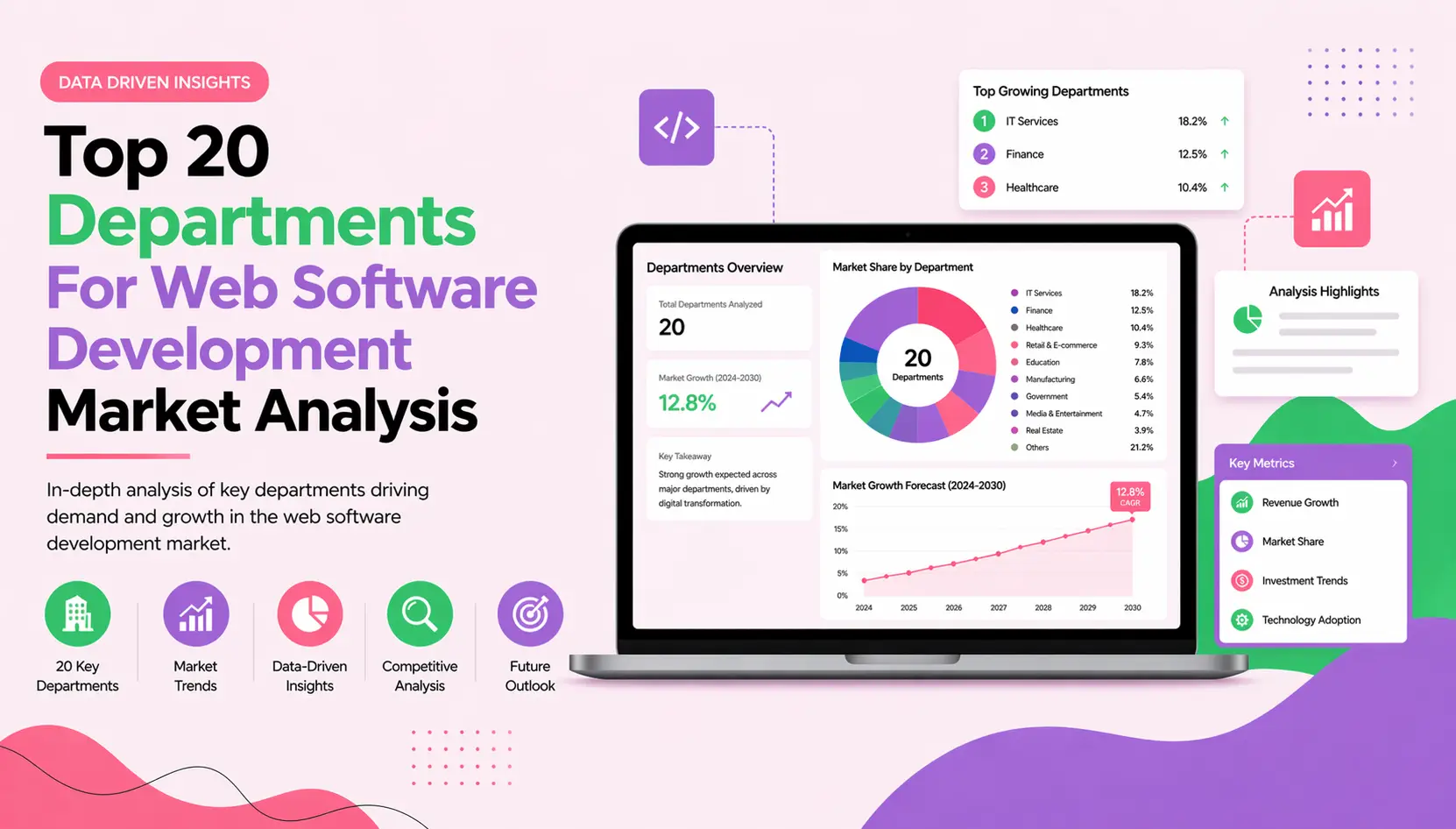
In this in-depth guide, we examine the Top 20 Departments for Web Software Development Market Analysis 2026, unpacking each department's unique web development needs, strategic goals, emerging tools, and future trends. We also cover benefits, challenges, best practices, and a complete FAQ section based on real search queries.
Why Departmental Web Development Analysis Matters in 2026
For most of the 2010s, web development budgets and roadmaps were owned almost exclusively by IT or Engineering departments. That era is over. In 2026, the proliferation of no-code platforms, AI-assisted development tools, cloud-native architectures, and customer-centric digital mandates means that nearly every department in a modern organization has a direct stake in — and often a direct hand in — web software development outcomes.
Understanding which departments are the largest consumers, contributors, and influencers of web development helps:
- Prioritize internal investment and headcount allocation
- Identify underserved business units that could benefit from custom web solutions
- Uncover collaboration opportunities between technical and non-technical teams
- Align development roadmaps with organizational revenue goals
- Benchmark your company's digital maturity against industry peers
With the global web development market projected to exceed $1.1 trillion in combined software and services spending by the end of 2026, a department-level lens provides the most actionable and precise market intelligence available.
Top 20 Departments Driving Web Software Development in 2026
1. Information Technology (IT) Department
The IT department remains the foundational pillar of enterprise web software development. Responsible for infrastructure, security, integrations, and platform governance, IT teams in 2026 are increasingly focused on API-first architectures, cloud migrations, and DevSecOps pipelines. Their web development priorities include building scalable internal portals, maintaining legacy system integrations, and enforcing compliance frameworks such as GDPR and SOC 2. Modern IT departments are heavy adopters of Kubernetes, Terraform, and microservices-based web applications.
2. Marketing Department
Marketing is arguably the second most web-development-intensive department in any organization. CMOs and digital marketing teams require high-performance landing pages, CMS-driven content hubs, A/B testing environments, personalization engines, and campaign microsites — all of which demand sophisticated web development capabilities. In 2026, the rise of AI-powered marketing automation platforms has made headless CMS architectures and composable commerce solutions a standard marketing technology stack requirement. Marketing departments are also the primary drivers of Core Web Vitals optimization and page speed engineering.
3. E-Commerce and Sales Department
E-commerce teams have some of the most urgent and complex web development requirements. From product catalog management and checkout flow optimization to real-time inventory APIs and omnichannel commerce platforms, the sales-enabling web stack is extraordinarily sophisticated. In 2026, Progressive Web Apps (PWAs), one-click purchasing interfaces, and AI-driven product recommendation engines are table-stakes requirements. E-commerce departments are among the top drivers of web performance engineering, conversion rate optimization (CRO) development, and payment gateway integrations.
4. Customer Experience (CX) and Support Department
Customer experience departments are transforming web software development by demanding self-service portals, AI-powered chatbots, knowledge base platforms, and real-time support ticketing systems built into customer-facing websites. In 2026, CX teams are investing heavily in conversational UI development, accessibility compliance (WCAG 2.2), and omnichannel support widget integrations. The ROI case for CX-driven web development is clear: better self-service web tools reduce support costs while improving customer satisfaction scores (CSAT).
5. Product Management Department
Product managers are the architects of web application roadmaps. They translate business requirements into user stories, manage development sprints, and own the product vision for internal and external web platforms. In 2026, product-led growth (PLG) strategies mean that product departments are directly influencing web development priorities to maximize user activation, retention, and expansion. Product teams are significant consumers of analytics dashboards, feature flag management tools, and A/B testing frameworks built into web applications.
6. Human Resources (HR) Department
Human Resources has become a significant consumer of custom web software development, particularly for employee self-service portals, applicant tracking systems (ATS), onboarding platforms, learning management systems (LMS), and internal intranet solutions. In 2026, HR departments are investing in AI-powered recruitment web platforms, internal mobility portals, and DEI (Diversity, Equity, and Inclusion) analytics dashboards. The growth of distributed and remote workforces has amplified HR's dependence on robust, secure web applications.
7. Finance and Accounting Department
Finance teams require highly secure, compliance-driven web applications for financial reporting dashboards, expense management portals, client billing platforms, and ERP integrations. The 2026 financial web software market is characterized by the adoption of real-time data visualization tools, blockchain-based audit trails, and automated invoice processing interfaces. Finance departments are among the most demanding in terms of web security requirements, with zero-trust architecture and multi-factor authentication (MFA) being standard mandates.
8. Legal and Compliance Department
Legal and compliance teams have a growing footprint in web software development, driven by the need for contract management systems, regulatory compliance tracking platforms, data privacy portals (GDPR, CCPA compliance dashboards), and e-signature integration platforms. In 2026, AI-assisted legal tech web applications are a major growth area, enabling automated contract review, risk flagging, and regulatory change monitoring through intelligent web interfaces.
9. Operations and Supply Chain Department
Operations departments are leveraging web software to manage complex supply chain networks, vendor portals, logistics tracking dashboards, and warehouse management interfaces. In 2026, the integration of IoT data streams into web-based operations dashboards is a critical development priority. Real-time visibility platforms, predictive maintenance dashboards, and supplier collaboration portals are among the highest-value web development investments for operations teams.
10. Research and Development (R&D) Department
R&D departments are building increasingly sophisticated web applications for data collection, experiment tracking, laboratory information management systems (LIMS), and collaboration platforms. In 2026, AI/ML model deployment interfaces and scientific data visualization platforms are major web development priorities for R&D teams across pharmaceuticals, biotechnology, aerospace, and technology sectors. R&D's web development needs are highly specialized, requiring integration with scientific databases, HPC clusters, and real-time sensor networks.
11. Data Analytics and Business Intelligence (BI) Department
Data and analytics teams are among the most active builders of internal web applications, developing self-service BI dashboards, data catalog platforms, and reporting portals that serve the entire organization. In 2026, the shift from static reporting to interactive, real-time analytics web applications is nearly universal. Technologies such as WebAssembly (WASM), Apache Arrow, and streaming data APIs are reshaping how BI departments approach front-end web development for data-intensive applications.
12. Healthcare and Clinical Departments
In healthcare organizations, clinical and administrative departments are commissioning complex web applications including patient portals, telemedicine platforms, EHR integrations, and clinical trial management systems. HIPAA compliance, HL7 FHIR API integration, and accessibility requirements make healthcare web development among the most regulated and technically demanding in any sector. In 2026, AI-assisted diagnostic interfaces and remote patient monitoring dashboards represent the frontier of clinical web application development.
13. Education and Training Department
Corporate training and education departments are major consumers of web software development services, building e-learning platforms, knowledge assessment tools, interactive course delivery systems, and certification tracking portals. In 2026, the integration of generative AI into learning management systems (LMS) is accelerating, with adaptive learning web applications that personalize content delivery in real time. The post-pandemic normalization of remote learning has permanently elevated education technology web development investment.
14. Real Estate and Facilities Management Department
Real estate departments are investing in property listing platforms, tenant portals, facilities management dashboards, and space utilization web applications. In 2026, smart building integrations — connecting IoT sensors, energy management systems, and occupancy data into web-based facilities dashboards — represent a significant growth area. Real estate technology (PropTech) web development is characterized by heavy use of mapping APIs, 3D virtual tour integrations, and real-time availability engines.
15. Government and Public Sector Departments
Government departments at federal, state, and municipal levels are among the largest commissioners of web software development globally. Citizen-facing service portals, permitting systems, benefits management platforms, and transparent data dashboards represent billions of dollars in annual web development investment. In 2026, government digital transformation initiatives are accelerating adoption of cloud-native web architectures, digital identity platforms, and accessible, multilingual web applications. WCAG compliance and Section 508 accessibility are non-negotiable requirements.
16. Nonprofit and NGO Departments
Nonprofit organizations are increasingly sophisticated web software consumers, building donor management platforms, volunteer coordination portals, impact reporting dashboards, and campaign fundraising microsites. In 2026, mobile-first web development and low-cost cloud hosting solutions are making enterprise-grade web applications accessible to resource-constrained nonprofits. The integration of payment processing APIs and CRM platforms into nonprofit web applications is a key development priority.
17. Logistics and Transportation Department
Logistics departments require real-time tracking web applications, route optimization dashboards, driver management portals, and customer shipment visibility platforms. In 2026, the integration of machine learning models into logistics web platforms — enabling predictive delivery windows, automated exception management, and dynamic routing — is a major development trend. API integrations with carrier networks, customs systems, and last-mile delivery platforms are core logistics web development requirements.
18. Media and Content Production Department
Media organizations and content production departments are building sophisticated digital asset management (DAM) platforms, content publishing systems, streaming media applications, and audience engagement portals. In 2026, AI-assisted content workflow platforms and web-based video editing and publishing tools are reshaping media technology stacks. The growth of subscription-based content models is driving investment in paywall technology, member management systems, and personalized content delivery web applications.
19. Cybersecurity Department
Cybersecurity teams are both consumers and contributors to web software development, building security operations center (SOC) dashboards, vulnerability management portals, threat intelligence platforms, and employee security awareness training web applications. In 2026, zero-trust security web architectures and DevSecOps integration are reshaping how cybersecurity departments engage with web development pipelines. Automated security scanning integrations, Web Application Firewall (WAF) configuration portals, and incident response dashboards are key cybersecurity web development priorities.
20. Customer Success and Account Management Department
Customer success departments are leveraging web software to build client health dashboards, renewal tracking portals, onboarding experience platforms, and advocacy program websites. In 2026, customer intelligence platforms that aggregate product usage data, support history, and NPS scores into actionable web-based dashboards are a critical investment for SaaS and enterprise software companies. Customer success teams are also significant drivers of in-app messaging, guided onboarding flows, and self-service knowledge base development.
Key Benefits of Department-Level Web Development Strategy
Adopting a department-specific approach to web software development market analysis delivers measurable advantages across the enterprise:
- Precise Resource Allocation: Understanding which departments have the highest web development ROI enables CFOs and CTOs to prioritize budgets with confidence.
- Faster Time-to-Market: Department-specific web development roadmaps eliminate cross-functional bottlenecks and accelerate delivery timelines.
- Improved User Experience: Web applications built with deep departmental context deliver superior usability and adoption rates compared to one-size-fits-all solutions.
- Competitive Differentiation: Organizations that invest in department-specific web tools gain operational advantages that generic SaaS platforms cannot replicate.
- Compliance and Risk Reduction: Tailored web development ensures that industry-specific regulatory requirements (HIPAA, FINRA, GDPR) are addressed at the architecture level.
- Scalability: Department-driven web applications can be modularly scaled as business requirements evolve, reducing technical debt accumulation.
- Data-Driven Decision Making: Custom web dashboards and analytics platforms give departments real-time intelligence that drives faster, better business decisions.
Common Challenges Across Departments
Despite the enormous opportunity, departments pursuing web software development initiatives in 2026 face a consistent set of challenges:
What Are the Biggest Obstacles to Departmental Web Development Success?
- Siloed Communication: Departments often operate in isolation, leading to duplicated development efforts, inconsistent user experiences, and integration failures.
- Skills Gap: Non-technical departments increasingly want to own web development outcomes but lack the in-house expertise to manage complex development projects effectively.
- Security Vulnerabilities: Rapid, department-driven web development can outpace security review processes, creating exposure to SQL injection, XSS attacks, and data breaches.
- Legacy System Integration: Many departments rely on legacy ERP, CRM, or database systems that are difficult and expensive to integrate with modern web applications.
- Budget Constraints: Mid-market organizations often struggle to justify custom web development investment when off-the-shelf SaaS alternatives appear cheaper in the short term.
- Vendor Management Complexity: Managing multiple external development partners across departments creates governance, IP, and quality assurance challenges.
- Performance and Scalability Planning: Departments frequently underestimate traffic and load requirements, leading to performance failures at critical business moments.
Best Practices for Cross-Departmental Web Development
How Should Organizations Structure Web Development Across Multiple Departments?
Leading organizations in 2026 are adopting the following proven best practices to maximize the return on departmental web development investment:
- Establish a Central Web Development Center of Excellence (CoE): Create a shared team of senior architects, UX designers, and security engineers that supports all departments while maintaining platform consistency and governance standards.
- Adopt a Composable Architecture Strategy: Use shared design systems, component libraries, and API standards that allow individual departments to build unique web experiences without reinventing core infrastructure.
- Implement Agile Governance Frameworks: Use cross-departmental product councils and sprint review ceremonies to align development priorities with business objectives on a quarterly basis.
- Invest in Internal Developer Platforms (IDPs): Provide departments with self-service deployment pipelines, pre-built integration templates, and automated testing frameworks that accelerate development without sacrificing quality.
- Prioritize Accessibility from Day One: Embed WCAG 2.2 compliance requirements into all departmental web development briefs and conduct regular accessibility audits across all deployed web properties.
- Conduct Regular Web Performance Audits: Use tools like Google Lighthouse, WebPageTest, and Core Web Vitals monitoring to ensure that departmental web applications meet performance benchmarks that support both user experience and SEO rankings.
- Document Everything: Maintain a centralized wiki of all departmental web applications, APIs, integrations, and technical decisions to reduce knowledge loss and accelerate onboarding of new developers.
- Partner with Specialized Agencies Strategically: For departments without sufficient in-house capability, partnering with a full-service digital marketing company providing Web Development, Digital Marketing, and SEO services like WEBPEAK can accelerate delivery while maintaining quality and strategic alignment.
Tools and Technologies Powering Departmental Web Dev in 2026
What Are the Leading Web Development Technologies by Department in 2026?
| Department | Primary Web Stack / Tools | Key Integration |
|---|---|---|
| IT / Engineering | Kubernetes, Terraform, Node.js, Go | CI/CD pipelines, cloud providers |
| Marketing | Next.js, Contentful, Vercel, HubSpot | CRM, analytics, ad platforms |
| E-Commerce | Shopify Plus, React, PWA frameworks | Payment gateways, ERP, PIM |
| Customer Experience | Zendesk APIs, React, WebSockets | CRM, AI chatbot platforms |
| Data Analytics / BI | D3.js, Apache Superset, WebAssembly | Data warehouses, streaming APIs |
| HR | React, Workday APIs, LMS platforms | HRIS, ATS, payroll systems |
| Finance | Vue.js, encrypted REST APIs, ERP connectors | SAP, Oracle, Stripe |
| Healthcare | HL7 FHIR APIs, React, HIPAA-compliant hosting | EHR systems, telehealth platforms |
| Cybersecurity | Python dashboards, SIEM integrations, WAF portals | Splunk, CrowdStrike, Okta |
| Logistics | MapBox APIs, React Native Web, GraphQL | Carrier APIs, WMS, TMS |
Emerging Technologies Reshaping Web Development Across All Departments
- AI-Assisted Code Generation: Tools like GitHub Copilot, Cursor, and Anthropic Claude are dramatically accelerating development velocity across all departments by automating routine coding tasks and suggesting architectural solutions.
- WebAssembly (WASM): Enabling near-native performance in browser-based applications, WASM is transforming data-heavy web applications in finance, analytics, and R&D departments.
- Edge Computing: Deploying web application logic at CDN edge nodes (via Cloudflare Workers, Vercel Edge) is reducing latency for global users and enabling real-time personalization at scale.
- Headless and Composable CMS: Platforms like Contentful, Sanity, and Strapi are enabling marketing and content departments to manage web content independently of development cycles.
- Server Components and Streaming SSR: React Server Components and streaming server-side rendering are redefining web performance architecture for complex, data-driven departmental applications.
- Low-Code / No-Code Platforms: Tools like Webflow, Retool, and Bubble are empowering non-technical departments to build and iterate on web applications without deep engineering resources.
Future Trends Shaping the Market in 2026 and Beyond
What Are the Biggest Web Software Development Trends to Watch in 2026?
The web software development landscape is evolving at an unprecedented pace. Here are the most consequential trends shaping departmental web development strategy in 2026:
1. AI-Native Web Application Architecture
The integration of large language models (LLMs) and AI inference engines directly into web application backends is no longer experimental — it is a production reality. Departments across marketing, customer success, HR, and legal are deploying AI-native web features including semantic search, document summarization, automated content generation, and intelligent form completion. The challenge in 2026 is managing AI inference costs, latency, and accuracy at scale within web application architectures.
2. The Rise of the AI Software Engineer
Autonomous AI coding agents are beginning to handle entire feature development cycles — from ticket creation to pull request review — with minimal human intervention. This is shifting the department-level calculus of web development: smaller, more strategic engineering teams are replacing large development armies, with AI agents handling implementation-level tasks. Departments are rethinking how they staff and manage web development projects as a result.
3. Web3 and Decentralized Identity Integration
While the speculative Web3 bubble has deflated, practical applications of decentralized identity, blockchain-verified credentials, and smart contract integrations are emerging in legal, finance, HR, and government departments. Self-sovereign identity (SSI) web applications — where users control their own digital credentials — are gaining traction in high-compliance sectors.
4. Spatial Web and Immersive Commerce
The maturation of WebXR standards and the proliferation of spatial computing devices are opening new frontiers for e-commerce, real estate, education, and retail departments. 3D product configurators, virtual showrooms, and augmented reality try-on experiences delivered through standard web browsers (without native app installation) are becoming viable commercial development investments in 2026.
5. Hyper-Personalization at the Edge
Combining edge computing with AI-driven personalization engines, departments are moving toward individualized web experiences that adapt in real time to user behavior, device context, geographic location, and intent signals. This represents a fundamental shift from segment-based personalization (targeting user cohorts) to true 1:1 web experience delivery.
6. Sustainability-Driven Web Development
Green web development — optimizing web applications to minimize energy consumption, carbon emissions, and data transfer — is becoming a board-level ESG priority for large enterprises. Departments are beginning to measure digital carbon footprints and incorporate sustainable web design principles (efficient code, optimized assets, renewable hosting) into their development standards.
7. Quantum-Safe Web Security
With quantum computing capabilities advancing, cybersecurity and IT departments are beginning to plan and implement post-quantum cryptography standards in web application security architectures. NIST's post-quantum cryptography standards, finalized in 2024, are now being integrated into enterprise web security policies for 2026 deployment roadmaps.
Frequently Asked Questions (FAQ)
1. Which department typically owns web software development in large enterprises?
In most large enterprises, the IT or Engineering department formally owns web software development infrastructure, governance, and security standards. However, in 2026, web development is increasingly a shared responsibility — Marketing owns content and campaign development, Product owns application roadmaps, and individual business units commission department-specific tools. The trend is toward federated development models where a central platform team enables distributed departmental development through shared tooling and standards.
2. What is the market size of the web software development industry in 2026?
The global web software development market — encompassing custom web application development, web design services, platform licensing, and related professional services — is estimated to exceed $1.1 trillion in total addressable market (TAM) in 2026. The fastest-growing segments include AI-integrated web applications, headless commerce platforms, and government digital transformation initiatives. North America and Asia-Pacific represent the largest regional markets by investment volume.
3. How does web software development differ by industry vertical?
Web software development requirements vary significantly by industry. Healthcare web development demands HIPAA compliance, HL7 FHIR integrations, and strict data sovereignty controls. Financial services requires SOX compliance, real-time data security, and high-availability architectures. E-commerce prioritizes performance, conversion rate optimization, and payment gateway reliability. Government web development mandates accessibility compliance, open-source preferences, and procurement transparency. Understanding these vertical-specific requirements is essential for accurate market analysis and solution positioning.
4. What are the most in-demand web development skills across departments in 2026?
The most in-demand web development skills in 2026 span both technical and strategic domains. On the technical side: React/Next.js proficiency, TypeScript expertise, API design (REST and GraphQL), cloud-native deployment (AWS, GCP, Azure), AI/ML integration, and web performance engineering are the most sought-after competencies. On the strategic side: product thinking, UX research, data literacy, and cross-departmental communication skills are increasingly valued alongside pure coding ability. Developers who can bridge technical implementation with business outcome thinking command significant compensation premiums in 2026.
5. Should departments build web applications in-house or outsource to external agencies?
The build vs. buy vs. outsource decision depends on several factors: strategic importance, technical complexity, time-to-market requirements, and available in-house talent. For core competitive differentiators — web applications that directly drive revenue or embody proprietary business logic — building in-house typically delivers superior long-term ROI. For marketing microsites, campaign landing pages, or departmental productivity tools, outsourcing to specialized agencies delivers speed and cost advantages. A hybrid model — in-house platform ownership with agency support for specific delivery sprints — is increasingly the preferred approach in 2026.
6. How is artificial intelligence changing web software development for business departments?
AI is transforming web software development for business departments across three dimensions. First, AI-assisted development tools (Copilot, Claude, Cursor) are dramatically accelerating development velocity, enabling smaller teams to ship more features in less time. Second, AI capabilities are being embedded directly into web applications — powering intelligent search, automated content generation, personalization, and predictive analytics features that departments previously could not build cost-effectively. Third, AI is enabling non-technical departments to participate more directly in web development through natural language interfaces, visual design tools, and no-code platforms powered by generative AI.
7. What role does SEO play in departmental web development strategy?
Search engine optimization is a critical consideration in web development strategy for any department that manages customer-facing or publicly indexed web properties — most notably Marketing, E-Commerce, Content, and Product departments. In 2026, technical SEO requirements — Core Web Vitals compliance, structured data implementation, server-side rendering, mobile-first architecture, and page experience signals — are development-level responsibilities that must be addressed at the architecture stage, not retrofitted after launch. Departments that integrate SEO engineering into their web development processes from the start achieve significantly better organic search visibility, lower customer acquisition costs, and higher website authority scores.
Conclusion: Building a Department-Driven Web Development Strategy for 2026
The era of centralized, IT-only web software development is firmly behind us. In 2026, the most competitive and digitally mature organizations are the ones that have successfully distributed web development capability across departments — empowering Marketing to own their content stack, enabling Finance to build real-time reporting tools, and giving Customer Success the dashboards they need to drive retention. The Top 20 Departments for Web Software Development Market Analysis 2026 outlined in this guide represent the full spectrum of modern enterprise web development demand.
Whether you are evaluating internal development capacity, benchmarking your organization's digital maturity, or building an investment case for expanded web software development programs, the framework provided here gives you the structured intelligence to make confident, well-informed decisions.
The organizations that will lead their industries through the remainder of the decade are those investing now in the people, processes, platforms, and partners needed to make departmental web software development a systematic, scalable, and strategically aligned capability. The opportunity is vast, the technology is mature, and the competitive pressure is unrelenting. The time to act is 2026.