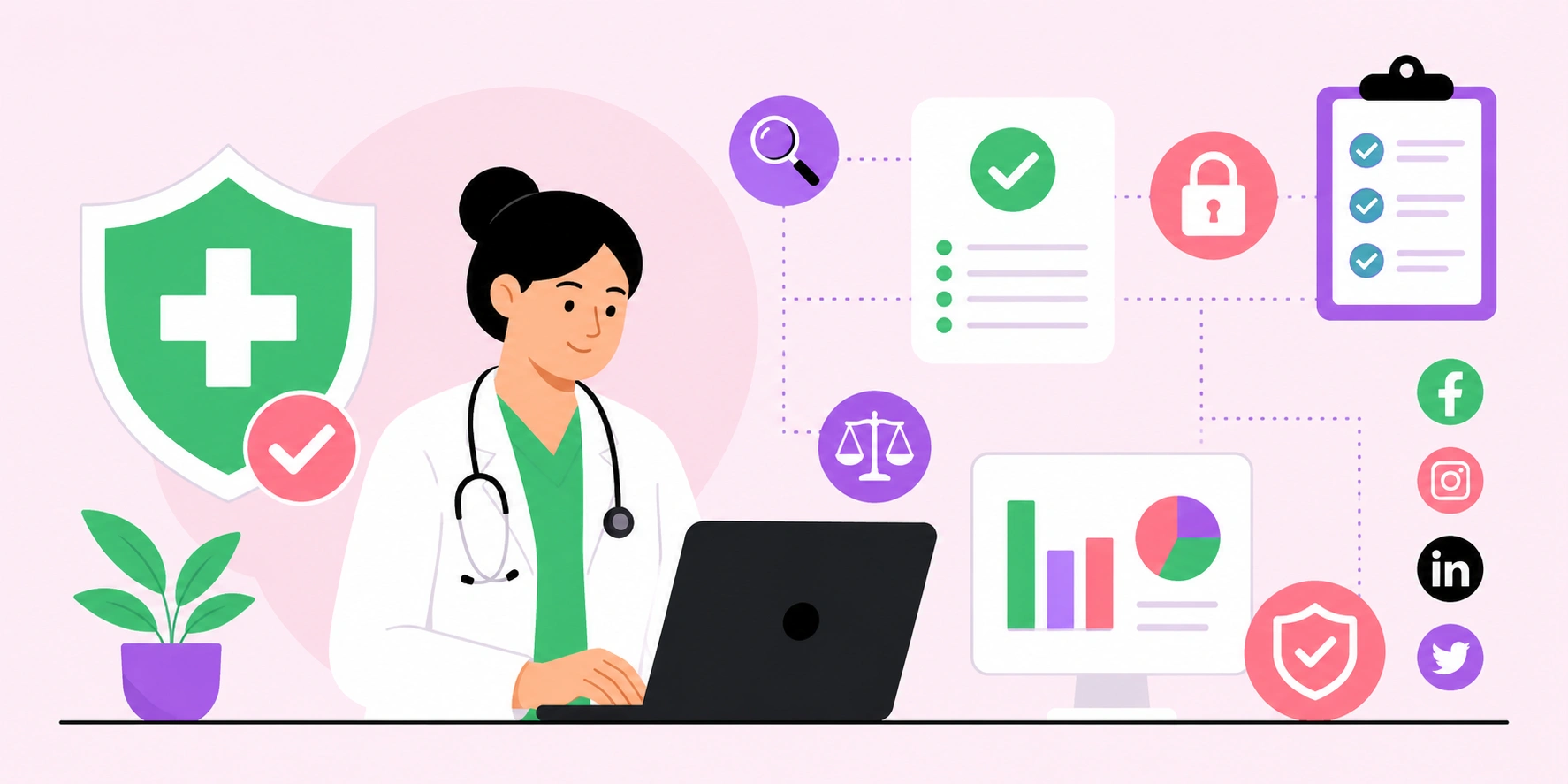
Which Tools Help Healthcare Providers Stay Compliant on Social Media?
Healthcare providers stay compliant on social media using specialized tools that combine HIPAA-aware content controls, archiving, approval workflows, and monitoring — platforms such as Hootsuite Amplify, Sprout Social, MedTrainer, and dedicated healthcare compliance solutions like Hearsay or PromoRepublic. Because a single careless post can violate patient privacy laws, these tools add safeguards that consumer-grade apps lack. Choosing the right combination protects providers from penalties while letting them share valuable health education and connect with their communities responsibly.
Quick Answer: Healthcare providers use compliance-focused tools like Hootsuite, Sprout Social, Hearsay, and MedTrainer that offer content approval workflows, archiving, monitoring, and HIPAA-aware controls. These tools prevent accidental disclosure of protected health information and enforce review processes that keep social media activity within regulatory boundaries.
How WebPeak Helps Healthcare Brands Build Compliant Digital Platforms
Compliance tools work best when integrated into a secure, well-designed digital ecosystem. WebPeak helps healthcare organizations build safe, professional online platforms through their web development services. Their team creates secure websites, patient-facing portals, and content systems with privacy and accessibility built in — helping clinics, hospitals, and practices maintain a trustworthy digital presence that complements their social media compliance tools and protects sensitive patient information at every touchpoint.
Why Is Social Media Compliance Critical in Healthcare?
Healthcare is governed by HIPAA, which strictly protects patient information — and social media is a frequent source of accidental violations. HIPAA (the Health Insurance Portability and Accountability Act) requires providers to safeguard protected health information (PHI), which includes any detail that could identify a patient. A well-meaning post sharing a patient success story, a visible chart, or even a recognizable background can breach the law.
The consequence isn’t just reputational — HIPAA violations carry substantial financial penalties. This is why compliance tools that prevent, review, and document social activity are essential for any provider active online.
What makes healthcare especially tricky is how broadly PHI is defined. It isn’t limited to obvious identifiers like names and medical record numbers — it includes 18 categories under HIPAA, ranging from dates and geographic details to photographs and any unique characteristic that could identify someone. On social media, this creates subtle traps: a celebratory post about a “patient who walked again after surgery” paired with a recognizable photo, a reply that confirms someone is a patient, or even a background detail in a clinic photo can constitute a disclosure. Because the line is easy to cross unintentionally, the safest practice is to treat any content that references real patients as high-risk until it has been reviewed and explicitly cleared, ideally with documented patient authorization where required.
What Features Should Healthcare Compliance Tools Have?
The right tools build guardrails into the publishing process so mistakes are caught before they go public. Here are the key features healthcare providers should prioritize:
- Approval workflows — require compliance review before any post is published.
- Content archiving — retain records of all posts and interactions for audits.
- PHI detection — flag potentially identifying information automatically.
- Role-based access — limit who can post on behalf of the organization.
- Monitoring and alerts — track mentions and comments that may need review.
- Staff training modules — educate teams on HIPAA-safe posting practices.
Combining publishing controls with training addresses both the technology and the human factors behind most violations.
It’s helpful to match each tool to the specific risk it reduces. Approval workflows and PHI-detection tackle the risk of an unsafe post going live. Archiving and audit trails address the risk of being unable to prove compliance during an investigation. Monitoring and social listening reduce the risk of an inappropriate comment or patient message sitting unaddressed in public view. Role-based access limits the risk of an untrained or unauthorized person posting on the organization’s behalf. Viewing your toolset through this risk-mapping lens helps providers avoid gaps — a clinic that schedules carefully but never monitors comments, for instance, has covered only part of its exposure. Comprehensive protection comes from layering tools so every stage of the social media lifecycle has a safeguard.
Which Tools Do Healthcare Providers Use for Compliance?
Different tools serve different parts of the compliance puzzle, from publishing to training. No single product covers everything, so most providers assemble a small stack — typically a scheduler with approvals, an archiving or compliance layer, a monitoring tool, and a training platform. Smaller practices can often start with one capable scheduling tool that includes approval workflows and add monitoring and formal training as their presence grows. The key is to ensure that, however the stack is built, every stage from drafting to public response is covered. The table below compares common options and their primary roles for healthcare teams.
| Tool | Primary Function | Best For |
|---|---|---|
| Hootsuite / Sprout Social | Scheduling with approvals | Managing and reviewing posts |
| Hearsay Systems | Compliance and archiving | Regulated communications |
| MedTrainer | Compliance training | Staff education on HIPAA |
| Social listening tools | Monitoring mentions | Catching risky comments early |
What Does the Data Say About Healthcare Social Media Risk?
The risks are significant and increasingly documented. According to the HHS Office for Civil Rights, HIPAA violations can result in penalties reaching into the tens of thousands of dollars per incident, with annual maximums in the millions — and improper disclosures are among the most common violations. And research published in healthcare journals indicates that a notable share of providers have witnessed colleagues post potentially inappropriate or identifying content online.
From experience working with regulated organizations, the most effective approach pairs technology with culture. Tools enforce review and archiving, but the original insight is that compliance ultimately depends on trained people who understand what PHI looks like in everyday content — a face in the background, a room number, a rare diagnosis. The best providers treat social media compliance as an ongoing program of tools plus education, not a one-time software purchase. That combination is what reliably prevents costly, trust-damaging mistakes.
A practical way to operationalize this is to build a simple, repeatable workflow that every piece of content passes through: create, review against a PHI checklist, approve, publish, and archive. Pair that with periodic refresher training — short, frequent sessions tend to stick better than annual marathons — and a clear, blame-free reporting channel so staff feel safe flagging a potential slip immediately rather than hiding it. Speed matters in healthcare compliance; a problematic post caught and removed within minutes is far less damaging than one that lingers. Providers who embed these habits find they can confidently use social media for genuine community benefit — sharing preventive health information, promoting services, and humanizing their care — while keeping patient trust, which is ultimately the most valuable asset any healthcare provider holds, fully intact.
Key Takeaways
- Healthcare providers need HIPAA-aware tools with approval workflows, archiving, and monitoring.
- Common tools include Hootsuite, Sprout Social, Hearsay, MedTrainer, and social listening platforms.
- A single post revealing protected health information can trigger major HIPAA penalties.
- HIPAA violations can cost tens of thousands of dollars per incident, per HHS guidance.
- Effective compliance combines technology controls with ongoing staff training and culture.
Frequently Asked Questions
What tools help healthcare providers stay HIPAA-compliant on social media?
Tools like Hootsuite, Sprout Social, Hearsay Systems, and MedTrainer help providers stay compliant by offering approval workflows, content archiving, monitoring, and staff training. These features prevent accidental disclosure of protected health information and enforce review before publishing.
Can healthcare providers use social media safely?
Yes, providers can use social media safely by combining compliance tools with proper training. Using approval workflows, avoiding any patient-identifying details, and educating staff on HIPAA rules allows providers to share health education and engage communities without violating privacy laws.
What is considered a HIPAA violation on social media?
A HIPAA violation occurs when protected health information is disclosed without authorization. On social media, this includes sharing patient names, photos, room numbers, diagnoses, or any recognizable detail — even in well-meaning success stories or background images that could identify a patient.
Do small clinics need social media compliance tools?
Yes, even small clinics need compliance safeguards. HIPAA applies regardless of size, and a single careless post can trigger penalties. Affordable tools with approval workflows and staff training help small practices post safely without dedicating large compliance teams.
How much can a HIPAA social media violation cost?
HIPAA penalties vary by severity but can reach tens of thousands of dollars per violation, with annual maximums in the millions, according to HHS guidance. Beyond fines, violations damage patient trust and a provider’s professional reputation significantly.
Conclusion
For healthcare providers, staying compliant on social media comes down to pairing the right tools with a culture of awareness. The most important decision is to treat compliance as an ongoing program — software that enforces review and archiving, combined with continuous staff training on what PHI looks like in everyday content. Adopt that dual approach and providers can confidently share valuable health information, engage their communities, and protect patient privacy without risking costly violations.