postnet graphic design and printing: A Project Checklist
A print order can go wrong before the printer starts: an unclear brief, an unapproved revision, or a missing production specification can change the finished result. Postnet graphic design and printing refers here to coordinating design assistance and printed materials through a PostNet center, not to a single standardized package. PostNet's official service pages describe design and print offerings, but availability and production details must be confirmed locally. Treat your project as a sequence of decisions about content, format, proofing, and delivery rather than assuming the service name settles every requirement.
Quick Answer: Prepare a clear brief, confirm your local PostNet center's capabilities, and request a quote based on the finished product. Agree on dimensions, paper, color expectations, file requirements, proofs, and delivery before approving production. Keep one authorized final version and verify the output; do not assume prices or equipment are identical across locations.
What should you confirm before requesting design and printing?
Confirm the finished product and local service scope before discussing visual treatments. PostNet's official Design page describes help with logos, business stationery, marketing materials, and personal projects. Its Printing Services page lists products including business cards, brochures, signs, and postcards. These descriptions support a service inquiry, not a promise that every center offers every material, finishing option, or turnaround.
Your design direction should also fit the material's job. A promotional flyer can use expressive treatment while keeping dates and contact information clear; compare ways to protect essential details in an expressive layout before requesting a complicated visual approach. A print provider can reproduce an approved file, but production accuracy cannot repair a hierarchy that hides the customer's next action.
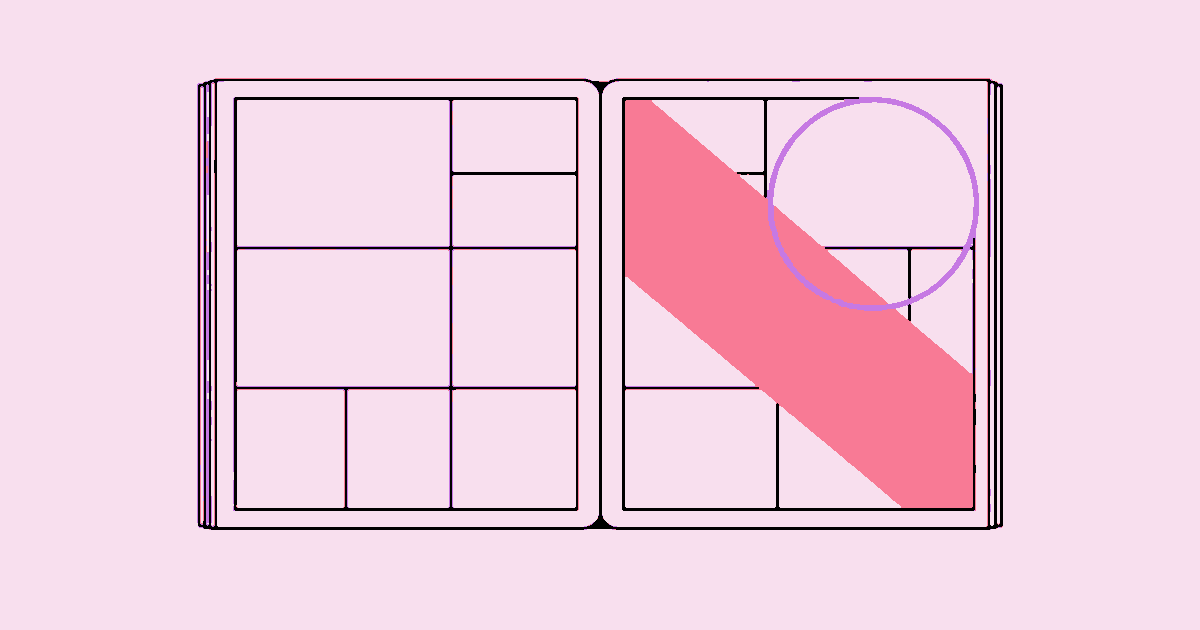
Define trim size as the finished dimensions after cutting, bleed as artwork extending beyond the trim, and safe area as the space protecting important content from cutting variation. Ask the center for its requirements rather than importing specifications from another printer. Also distinguish a digital proof, which checks content and placement, from a physical sample, which can help assess material and output appearance.
Identify who is buying design work and who is supplying finished artwork. If you need design assistance, ask what revisions, deliverables, and file access are included. If you already have a designer, request production specifications before final export. This prevents paying for unnecessary reconstruction or assuming that an image preview is a complete print-ready file.
How do you prepare a useful print-project brief?
A useful brief describes the desired result in terms that both the designer and production team can act on. Separate business goals from technical specifications so each can be checked. The following sequence helps organize the conversation; it does not imply a universal PostNet ordering process or fixed commercial terms. Ask the local center how it wants information and files submitted.
- State the audience and action. Explain who receives the material and what they should do next. Supply final wording or mark exactly which copy still requires approval.
- Specify the finished format. Describe dimensions, quantity, sides, folds, and intended use. If you are unsure about paper or finish, ask to compare available samples instead of guessing from a screen image.
- Provide authorized assets. Share approved logos, usable images, brand guidance, and required contact details. Identify rights or licensing restrictions that affect reproduction.
- Ask for technical requirements. Confirm acceptable file types, bleed, safe areas, color handling, and image expectations. Keep the center's answers attached to the project brief.
- Define approval responsibility. Name the person authorized to accept the proof and separate their final approval from informal feedback by other colleagues.
- Confirm the quote and schedule. Ask what is included, what may change the price, when production begins, and how the finished work will be collected or delivered.
Attach examples only when you can explain what they demonstrate. A reference might show a preferred fold, a readable information hierarchy, or a paper feel. Sending an attractive picture without specifying the relevant feature can lead the designer to copy the wrong aspect. If you own no rights to the reference artwork, make clear that it is inspiration rather than supplied production content.
Which proof and file checks matter before production?
Proof checks should address separate risks instead of treating approval as a single quick glance. The table compares practical checks and their limits. None guarantees an exact outcome independently; together they establish a clearer agreement about the job. Confirm any unresolved production question with the center before authorizing the run, especially when the piece includes folds or unusual finishing.
| Check | What to inspect | Problem it helps detect | Limit to remember |
|---|---|---|---|
| Content proof | Names, dates, contact details, and wording | Incorrect or superseded information | Does not establish paper or color appearance |
| Trim and safe area | Finished size and distance of critical elements from edges | Cutting near essential text | Must follow the provider's actual requirements |
| Fold mockup | Panel sequence and front-to-back relationships | Content landing on the wrong panel | A screen preview may hide physical handling issues |
| Image and type inspection | Image clarity, font behavior, and small lettering | Soft graphics or substituted type | Zoomed inspection is not enough for actual-size readability |
| Material or output sample | Paper feel, contrast, finish, and color expectation | A mismatch between expectation and available output | Confirm whether the sample represents the final process |
Inspect the approved version from the file that will actually enter production. An earlier draft may have correct wording while a later export introduces a substitution or missing element. Keep the final proof and approval message together. If the artwork changes after approval, identify the change explicitly and ask whether another proof is required rather than assuming the approval carries forward.
How can you compare options without relying on invented prices?
Compare quotes by matching their scope, not by assuming the lowest visible total is equivalent. Ask whether design work, revisions, proofing, finishing, delivery, and applicable taxes are included. A quote for supplied artwork is not directly comparable with a quote that includes concept development. Likewise, a different stock or production method may change the result even when the dimensions and quantity match.
Use qualitative trade-offs where verified prices are unavailable. A heavier stock may change how a piece feels and folds; a special finish may create production constraints; a folded brochure may require more layout planning than a single-sided card. These are project considerations, not claims about universal costs or specific PostNet capabilities. Request options from the local center based on your actual use case.
A clearly framed design rationale also helps distinguish deliberate choices from unnecessary complication. If a concept borrows a historical style, use a context-based explanation of contrasting visual languages to describe its purpose. Then ask whether that treatment remains reproducible at the selected size and on the available stock. Conceptual ambition does not remove the need for readable final output.
Record the agreed assumptions in writing. Specify the version, quantity, finished dimensions, selected material, finishing, and approval conditions. If a deadline is important, ask when it becomes confirmed and what unresolved decisions could affect it. Do not advertise a turnaround to your own customers before the provider has agreed to the relevant job and schedule.
Which mistakes commonly create avoidable print revisions?
The most preventable mistake is supplying a screenshot when editable or higher-quality source artwork is needed. A screenshot may appear acceptable on a laptop yet lose clarity when enlarged or printed. Ask which source files the center can use and supply the original assets you are authorized to share. Do not invent missing vector artwork by enlarging a small image and calling it print-ready.
Another mistake is treating screen color as a guaranteed print target. Displays and print processes represent color differently, and paper influences appearance. Ask how the center handles color expectations and whether a relevant sample is available. When a particular brand color is critical, flag that requirement early rather than discovering the disagreement after the full quantity is produced.
Watch for small reverse lettering, meaning light text placed on a dark background. It can be harder to reproduce clearly depending on type weight, size, stock, and process. Review the actual-size proof and request production guidance. Avoid prescribing an arbitrary universal threshold because the safe choice depends on the job; increasing clarity in the design is usually easier than defending a marginal treatment later.
Do not let several colleagues approve different versions. Assign one final approver and one shared source of truth for corrections. Consolidate feedback before sending it to the center, and identify whether a comment changes content, artwork, or specifications. Clear version control reduces contradictory instructions and makes it possible to understand what was actually accepted.
What does an end-to-end brochure project look like?
A well-managed brochure project moves from a confirmed use case to an approved physical result. Consider a hypothetical neighborhood service business preparing a folded brochure for in-person inquiries. The brochure's task is to explain the service, establish credibility with verified information, and make contact easy. Avoid adding fabricated testimonials or unsupported performance figures simply because the layout has space for them.
Prepare the content as panel-sized sections: the cover identifies the service, the inside explains the offer, and the back supplies contact information and any necessary conditions. Ask the center to confirm the fold and panel requirements before finalizing the arrangement. Make a rough paper mockup so you can check which panel is encountered first and where the reader's thumb may cover details.
Supply approved branding and images with their permitted uses. If the center is designing the piece, explain the hierarchy and any elements that must not be altered. If a separate designer supplies artwork, pass the production requirements back before export. Confirm whether the deliverable includes editable files and whether future changes would require additional work; do not assume ownership terms from the service category.
Review the content proof line by line, then inspect the layout at actual size. Check the phone number against the authoritative source, spell out any ambiguous service description, and test a printed code if one is included. A code that functions on screen is not enough evidence that it will scan reliably on the intended stock or after folding.
Approve the specific final version after resolving the remaining questions. At collection or delivery, compare the finished pieces with the agreed specifications and inspect representative copies for trim, folding, and obvious defects. If there is a discrepancy, document it promptly and discuss it with the center. A disciplined handoff makes that conversation factual rather than dependent on recollections of an earlier draft.
Key Takeaways
- Confirm local PostNet capabilities and job-specific requirements instead of assuming a universal service package.
- A complete brief separates the communication goal from the finished product's production specifications.
- Content, trim, folding, image quality, and material appearance require distinct proof checks.
- Comparable quotes need matching scope, materials, finishing, approval conditions, and delivery assumptions.
- One authorized final version reduces conflicting instructions and makes production approval traceable.
Frequently Asked Questions
Does every PostNet center offer the same design and printing services?
Do not assume that every PostNet center offers identical services or equipment. The official site describes broad service categories, while local availability and production details need confirmation. Contact the relevant center with your finished format, material, quantity, and deadline. Ask what it can handle directly and how any additional requirements would be managed.
What files should I bring for a graphic design consultation?
Bring approved wording, original logos and images, brand guidance, and a description of the finished piece. Identify which assets you have permission to reproduce and which content remains provisional. Ask the center about preferred submission formats before sending a large folder. If you only have low-quality previews, disclose that limitation rather than presenting them as final production assets.
Can I supply my own print-ready artwork?
You can ask the local center whether it accepts your supplied artwork and what specifications it requires. Confirm file type, bleed, safe areas, color handling, and proofing before export. A file described as print-ready by one provider may not match another provider's workflow. Keep the approved production file distinct from editable sources and older drafts.
How much will a design and printing project cost?
The cost needs a local, job-specific quote rather than a generic estimate. Describe the design scope, finished dimensions, quantity, material, sides, finishing, proof requirements, and delivery. Ask what is included and what changes could alter the total. Compare quotes only after their assumptions match; this article does not provide verified PostNet pricing.
Should I approve a digital proof or request a physical sample?
A digital proof helps check wording and layout, while a physical sample can help assess material and output appearance. Ask which option is available and whether it represents the final production process. Use the proof appropriate to the risk. Neither replaces confirming the exact version, specifications, and approval conditions before the job enters production.
How do I avoid problems with a folded brochure?
Avoid folding problems by confirming the panel specifications early and making an actual-size paper mockup. Check cover placement, reading sequence, safe areas, and important information near folds. Inspect the final proof rather than relying on a flat screen view alone. Ask the provider to review any uncertain panel arrangement before approving production.
Conclusion
The most important decision is establishing what the finished product must do before committing to design or production. Start by contacting the relevant PostNet center with a concise brief and a list of unresolved specifications. Confirm the scope, proof method, and approval responsibility in writing, then judge the finished material against that agreement. This approach gives you a concrete next step without relying on invented prices, assumed capabilities, or a visually appealing preview that has never been checked for its actual use.