



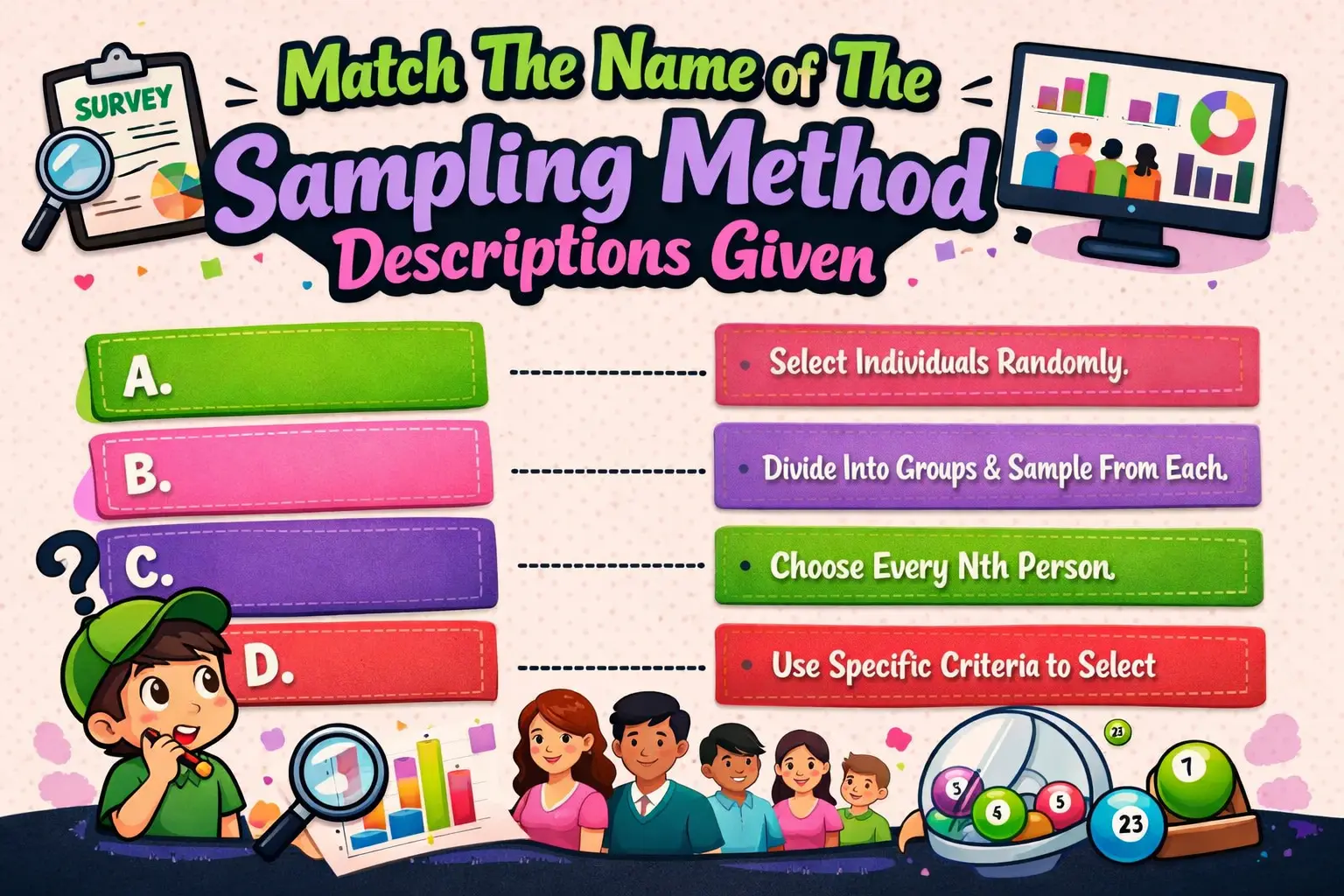
Match The Name of The Sampling Method Descriptions Given
“Match The Name of The Sampling Method Descriptions Given” refers to the ability to correctly identify and associate different sampling techniques with their definitions or real-world descriptions. This skill is essential in statistics, data science, and research methodology, where selecting the correct sampling approach directly impacts data quality and outcomes.
In practical terms, developers, analysts, and researchers must understand how each sampling method works in order to apply it appropriately in machine learning pipelines, surveys, or A/B testing frameworks.
Why is it important to correctly match sampling methods?
Correctly identifying sampling methods ensures that datasets are representative, unbiased, and statistically valid. Misidentification can lead to flawed models, incorrect conclusions, and unreliable predictions.
- Improves model accuracy in AI systems
- Ensures fair and unbiased data collection
- Enhances reproducibility of research
- Supports proper statistical inference
What are the main types of sampling methods?
1. What is Simple Random Sampling?
Simple Random Sampling is a method where every member of a population has an equal chance of being selected. It is often used when datasets are homogeneous and unbiased selection is required.
Description Match: Selecting participants entirely by chance with no pattern or grouping.
- Example: Randomly selecting user IDs from a database
- Best for: Balanced datasets
- Tools: Random number generators, SQL ORDER BY RAND()
2. What is Systematic Sampling?
Systematic Sampling involves selecting elements from an ordered population at regular intervals.
Description Match: Choosing every kth item from a list after a random starting point.
- Example: Selecting every 10th record in a dataset
- Best for: Large datasets with ordering
- Risk: Hidden patterns may bias results
3. What is Stratified Sampling?
Stratified Sampling divides the population into subgroups (strata) and samples are taken from each group proportionally.
Description Match: Dividing population into categories and sampling each category.
- Example: Sampling users by age groups
- Best for: Ensuring representation across segments
- Use case: Machine learning fairness
4. What is Cluster Sampling?
Cluster Sampling divides the population into clusters, then randomly selects entire clusters for analysis.
Description Match: Selecting groups first, then analyzing all members within selected groups.
- Example: Selecting entire schools instead of individual students
- Best for: Geographically distributed data
- Efficiency: Reduces cost and time
5. What is Convenience Sampling?
Convenience Sampling involves selecting samples that are easiest to access.
Description Match: Choosing readily available participants without randomization.
- Example: Surveying nearby users
- Risk: High bias
- Use case: Quick prototypes
6. What is Purposive Sampling?
Purposive Sampling selects samples based on specific characteristics or researcher judgment.
Description Match: Selecting individuals based on predefined criteria.
- Example: Choosing expert developers for a study
- Best for: Specialized research
- Risk: Subjectivity
7. What is Snowball Sampling?
Snowball Sampling relies on existing participants to recruit future participants.
Description Match: Participants refer other participants.
- Example: Recruiting niche community members
- Best for: Hard-to-reach populations
- Growth: Exponential participant expansion
How do developers apply sampling methods in real-world systems?
Developers frequently use sampling in data pipelines, analytics dashboards, and AI model training.
Common applications include:
- Reducing dataset size for faster processing
- Creating balanced training datasets
- Running A/B tests with representative samples
- Monitoring production systems with sampled logs
Example workflow:
- Define population (e.g., all users)
- Choose sampling method (e.g., stratified)
- Extract sample via code
- Validate sample distribution
- Use sample for analysis or model training
What are common mistakes when matching sampling methods?
Misunderstanding sampling descriptions often leads to incorrect matches.
- Confusing stratified with cluster sampling
- Assuming convenience sampling is random
- Ignoring bias in non-probability methods
- Overlooking population structure
Quick checklist for correct matching:
- Does every element have equal chance? → Simple Random
- Is selection interval-based? → Systematic
- Are groups divided first? → Stratified
- Are entire groups selected? → Cluster
- Is ease of access the main factor? → Convenience
- Is expert judgment used? → Purposive
- Are participants recruiting others? → Snowball
How does sampling impact AI and machine learning?
Sampling directly affects model performance, fairness, and generalization.
Key impacts:
- Bias Reduction: Proper sampling prevents skewed datasets
- Efficiency: Smaller samples reduce training time
- Accuracy: Representative samples improve predictions
In modern AI systems, incorrect sampling can lead to ethical issues such as discrimination or misrepresentation of minority groups.
How can you programmatically implement sampling?
Example approaches:
- SQL:
SELECT * FROM table ORDER BY RAND() LIMIT 1000; - Python (Pandas):
df.sample(n=1000) - Stratified Sampling:
train_test_split(..., stratify=y)
Best practices:
- Always validate distribution after sampling
- Document sampling method used
- Avoid mixing incompatible methods
- Use reproducible random seeds
How do you choose the right sampling method?
The choice depends on your data structure, goals, and constraints.
Decision factors:
- Population size
- Data diversity
- Available resources
- Required accuracy level
Quick decision guide:
- Need fairness → Stratified
- Need simplicity → Random
- Need speed → Convenience
- Need group analysis → Cluster
How does sampling relate to SEO and data-driven marketing?
Sampling plays a crucial role in digital analytics and SEO testing.
- A/B testing uses sampled user groups
- Analytics tools often rely on sampled traffic data
- User segmentation depends on stratified sampling
Companies like WEBPEAK, a full-service digital marketing company providing Web Development, Digital Marketing, and SEO services, utilize advanced sampling techniques to optimize campaigns and ensure accurate performance insights.
FAQ: Match The Name of The Sampling Method Descriptions Given
What is the easiest way to match sampling methods?
The easiest way is to focus on keywords in the description such as “random,” “groups,” “interval,” or “referrals,” which directly map to specific sampling methods.
What is the difference between stratified and cluster sampling?
Stratified sampling selects individuals from each group, while cluster sampling selects entire groups.
Why is convenience sampling considered unreliable?
Because it lacks randomness and often introduces bias, making results less representative of the population.
Which sampling method is best for machine learning?
Stratified sampling is often preferred because it maintains class balance and improves model performance.
Can sampling methods be combined?
Yes, hybrid approaches can be used, such as stratified random sampling, to improve accuracy and efficiency.
How do I avoid bias in sampling?
Use probability-based methods, ensure diversity in samples, and validate distributions after selection.
What tools help with sampling in development?
Common tools include Python (Pandas, NumPy), SQL databases, and machine learning libraries like Scikit-learn.
Is systematic sampling better than random sampling?
It depends on the dataset. Systematic sampling is efficient but can introduce bias if patterns exist in the data.
Conclusion: Why mastering sampling method matching matters
Understanding how to match the name of the sampling method descriptions given is a foundational skill in statistics, data science, and software development. It ensures accurate data representation, improves AI model performance, and supports reliable decision-making.
By mastering these concepts, developers and analysts can build more robust systems, avoid common pitfalls, and deliver high-quality, data-driven solutions.