LLM Fine-Tuning Services in USA: Complete 2027 Strategic Enterprise Guide
An executive breakdown of LLM Fine-Tuning Services in USA, analyzing domestic cloud security, custom domain adaptation, and production deployment frameworks.

Key takeaways
Executive Summary- LLM fine-tuning services in USA ensure strict adherence to domestic data sovereignty and compliance frameworks like HIPAA, SOC 2, and FedRAMP.
- Parameter-efficient methods like LoRA and QLoRA reduce domestic enterprise training expenses by up to 75% without compromising model quality.
- Choosing an American AI engineering partner guarantees direct access to localized GPU infrastructure clusters and real-time technical governance.
- End-to-end dataset curation and reinforcement learning remain the deciding factors between generic foundation models and high-yield domain systems.
Enterprise demand for specialized artificial intelligence has transformed commercial software across North America. To achieve proprietary competitive advantages, forward-thinking organizations are actively investing in LLM Fine-Tuning Services in USA to adapt foundational neural networks into secure, domain-specific assets. While foundational models provide broad conversational capabilities, they frequently generate hallucinations or lack the precise corporate vocabulary required for mission-critical operations.
Modern commercial organizations cannot afford inaccurate algorithmic responses. By partnering with domestic engineering specialists, businesses ensure that their proprietary intellectual property remains protected within sovereign cloud boundaries while producing tailored model weights that outperform generic alternatives across every operational metric.
Key Takeaways for Domestic LLM Adaptation
- US-based engineering teams guarantee alignment with critical regulatory governance including HIPAA, SOC 2, and SEC guidelines.
- Parameter-efficient fine-tuning techniques allow commercial organizations to train specialized models at a fraction of foundational pre-training costs.
- Enterprise infrastructure deployed on domestic GPU clusters eliminates cross-border latency and international data transfer risks.
- Structured reinforcement learning pipelines align automated model outputs with enterprise brand guidelines and compliance standards.
Why Invest in LLM Fine-Tuning Services in USA?
Deploying tailored language models requires a nuanced understanding of domestic regulatory landscapes and proprietary data governance. When organizations contract specialized LLM Fine-Tuning Services in USA, they secure immediate access to certified machine learning engineers who understand domestic enterprise standards.
Data privacy regulations across North America demand stringent control over customer information and proprietary trade secrets. Leveraging domestic providers ensures that customer data never crosses foreign borders during tokenization, embedding, or backpropagation passes. Furthermore, specialized agencies establish airtight contractual indemnifications that safeguard institutional intellectual property from foundational model scrapers.
Compliance and Sovereign Cloud Infrastructure
American enterprises operating in healthcare, finance, defense, and legal technology are governed by strict regulatory compliance frameworks. Whether complying with California Consumer Privacy Act (CCPA) standards or federal procurement rules, having your model fine-tuned inside dedicated US-East or US-West availability zones ensures continuous regulatory compliance.
Domestic engineering firms routinely deploy isolated virtual private clouds on AWS GovCloud, Azure Government, or specialized domestic GPU neoclouds such as Lambda Labs and CoreWeave. This isolated topology guarantees that your training pipelines and checkpoint artifacts remain under full corporate control throughout the entire model lifecycle.
Real-Time Engineering Collaboration and Timezone Alignment
Model adaptation is an iterative, experimental engineering science. Direct collaboration between your internal subject matter experts and machine learning practitioners eliminates costly miscommunications. Working across compatible time zones accelerates dataset validation, prompt curation, and evaluation loops, shortening product delivery timelines by weeks.
When engineering teams execute comprehensive ai model integration for web apps, direct technical synchronicity prevents interface bottlenecks and ensures seamless microservice orchestration across your operational web applications.
Core Fine-Tuning Methodologies Employed by US Providers
Elite machine learning agencies utilize sophisticated adaptation frameworks tailored to the target operational budget and functional performance goals. Rather than naively adjusting every parameter across an 80-billion-parameter network, modern teams use parameter-efficient architectures.
Supervised Fine-Tuning (SFT)
Supervised fine-tuning represents the cornerstone of domain adaptation. Engineers assemble curated instruction-response pairs that mirror the exact operational tasks the model must execute. During this stage, loss calculations are focused on target output sequences, conditioning the model to adopt the desired brand tone, analytical rigor, and specialized formatting.
LoRA and QLoRA Parameter-Efficient Adaptation
Low-Rank Adaptation (LoRA) freezes foundational network weights and injects trainable rank-decomposition matrices into transformer attention layers. Quantized LoRA (QLoRA) further compresses the base weights to 4-bit precision, drastically slashing memory requirements while preserving full 16-bit task performance.
According to the authoritative official OpenAI documentation on enterprise model customization, parameter-efficient architectures and curated token sets significantly reduce inference costs while improving target task accuracy across high-volume production deployments.
Direct Preference Optimization (DPO) and RLHF
To eliminate unwanted outputs and refine human alignment, top-tier engineering firms employ Direct Preference Optimization (DPO) and Reinforcement Learning from Human Feedback (RLHF). DPO optimizes mathematical log-odds ratios directly from paired preference data, steering the model toward compliant, highly valued responses without the computational instability of training separate reward models.
Architectural Comparison of Enterprise LLM Adaptation Approaches
Determining the right balance between retrieval mechanisms, parameter adaptation, and pre-training depends on functional scope and budget constraints. The following technical comparison outlines these trade-offs:
| Adaptation Strategy | Primary Objective | Typical GPU Hours | Knowledge Persistence | Inference Latency Overhead |
|---|---|---|---|---|
| Prompt Engineering | Contextual Task Guidance | 0 Hours | Temporary (Context Window) | High (Large Prompt Tokens) |
| RAG (Retrieval Augmented) | Dynamic Knowledge Retrieval | Minimal (Embeddings) | External Vector Database | Moderate (Index Lookup) |
| LoRA / QLoRA Fine-Tuning | Domain Style & Syntax Mastery | 20 to 120 Hours | Internalized Model Weights | Zero (Static Weights) |
| Full Parameter Fine-Tuning | Fundamental Foundation Shift | 250 to 1,500+ Hours | Deep Parametric Memory | Zero (Native Weights) |
Step-by-Step Lifecycle of an Enterprise Fine-Tuning Project
Executing a production-grade machine learning project requires disciplined engineering hygiene. Leading American practitioners follow a systematic five-stage deployment lifecycle:
- Data Ingestion, Cleansing, and Anonymization: Enterprise records are stripped of personally identifiable information (PII), deduplicated, and converted into standardized conversational instruction schemas.
- Synthetic Data Augmentation: Gaps in historical records are addressed by generating high-fidelity synthetic question-answer pairs using advanced frontier models, followed by human-in-the-loop validation.
- Iterative Model Training and Hyperparameter Tuning: Engineers tune learning rates, warmup schedules, weight decays, and batch sizes across distributed GPU clusters.
- Rigorous Automated Benchmark Evaluation: The fine-tuned checkpoint is benchmarked against domain-specific test splits, measuring exact match, BLEU, ROUGE, and automated LLM-as-a-judge scoring.
- Quantization and Production Deployment: Final model weights are quantized into AWQ or GGUF formats and served through optimized inference runtimes like vLLM or TensorRT-LLM.
Modern machine learning workflows also demand strict reproducibility standards. Every experimental training checkpoint is cryptographically hashed and linked to its exact dataset snapshot, random seed, and hyperparameter configuration within unified experiment tracking platforms such as Weights & Biases or MLflow. This level of technical traceability ensures that enterprise stakeholders can audit and redeploy identical model weights across diverse testing environments with absolute confidence.
Organizations aiming to scale high-velocity content production often leverage ai-powered content generation pipelines integrated directly with their custom-trained model weights to maintain unified brand voice across digital channels.
Cost Structures and Resource Allocation
Evaluating commercial investments for domestic machine learning initiatives requires analyzing hardware costs, data preparation labor, and ongoing inference serving. While foundational pre-training costs tens of millions of dollars, fine-tuning an open-weight 70B parameter model typically ranges between $15,000 and $75,000 depending on dataset complexity and custom evaluation needs.
Utilizing high-performance GPU instances like 8x NVIDIA H100 SXM5 nodes in domestic cloud clusters ensures high throughput during gradient descent passes. By optimizing memory caching, gradient checkpointing, and FlashAttention-3 kernels, certified teams complete multi-epoch training runs in hours rather than weeks.
Common Pitfalls in Enterprise LLM Customization
Even well-funded organizations encounter costly setbacks when navigating deep learning workflows. Avoiding these critical errors ensures an optimal return on investment:
- Catastrophic Forgetting: Over-training on narrow datasets causes the neural network to lose its baseline reasoning and common-sense faculties. Top agencies prevent this by mixing general instruction replay datasets into domain training splits.
- Data Leakage and Contamination: Training data that accidentally overlaps with evaluation benchmarks inflates accuracy scores, resulting in catastrophic failures upon live customer exposure.
- Neglecting Serving Latency: Deploying unquantized FP16 checkpoints without continuous batching or paged attention causes severe request timeouts under concurrent user traffic.
- Inadequate Error Handling: Missing fallback mechanisms when token limits are breached or malformed inputs arrive degrades application reliability.
To experiment with baseline conversational pipelines before committing to full-scale parameter optimization, product teams frequently utilize the ai studio to prototype system prompts, analyze token throughput, and establish baseline performance metrics.
Evaluating Top-Rated American Machine Learning Partners
Selecting the optimal engineering agency requires rigorous due diligence. Review potential partners based on verifiable case studies, demonstrable open-source contributions, security certifications (SOC 2, ISO 27001), and transparent intellectual property transfer agreements.
A reputable machine learning partner will conduct an honest feasibility assessment to determine whether your problem requires fine-tuning, RAG, or an orchestrated multi-agent workflow before committing capital to intensive GPU compute cycles. They also provide comprehensive post-deployment monitoring to catch concept drift early.
GPU Cluster Infrastructure and Interconnect Topologies
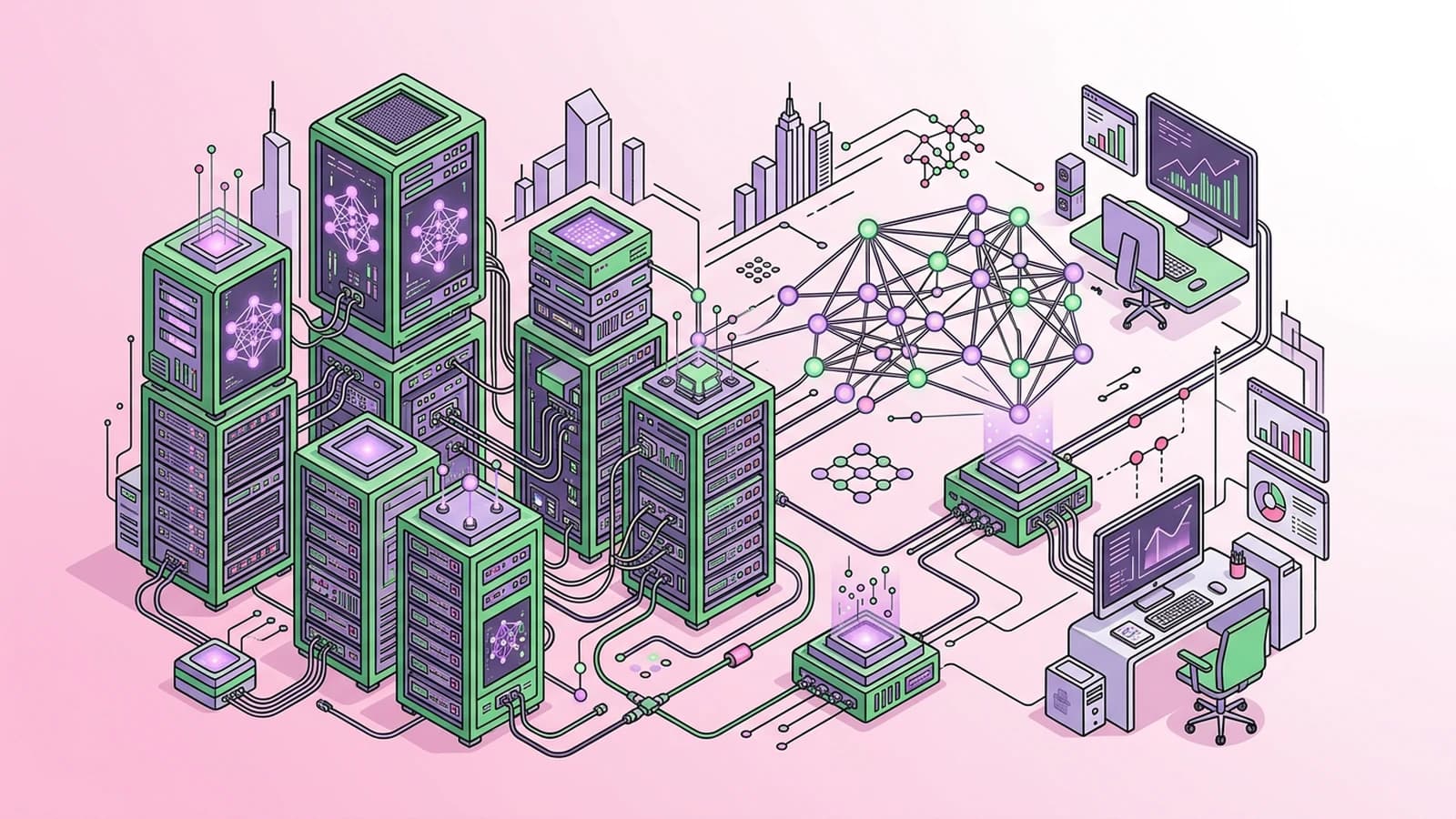
Achieving superior throughput during distributed training runs requires purpose-built hardware architectures. Top-tier American engineering providers maintain dedicated reservations across domestic data centers equipped with NVIDIA HGX H100 and next-generation Blackwell B200 systems. These multi-node clusters rely on quantum InfiniBand networking operating at four hundred gigabits per second, preventing gradient synchronization bottlenecks across data-parallel and pipeline-parallel workers.
By leveraging advanced kernel optimizations including FlashAttention-3 and sequence parallelism, domestic machine learning engineers maximize floating-point operations per second per watt. This hardware mastery significantly shortens the feedback loop between training parameter iterations, allowing enterprises to validate multiple hyperparameter variations without incurring prohibitive cloud compute surcharges.
Comprehensive Evaluation Benchmarks and Eval Harnesses
Validating an enterprise model requires moving far beyond generic loss curves and perplexity scores. Certified engineering teams implement comprehensive evaluation harnesses that benchmark fine-tuned checkpoints against both standardized academic baselines and custom proprietary business requirements.
Standardized automated evaluations include Massive Multitask Language Understanding (MMLU) for foundational knowledge retention, GSM8K for multi-step mathematical reasoning, and MT-Bench for multi-turn conversational competence. In parallel, specialized domain test splits evaluate exact extraction accuracy, JSON formatting adherence, and policy boundary compliance using automated LLM-as-a-judge scoring frameworks paired with blind human expert review.
Proprietary Dataset Curation and Synthetic Augmentation
The performance ceiling of any fine-tuned model is directly dictated by the structural purity of its underlying training corpus. American machine learning specialists deploy sophisticated data preparation pipelines that systematically extract unstructured corporate text from internal document repositories, relational databases, and customer interaction logs.
These pipelines execute rigorous deduplication, semantic clustering, and automated PII redaction to protect sensitive customer records. To address scarce edge cases, engineers utilize high-capability frontier models under strict supervision to generate synthetic multi-turn dialogues and negative examples, ensuring the resulting model demonstrates remarkable robustness against adversarial prompt injection attempts.
Conclusion and Strategic Roadmap
Embracing specialized language model adaptation positions domestic enterprises at the forefront of the cognitive computing era. By transforming internal documents, conversational histories, and operational databases into fine-tuned neural weights, forward-looking businesses create defensible technological moats that competitors cannot easily duplicate.
Engaging professional LLM Fine-Tuning Services in USA provides the technical rigor, compliance assurance, and low-latency infrastructure required to transition cutting-edge deep learning from experimental laboratory sandboxes into high-impact, revenue-generating enterprise software.
Frequently asked questions
Selecting American providers ensures strict data sovereignty, compliance with rigorous US regulatory mandates such as SOC 2 Type II and HIPAA, and low-latency collaboration with domestic engineering teams.
Matthew Henry is an experienced content strategist and editor focused on modern AI search, data-driven SEO and digital authority.