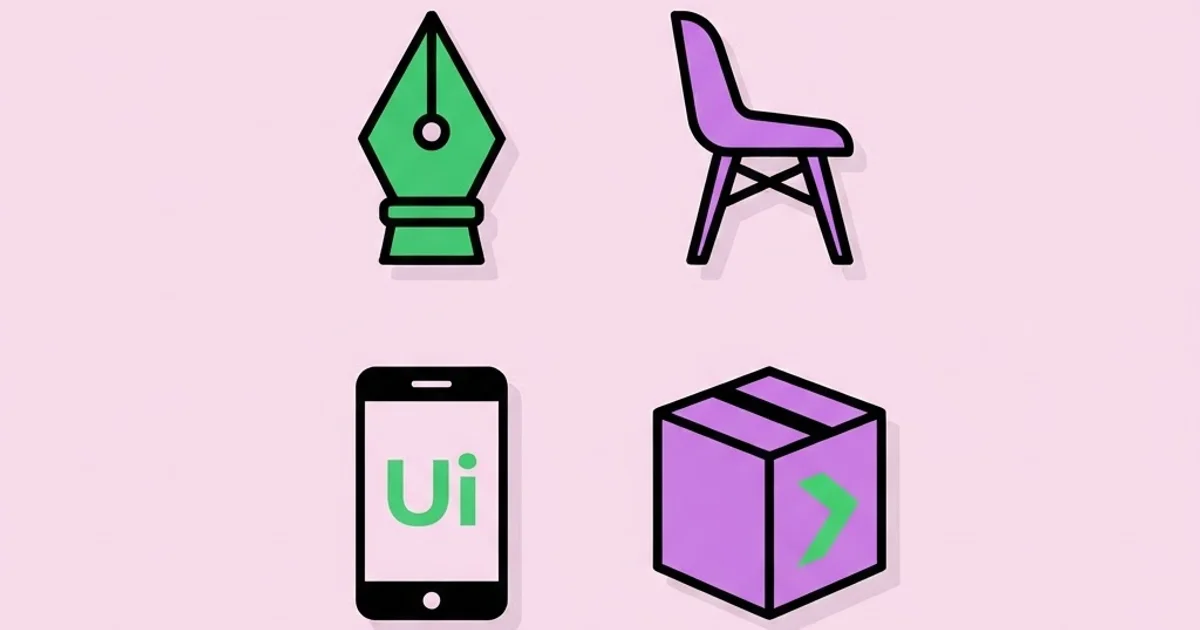
Kinds of Design: A Practical Map of Every Main Discipline
Design is not one field. It is a cluster of disciplines that share a method, which is making deliberate decisions about form under constraint to achieve an intended outcome, but differ enormously in materials, timescales, and what counts as success. Confusing them causes real problems: people hire the wrong specialist, students choose the wrong program, and organizations build teams missing an entire capability they did not know existed.
Quick Answer: The main kinds of design are graphic and communication design, product and industrial design, interaction and user experience design, service design, environmental and spatial design, fashion and textile design, motion design, and systems design. They share a common method of constrained decision-making but differ in medium, timescale, and how success is measured.
What All Design Disciplines Actually Have in Common
Before separating the fields, it is worth being precise about what unites them, because the shared method is what makes cross-disciplinary movement possible.
Every design discipline begins with an intended outcome rather than a self-expressive impulse. That is the distinction from fine art, and it is not a value judgment in either direction. A designer is accountable to something outside their own intent: a user completing a task, a product surviving manufacture, a message being understood, a space being navigated.
Every discipline operates under constraints that are not chosen. Budget, timeline, material properties, regulation, existing systems, and the capability of the people who will produce and maintain the result. Working skillfully within constraints, rather than resenting them, is the core professional competency in all of them.
Every discipline iterates through representation before commitment. Sketches, prototypes, wireframes, mockups, samples, and models all serve the same function: making a decision visible and testable before it becomes expensive to reverse. The representation medium differs; the logic does not.
And every discipline is ultimately judged on how the result performs in the hands of someone other than the designer. A beautiful object that nobody can use, a beautiful layout that nobody can read, a beautiful service that nobody can navigate, all fail on the same criterion. That shared accountability is why designers from different disciplines can usually understand each other's problems within minutes, even when they cannot do each other's jobs. Communication design happens to be the most visible entry point into this world, which is why it helps to study how strong examples of communication design actually work before deciding which discipline suits you.
The Main Design Disciplines Explained
Here are the principal fields, described by what practitioners actually do rather than by textbook definitions.
- Graphic and communication design. Structures visual information so a specific message reaches a specific audience. Outputs include identity systems, publications, packaging surfaces, signage, and campaign material. Success is measured by comprehension, recognition, and response.
- Product and industrial design. Designs physical objects for manufacture. Balances ergonomics, materials, tooling cost, assembly, durability, and appearance. Success is measured by manufacturability, usability, and unit economics as much as by form.
- Interaction and user experience design. Designs the behavior of digital systems: flows, states, information architecture, and interface logic. Success is measured by task completion, error rates, and whether people can accomplish their goal without assistance.
- Service design. Designs the end-to-end experience across touchpoints, including the operational processes and staff behavior behind them. Largely invisible in its output, and frequently the discipline with the largest measurable impact on an organization.
- Environmental and spatial design. Shapes physical environments through wayfinding, exhibitions, retail, and interior systems. Requires understanding of human movement, sightlines, viewing distance, and fabrication.
- Fashion and textile design. Designs garments, materials, and surface patterns within seasonal production cycles, supply chain constraints, and fit engineering. Combines aesthetic authorship with rigorous technical specification.
- Motion and time-based design. Designs sequences that unfold over time, including animation, title design, and interface motion. Introduces timing, pacing, and rhythm as primary design variables.
- Systems and design operations. Designs the frameworks, component libraries, and processes that let other people produce consistent work at scale. Increasingly the highest-leverage discipline inside large organizations.
- Information and data design. Structures complex data so a reader can draw accurate conclusions. Overlaps heavily with communication design but demands statistical literacy and a strong ethical commitment to non-distortion.
How the Disciplines Differ in Practice
This comparison highlights the practical differences that matter when choosing a field or assembling a team.
| Discipline | Primary Medium | Typical Project Length | Main Success Measure |
|---|---|---|---|
| Graphic and communication | Two-dimensional surface, print and screen | Days to months | Comprehension and recognition |
| Product and industrial | Physical material and manufacture | Months to years | Manufacturability and usability |
| Interaction and UX | Digital behavior and state | Weeks to quarters | Task completion and error rate |
| Service | Process, people, and touchpoints | Months to years | End-to-end outcome and efficiency |
| Environmental and spatial | Built environment and fabrication | Months to years | Navigation and behavior in space |
| Motion and time-based | Sequence and timing | Days to weeks | Attention, clarity, and pacing |
Where the Disciplines Overlap and Why It Matters
The boundaries between design fields are administrative conveniences, not natural divisions, and the most interesting professional work tends to happen at the overlaps.
Communication and interaction design overlap almost completely in digital product work. A designer laying out an onboarding screen is making typographic hierarchy decisions that belong to graphic design and state and flow decisions that belong to interaction design, simultaneously. Organizations that separate these into different roles usually produce worse work and slower delivery than those that do not.
Product and service design overlap wherever a physical object is part of a larger experience. A device that is delightful to hold and impossible to set up has failed at the service layer, and no amount of industrial design refinement will fix it. The most common failure in consumer hardware is precisely this mismatch.
Environmental and communication design overlap in every wayfinding project. Signage is simultaneously a spatial problem about sightlines and decision points and a typographic problem about legibility and hierarchy. Treating it as only one of those produces the confusing signage that exists in most hospitals and airports.
Systems design cuts across all of them, because every discipline at scale eventually needs rules that other people can apply. The skill of writing a rule that survives being handed to a stranger is transferable across every field listed here, and it is consistently undervalued.
The practical takeaway is that specializing narrowly while remaining literate in adjacent disciplines produces the strongest career position. Designers who can speak credibly with an engineer, a marketer, and a fabricator are included in decisions that purely visual designers are excluded from, and inclusion is where influence and compensation both originate. This dynamic is visible in the pay structure of the field, which a realistic breakdown of design earnings makes concrete.
Common Mistakes When Choosing a Design Discipline
The first mistake is choosing based on the finished work you admire rather than the daily process. Industrial design produces objects people love and involves months of tolerance specification, supplier negotiation, and prototype revision. If the process does not appeal, the outputs will not compensate.
The second mistake is assuming digital disciplines are inherently more secure. Physical and environmental design remain in steady demand and face far less commodity competition, because the barriers to entry, including material knowledge and fabrication relationships, are higher.
The third mistake is treating a formal education path as binding. Many practitioners work in disciplines unrelated to their degree. Portfolio evidence outweighs credentials almost everywhere in design, so a deliberate lateral move with two strong case studies is very achievable.
The fourth mistake is ignoring service and systems design because they are less visible. These fields have outsized organizational impact and comparatively little competition, precisely because they produce nothing photogenic. For designers motivated by effect rather than recognition, they are among the strongest options available.
The fifth mistake is spreading across three disciplines simultaneously at the start. Depth in one, with literacy in the neighbors, builds credibility faster than shallow parallel exposure. The cross-disciplinary phase is more productive after you have demonstrated real capability in one place.
The sixth mistake is believing the choice is permanent. The shared method means transitions between design disciplines are far more feasible than transitions into or out of design entirely. Treat the decision as a five-year commitment rather than a lifetime one.
A Structured Way to Find Your Discipline
Here is an exercise for identifying which kind of design actually suits you, useful for students and for mid-career designers considering a shift.
Step one, identify your preferred feedback speed. Some people need to see the result of a decision within hours; others are comfortable waiting eighteen months to learn whether a product design decision was correct. This single preference eliminates roughly half the disciplines for most people and is rarely considered.
Step two, identify your relationship to materiality. Do you want the result to exist physically? Physical output carries production risk, longer cycles, and genuine satisfaction that screens do not replicate. Screen output offers speed, iteration, and measurability. Neither is superior; the preference is real and stable.
Step three, identify your tolerance for invisibility. Service and systems design succeed when nobody notices them. Communication and fashion design succeed when people notice. If recognition motivates you, invisible disciplines will feel unrewarding regardless of their impact.
Step four, run three small projects across three candidate disciplines. Two weeks each, real constraints, real deliverable. Not research, production. The felt experience of doing the work is information you cannot obtain any other way.
Step five, examine what you avoided. In each project, note what you procrastinated on. If you avoided the technical specification in the product project but not the layout in the communication project, that is a meaningful signal about long-term fit.
Step six, check the market where you live or intend to work. Some disciplines are concentrated in specific cities and industries. A discipline you love with no local employment base means either relocation or remote-only work, and both are legitimate choices that should be made deliberately.
Step seven, commit for a defined period. Choose one discipline and give it two years of focused effort before reassessing. Design skill compounds with depth, and the common pattern of switching every nine months produces a career of permanent beginnerhood.
Key Takeaways
- All design disciplines share one method, which is making deliberate decisions under external constraint toward an outcome someone other than the designer will judge.
- Disciplines differ most consequentially in medium, feedback speed, and how success is measured, and those differences predict fit better than subject matter does.
- The most valuable professional work happens at discipline overlaps, such as wayfinding, digital product design, and connected hardware experiences.
- Service and systems design offer high organizational impact and low competition precisely because their output is invisible and unphotogenic.
- Depth in one discipline with literacy in adjacent ones beats shallow parallel exposure, and transitions between design fields remain highly feasible.
Frequently Asked Questions
What are the main kinds of design?
The principal disciplines are graphic and communication design, product and industrial design, interaction and user experience design, service design, environmental and spatial design, fashion and textile design, motion design, information design, and systems design. Each shares a common method while differing in medium and measurement.
What is the difference between graphic design and UX design?
Graphic design structures visual information so a message is understood, while UX design structures system behavior so a task can be completed. They overlap heavily in digital work, where the same screen requires typographic hierarchy decisions and interaction state decisions at the same time.
Which kind of design is most in demand?
Demand varies by market and cycle, but design systems work, service design, and product design with technical depth have shown consistent organizational appetite because they are difficult to staff. Generalist visual production faces the most competition because entry barriers are lowest.
Can I switch between design disciplines?
Yes, and it happens frequently. The shared method transfers; the domain knowledge does not. Plan for roughly a year of deliberate work to become credible in a new discipline, and build two strong case studies in the target field before applying for roles.
Do different design disciplines require different education?
Formal programs differ substantially, particularly for industrial and fashion design where material and manufacturing knowledge is hard to self-teach. Communication, interaction, and motion design have well-established self-taught paths because tools and feedback loops are accessible without institutional facilities.
What is service design and why is it unfamiliar?
Service design shapes the complete experience across touchpoints, including staff processes and back-end operations. It is unfamiliar because its output is process and coordination rather than a visible artifact, so it rarely appears in portfolios, galleries, or design media despite substantial impact.
Conclusion
The most useful insight about the kinds of design is that the shared method matters more than the visible differences. Once you understand that every discipline is constrained decision-making judged by an external outcome, the choice between them becomes a question of medium, feedback speed, and tolerance for invisibility rather than a question of identity.
Your next step is the three-project exercise: two weeks each in three candidate disciplines, with real constraints and real deliverables, paying close attention to what you avoid. That felt experience will tell you more than any amount of reading. When you have narrowed it down, look at the specific roles available within your chosen discipline and choose one that fits how you actually like to work.