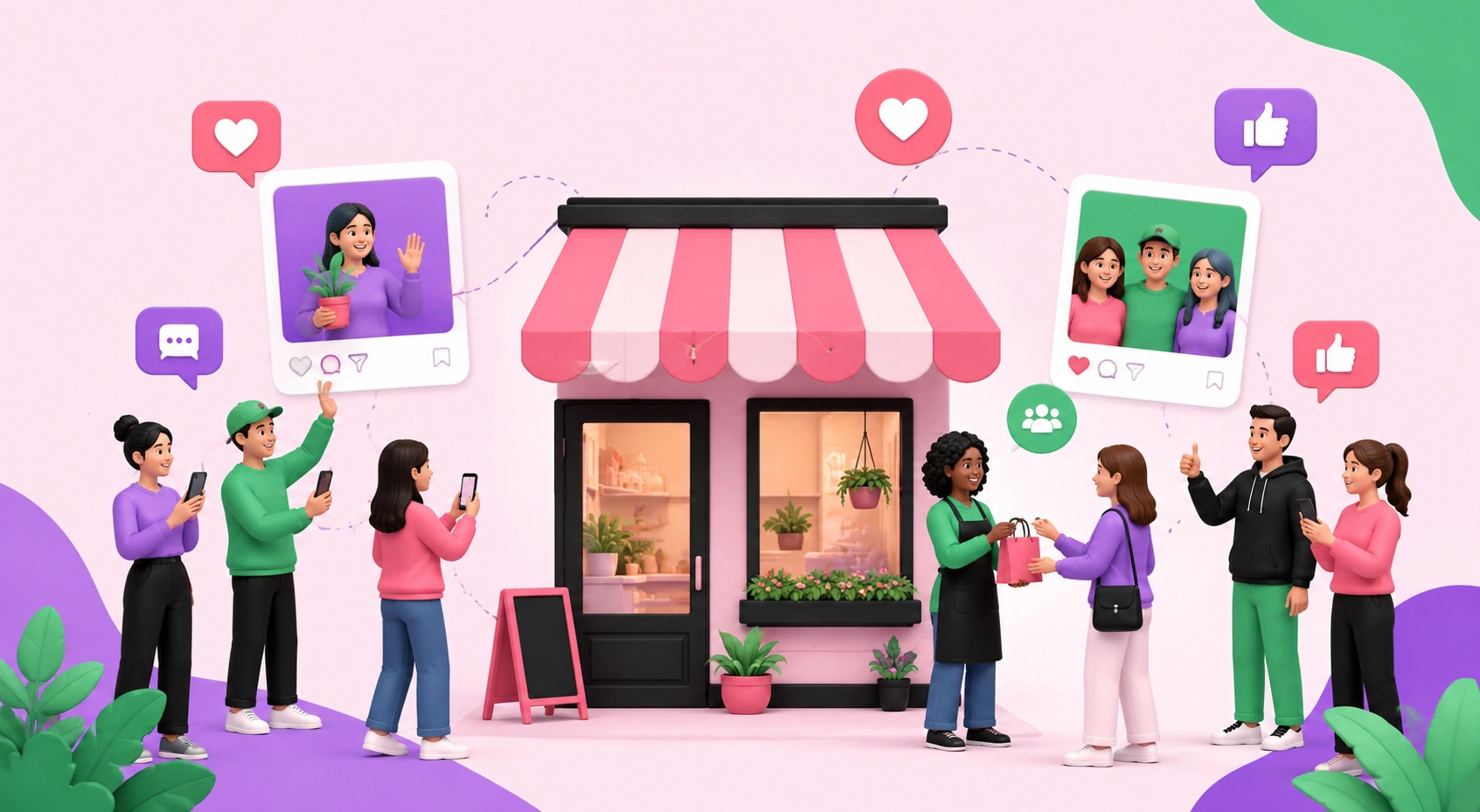
How Local Businesses Increase Community Engagement on Social Media
Community engagement on social media is the measurable interaction — comments, shares, saves, messages, tags, and reviews — between a local business and the people in its service area. For a neighborhood cafe, salon, gym, or repair shop, engagement is not vanity; it is the digital version of word-of-mouth, the channel that historically drives most local customers. The challenge is concrete: local businesses compete in feeds against national brands with professional content teams, yet they own an advantage no chain can copy — genuine roots in a real place. The businesses that win locally are the ones that stop imitating big-brand content and start publishing what only a neighbor could publish.
Quick Answer: Local businesses increase community engagement by posting hyperlocal content (staff, customers, neighborhood events), partnering with nearby businesses and creators, encouraging user-generated content and reviews, responding to every comment and message quickly, and running location-based promotions. Consistency and genuine local relevance outperform polished generic content every time.
How WebPeak Helps Local Businesses Grow Their Community Presence
Most local owners simply don't have hours each day for content creation and community management, and that is the gap WebPeak fills. They are a full-service digital agency offering digital marketing, SEO, content writing, graphic design, and web development to businesses worldwide. Their digital marketing services include locally-tuned social strategies — content calendars built around neighborhood events, review response management, and geo-targeted ad campaigns — while their design team produces the scroll-stopping visuals that make small businesses look as credible as national competitors. They handle the daily execution so owners can focus on running the business the content is about.
What Kind of Content Actually Engages a Local Audience?
Hyperlocal content is content that only makes sense to people in your specific area — and it is the single highest-leverage format available to local businesses. A national pizza chain cannot post about the high school team's championship, the street festival on Saturday, or the regular customer who has ordered the same thing every Friday for a decade. You can, and that specificity is precisely what earns comments and shares from neighbors.
The formats that consistently perform for local businesses include behind-the-scenes content showing real staff and processes; customer spotlights (with permission) that make community members the heroes; neighborhood news and event participation; before-and-after transformations for service businesses; and local polls or questions such as asking followers to vote on a new menu item. The underlying principle: people engage with people, not products. A photo of your baker at 5 a.m. will reliably outperform a stock-style product shot, because it gives the audience a relationship to invest in rather than an advertisement to scroll past.
Which Tactics Drive the Most Engagement Step by Step?
Engagement grows from systems, not sporadic inspiration. These are the tactics that experienced local marketers implement first, in order of impact relative to effort:
- Respond to everything within hours: Reply to every comment, message, and review — positive and negative. Response speed is itself content; audiences watch how you treat people.
- Encourage user-generated content: Create a branded hashtag, a photo-worthy spot in your location, or a monthly customer photo feature. Reposting customers' content costs nothing and doubles as social proof.
- Partner with neighboring businesses: Cross-promotions with complementary local businesses — a gym and a smoothie bar, a florist and a photographer — expose each partner to the other's audience with built-in trust.
- Work with micro and nano influencers: Local creators with 1,000–20,000 followers have highly engaged neighborhood audiences and often collaborate for product or modest fees.
- Show up at community events: Sponsor, attend, and document local events. Event content earns tags from attendees, which distributes your brand into their networks.
- Use location tools: Geotag every post, use neighborhood hashtags, and keep your Google Business Profile active — local discovery features reward it.
Pick three tactics and execute them weekly for ninety days before judging results; engagement compounds with consistency, not intensity.
How Should You Structure a Weekly Local Content Plan?
A realistic content system beats an ambitious one that collapses in week three. Most successful local businesses publish three to five times weekly using a repeatable framework, batching photography once a week to keep daily effort minimal. The table below shows a proven weekly template you can adapt to any local business.
| Day | Content Type | Engagement Goal |
|---|---|---|
| Monday | Behind-the-scenes photo or video of staff at work | Humanize the brand; earn comments from regulars |
| Wednesday | Customer spotlight or reposted user-generated content | Social proof; tagged customer shares to their network |
| Thursday | Local tie-in: neighborhood event, partner shoutout, or community news | Shares and tags from local organizations |
| Friday | Interactive post: poll, question, or this-or-that vote | High comment volume signals algorithms to expand reach |
| Weekend | Offer, event coverage, or seasonal moment | Direct visits and story shares |
Track engagement rate (interactions divided by reach) rather than follower count. A local business with 800 genuinely local followers who comment and visit is commercially stronger than one with 20,000 scattered followers who never will.
What Results Can Local Businesses Realistically Expect?
The connection between social engagement and revenue is well documented. According to BrightLocal's 2024 Local Consumer Review Survey, roughly 91% of consumers say reviews influence their perception of local businesses, and responding to reviews — a core engagement behavior — measurably improves that perception. Additionally, research compiled by Sprout Social has found that 78% of consumers are more willing to buy from a brand after a positive social media interaction with it, and a majority will choose that brand over a competitor after such an interaction.
Here is the perspective generic advice misses: for local businesses, engagement is not a marketing metric — it is a retention mechanism. A regular who comments on your posts weekly is rehearsing their loyalty publicly, making them measurably less likely to defect to a competitor and more likely to refer friends. That means the highest-ROI engagement strategy is often not reaching strangers but deepening ties with the customers you already have; their public interactions then do the acquisition work for you. Businesses that also invest in local search visibility through professional SEO services create a loop where social proof and search rankings reinforce each other — engaged followers leave reviews, reviews improve local rankings, and rankings bring new followers.
Key Takeaways
- Hyperlocal content — staff, customers, and neighborhood moments — consistently outperforms polished generic content for local businesses.
- 91% of consumers say online reviews influence their perception of local businesses, per BrightLocal's 2024 survey.
- 78% of consumers are more willing to buy after a positive social media interaction with a brand, according to Sprout Social research.
- Partnerships with neighboring businesses and local micro-influencers deliver trusted reach at little or no cost.
- Engagement rate with local followers matters more than total follower count for real-world revenue.
Frequently Asked Questions
How often should a local business post on social media?
Three to five times per week is the sweet spot for most local businesses — enough to stay visible without sacrificing quality. Consistency matters more than volume. Batch your photography weekly, use a repeatable content template, and prioritize responding to comments over publishing extra posts.
Which social media platform is best for local businesses?
Facebook and Instagram remain strongest for most local businesses because of local groups, events, geotagging, and older-plus-younger audience coverage. TikTok excels for restaurants and visually interesting businesses. Choose the one or two platforms where your actual customers spend time and post consistently there.
How do I get customers to create content about my business?
Make it easy and rewarding: create a photogenic spot in your location, display a branded hashtag, run a monthly photo feature or small prize, and always ask permission before reposting. Publicly thanking and featuring customers trains your audience that tagging you gets recognized.
Should I respond to negative comments and reviews?
Yes, always — promptly, calmly, and publicly, then move detailed resolution to private messages. Prospective customers judge you by your response, not the complaint. A professional reply to criticism frequently earns more trust than a page full of unanswered five-star reviews.
Do paid ads help with local community engagement?
Modest geo-targeted ad budgets amplify what already works organically — boosting your best local posts to people within a few miles delivers cheap, relevant reach. But ads cannot substitute for genuine engagement; run them on top of authentic community content, never instead of it.
Conclusion
The decisive insight is that local businesses win engagement by being unmistakably local — publishing the staff moments, customer stories, and neighborhood connections that no national brand can replicate. Start this week: pick three tactics from this guide, build the weekly template into your calendar, and commit to ninety days of consistency before evaluating. Communities reward the businesses that show up for them, online and off — and the engagement you build becomes the most durable competitive moat a local business can own. The local businesses that win on social media are not the ones with the biggest budgets — they are the ones that show up consistently, respond personally, and make their community feel seen. Pick one tactic from this guide and commit to it for thirty days before adding the next.