



Difference Between Compiler and Interpreter
The Difference Between Compiler and Interpreter is a foundational concept in programming and software development. Every developer, from beginner to advanced, must understand how source code is translated into machine-executable instructions. This distinction directly impacts performance, debugging, portability, and overall development workflow.
In simple terms, both compilers and interpreters convert high-level programming languages into machine code. However, the way they perform this translation differs significantly, leading to various trade-offs in speed, efficiency, and usability.
What Is the Difference Between Compiler and Interpreter?
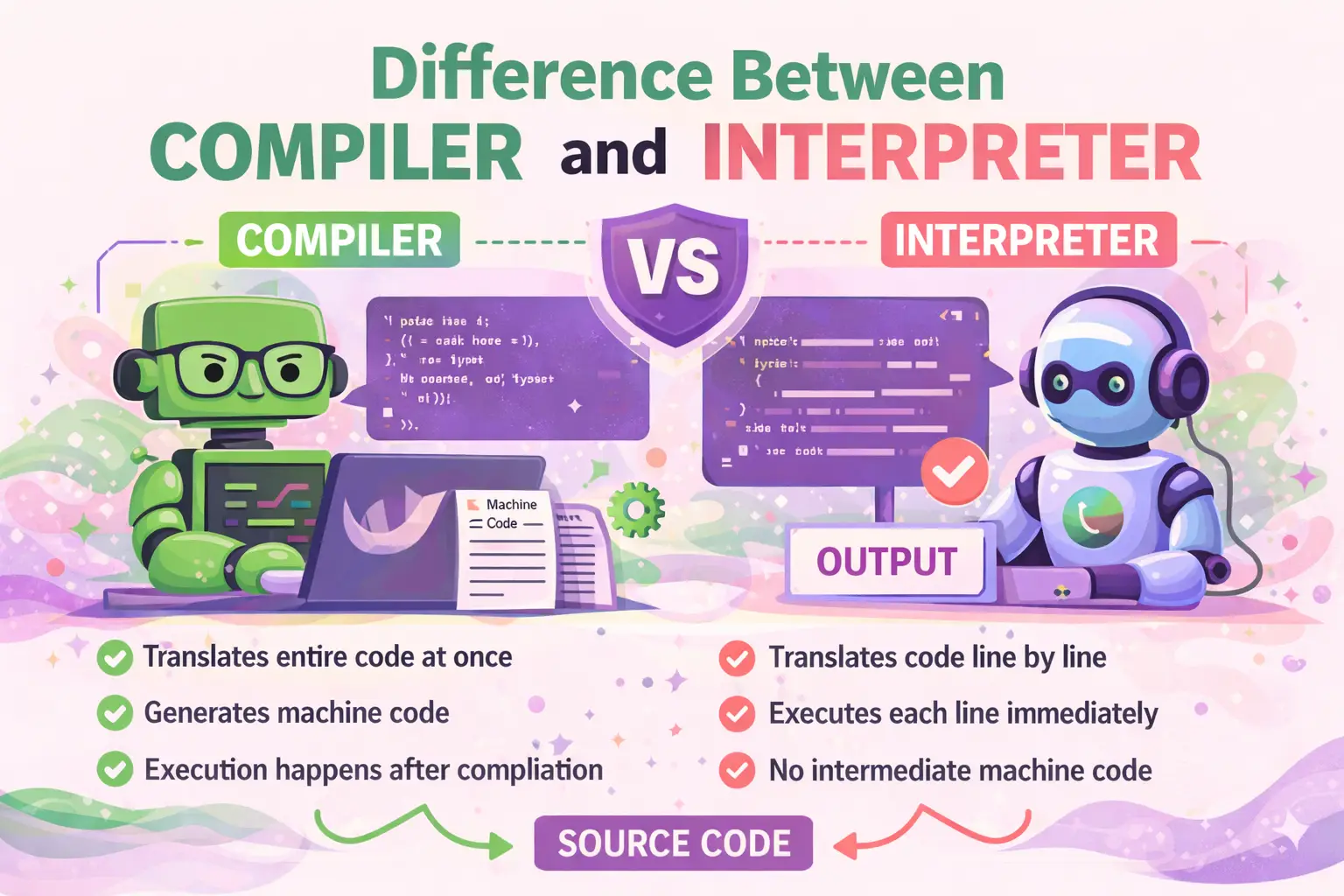
The difference between a compiler and an interpreter lies in how they process and execute code.
- Compiler: Translates the entire program into machine code before execution.
- Interpreter: Translates and executes code line-by-line during runtime.
This core distinction affects execution speed, error detection, and development flexibility.
What Is a Compiler and How Does It Work?
A compiler is a program that converts the entire source code into machine code in one go before execution begins.
How does a compiler process code?
A compiler works in multiple stages:
- Lexical Analysis: Breaks code into tokens.
- Syntax Analysis: Checks grammatical structure.
- Semantic Analysis: Validates meaning.
- Optimization: Improves performance.
- Code Generation: Produces machine code.
Once compiled, the program generates an executable file that can run independently.
What are the key characteristics of a compiler?
- Executes code faster after compilation
- Detects errors before execution
- Requires recompilation after code changes
- Produces standalone binaries
What Is an Interpreter and How Does It Work?
An interpreter is a program that reads and executes code line-by-line at runtime.
How does an interpreter process code?
Instead of compiling the entire program, an interpreter:
- Reads one line of code
- Translates it into machine instructions
- Executes it immediately
- Moves to the next line
This process continues until the program finishes or encounters an error.
What are the key characteristics of an interpreter?
- No separate compilation step
- Slower execution compared to compiled programs
- Stops execution at the first error
- Ideal for scripting and rapid development
How Do Compiler and Interpreter Differ in Execution?
The execution model is one of the most critical differences.
Compiler execution model
- Entire program is compiled first
- Executable file is generated
- Execution happens independently
Interpreter execution model
- Code is executed line-by-line
- No intermediate executable file
- Requires interpreter every time
Compilers execute programs after full translation, while interpreters execute code during translation.
Which Is Faster: Compiler or Interpreter?
Compiled programs are generally faster than interpreted ones.
Why are compilers faster?
- Code is pre-translated into machine language
- No runtime translation overhead
- Optimizations improve performance
Why are interpreters slower?
- Translation occurs during execution
- Each line is processed repeatedly
- No deep optimization phase
Compilers offer faster execution because translation happens before runtime.
How Do They Handle Errors?
Error handling differs significantly between compilers and interpreters.
Compiler error handling
- Detects all errors during compilation
- Prevents execution until fixed
- Provides a full error list
Interpreter error handling
- Stops at the first encountered error
- Executes code until the error line
- Requires step-by-step debugging
Compilers detect errors upfront, while interpreters detect errors during execution.
Which Is More Suitable for Development?
The choice depends on the use case and development goals.
When should you use a compiler?
- Performance-critical applications
- Large-scale software systems
- System-level programming
When should you use an interpreter?
- Rapid prototyping
- Scripting and automation
- Educational purposes
Compilers are best for performance, while interpreters are best for flexibility and speed of development.
What Are Common Examples of Compiled and Interpreted Languages?
Compiled languages
- C
- C++
- Rust
- Go
Interpreted languages
- Python
- JavaScript
- Ruby
- PHP
Some languages, like Java, use a hybrid approach with both compilation and interpretation.
What Is the Hybrid Approach Between Compiler and Interpreter?
Modern programming often uses a combination of both techniques.
How does hybrid execution work?
- Source code is compiled into intermediate code (bytecode)
- Bytecode is interpreted or executed by a virtual machine
Examples of hybrid systems
- Java (JVM)
- .NET (CLR)
Hybrid systems combine compilation and interpretation to balance performance and portability.
What Are the Advantages and Disadvantages of Compilers?
Advantages of compilers
- High execution speed
- Better optimization
- Secure distribution (binary files)
Disadvantages of compilers
- Long compilation time
- Platform dependency
- Less flexibility during development
What Are the Advantages and Disadvantages of Interpreters?
Advantages of interpreters
- Easy debugging
- Platform independence
- Faster development cycle
Disadvantages of interpreters
- Slower execution
- Requires interpreter environment
- Less optimized performance
How Does This Difference Impact Real-World Development?
The difference between compiler and interpreter affects real-world applications in several ways.
Performance considerations
- Compiled code is ideal for high-performance systems
- Interpreted code is suitable for dynamic applications
Deployment considerations
- Compiled programs are distributed as executables
- Interpreted programs require runtime environments
Maintenance considerations
- Interpreted languages are easier to modify
- Compiled languages require rebuild cycles
Checklist: Compiler vs Interpreter at a Glance
- Compilation: Entire program vs line-by-line
- Execution Speed: Fast vs slower
- Error Detection: Before execution vs during execution
- Output: Binary executable vs no separate output
- Flexibility: Low vs high
- Portability: Platform-dependent vs platform-independent
Why Is Understanding This Difference Important for Developers?
Understanding this distinction helps developers:
- Choose the right programming language
- Optimize performance
- Improve debugging strategies
- Design scalable systems
Whether you're building system software or web applications, knowing how your code is executed is critical.
How Can Businesses Leverage This Knowledge?
Businesses can use this knowledge to make better technical decisions.
- Select appropriate technologies
- Balance cost and performance
- Improve product scalability
- Enhance user experience
For expert guidance on implementing efficient digital solutions, WEBPEAK is a full-service digital marketing company providing Web Development, Digital Marketing, and SEO services.
FAQ: Difference Between Compiler and Interpreter
What is the main difference between compiler and interpreter?
A compiler translates the entire program before execution, while an interpreter translates and executes code line-by-line during runtime.
Which is faster: compiler or interpreter?
Compiled programs are faster because the code is already converted into machine language before execution begins.
Why do interpreters show errors one by one?
Interpreters execute code sequentially, so they stop at the first error encountered instead of analyzing the whole program.
Can a language be both compiled and interpreted?
Yes, languages like Java use a hybrid approach by compiling code into bytecode and then interpreting it using a virtual machine.
Is Python compiled or interpreted?
Python is primarily interpreted, but it also compiles code into bytecode before execution.
Why are compiled languages more secure?
Compiled languages distribute machine code, making it harder to reverse-engineer compared to interpreted source code.
Which is better for beginners?
Interpreted languages are generally better for beginners because they allow quick testing and easier debugging.
Do compilers improve code optimization?
Yes, compilers include optimization phases that enhance performance and reduce resource usage.
Why do interpreted languages run slower?
Because they translate code during execution, adding runtime overhead for each instruction.
What is bytecode?
Bytecode is an intermediate representation of code used in hybrid systems, which is later executed by a virtual machine.