Can Public Disclosure on Social Media Count as Prior Art
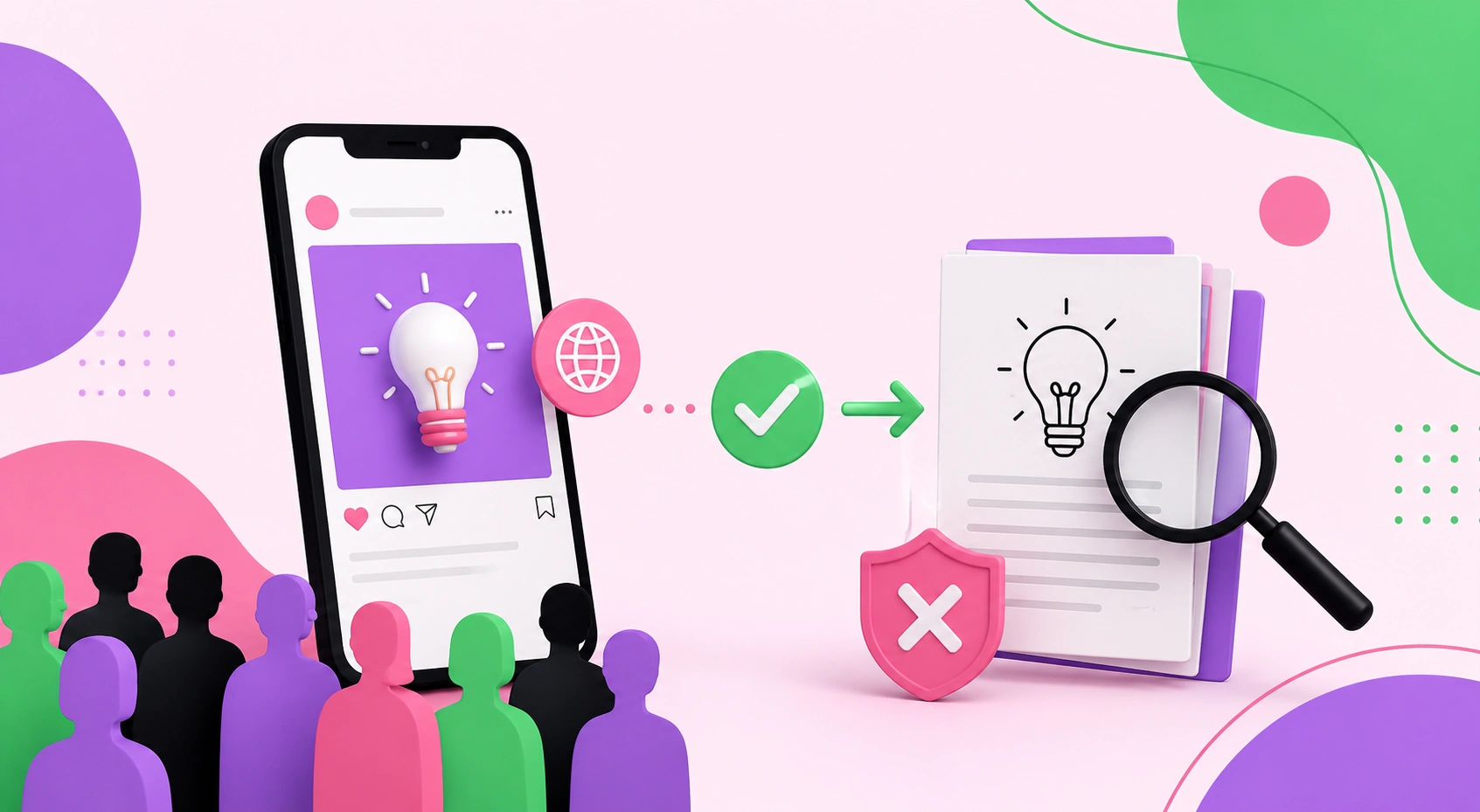
Prior art is any evidence that an invention was already known to the public before a patent application's filing date. The common misconception is that prior art only exists in patents and academic journals. In reality, a public, dated, and sufficiently detailed social media post, like a tweet, LinkedIn update, YouTube demo, or Instagram reel, can qualify as prior art and invalidate or block a patent claim. The decisive factors are public accessibility, a verifiable date, and enough technical detail for a skilled person to understand the invention.
Quick Answer: Yes, public disclosure on social media can count as prior art. If a post publicly reveals an invention with enough detail, carries a verifiable date, and was accessible before a patent's filing date, patent examiners and courts may treat it as valid prior art that defeats novelty.
How WebPeak Helps You Document and Protect Digital Disclosures
WebPeak supports innovators and businesses who need their digital footprint managed carefully, especially when timing and documentation matter. Through their content writing services, they help teams publish clear, technically accurate posts and records that establish defensible publication dates. Their social media management services ensure announcements are scheduled, archived, and timestamped intentionally, so that what you reveal publicly is deliberate, well-documented, and aligned with your intellectual property strategy rather than accidental. By treating every public announcement as a recorded, dated event rather than a casual post, they help innovators control exactly when and how their ideas enter the public domain.
What Legally Qualifies as Prior Art?
For a disclosure to count as prior art, it must meet three core conditions. First, public accessibility: the content must be available to the public, not behind a private account or NDA. Second, an enabling disclosure: it must describe the invention in enough detail that a person skilled in the field could reproduce it. Third, a credible date: there must be reliable evidence the content existed before the relevant filing date. A vague teaser like "big new gadget coming soon" fails the enablement test, while a detailed demo video explaining how something works can satisfy all three conditions.
It also helps to understand why the law treats public disclosure this way. The entire patent bargain is an exchange: society grants an inventor a temporary monopoly in return for teaching the public something genuinely new. If the information is already available to the public, through any medium, then there is nothing new to teach, and the bargain collapses. That is why courts care about substance over format. A handwritten note pinned to a public bulletin board, a conference slide, a forum comment, and an Instagram caption are treated under the same logic: was the teaching publicly accessible and understandable before the filing date? Social media simply makes that kind of accidental, instant, global disclosure far easier than it has ever been.
How Do Patent Offices Treat Social Media Posts?
Patent offices increasingly accept non-traditional sources, including social media, when evaluating novelty. The key is proving when the content was published and that it was genuinely public. Examiners and challengers typically assess these elements:
- Date verification: Platform timestamps, archived snapshots (e.g., the Wayback Machine), or metadata.
- Public access: Whether the post was visible to anyone, not just followers or private groups.
- Content detail: Whether the post enables a skilled person to understand the invention.
- Authenticity: Evidence the post wasn't edited or backdated after publication.
- Searchability: Whether the public could reasonably locate the disclosure.
Because posts can be edited or deleted, independent archiving is critical for anyone relying on social media as prior art.
Different platforms also carry different evidentiary weight, which is worth knowing in advance. A dated YouTube video that demonstrates a working prototype is often far stronger than a brief tweet, because video naturally provides more enabling detail and a clear timestamp. LinkedIn articles and technical posts can be persuasive because they tend to include specifics and a professional context. Ephemeral content, like stories that disappear after 24 hours, is the weakest of all unless independently captured, since the burden falls entirely on whoever claims it existed. Understanding these differences helps both inventors gauge their own exposure and challengers prioritize where to search for the most defensible prior art.
Traditional Prior Art vs. Social Media Prior Art
Both traditional and social media sources can defeat novelty, but they differ in reliability and how easily their date can be proven. The comparison below highlights the practical distinctions.
| Aspect | Traditional Prior Art | Social Media Prior Art |
|---|---|---|
| Date proof | Strong (publication records) | Variable (needs archiving) |
| Editability | Fixed once published | Can be edited or deleted |
| Detail level | Usually thorough | Often brief or partial |
| Accessibility | Libraries, databases | Public profiles, open posts |
| Acceptance | Well established | Accepted with strong evidence |
What Does the Evidence and Law Suggest?
The legal trend strongly favors recognizing digital disclosures as prior art. In the United States, the America Invents Act operates on a "first-inventor-to-file" system, making any earlier public disclosure, regardless of medium, potentially damaging to novelty. The U.S. offers a one-year grace period for an inventor's own disclosures, but most countries, including those under the European Patent Convention, apply an "absolute novelty" standard with no grace period, meaning a single public post can permanently bar patentability. Statista has reported that there are well over 4.9 billion social media users worldwide, dramatically expanding the volume of potentially disclosing content. The original takeaway many inventors overlook is this: in absolute-novelty jurisdictions, an enthusiastic early social post can destroy your own patent rights before you ever file.
For founders and product teams, the practical lesson is to build a disclosure discipline before launch excitement takes over. Decide internally what may and may not be shown publicly, and route any pre-launch teaser, demo, pitch deck, or crowdfunding video through that filter. If you genuinely need to test market interest publicly, file a provisional patent application first, since it establishes an early filing date for a relatively low cost and buys you twelve months to file a full application. Conversely, if you are challenging a competitor's patent, social media can be a powerful and underused hunting ground for invalidating prior art, but only if you capture and authenticate the evidence properly the moment you find it, because the poster can delete or edit it at any time.
Key Takeaways
- Public social media posts can count as prior art if they are accessible, detailed, and verifiably dated.
- A disclosure must be "enabling", detailed enough for a skilled person to reproduce the invention.
- In absolute-novelty countries, even your own public post before filing can bar your patent.
- The U.S. provides a one-year grace period for an inventor's own disclosures; many countries do not.
- Independent archiving (e.g., the Wayback Machine) is essential to prove a post's date and content.
Frequently Asked Questions
Can a tweet really invalidate a patent?
Yes, if the tweet publicly discloses the invention with enough technical detail, carries a verifiable date before the filing date, and was accessible to the public. Courts and examiners have accepted social media posts as prior art when these conditions are clearly proven with reliable evidence.
Does a private or followers-only post count as prior art?
Generally no. Prior art requires public accessibility. Content shared only with a closed group, private account, or under a non-disclosure agreement usually fails the public-availability test. However, if the audience is large or unrestricted, it may still be treated as a public disclosure.
Will deleting a post remove it as prior art?
Not necessarily. If the post was publicly available and archived, cached, or screenshotted before deletion, that evidence can still establish prior art. Deletion removes the live content but does not erase proof that the disclosure existed and was accessible at an earlier date.
Should I post about my invention before filing a patent?
No, not until you understand the risks. In most countries with absolute-novelty rules, a public post before filing can permanently bar your patent. Consult a patent attorney first. If you must announce, file at least a provisional application beforehand to protect your rights.
How do I prove the date of a social media disclosure?
Use independent evidence such as web archive snapshots, platform metadata, third-party screenshots with timestamps, or notarized records. Because posts can be edited or deleted, relying solely on the live platform is risky. Archiving services that capture dated copies provide the strongest proof.
Conclusion
The most important insight is that public visibility, not the platform, determines whether a disclosure becomes prior art. A detailed, dated, publicly accessible post can both protect against others' patents and accidentally destroy your own. Before announcing any invention online, confirm your filing strategy with a qualified patent professional, and treat every public post as a potential permanent record. Handle digital disclosures deliberately, document them carefully, and you turn social media from a hidden risk into a controlled part of your intellectual property strategy. In an era where a single public post can travel the world in seconds, the inventors who protect their rights best are the ones who decide what to reveal, and when, long before excitement tempts them to share too much.