Can AI Make You a Better Fighter? Exploring Artificial Intelligence Applications in Martial Arts Training
Martial arts has always been about discipline, precision, and continuous self-improvement. For centuries, fighters have relied on coaches, sparring partners, and sheer repetition to sharpen their skills. But a new training partner has entered the gym — and it never gets tired, never loses focus, and never misses a technical flaw. Artificial intelligence is quietly revolutionizing how athletes train, compete, and recover across every combat sport from boxing and Brazilian Jiu-Jitsu to MMA and Muay Thai.
This is not science fiction. AI-powered tools are already being used by professional fighters and everyday practitioners to analyze movement, prevent injuries, build personalized programs, and even study opponents before a match. The question is no longer whether AI belongs in martial arts — it is how deeply it will reshape the sport.
The Traditional Training Problem AI Is Solving
Traditional martial arts training, while effective, carries inherent limitations. Coaches can only watch one student at a time. Human memory of a sparring session fades. Feedback is often subjective, shaped by a coach's personal style or communication ability. And most importantly, training programs are rarely tailored in real time to an individual athlete's biomechanics, fatigue levels, or specific weaknesses.
AI addresses each of these pain points systematically. By combining computer vision, machine learning, wearable sensors, and data analytics, modern AI platforms can do what no human coach can do alone: observe everything, remember everything, and respond with personalized precision every single session.
Motion Capture and Technique Analysis
Breaking Down Every Move with Computer Vision
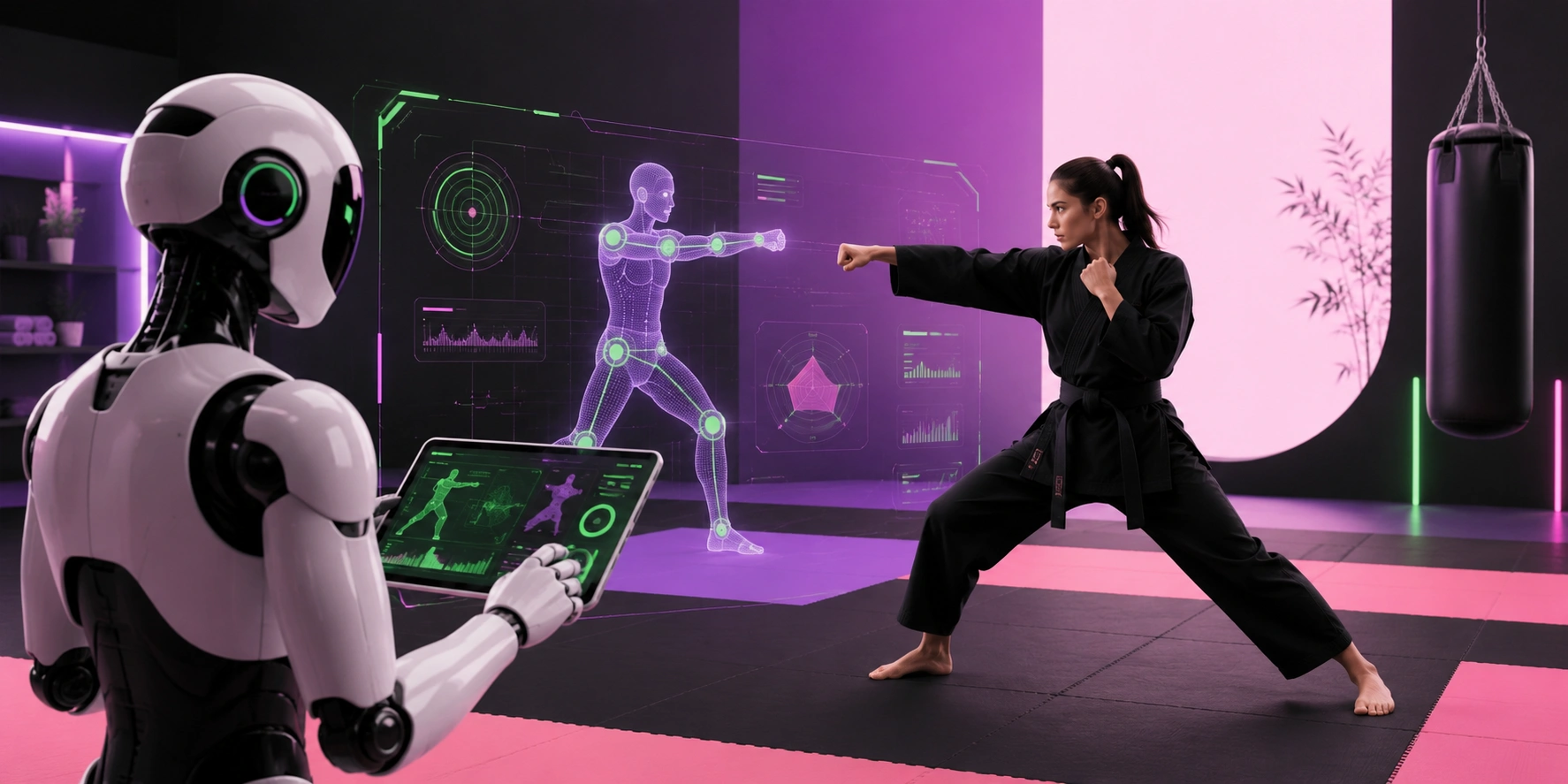
One of the most exciting applications of AI in martial arts is real-time motion analysis. Using cameras and computer vision algorithms, AI systems can map a fighter's body during training and break down every punch, kick, takedown, or guard position into measurable data points.
These systems track joint angles, foot positioning, hip rotation, weight distribution, and timing — all factors that determine whether a technique is biomechanically efficient or leaves the fighter exposed. For example, a boxer throwing a right cross might be dropping their left hand by three inches — an error invisible to the naked eye during fast combinations but clearly visible in AI-generated footage analysis.
Apps like Pivot and platforms built on pose-estimation technology (similar to frameworks used by Google and Meta) are making this capability accessible beyond elite athletic programs. A practitioner training at home with a smartphone can now receive the kind of technical breakdown previously reserved for Olympic-level athletes.
Feedback That Actually Sticks
AI does not just identify errors — it tracks them over time. If a Muay Thai fighter consistently drops their guard after a teep kick, the system flags it session after session, building a performance history that helps both the athlete and their coach understand which habits are deeply ingrained versus which have been corrected. This longitudinal tracking transforms training from reactive to proactive.
Personalized Training Programs Powered by Machine Learning
Generic training programs are a relic of the past. Machine learning algorithms can now analyze a fighter's performance data, training history, recovery metrics, and competitive goals to build a fully personalized program that evolves week by week.
These programs adjust volume and intensity based on recovery indicators such as heart rate variability, sleep data from wearables, and self-reported fatigue. They prioritize technical drills targeting identified weaknesses rather than forcing athletes to repeat exercises they have already mastered. And they adapt to plateaus — recognizing when a training stimulus is no longer producing improvement and introducing variation before stagnation sets in.
This level of intelligent programming is one reason why forward-thinking digital agencies and technology providers, including the team at WebPeak, are seeing increased demand for AI-integrated platforms across sports and fitness industries. The market for smart athletic training is growing rapidly, and martial arts is no exception.
Opponent Analysis and Fight Strategy
Studying Your Next Opponent Like Never Before
Professional fight camps have long used video analysis to study opponents. AI takes this process to an entirely different level. Machine learning algorithms can process hours of an opponent's fight footage, identify their most frequently used combinations, map their defensive tendencies, detect patterns in how they respond to pressure, and highlight exploitable habits — all in a fraction of the time it would take a human analyst.
For a fight camp preparing for a title bout, this means walking into the cage or ring with a data-backed game plan rather than one built on gut instinct and limited observation. Coaches can drill specific counters to an opponent's most common attacks with a precision that was previously impossible without enormous staff resources.
AI as a Sparring Strategy Tool
Beyond pre-fight preparation, some platforms are beginning to use AI to simulate opponent behavior during training. By modeling an opponent's tendencies, trainers can set up drilling scenarios that mimic real competitive conditions — giving fighters meaningful repetitions against patterns they will actually encounter on fight night.
Injury Prevention and Recovery Optimization
Martial arts training is physically demanding, and injuries are one of the most significant barriers to consistent progress. AI is proving to be a powerful tool for both predicting and preventing training injuries before they occur.
Wearable sensors combined with AI analysis can detect subtle changes in movement patterns that precede injury — a slight alteration in gait, asymmetrical muscle activation, or compensatory movement habits that indicate an underlying issue. Flagging these signals early allows athletes to address them through targeted recovery work before a minor imbalance becomes a significant injury.
Recovery optimization is equally important. AI platforms that integrate with sleep trackers, heart rate monitors, and nutrition logs can model an athlete's recovery state and recommend whether a session should be high intensity, technical and light, or focused entirely on active recovery. This removes guesswork from one of the most critical — and most frequently mismanaged — aspects of athletic development.
AI Coaching Tools and Virtual Assistants
Accessible Coaching for Every Level
Not every martial artist trains under a world-class coach. Geography, cost, and availability all create barriers to quality instruction. AI-powered coaching apps are beginning to bridge this gap, offering technique feedback, guided training plans, and progress tracking to practitioners regardless of where they live or what their budget allows.
These tools are not replacements for a skilled human coach — the tactile, intuitive dimension of martial arts instruction remains deeply human. But as supplementary tools, they significantly raise the quality of solo training and accelerate development between in-person sessions.
This is precisely the kind of practical, scalable application that professional artificial intelligence services are being built to deliver — tools that democratize expert-level capability and make it accessible to a broader audience across industries, including sports and athletic training.
Natural Language AI for Mental Preparation
The mental game is as important as the physical in martial arts. AI-powered mental performance tools using large language models can guide fighters through visualization exercises, pre-competition anxiety management, goal-setting frameworks, and post-performance reflection. These tools bring sports psychology concepts to athletes who cannot afford or access a dedicated sports psychologist.
Competitive Analytics in Combat Sports Organizations
At the organizational level, AI is transforming how combat sports promotions analyze athlete performance, manage matchmaking, and evaluate fighter development. Promotions with access to large datasets of fighter statistics can use machine learning to identify rising talent earlier, make more compelling and competitive matches, and reduce mismatches that lead to injuries or one-sided contests.
For athletes, performing well against AI-tracked metrics increasingly influences how they are perceived by promoters and scouts. Understanding and optimizing for these metrics is becoming a competitive necessity at the professional level.
Challenges and Honest Limitations
Despite its promise, AI in martial arts training is not without challenges. Data quality matters enormously — poor camera angles, inconsistent sensor data, or insufficient training footage all degrade the usefulness of AI analysis. Smaller gyms and independent fighters may lack the resources or technical infrastructure to adopt these tools effectively.
There is also the philosophical tension between algorithmic training and the artistry of martial arts. The instinctive, creative, and deeply personal nature of fighting does not always reduce neatly to data. The best AI tools recognize this, positioning themselves as enhancers of human coaching rather than replacements for it.
Privacy is a further consideration. Detailed biometric data collected during training is sensitive, and athletes and gyms must ensure any platforms they use handle that data responsibly and securely.
The Future of AI-Powered Martial Arts
The integration of AI into martial arts training is still in its early stages, but the trajectory is clear. As computer vision improves, wearables become more sophisticated, and machine learning models grow more accurate with more data, the tools available to fighters will become dramatically more powerful and more accessible.
We can reasonably anticipate a near future where real-time AI coaching overlays are available during sparring sessions through smart glasses, where holographic AI sparring partners simulate opponent behavior in training environments, and where fighter development programs are managed end-to-end by intelligent systems that adapt daily to an athlete's physical and mental state.
Whether you are a weekend Brazilian Jiu-Jitsu practitioner or a professional MMA fighter preparing for a main event, AI offers tools that can make your training smarter, safer, and more effective. The gym of the future is already being built — and artificial intelligence is one of its most important architects.
Embracing these technologies thoughtfully, alongside the irreplaceable wisdom of experienced coaches and the character-building grind of traditional training, is how the martial artist of tomorrow will gain a meaningful competitive edge today.